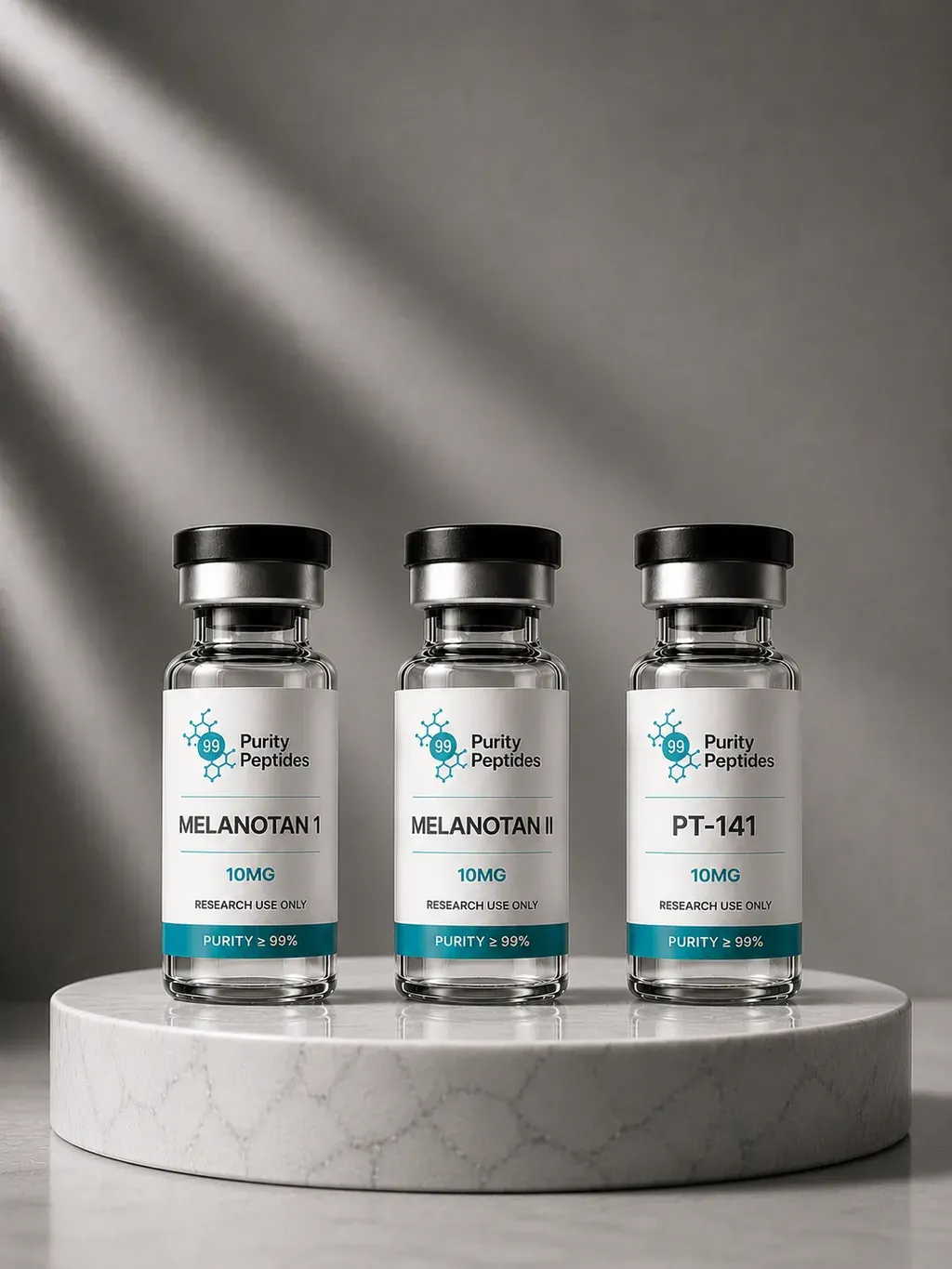
The Melanocortin Analog Comparator supplies three analogs of α-melanocyte-stimulating hormone at 10 mg each. Melanotan I is a linear 13-residue analog with two substitutions. Melanotan II is a truncated cyclic heptapeptide. PT-141 is the deamidated metabolite of Melanotan II. All three retain the shared His-Phe-Arg-Trp core sequence and differ in structure and receptor selectivity across the melanocortin receptor family. For research use only.
HPLC certified
Independent analysis
Highest standard
Full traceability
The Melanocortin Analog Comparator brings together three analogs derived from α-melanocyte-stimulating hormone, a 13-residue peptide, at matched 10 mg mass. All three retain the core His-Phe-Arg-Trp message sequence with a D-phenylalanine substitution, so the set compares structural strategy and receptor selectivity rather than pharmacophore.
The three represent a structural progression. Melanotan I, also known as NDP-α-MSH and afamelanotide, is a linear 13-residue analog carrying norleucine at position 4 and D-phenylalanine at position 7. Melanotan II is a truncated cyclic heptapeptide closed by a lactam bridge. PT-141, also known as bremelanotide, is the deamidated derivative of Melanotan II — a metabolite of that compound rather than an independently designed molecule.
The melanocortin receptor family comprises five receptors, MC1R through MC5R, all coupling through Gs to cAMP. MC2R responds specifically to ACTH rather than to α-MSH-derived analogs, so four receptors are addressable by the compounds in this set. Selectivity here means discrimination across that family.
One analytical point matters when sourcing. Because PT-141 differs from Melanotan II only by an amide-to-hydroxyl substitution, the two compounds differ in mass by approximately one dalton. Low-resolution mass spectrometry may not reliably resolve that difference.
All three vials are supplied lyophilized with batch documentation.
For Research Use Only. Not intended for human consumption, therapeutic use, veterinary use, or diagnostic applications.
The Melanocortin Analog Comparator is a three-vial set containing Melanotan I, Melanotan II and PT-141 at 10 mg each. All three derive from α-melanocyte-stimulating hormone and retain its His-Phe-Arg-Trp core sequence. They differ in structure — linear, cyclic, and a metabolite of the cyclic form — and in how they distribute across the melanocortin receptor family.
| Compound | Mass | Also known as | Structure | Residues |
|---|---|---|---|---|
| Melanotan I | 10 mg | NDP-α-MSH, afamelanotide | Linear | 13 |
| Melanotan II | 10 mg | MT-II | Cyclic lactam | 7 |
| PT-141 | 10 mg | Bremelanotide | Cyclic lactam | 7 |
All three vials are supplied as lyophilized powder with batch documentation. Melanotan I is also available in nasal spray format.
Melanocortin receptors are a family of five G protein-coupled receptors, designated MC1R through MC5R. All couple through Gs to adenylate cyclase and cAMP, and they differ in tissue distribution and in which endogenous melanocortin peptides engage them.
Because the family has multiple members, selectivity in this context means discrimination between receptors — a compound may engage some members and not others, or engage several with differing potency.
MC2R is the ACTH receptor. It responds specifically to adrenocorticotropic hormone and requires an accessory protein for function, and it is not engaged by α-MSH-derived analogs.
So a compound described as a non-selective melanocortin agonist is engaging MC1R, MC3R, MC4R and MC5R — four receptors, not five. That distinction is frequently blurred in descriptions of these compounds.
α-melanocyte-stimulating hormone is a 13-residue peptide, and its receptor activity depends on a short core message sequence: His-Phe-Arg-Trp.
All three compounds in this set retain that core, with phenylalanine in the D-configuration rather than the L-configuration found in the native hormone. That substitution confers resistance to proteolytic degradation and is shared across the set.
The pharmacophore is therefore constant across all three compounds. What differs is the structural context that core sits in.
Be the first to share your experience with this product and help other researchers!

GHK-Cu nasal spray research reviewed: three mouse studies from one lab, no human data, and what is still unknown about absorption and tolerability.

MOTS-c vs SS-31 compared on identity, mechanism, animal data and human trial evidence — including why no direct comparison exists.
A dated tracker of peptide regulation in 2026: the 503A Bulks List, the July FDA committee vote, warning letters, recalls and WADA rules, with sources.
(faqs)