Reconstitution turns a lyophilized peptide back into a solution you can measure and work with. The arithmetic behind it is simple, but it is also where many research errors begin. A misplaced decimal, a label weight that does not reflect actual peptide content, or a diluent volume chosen without thinking about pipetting accuracy can all shift every concentration in a study.
This page is built as a reference you can keep open or print. It gives a master concentration chart for common vial sizes and diluent volumes, the single formula behind every value in it, and a dilution table for preparing working solutions. It also covers the corrections most charts leave out: net peptide content, salt form and the practical factors that should guide how much diluent you choose.
The chart describes concentrations of research solutions only. It does not describe doses, routes or any use in people or animals.
Research use only. All products referenced on this page are intended solely for in vitro laboratory research. They are not for human or veterinary use.
Key Takeaways
- Concentration equals the amount of peptide divided by the volume of diluent. Every value in the chart comes from that one formula.
- Adding more diluent lowers the concentration but does not change the total amount of peptide in the vial.
- The label weight is a target and often refers to powder, not pure peptide. Net peptide content from the lot certificate of analysis gives a more accurate starting amount [1,2].
- Salt form matters. Counterions such as trifluoroacetate can make up a significant share of the powder weight [2,3].
- Choose a diluent volume that gives a concentration easy to pipette accurately and suitable for the peptide's solubility and stability.
- For working solutions, use the dilution relationship C1 × V1 = C2 × V2.
How Reconstitution Concentration Works
Every number on this page comes from one relationship:
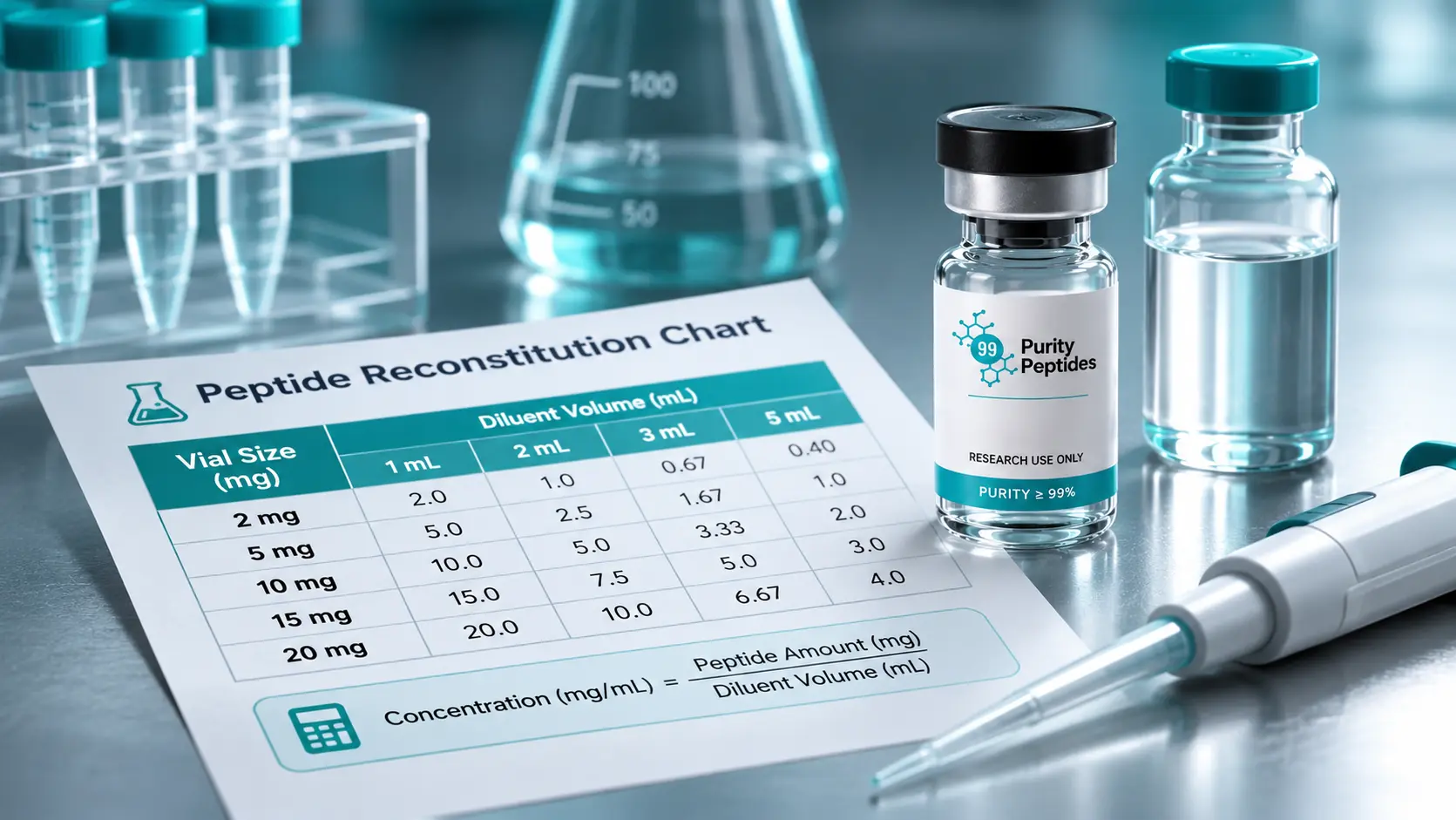
Concentration (mg/mL) = peptide amount (mg) ÷ diluent volume (mL)
If a vial contains 10 mg of peptide and you add 2 mL of diluent, the solution is 5 mg/mL. Add 5 mL instead, and it is 2 mg/mL. The total peptide stays at 10 mg either way. Only the amount per millilitre changes.
Units That Cause Confusion
Most errors come from unit conversions rather than the formula itself. These equivalences are worth keeping in view.
- 1 mg = 1,000 µg (micrograms).
- 1 mL = 1,000 µL (microlitres).
- 1 mg/mL is the same as 1 µg/µL and the same as 1,000 µg/mL.
- 0.1 mL equals 100 µL.
A useful check: at 1 mg/mL, every microlitre contains one microgram. If your concentration is 5 mg/mL, each microlitre contains 5 µg, and 100 µL contains 500 µg.
Why the Chart Uses mg/mL
Concentration in mg/mL is the standard unit in analytical and cell-based work, and it converts cleanly to molarity once you know the peptide's molecular weight. To convert, divide the concentration in mg/mL by the molecular weight in g/mol, which gives mol/L. For a 1,000 Da peptide at 1 mg/mL, that is 1 mM.
Master Peptide Reconstitution Chart
The chart below shows the resulting concentration for common vial sizes at four diluent volumes. It assumes the vial contains the stated amount of peptide. See the next section for how to correct that assumption.
Peptide in vial | 1 mL diluent | 2 mL diluent | 3 mL diluent | 5 mL diluent |
|---|---|---|---|---|
2 mg | 2.0 mg/mL | 1.0 mg/mL | 0.67 mg/mL | 0.40 mg/mL |
5 mg | 5.0 mg/mL | 2.5 mg/mL | 1.67 mg/mL | 1.0 mg/mL |
10 mg | 10.0 mg/mL | 5.0 mg/mL | 3.33 mg/mL | 2.0 mg/mL |
15 mg | 15.0 mg/mL | 7.5 mg/mL | 5.0 mg/mL | 3.0 mg/mL |
20 mg | 20.0 mg/mL | 10.0 mg/mL | 6.67 mg/mL | 4.0 mg/mL |
30 mg | 30.0 mg/mL | 15.0 mg/mL | 10.0 mg/mL | 6.0 mg/mL |
50 mg | 50.0 mg/mL | 25.0 mg/mL | 16.7 mg/mL | 10.0 mg/mL |
Values for 3 mL are rounded to two decimal places, so they are approximate. For other combinations, divide the peptide amount by the volume, or use our peptide calculator, which performs the same calculation for any inputs.
Reading the Chart
Find your vial size in the left column, then read across to the volume you plan to add. The cell shows the concentration of the resulting stock solution. To find the amount of peptide in any volume of that stock, multiply the concentration by the volume. For example, 50 µL of a 5 mg/mL solution contains 250 µg.
High Concentrations and Solubility
Some cells in the chart describe very concentrated solutions, such as 50 mg in 1 mL. Not every peptide dissolves at those levels. Hydrophobic sequences, longer chains and peptides prone to aggregation may need more diluent, a different solvent or gentle handling to dissolve fully. A concentration that looks convenient on paper is only useful if the peptide stays in solution.
Correcting for What Is Actually in the Vial
The chart assumes the vial holds exactly the stated amount of peptide. In practice, that assumption often fails, for two separate reasons.
Net Peptide Content
A lyophilized peptide powder is not pure peptide. It also contains counterions bound to the peptide's charged groups and some residual water. Net peptide content is the percentage of the powder that is actually peptide, measured by methods such as amino acid analysis or nitrogen analysis [1,2]. Net peptide content is a different measurement from HPLC purity [1].
If the label weight refers to powder, the real amount of peptide is the label weight multiplied by the net peptide content. A 10 mg vial at 80% net peptide content contains 8 mg of peptide. Reconstituted in 2 mL, that gives 4 mg/mL, not the 5 mg/mL the chart would suggest.
Salt Form
The counterion type affects how much of the powder is peptide. Trifluoroacetate, the default counterion left by standard synthesis and HPLC purification, is heavier than acetate. Theoretical net peptide content can be estimated by dividing the peptide's molecular weight by the peptide weight plus the number of counterions multiplied by the counterion weight [2]. For a 1,000 Da peptide with two trifluoroacetate counterions, that comes to about 81% [2].
For short peptides with several basic residues, the effect is larger. Our salt forms guide works through examples in which a trifluoroacetate salt is roughly two-thirds peptide by weight. Using the label weight without correction in that case overstates the concentration by about 50%.
Fill Accuracy
Separately from chemistry, the amount filled into each vial can vary from the label. Independent testing has documented fills ranging from close to exact to substantially over or under the stated amount. Our vial fill accuracy guide explains why, and how to read measured content on a certificate of analysis.
Which Number to Use
When the lot certificate of analysis reports measured peptide content per vial, use that figure. If it reports net peptide content and the label refers to powder, multiply the two. If neither is available, use the label weight and note in your records that the starting amount is unverified. Our guide to reading a certificate of analysis covers where to find each figure. You can review 99 Purity Peptides lot documentation on our certificates page.
Choosing a Diluent Volume
The chart shows that many volumes are possible for any vial. The right choice depends on what you will do with the solution afterwards.
Pipetting Accuracy
Small volumes are harder to measure accurately than large ones. If your experiment needs 10 µg per well, a 10 mg/mL stock requires pipetting 1 µL, which is difficult to do precisely. A 1 mg/mL stock requires 10 µL, which is far more reliable. As a general principle, choose a stock concentration that lets you work within the comfortable range of the pipettes you have, or plan an intermediate dilution.
Solubility
As noted above, very concentrated solutions may not stay dissolved. Starting with a moderate volume and observing whether the solution is clear is safer than forcing a high concentration. A cloudy or particulate solution indicates incomplete dissolution or aggregation, and its true concentration is unknown.
Stability and Storage
Peptides in solution are generally less stable than lyophilized powder. Concentration can influence stability, and very dilute solutions may lose a larger proportion of peptide to adsorption onto container surfaces. Many labs reconstitute at a moderate stock concentration, divide the stock into single-use aliquots and freeze them, rather than repeatedly thawing and refreezing one vial. Our peptide storage guidelines and guide to reconstituted peptide stability cover this in detail.
Vial Capacity
A vial can only hold so much liquid. Adding a large volume to a small vial can leave too little headspace for mixing. Check the vial's capacity before choosing a high-volume column from the chart.
Choosing a Diluent
The diluent affects solubility, sterility and how long a solution can be kept.
Bacteriostatic Water
Bacteriostatic water is sterile water containing a small amount of benzyl alcohol, which inhibits bacterial growth in multi-use vials. It is commonly used when a reconstituted solution will be sampled repeatedly. Benzyl alcohol may not suit every assay, particularly sensitive cell-based work, so check compatibility with your experimental system. Our bacteriostatic water reconstitution guide covers technique.
Sterile Water
Sterile water without preservative is suitable when the solution will be used immediately or divided into single-use aliquots. It avoids introducing benzyl alcohol but offers no protection against contamination after opening.
Dilute Acetic Acid and Other Solvents
Some hydrophobic or basic peptides dissolve poorly in water and dissolve more readily in dilute acetic acid. Our acetic water reconstitution guide explains when that applies. Strongly hydrophobic peptides may need small amounts of organic solvent, which must then be accounted for in the final assay.
Buffers
Reconstituting directly into a buffer such as phosphate-buffered saline is sometimes convenient, but some peptides are less soluble at neutral pH or in high-salt solutions. A common approach is to dissolve the peptide in water or a mild solvent first, then dilute into buffer.
Preparing Working Solutions From a Stock
A reconstituted vial is usually a concentrated stock. Most experiments need lower working concentrations, prepared by dilution.
The Dilution Formula
Dilutions follow one relationship:
C1 × V1 = C2 × V2
C1 is the stock concentration, V1 is the volume of stock you take, C2 is the target concentration and V2 is the final volume. Rearranged, the volume of stock needed is V1 = (C2 × V2) ÷ C1. Keep units consistent: if C1 is in mg/mL, express C2 in mg/mL too.
Dilution Table for a 10 mL Working Solution
The table below shows how much stock to add, then bring to 10 mL total with diluent or medium, to reach common working concentrations.
Stock concentration | For 1 µg/mL | For 10 µg/mL | For 100 µg/mL |
|---|---|---|---|
1 mg/mL | 10 µL | 100 µL | 1,000 µL |
2 mg/mL | 5 µL | 50 µL | 500 µL |
5 mg/mL | 2 µL | 20 µL | 200 µL |
10 mg/mL | 1 µL | 10 µL | 100 µL |
Several cells require very small volumes, such as 1 or 2 µL. Those are difficult to pipette accurately. A serial dilution, for example first diluting the stock tenfold and then using the intermediate solution, gives better accuracy.
Serial Dilutions
To build a concentration series, prepare the highest working concentration first, then dilute stepwise. A tenfold series takes 1 part of each solution into 9 parts of diluent. Each step carries forward any error from the step before, so careful pipetting at the first step matters most.
Worked Examples
These examples show how the chart and corrections combine in practice.
Example One: Straight From the Chart
A 5 mg vial is reconstituted with 2 mL of diluent. The chart gives 2.5 mg/mL. To find the amount in 40 µL, multiply 2.5 µg/µL by 40 µL, which gives 100 µg.
Example Two: Correcting for Net Peptide Content
A vial labelled 10 mg has a certificate of analysis reporting 85% net peptide content, and the label refers to powder. Actual peptide is 10 × 0.85 = 8.5 mg. Reconstituted in 2 mL, the concentration is 4.25 mg/mL, not 5 mg/mL. Every working solution prepared from it should use 4.25 mg/mL as C1.
Example Three: Choosing a Practical Volume
A study needs a 1 µg/mL working solution in 10 mL. With a 10 mg vial in 1 mL (10 mg/mL), the dilution table calls for 1 µL of stock, which is hard to pipette accurately. Reconstituting the same vial in 5 mL instead gives 2 mg/mL, requiring 5 µL. A tenfold intermediate dilution to 0.2 mg/mL would raise that to 50 µL, which is easy to measure accurately.
Example Four: Converting to Molarity
A 2 mg/mL solution of a peptide with a molecular weight of 1,419.5 g/mol has a molar concentration of 2 ÷ 1,419.5 = 0.00141 mol/L, or about 1.41 mM. Molar concentrations are more meaningful than mass concentrations when comparing peptides of different sizes.
Compound-Specific Charts
The master chart works for any peptide, but some compounds come in unusual vial sizes or blends, and compound-specific pages add molecular weight and handling notes. We publish dedicated references for several research peptides:
- BPC-157 reconstitution chart
- TB-500 reconstitution chart
- Ipamorelin reconstitution chart
- KLOW reconstitution and concentration reference
For converting volumes into syringe graduations, see our bacteriostatic water unit conversion chart. For background on choosing a diluent volume, see how much bacteriostatic water to use when reconstituting peptides.
Reconstitution Technique
Good technique protects both the peptide and the accuracy of the solution.
Before Opening
Let a refrigerated or frozen vial reach room temperature before opening it. Opening a cold vial lets moisture condense on the powder. Check the lot number against the certificate of analysis, and gently tap the vial so the powder settles at the bottom.
Adding Diluent
Measure the diluent accurately with a calibrated pipette or syringe. Add it slowly down the inside wall of the vial rather than directly onto the powder, which reduces foaming. Use sterile technique throughout, including wiping the stopper before puncturing it.
Dissolving
Swirl or roll the vial gently until the powder dissolves. Vigorous shaking can cause foaming and, for some peptides, aggregation. Allow a few minutes for full dissolution. The solution should be clear and free of visible particles.
Labelling and Recording
Label the vial with the peptide, lot number, concentration, diluent, date and your initials. Record the starting amount you used, whether label weight, measured content or label weight corrected for net peptide content. That record is what allows someone else, or you months later, to reproduce the work.
Common Reconstitution Errors
Most reconstitution problems fall into a short list.
- Using the label weight without checking net peptide content or salt form, which overstates concentration.
- Confusing mg with µg or mL with µL, producing thousandfold errors.
- Choosing a stock concentration that requires pipetting volumes too small to measure accurately.
- Forcing a high concentration that the peptide cannot sustain, leaving undissolved material.
- Shaking vigorously, causing foaming and possible aggregation.
- Repeatedly freezing and thawing a single stock instead of preparing aliquots.
- Failing to label concentration and date, leading to mix-ups between stocks.
- Switching lots mid-study without comparing their certificates of analysis.
Printing and Using This Chart
This page is designed to print cleanly. The master chart and dilution table fit on a single page when printed in portrait orientation. A downloadable PDF version is also available at our printable reconstitution chart. Keep a copy near your bench, but always confirm the starting amount against the lot certificate of analysis before relying on any value.
The Bottom Line
A reconstitution chart is only as accurate as the starting amount you feed into it. The arithmetic itself is a single division, and the chart above gives the results for the most common combinations. What turns that arithmetic into reliable research is the step most charts skip: confirming how much peptide is actually in the vial, accounting for salt form and net peptide content, and choosing a volume that suits your pipettes, the peptide's solubility and your storage plan.
Use the master chart for quick reference, the dilution table for working solutions, and the lot certificate of analysis for the starting number. Record which figure you used every time. For related reading, see why peptide purity matters and our research peptide glossary.
References
- Bachem. Quality control of amino acids and peptides: a guide. 2025. https://www.bachem.com/knowledge-center/quality-control-of-amino-acids-peptides-a-guide/
- AmbioPharm. How is theoretical net peptide content calculated? Peptide FAQs. https://www.ambiopharm.com/faq/how-is-theoretical-net-peptide-content-calculated/
- Sikora K, Jaśkiewicz M, Neubauer D, Migoń D, Kamysz W. The Role of Counter-Ions in Peptides: An Overview. Pharmaceuticals (Basel). 2020;13(12):442. PMID: 33287352. DOI: 10.3390/ph13120442.
Frequently Asked Questions
How do I calculate peptide concentration after reconstitution?
Divide the amount of peptide in the vial by the volume of diluent added. A 10 mg vial reconstituted with 2 mL gives 5 mg/mL. The same formula applies to every vial size and volume, and every value in the chart on this page comes from it.
Does adding more water change the amount of peptide in the vial?
No. Adding more diluent lowers the concentration, but the total amount of peptide stays the same. A 10 mg vial contains 10 mg of peptide whether it is dissolved in 1 mL or 5 mL. Only the amount in each millilitre changes.
Why might my actual concentration be lower than the chart shows?
The chart assumes the vial holds exactly its labelled amount of peptide. In practice, part of the powder is counterion and water rather than peptide, and fill amounts can vary. If the label refers to powder weight, multiply it by the net peptide content from the lot certificate of analysis to find the real peptide amount.
What is net peptide content?
Net peptide content is the percentage of a lyophilized powder that is actually peptide, after accounting for counterions and moisture. It is usually measured by amino acid analysis or nitrogen analysis. It is different from HPLC purity, which measures what fraction of the peptide material is the correct sequence.
How does salt form affect reconstitution?
Most synthetic peptides are supplied as salts, with counterions bound to their charged groups. Heavier counterions such as trifluoroacetate make up a larger share of the powder weight than lighter ones such as acetate. For short peptides with several charged sites, a trifluoroacetate salt can be roughly two-thirds peptide by weight, which significantly lowers the true concentration.
How much diluent should I add to a peptide vial?
Choose a volume that gives a stock concentration easy to pipette accurately in your experiments, that the peptide can dissolve at, and that fits your storage plan. Very high concentrations may not dissolve fully, while very dilute stocks may require large volumes and lose more peptide to container surfaces. Moderate stocks divided into single-use aliquots are a common approach.
Which diluent should I use for reconstitution?
Bacteriostatic water is common for solutions that will be sampled more than once, because its benzyl alcohol inhibits bacterial growth, but it may not suit sensitive cell assays. Sterile water suits immediate use or single-use aliquots. Dilute acetic acid helps some hydrophobic or basic peptides dissolve. The right choice depends on the peptide and the experiment.
How do I convert mg/mL to µg per microlitre?
They are the same value. One milligram per millilitre equals one microgram per microlitre. A 5 mg/mL solution therefore contains 5 µg in every microlitre, and 500 µg in 100 µL.
How do I prepare a working solution from my stock?
Use the dilution formula C1 × V1 = C2 × V2. Rearranged, the volume of stock needed equals the target concentration multiplied by the final volume, divided by the stock concentration. For example, 10 mL at 10 µg/mL from a 1 mg/mL stock requires 100 µL of stock brought to 10 mL.
What if the dilution needs a volume too small to pipette accurately?
Prepare an intermediate dilution first. For example, dilute the stock tenfold, then use the intermediate solution for the final dilution. This increases the volume you pipette at the last step and improves accuracy, at the cost of one extra step.
How do I convert a peptide concentration to molarity?
Divide the concentration in mg/mL by the peptide's molecular weight in g/mol. The result is in mol/L. A 1 mg/mL solution of a 1,000 Da peptide is 1 mM. Molar concentrations make it easier to compare peptides of different sizes.
Why is my reconstituted peptide cloudy?
Cloudiness usually means the peptide has not fully dissolved or has begun to aggregate. Gentle swirling and a few minutes of standing may help. If it persists, the peptide may need more diluent, a different solvent or a lower concentration. A cloudy solution's true concentration is unknown, so it should not be used for quantitative work.
Should I shake the vial to dissolve the peptide?
Gentle swirling or rolling is preferable. Vigorous shaking can cause foaming and, for some peptides, aggregation. Adding diluent slowly down the vial wall and allowing time for the powder to dissolve usually gives a clear solution without shaking.
How should I store a reconstituted peptide?
Peptides are generally less stable in solution than as dry powder. A common practice is to divide the stock into single-use aliquots and store them frozen, avoiding repeated freeze-thaw cycles. Storage conditions vary by peptide, so check compound-specific guidance and label each aliquot with its concentration and date.