Most synthetic research peptides are sold as salts, not as the bare peptide. Each positive charge on the peptide is balanced by a negatively charged counterion, usually trifluoroacetate (TFA) or acetate. That counterion adds weight, so a 10 mg TFA salt and a 10 mg acetate salt of the same peptide contain different amounts of actual peptide. This guide explains where each salt form comes from, how it changes your calculations and results, and how to read it on a certificate of analysis.
Research use only. All products referenced on this page are intended solely for in vitro laboratory research. They are not for human or veterinary use.
Key Takeaways
- A peptide's salt form names the counterion paired with its charged groups, most often trifluoroacetate, acetate or chloride.
- TFA salts are the normal result of Fmoc synthesis and reversed-phase HPLC purification. They are not a sign of poor quality.
- Counterions take up a measurable share of vial mass. A short peptide with three basic sites is about 68% peptide in theory as a TFA salt and about 80% as an acetate salt.
- TFA has interfered with some cell-based assays at very low concentrations, which is why acetate or hydrochloride forms are often chosen for biological work.
- Regulators treat salt forms as separate substances, and the October 2026 HHS compounding policy names a specific form for each peptide it covers.
- A useful certificate of analysis states the salt form or reports net peptide content. Without that, mass-based concentration calculations carry hidden error.
What Is a Peptide Salt Form?
A peptide salt form is the peptide plus the counterions that neutralize its charges. Peptides contain ionizable groups: a free N-terminal amine and the side chains of lysine, arginine and histidine. Under the acidic conditions used to purify and freeze-dry peptides, these groups carry a positive charge, and each one pairs with a negative ion from the surrounding solution.
That negative ion is the counterion. Which one it is depends on the last acid the peptide met before lyophilization. Basic residues and the free N-terminus become protonated and pick up TFA, acetate or chloride counterions depending on the final buffer [7].
So a vial labelled with a peptide name actually holds three things: the peptide, its counterions and some residual water. The salt form tells you which counterion is present. The peptide's sequence decides how many there are.
Free Base, Acetate, TFA and Hydrochloride
The four salt descriptions you will see on research listings mean the following.
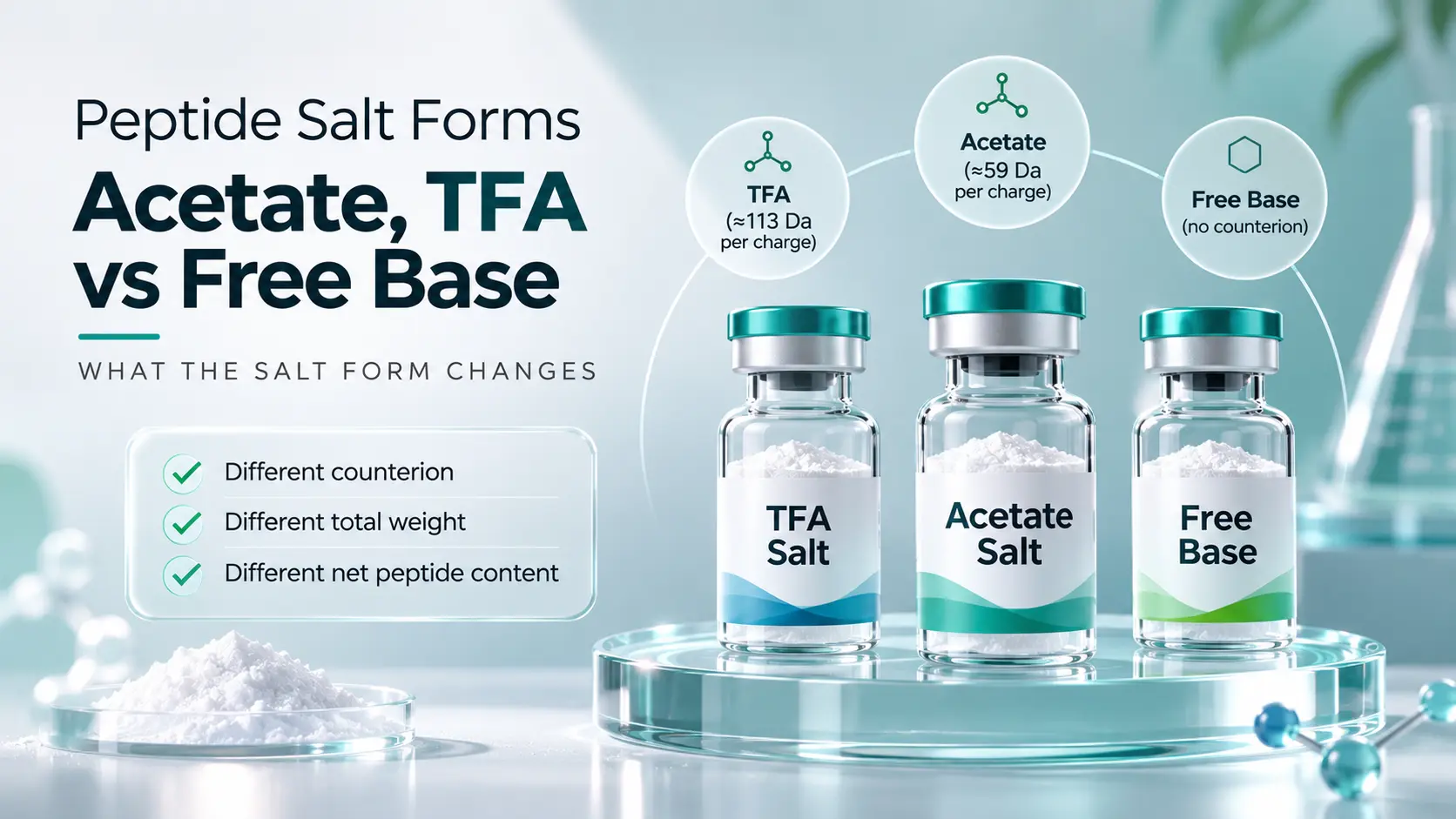
- TFA salt: the peptide is paired with trifluoroacetate (CF3COO-), about 113 Da per charge. This is the default for research-grade synthetic peptides.
- Acetate salt: paired with acetate (CH3COO-), about 59 Da per charge. It is made by ion exchange or acetic-acid purification and is the usual form for marketed peptide drugs [1].
- Hydrochloride salt: paired with chloride (Cl-), about 35.5 Da per charge. It is common in biological studies and used for some approved peptides [1].
- Free base: isolated without an added acid counterion. HHS specifies Semax in this form in its 2026 compounding policy [8].
Vendor listings often use "free base" loosely, sometimes as nothing more than the peptide's name. Treat it as a claim to confirm on the certificate of analysis, not as a default.
Why Most Research Peptides Start as TFA Salts
A TFA salt is a by-product of manufacturing, not a choice made for the end user. Trifluoroacetic acid reaches the peptide at two points in the process.
The first is cleavage. In Fmoc solid-phase synthesis, a TFA cocktail cuts the finished chain from the resin and removes side-chain protecting groups in the same step. Our peptide synthesis methods guide walks through that workflow.
The second is purification. Reversed-phase HPLC normally uses water and acetonitrile with a small amount of TFA as an ion-pairing agent. The peptide forms a TFA salt because it is exposed to this TFA and water buffer during purification [7].
Freeze-drying removes the volatile free acid, but trifluoroacetate bound to the peptide's charges stays behind. TFA cannot be fully removed this way because it has formed a salt. If residual TFA is a concern, the practical option is to order a more biocompatible salt form [6].
Converting a TFA salt to acetate or chloride is therefore an extra, deliberate step. It adds time, cost and some loss of product.
TFA vs Acetate Peptide Salts Compared
Acetate dominates approved peptide drugs, while TFA dominates early research material. A 2020 review of counterions in peptides found that most marketed peptide drugs are acetate salts. Of 30 selected FDA-approved peptides in its table, 25 are acetates, and only bivalirudin and corticorelin are TFA salts [1].
Property | TFA salt | Acetate salt |
|---|---|---|
How it is produced | Default output of cleavage and RP-HPLC | Requires ion exchange or acetate-based purification |
Counterion mass per charge | About 113 Da | About 59 Da |
Peptide share per mg of powder | Lower | Higher |
Behavior in cell-based assays | Documented interference in some systems | Generally preferred for biological work |
Volatility of the counterion | Bound TFA is not volatile | Acetic acid is volatile, so content can drift during drying |
Overlap with infrared amide I band | Strong band near 1,700 cm-1 | Minimal |
Use in approved drugs | Rare | The usual choice |
Relative cost | Lowest | Higher, because of the exchange step |
Two rows deserve a closer look. TFA's strong infrared band around 1,700 cm-1 overlaps the amide I band used to study secondary structure [1]. If you are running FTIR or related structural work, the counterion becomes part of your spectrum.
Acetate is also not automatically the most stable form. The same review describes cases where a hydrochloride salt outlasted both acetate and TFA in stability testing. It also describes an octreotide acetate formulation that lost more peptide at 40 °C than the chloride version [1]. The best salt for stability depends on the sequence, which is why drug developers screen salt forms instead of assuming one.
How Salt Form Changes the Amount of Peptide in a Vial
This is the part most buyers miss. Counterions have mass, and that mass is weighed together with the peptide. The label weight of a lyophilized vial covers the whole salt plus any water, not the peptide alone.
Net peptide content is the percentage of peptide relative to non-peptide material, which is mostly counterions and moisture. It is a different measurement from purity [6]. Purity tells you what fraction of the peptidic material is the target sequence. Net peptide content tells you what fraction of the powder is peptide at all.
The Theoretical Calculation
If counterions were the only non-peptide component, theoretical net peptide content would be the peptide's molecular weight divided by the sum of that weight and the counterion weight multiplied by the number of charged sites. A worked example from one manufacturer: a 1,000 Da TFA peptide with two binding sites comes out at about 81% [7].
Worked Examples
The figures below use published molecular weights and count the basic sites likely to be protonated under acidic lyophilization conditions. They are theoretical upper limits, and real values are lower once water is included.
Peptide (MW) | Charged sites | As TFA salt | As acetate salt | Peptide in a 10 mg vial (TFA vs acetate) |
|---|---|---|---|---|
Ipamorelin (about 711.9 Da) | 3 | About 67.7% | About 80.1% | About 6.8 mg vs 8.0 mg |
BPC-157 (about 1,419.5 Da) | 2 | About 86.3% | About 92.3% | About 8.6 mg vs 9.2 mg |
Short peptides with several basic residues lose the most mass to counterions, and the gap between TFA and acetate widens with each extra charge. For ipamorelin, choosing a TFA salt over an acetate salt shifts peptide content by more than a milligram per 10 mg vial.
That gap carries straight into concentration math. Reconstitute a "10 mg" ipamorelin TFA salt in 2 mL and assume 5 mg/mL, and the true peptide concentration is nearer 3.4 mg/mL before any water correction. Our peptide calculator works from the mass you enter, so use the net peptide mass from the COA when it is available.
Why Water Makes the Real Number Lower
Lyophilized peptides absorb moisture. Net peptide content varies with peptide polarity, the lyophilization process, storage conditions and humidity exposure [6]. For that reason, manufacturers measure actual net peptide content directly, typically by nitrogen elemental analysis or quantitative amino acid analysis, rather than relying on the formula [7].
Does TFA Affect Research Results?
It can, and the best-known evidence is specific. In a 1999 study, trifluoroacetate at 10^-8 to 10^-7 M reduced cell numbers and thymidine incorporation in fetal rat osteoblast cultures within 24 hours. Similar effects appeared in articular chondrocytes and neonatal mouse calvariae. TFA salts of amylin and calcitonin consistently produced less proliferation than their hydrochloride salts. The authors warned that this could hide a real proliferative effect or create a false antiproliferative one, and they recommended converting peptides to a hydrochloride or equivalent salt before biological testing [2].
The concentration range is what makes this matter. A peptide tested at micromolar levels brings its counterions with it, so the TFA concentration in a well can easily exceed the range where those effects appeared.
The wider evidence is mixed rather than uniformly negative:
- A comparison of acetate, hydrochloride and TFA salts of five antimicrobial peptides, including LL-37, found substantial differences between salts, but no consistent pattern across peptides [3].
- Replacing TFA with acetate or chloride did not reduce the activity of the antimicrobial peptide Leg1 [4].
- A 2025 study of a peptide hydrogel found no significant difference between TFA and hydrochloride forms in the properties that mattered for its intended use [5].
A fair reading is that TFA is not a universal problem, but it is a known variable. Studies most sensitive to salt form include cell proliferation and viability assays, receptor binding work, FTIR and secondary-structure studies, and quantitative dose-response experiments. Analytical method development and reference-standard work are usually far less sensitive, as long as the counterion's mass is accounted for.
How to Identify the Salt Form on a Certificate of Analysis
A well-documented COA answers the salt-form question directly, and when it doesn't, you can usually work it out. Our guide to reading a certificate of analysis covers the full document. These are the items that relate to salt form.
- Product name line: look for "acetate", "TFA salt", "trifluoroacetate", "HCl" or "free base" after the peptide name. A bare name tells you nothing.
- Molecular weight: check whether it describes the peptide alone or the salt. A figure that matches the bare sequence suggests the counterion has not been accounted for.
- Net peptide content: usually given as a percentage from amino acid or nitrogen analysis. This single number resolves most of the uncertainty.
- Counterion content: sometimes reported as TFA or acetate content in % w/w, measured by ion chromatography or HPLC. Counterion analysis confirms the salt form and supports accurate concentration calculations [10].
- Water content: a Karl Fischer result accounts for the rest of the mass.
- HPLC purity: useful, but it does not reveal the salt form. A 99% pure TFA salt can still be only about two-thirds peptide by weight.
If a COA reports purity and identity but no salt form, net peptide content or counterion content, ask the supplier which form was supplied. You can view 99 Purity Peptides lot documentation on our certificates page.
A simple consistency check also helps. Mass spectrometry measures the peptide ion, not the salt, so the observed mass should match the bare sequence. If the COA also lists a salt-inclusive molecular weight, the two figures should differ by roughly the counterion mass multiplied by the number of charged sites.
How TFA Is Removed or Exchanged
When a study needs a defined acetate or chloride form, the TFA salt is converted after purification. A published review summarizes the main approaches [1]:
- Repeated dissolution in dilute hydrochloric acid followed by lyophilization. It is simple, but it needs several cycles, removal stays incomplete, and strong acid can hydrolyze sensitive sequences.
- Ion-exchange resins. Quaternary ammonium resins loaded with acetate or chloride give very high exchange rates.
- Preparative HPLC with a different acid modifier, such as acetic acid in place of TFA, which is less efficient for some sequences.
- Other methods, including carbonate-form resins, deprotonation followed by reprotonation, and dialysis for larger peptides.
An "acetate" peptide can still contain residual TFA, so content testing is what confirms an exchange worked. Fluorine-19 NMR detects TFA as a single peak near -75 ppm, and infrared bands near 1,147 and 1,200 cm-1 can track exchange progress [1].
Why Salt Form Now Matters for Regulation
Salt form moved from a technical footnote to a regulatory detail in 2026. FDA's Pharmacy Compounding Advisory Committee listed BPC-157, KPV and the TB-500 fragment (LKKTETQ) each in free base and acetate forms for its July meeting [12]. The committee then voted 8-6-1, twice, to place BPC-157 free base and BPC-157 acetate on the 503A list [9]. During that meeting, an FDA official asked the committee, "What is BPC-157?" [11]. Salt form is one concrete reason two products sold under the same name are not the same material.
The October 30, 2026 HHS enforcement-discretion policy for 503A compounding names one form per peptide [8]:
- BPC-157: acetate
- Epitalon: acetate
- KPV: acetate
- MOTS-c: acetate
- Semax: free base
- TB-500 (LKKTETQ fragment): acetate
That policy applies to licensed compounders, not to research suppliers, and it does not change the research-only status of any product in our catalogue. It does show where regulators draw identity lines, and it is a useful benchmark for how precisely a COA should describe a substance. For the wider picture, see our peptide regulatory status tracker. Related research materials include Semax, MOTS-c, Epithalon and the BPC-157 and TB-500 blend.
How to Choose a Salt Form for Your Study
No single salt form is right for every experiment. These questions usually settle it.
- Cell-based or tissue-based work: prefer acetate or hydrochloride, or include a vehicle control containing a matching TFA concentration.
- Comparisons across lots or suppliers: keep the salt form constant, because switching mid-study changes peptide mass per milligram and can look like a potency shift.
- Accurate molar concentrations: work from net peptide content, not label weight, whatever the salt form.
- Structural work such as FTIR: avoid TFA, or document and subtract its contribution.
- Purely analytical work: a TFA salt is usually acceptable and often the cheapest option.
Whatever you choose, record it. A good methods section states the salt form and whether reported amounts refer to the powder or to peptide content. That one detail makes a study reproducible in another lab.
Salt Form and Handling
Salt form also affects how a peptide behaves after the vial is opened. Counterions influence solubility and the pH of a freshly reconstituted solution. Some hydrophobic sequences dissolve more readily in dilute acetic acid, as covered in our acetic water reconstitution guide. Storage principles stay the same for every salt form: keep lyophilized material cold, dry and away from light, as outlined in our peptide storage guidelines.
The Bottom Line
Salt form decides how much of the powder in a vial is actually peptide, and it can change the outcome of sensitive assays. TFA salts are normal and suitable for many uses, but they weigh more and can interfere with biological work. Acetate salts cost more to produce and carry more peptide per milligram. The practical rule is to know which form you have and to calculate from net peptide content. For related reading, see why peptide purity matters, how peptide labs ensure purity and our research peptide glossary.
References
- Sikora K, Jaśkiewicz M, Neubauer D, Migoń D, Kamysz W. The Role of Counter-Ions in Peptides: An Overview. Pharmaceuticals (Basel). 2020;13(12):442. PMID: 33287352. DOI: 10.3390/ph13120442.
- Cornish J, Callon KE, Lin CQ, Xiao CL, Mulvey TB, Cooper GJ, Reid IR. Trifluoroacetate, a contaminant in purified proteins, inhibits proliferation of osteoblasts and chondrocytes. Am J Physiol. 1999;277(5):E779-E783. PMID: 10567002. DOI: 10.1152/ajpendo.1999.277.5.E779.
- Sikora K, Jaśkiewicz M, Neubauer D, Bauer M, Bartoszewska S, Barańska-Rybak W, Kamysz W. Counter-ion effect on antistaphylococcal activity and cytotoxicity of selected antimicrobial peptides. Amino Acids. 2018;50(5):609-619. PMID: 29307075. DOI: 10.1007/s00726-017-2536-9.
- Heymich ML, Srirangan S, Pischetsrieder M. Stability and Activity of the Antimicrobial Peptide Leg1 in Solution and on Meat and Its Optimized Generation from Chickpea Storage Protein. Foods. 2021;10(6):1192. PMID: 34070446. DOI: 10.3390/foods10061192.
- Impact of counterion and salt form on the properties of long-acting injectable peptide hydrogels for drug delivery. Faraday Discuss. 2025;260:215-234. DOI: 10.1039/d4fd00194j. https://pubs.rsc.org/en/Content/ArticleLanding/2025/FD/D4FD00194J
- Bachem. Quality control of amino acids and peptides: a guide. 2025. https://www.bachem.com/knowledge-center/quality-control-of-amino-acids-peptides-a-guide/
- AmbioPharm. Peptide FAQs: What is a counterion? How is theoretical net peptide content calculated? Which salt form should I choose? https://www.ambiopharm.com/faq/how-is-theoretical-net-peptide-content-calculated/
- Venable LLP. HHS Announces Interim Enforcement Discretion for Section 503A Compounding with Certain Peptide Bulk Drug Substances. November 2026. https://www.venable.com/insights/publications/2026/11/hhs-announces-interim-enforcement
- Healio. FDA committee recommends looser restrictions for several peptides. 2026. https://www.healio.com/news/endocrinology/20260915/fda-committee-recommends-looser-restrictions-for-several-peptides
- Biosynthesis Inc. Peptide Counterion Analysis (Salt Form Characterization). https://www.biosyn.com/tew/peptide-counterion-analysis.aspx
- Regulatory Affairs Professionals Society. FDA advisory committee backs two controversial peptides. July 2026. https://www.raps.org/resource/fda-advisory-committee-backs-two-controversial-peptides.html
- Frier Levitt. FDA to Remove 12 Popular Peptides from the Category 2 "Do Not Compound" List. 2026. https://www.frierlevitt.com/articles/fda-peptides-do-not-compound-list-update-2026/
Frequently Asked Questions
What is the difference between TFA and acetate peptides?
The peptide sequence is identical and only the counterion differs. Trifluoroacetate weighs about 113 Da per charge and acetate about 59 Da, so an acetate salt contains more peptide per milligram of powder. Acetate is also preferred for most biological work because TFA has interfered with some cell-based assays.
Is a TFA salt a sign of a low-quality peptide?
No. A TFA salt is the standard output of Fmoc synthesis and reversed-phase HPLC purification. Quality depends on identity, purity and documentation. A TFA salt only becomes a problem when it is undisclosed or when the study is sensitive to TFA.
Does TFA affect cell culture results?
It can. A 1999 study found that trifluoroacetate at 10^-8 to 10^-7 M reduced osteoblast and chondrocyte proliferation, and TFA salts of amylin and calcitonin showed less proliferative activity than hydrochloride salts. Other studies found no meaningful difference for particular peptides, so the effect depends on the peptide and the assay.
What does free base mean for a peptide?
It means the peptide was isolated without an added acid counterion. Some vendors use the term loosely to mean nothing more than the peptide name, so confirm it on the certificate of analysis. The October 2026 HHS compounding policy specifies Semax in free base form and the other five listed peptides as acetates.
Is BPC-157 acetate different from BPC-157 free base?
The peptide sequence is the same, but regulators treat them as separate substances, and FDA's advisory committee voted on each form separately in July 2026. In theory, BPC-157 acetate is roughly 7 to 8 percent acetate by mass, so 10 mg of the acetate salt contains less peptide than 10 mg of free base.
How do I find the salt form on a certificate of analysis?
Check the product name for acetate, TFA or HCl, then look for net peptide content and counterion content. Compare the stated molecular weight with the bare sequence weight. HPLC purity alone does not reveal the salt form.
Should I recalculate concentration when switching salt forms?
Yes. Moving from a TFA salt to an acetate salt of the same peptide changes how much peptide each milligram contains. For short, highly charged peptides the difference can exceed 10 percent of label weight, so work from net peptide content to keep concentrations comparable.
Can TFA be completely removed from a peptide?
Not by freeze-drying alone, because trifluoroacetate is bound to the peptide's charged groups. Exchange methods such as ion-exchange resins or repeated hydrochloric acid treatment can replace most of it. Residual TFA should be confirmed by content testing, for example ion chromatography or fluorine-19 NMR.