Last reviewed: September 2026

Quick Answer: Ipamorelin reconstitution is simple division. A 5 mg ipamorelin vial mixed with 2 mL of bacteriostatic water gives 2.5 mg/mL (2,500 mcg/mL), which is 25 mcg per U-100 syringe unit. A 10 mg vial in 2 mL gives 5 mg/mL, or 50 mcg per unit. Blend vials need per-component arithmetic, shown below.
Key Takeaways
- A 5 mg ipamorelin vial mixed with 2 mL of bacteriostatic water yields 2.5 mg/mL, which is 25 mcg per U-100 syringe unit.
- A 10 mg vial in 2 mL yields 5 mg/mL, or 50 mcg per U-100 syringe unit.
- A "5/5 mg" blend label means 5 mg of each peptide — 10 mg of total powder — and each component's concentration is its own 5 mg divided by the water volume.
- "3ML" on a vial describes the glassware's fill capacity, not a reconstitution instruction.
- Ipamorelin is a five-residue synthetic peptide (Aib-His-D-2-Nal-D-Phe-Lys-NH2) with a molecular weight of 711.9 g/mol, listed as PubChem CID 9831659 [1].
- USP General Chapter <797>, via CDC guidance, recommends discarding an opened multi-dose vial within 28 days; that limit also governs the opened bacteriostatic water vial [3].
- No peer-reviewed measurement of reconstituted ipamorelin stability was found in a September 2026 literature search; supplier-published figures disagree with each other.
- The labeled milligram weight includes counterions and moisture, so true peptide concentration sits below the chart — the certificate of analysis gives the correction.
Research Use Only. This page is a laboratory arithmetic reference. Nothing here is medical, dosing, or health advice, and nothing here describes use in any person. All compounds discussed are sold as research materials, not for human or veterinary consumption.
How we graded the evidence: compendial standards and primary literature outrank supplier-published specifications, which outrank vendor marketing pages. Where only supplier claims exist, this page labels them as such instead of presenting them as measured data. Every arithmetic cell was computed by hand and re-checked; rounded figures are flagged.
How Much Bacteriostatic Water for a 5 mg or 10 mg Vial?
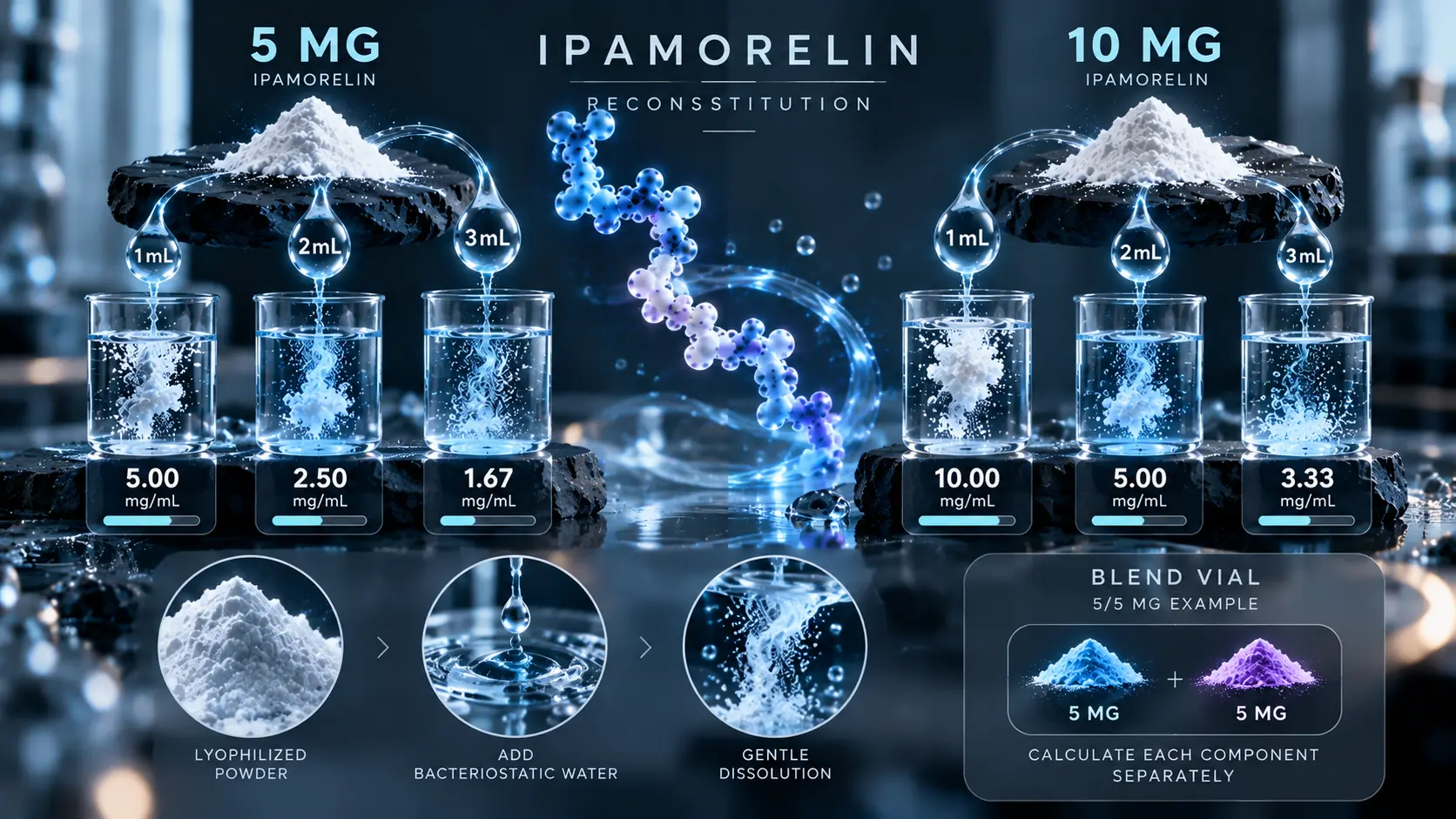
For a 5 mg vial, the reference volumes are 1, 2, or 3 mL of bacteriostatic water; for a 10 mg vial, the same three volumes apply. The concentration is the vial's milligram content divided by the milliliters added, and the powder's own volume is negligible next to the water. Four terms need plain definitions before the numbers make sense. Lyophilized means freeze-dried: the powder in the vial. Reconstitution means dissolving that powder in a diluent. Bacteriostatic water is sterile water containing 0.9% benzyl alcohol as a preservative, which is what permits a vial to be drawn from repeatedly [6]. A U-100 syringe unit is a graduation of volume: 100 units fill 1 mL, so one unit is 0.01 mL.
Two common phrasings of this question are "how much bac water for 5mg ipamorelin" and "how much bac water for 10mg ipamorelin". Both reduce to the same division, worked out in full here.
Vial size | Bacteriostatic water added | Concentration (mg/mL) | Concentration (mcg/mL) | U-100 units per mL | Micrograms per one syringe unit |
|---|---|---|---|---|---|
5 mg | 1 mL | 5 mg/mL | 5,000 mcg/mL | 100 | 50 mcg |
5 mg | 2 mL | 2.5 mg/mL | 2,500 mcg/mL | 100 | 25 mcg |
5 mg | 3 mL | 1.67 mg/mL | 1,667 mcg/mL | 100 | 16.7 mcg |
10 mg | 1 mL | 10 mg/mL | 10,000 mcg/mL | 100 | 100 mcg |
10 mg | 2 mL | 5 mg/mL | 5,000 mcg/mL | 100 | 50 mcg |
10 mg | 3 mL | 3.33 mg/mL | 3,333 mcg/mL | 100 | 33.3 mcg |
Two things about the chart deserve emphasis. First, the units-per-mL column never changes: it is a property of the syringe, not the solution. Second, the chart stops at concentration and never converts it into an amount for any person.
How Does the Arithmetic Change for a Two-Peptide Blend Vial?
Each component is calculated on its own. A label reading "5/5 mg" means 5 mg of the first peptide and 5 mg of the second peptide in a single vial, which is 10 mg of total powder. The per-component formula is unchanged: component milligrams divided by water milliliters. A second formula covers the combined powder: total milligrams divided by milliliters. Worked through with 2 mL of water, a "5/5 mg" blend gives 2.5 mg/mL of each component (2,500 mcg/mL, or 25 mcg per U-100 unit) and 5 mg/mL of total powder (5,000 mcg/mL, or 50 mcg per unit).
Water added | Per-component concentration (mg/mL) | Per-component concentration (mcg/mL) | Per-component mcg per syringe unit | Total powder concentration (mg/mL) |
|---|---|---|---|---|
1 mL | 5 mg/mL | 5,000 mcg/mL | 50 mcg | 10 mg/mL |
2 mL | 2.5 mg/mL | 2,500 mcg/mL | 25 mcg | 5 mg/mL |
3 mL | 1.67 mg/mL | 1,667 mcg/mL | 16.7 mcg | 3.33 mg/mL |
The common misreading is treating "5/5 mg" as 5 mg total. That mistake halves every downstream number: dividing 2.5 mg by 2 mL gives 1.25 mg/mL per component instead of the true 2.5 mg/mL. Treat "5/5 mg" here as an illustrative example only. Read the label on your own vial and its certificate of analysis, because blend labeling varies between suppliers.
What Does "3ML" on the Vial Label Mean?
"3ML" is the vial's nominal fill capacity, not a reconstitution instruction. Vial glassware is made in standard sizes, and the marking tells you how much liquid the vial can hold. It says nothing about how much water to add. Confusing capacity with instruction is a small error with real consequences: it suggests adding 3 mL to every vial regardless of its milligram content.
Label marking | What it means | What it is not |
|---|---|---|
"3ML" | Nominal capacity of the glass vial | A reconstitution volume |
"5 mg" or "10 mg" | Net weight of lyophilized powder in the vial | A concentration |
"5/5 mg" | 5 mg of each component in a blend vial | 5 mg total |
Lot or batch number | Traceability to the vial's certificate of analysis | A quality claim on its own |
The same reading applies wherever a vial carries a capacity marking: it describes the glassware, never the water volume.
How Do You Do Ipamorelin Reconstitution, Step by Step?
The procedure is short: verify, disinfect, transfer, mix gently, confirm, label.
- Read the vial label and confirm the milligram content. Check that the powder is a dry, intact cake with no discoloration.
- Wipe the vial's rubber stopper with an alcohol swab and let it dry completely before the stopper is punctured [3].
- Draw the chosen volume of bacteriostatic water into the syringe.
- Add the water slowly down the inside wall of the vial, not directly onto the powder [4].
- Swirl the vial gently until the powder dissolves fully. Do not shake it: a peptide manufacturer's handling note advises gentle swirling and warns against vigorous agitation [4].
- Confirm the solution is clear with no visible particles, then label the vial with the reconstitution date.
The date on the label matters more than it looks. It starts the clock described in the next section.
Which Shelf-Life Clock Applies?
Two clocks run at once, and the shorter one governs. The first clock is the peptide solution's own stability. The second is the opened bacteriostatic water vial's 28-day limit. The only one of the two with a compendial source is the second.
The 28-day rule comes from USP General Chapter <797>, the compounding standard for sterile preparations. The CDC's injection-safety guidance quotes it directly: once a multi-dose vial is opened — needle-punctured — the vial should be dated and discarded within 28 days, unless the manufacturer states another date for that opened vial, and the beyond-use date should never exceed the manufacturer's original expiration date [3]. The clock starts at first puncture, not first use. A vial opened on day one of a two-year shelf life is still discarded at day 28.
The peptide-solution clock is murkier. A targeted literature search in September 2026 found no peer-reviewed measurement of reconstituted ipamorelin stability: no study, no timepoint, no degradation curve. What exists is a spread of supplier-published specifications that disagree with each other.
Published claim | Source type | Standing |
|---|---|---|
14–28 days at 2–8 °C | Supplier-published specification | Guidance, not measured data |
30 days at 2–8 °C | Supplier-published specification | Guidance, not measured data |
Up to 3 months at 2–8 °C | Supplier-published specification | Outlier; no data shown |
4 °C for 2–7 days; below −18 °C long-term with carrier protein | Supplier-published specification | Most conservative refrigerated figure found |
"Aliquot and store reconstituted solutions at −20 °C (or lower) to minimise degradation" | Supplier-published specification (live read) | Frozen-storage guidance only; no duration and no refrigerated figure given [5] |
The honest summary is that nobody has published a measurement, and the suppliers do not agree. Treat every refrigerated figure above as a supplier's guidance, not a result. One more consequence of the 28-day rule deserves plain stating. A solution made from an already-opened water vial is best treated as limited by that vial: water first punctured fifteen days ago leaves fourteen days on the 28-day clock, not twenty-eight [3]. For broader context, see reconstituted peptide stability and storage and the peptide storage guidelines.
Does Net Peptide Content Change the Numbers?
Yes, and always downward. The milligram figure on the label is the weight of everything freeze-dried into the vial: peptide, counterions, and residual moisture. Ipamorelin is manufactured and isolated as a salt — the original synthesis paper describes it as a trifluoroacetate — so a share of the labeled weight is counterion, not peptide [2]. The certificate of analysis reports the true peptide content as a percentage, and that percentage is the number the chart should really use.
An illustrative example makes the gap concrete. These are round teaching numbers, not a real certificate.
Label-based | True peptide (illustrative) | |
|---|---|---|
Powder in vial | 5 mg | 4.0 mg at 80% peptide content |
In 2 mL water | 2.5 mg/mL | 2.0 mg/mL |
Per U-100 unit | 25 mcg | 20 mcg |
At 80% peptide content, every number in the chart sits 20% high. The correction is simple once the COA is in hand: multiply the label milligrams by the peptide-content fraction before dividing by the water volume. The site's guide to reading a certificate of analysis walks through the relevant lines, and batch documents live in the certificate library.
What This Page Does Not Cover
This page is arithmetic, nothing more. It does not say what amount is appropriate for any person, and no concentration on it implies one. It says nothing about schedules, timing, or combinations. It also says nothing about what ipamorelin or CJC-1295 are studied for. For that background, the site keeps separate pages: an ipamorelin background page, a CJC-1295/ipamorelin research overview, and a blend-versus-single-peptides comparison. For neighboring compounds, see the general peptide reconstitution chart and the guide to how much bacteriostatic water to use with other peptides.
Where Should You Go From Here?
Three kinds of pages extend this one. The general peptide reconstitution chart covers the same method for other peptides. The BAC water and insulin syringe unit conversion chart covers syringe graduations in more depth. And the guide to reading a certificate of analysis shows how to check the true peptide content behind any label. The site also publishes peptide calculators for volumes this ipamorelin reconstitution chart does not tabulate.
For research materials with lot documentation: ipamorelin is listed in 5 mg and 10 mg vials, the CJC-1295/ipamorelin blend is the two-peptide vial discussed above, and bacteriostatic water is the diluent used throughout this chart.
References
[1] National Center for Biotechnology Information. PubChem Compound Summary for CID 9831659, Ipamorelin. Molecular formula C38H49N9O5; molecular weight 711.9 g/mol (PubChem 2.2; vendor COAs list 711.85 g/mol); CAS 170851-70-4. Live read, September 2026. https://pubchem.ncbi.nlm.nih.gov/compound/9831659
[2] Raun K, Hansen BS, Johansen NL, Thogersen H, Madsen T. Ipamorelin, the first selective growth hormone secretagogue. Eur J Endocrinol. 1998;139(5):552-61. PMID: 9849822. PubMed record live-read, September 2026; the trifluoroacetate-salt, solubility, and pKa details are from the paper's published full text (search-excerpt verified). https://pubmed.ncbi.nlm.nih.gov/9849822/
[3] Centers for Disease Control and Prevention. Preventing Unsafe Injection Practices. Page loads (live read, September 2026); the quoted USP General Chapter <797> 28-day wording is search-excerpt verified from the CDC's published guidance. http://cdc.gov/injection-safety/hcp/clinical-safety/
[4] Bachem AG. Care and Handling of Peptides. Knowledge Center. https://www.bachem.com/knowledge-center/care-and-handling-of-peptides/
[5] A UK research-peptide supplier product page (name withheld), supplier-published specification read September 2026: aliquot and store reconstituted solutions at −20 °C or lower to minimise degradation. No duration and no refrigerated figure given.
[6] Hospira, Inc. Bacteriostatic Water for Injection, USP. Prescribing information, revised 08/2019, DailyMed listing updated through May 2026. Describes 0.9% benzyl alcohol and a multiple-dose container from which repeated withdrawals may be made. The label prints no post-puncture discard date; the 28-day limit comes from USP General Chapter <797>, as quoted in [3]. https://dailymed.nlm.nih.gov/dailymed/fda/fdaDrugXsl.cfm?setid=87d6e9dc-fe3b-4593-ac9a-d7493d1959c7
Frequently Asked Questions
How much bacteriostatic water do I add to a 5 mg ipamorelin vial?
Add 1, 2, or 3 mL; the reference volumes give 5, 2.5, or 1.67 mg/mL. Two milliliters is the most commonly tabulated, yielding 2.5 mg/mL — that is 2,500 mcg/mL, or 25 mcg per U-100 syringe unit. The water volume only sets the concentration. The vial still holds 5 mg of powder whichever volume you choose.
How much bacteriostatic water do I add to a 10 mg ipamorelin vial?
The same three volumes give 10, 5, or 3.33 mg/mL. At 2 mL the concentration is 5 mg/mL, which is 5,000 mcg/mL or 50 mcg per U-100 syringe unit. As with the 5 mg vial, the powder content is fixed and only the concentration changes. Pick the volume whose per-unit arithmetic is cleanest for your measurements.
What concentration is 5 mg of ipamorelin in 2 mL?
It is 2.5 mg/mL. Divide the powder by the water: 5 ÷ 2 = 2.5. In micrograms that is 2,500 mcg/mL, and on a U-100 syringe it works out to 25 mcg per unit. The division behind it is the entire method.
How many syringe units is 2 mL or 3 mL of bacteriostatic water?
On a U-100 syringe, 100 units make 1 mL, so 2 mL is 200 units and 3 mL is 300 units. Units are graduations of volume, not amounts of peptide — 200 units of water carries no peptide until it has dissolved a vial's powder. Keep volume units and peptide mass as separate ideas.
How many micrograms is one syringe unit at a given concentration?
Divide the mcg/mL figure by 100. At 2.5 mg/mL (2,500 mcg/mL), one unit is 25 mcg; at 5 mg/mL it is 50 mcg. The divisor is always 100 on a U-100 syringe because one unit is 0.01 mL. Every concentration converts the same way.
How do I reconstitute a CJC-1295/ipamorelin blend vial?
Exactly as a single-peptide vial: the same disinfect, transfer, and gentle-swirl steps from the procedure above. Only the arithmetic differs. Divide each component's milligrams by the water volume — a 5/5 mg blend in 2 mL gives 2.5 mg/mL of each component. Read your own vial label first, since blend ratios vary between suppliers.
Does "5/5 mg" mean 5 mg total or 5 mg of each?
It means 5 mg of each, for 10 mg of total powder. This is the misreading the blend section corrects: treating it as 5 mg total halves every downstream number. If a label ever means something else, the certificate of analysis settles it — but five of each is the usual reading of that format.
How do I calculate each component's concentration in a blend?
Take the component milligrams and divide by the water milliliters, once per component. For a 5/5 mg blend in 2 mL: 5 ÷ 2 = 2.5 mg/mL per component. The total-powder concentration is the sum divided by the volume: 10 ÷ 2 = 5 mg/mL. Never average the two numbers or split the difference.
What does "3ML" on a vial mean?
It is the vial's nominal fill capacity — the volume the glass is sized to hold. It is not an instruction to add 3 mL. Vial sizes are standardized, so the marking appears whether the vial holds 5 mg or 10 mg of powder. Choose the water volume from the chart, not from the glassware.
Can I use sterile water instead of bacteriostatic water?
Only if the vial will be used up at once. Sterile water for injection has no preservative, so an opened vial of it is single-use. Bacteriostatic water's 0.9% benzyl alcohol is what permits repeated withdrawals, under the 28-day opened-vial limit. The two products are not interchangeable for multi-draw work.
Should the vial be shaken to dissolve it?
No. Swirl it gently until the powder disappears. A peptide manufacturer's handling note advises gentle swirling and warns against vigorous agitation. Shaking also foams the solution, which makes clean measurement harder. If powder clings to the glass, roll the vial between your palms instead.
How long does reconstituted ipamorelin last in the refrigerator?
No published measurement exists — that is the honest answer, and the literature search behind it is described above. Supplier-published figures range from 2–7 days to 3 months at 2–8 °C, which is not agreement. The only hard limit with a compendial source is the 28-day opened-vial rule for the water itself.
Can reconstituted ipamorelin be frozen?
One supplier's published specification says to aliquot and store reconstituted solutions at −20 °C or lower to minimise degradation, without giving a duration. That is a supplier specification, not peer-reviewed data, and no published study covers frozen storage of reconstituted ipamorelin. Any thawed solution should be checked for clarity before laboratory use.
Is there an ipamorelin reconstitution calculator?
The site publishes peptide calculators that cover arbitrary volumes, named in the closing section. For the standard cases, the chart above already does the work: pick the vial size and water volume, then read the row. The underlying operation is a single division, which is why a chart beats a calculator for the common volumes.
Does adding more bacteriostatic water change how much peptide is in the vial?
No. The vial always contains its labeled milligrams; water only changes the concentration. More water means a lower mg/mL figure, so each syringe unit carries fewer micrograms — but the total peptide in the vial is identical. Dilution redistributes; it does not remove.