Last reviewed: September 2026. Every figure on this page was recomputed on 27 September 2026.

Quick Answer
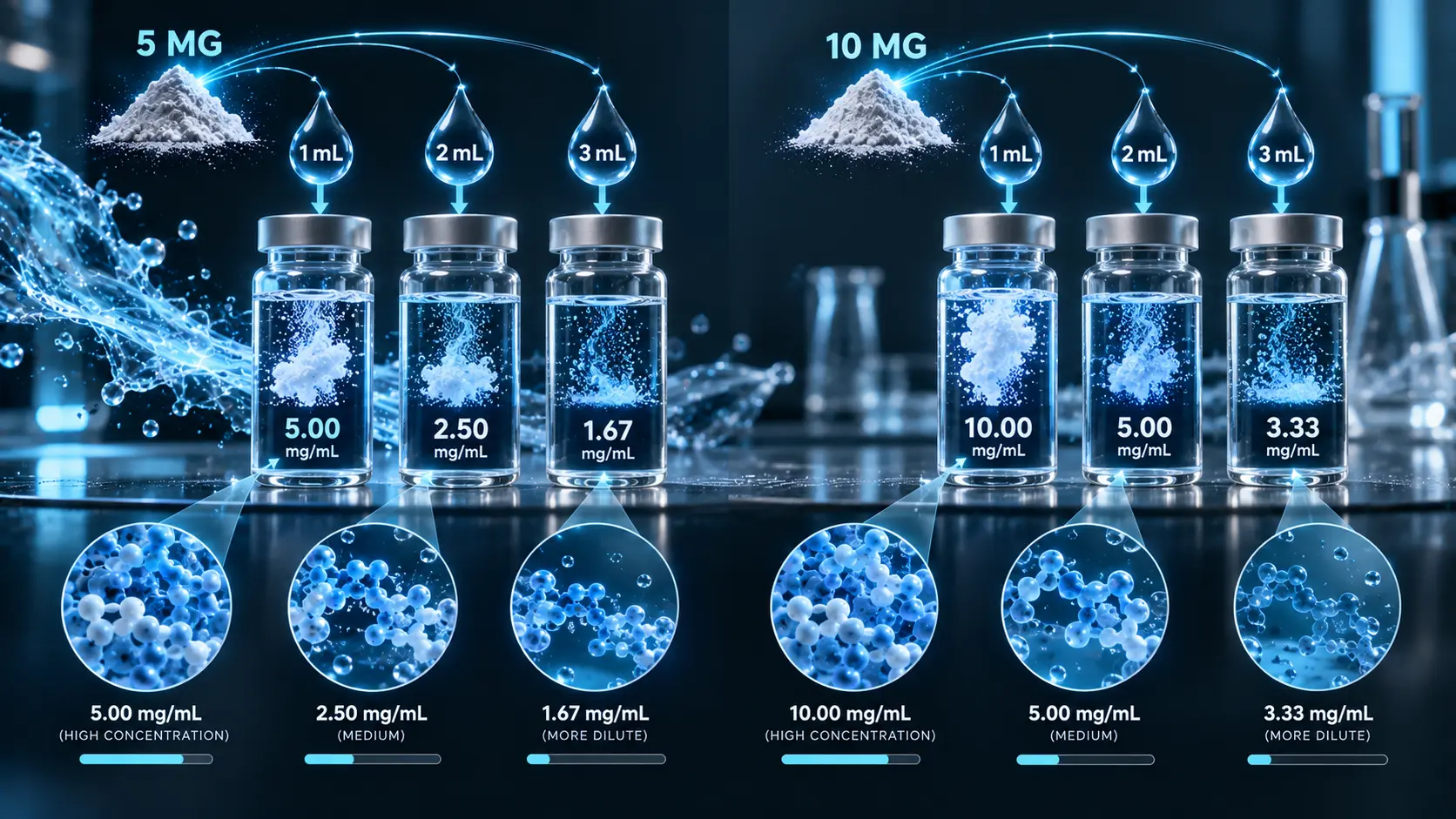
BPC-157 reconstitution is one division: peptide mass in milligrams divided by bacteriostatic water volume in millilitres. A 5 mg vial of BPC-157 gives 5 mg/mL at 1 mL, 2.5 mg/mL at 2 mL and 1.67 mg/mL at 3 mL. A 10 mg vial gives 10 mg/mL, 5 mg/mL and 3.33 mg/mL at the same three volumes.
Key Takeaways
- Concentration is mass divided by volume. 10 mg in 2 mL is 5 mg/mL, which is 5,000 mcg/mL.
- BPC-157 is a 15-residue peptide, sequence GEPPPGKPADDAGLV, formula C62H98N16O22, average molecular weight 1,419.56 g/mol [1]. At 5 mg/mL the solution is about 3.52 mM.
- The "3ML" in the product title is the glass capacity of the vial. It is not a volume instruction.
- Bacteriostatic water is a multiple-dose container by label. Once punctured, USP General Chapter <797> gives it 28 days [2][3][4].
- A reconstituted vial runs on two clocks, the diluent's 28 days and the peptide's own stability. The shorter one wins.
- Our PubMed search on 27 September 2026 found no published study measuring BPC-157 stability in reconstituted solution over time. Vendor storage windows are convention.
- A vial labelled 5 mg holds 5 mg of lyophilized material. Bachem puts typical net peptide content at 70 to 90 percent of that mass [5]. The certificate of analysis tells you the real figure.
Research Use Only. BPC-157 and bacteriostatic water are supplied for laboratory and analytical research. Nothing on this page is for human or veterinary use, and none of it is medical, health or administration guidance. The tables convert a labelled peptide mass and a diluent volume into a solution concentration. No figure here is an amount of anything for a person or an animal.
How we graded the evidence
Three tiers. Primary sources are the FDA drug label on DailyMed, the CDC statement of USP <797>, PubChem, and peer-reviewed papers on PubMed. Technical sources are handling notes from a major peptide manufacturer. Convention is anything repeated across vendor pages with no measurement behind it. Where a claim rests on convention, the text says so.
How Much Bacteriostatic Water for a 5 mg or 10 mg BPC-157 Vial?
Any of 1 mL, 2 mL or 3 mL works, and the volume you pick sets the concentration you get. Nothing about the vial fixes the answer. A researcher who wants a 5 mg/mL stock adds 1 mL to a 5 mg vial or 2 mL to a 10 mg vial. Both are correct.
The chart below covers the two vial masses sold on this site at the three volumes a 3 mL vial can physically hold. Molar values use the 1,419.56 g/mol molecular weight from PubChem [1]. Each cell was recomputed by hand and in code on 27 September 2026.
BPC-157 reconstitution chart for 5 mg and 10 mg vials at 1 mL, 2 mL and 3 mL of bacteriostatic water
Vial label | Bacteriostatic water added | Concentration (mg/mL) | Concentration (mcg/mL) | Micrograms per U-100 syringe unit (0.01 mL) | Molar concentration |
|---|---|---|---|---|---|
5 mg | 1 mL | 5.00 | 5,000 | 50 mcg | 3.52 mM |
5 mg | 2 mL | 2.50 | 2,500 | 25 mcg | 1.76 mM |
5 mg | 3 mL | 1.67 | 1,667 | 16.7 mcg | 1.17 mM |
10 mg | 1 mL | 10.00 | 10,000 | 100 mcg | 7.04 mM |
10 mg | 2 mL | 5.00 | 5,000 | 50 mcg | 3.52 mM |
10 mg | 3 mL | 3.33 | 3,333 | 33.3 mcg | 2.35 mM |
A U-100 insulin syringe is graduated so that 100 units equal 1 mL, which makes one syringe unit 0.01 mL. The micrograms per unit column is therefore the concentration in mcg/mL divided by 100. A unit here is a volume graduation on the barrel, not an amount for any person; the BAC water and insulin syringe unit conversion chart covers other syringe scales such as U-50 and U-40.
Two of the six cells are not round numbers. 5 mg in 3 mL is 1.6667 mg/mL and 10 mg in 3 mL is 3.3333 mg/mL. Both are shown to two decimals, which is the precision a bench pipette justifies. An assay that needs an exact round concentration should choose 1 mL or 2 mL, or change the target.
The molar column is the one competitors never print. It matters for anyone comparing this peptide with another at equal molarity, which is how most cell-culture and binding work is designed. A 5 mg/mL stock of a 1,419.56 g/mol peptide and a 5 mg/mL stock of a 4,963 g/mol peptide differ in molarity by a factor of three and a half.
For any other vial mass, the site's general peptide reconstitution chart carries 2 mg to 100 mg at up to 10 mL. The bacteriostatic water guide covers the volume decision for compounds not listed here.
How Is the Concentration Worked Out?
Concentration in mg/mL equals the labelled peptide mass in mg divided by the diluent volume in mL. Written out:
Concentration (mg/mL) = peptide mass (mg) ÷ bacteriostatic water volume (mL)
The 5 mg case at 2 mL: 5 ÷ 2 = 2.5 mg/mL. Multiply by 1,000 to get 2,500 mcg/mL. Pipetting 100 µL of that solution moves 250 mcg of labelled peptide.
The 10 mg case at 3 mL: 10 ÷ 3 = 3.333 mg/mL, or 3,333 mcg/mL. Every 100 µL holds 333 mcg.
The formula treats diluent volume and final solution volume as identical. That is a fair approximation. Ten milligrams of lyophilized powder dissolved in 2 mL of water changes the volume by a few microlitres, which is below the reading error of any syringe or pipette used to add it. Nobody applies a displacement correction at this scale, and nobody should.
To convert to molar, divide mg/mL by the molecular weight in g/mol and multiply by 1,000. For 2.5 mg/mL: 2.5 ÷ 1,419.56 × 1,000 = 1.761 mM. The molecular weight comes from PubChem compound record CID 9941957, which lists the formula C62H98N16O22 [1]. Recomputing that formula from standard atomic weights gives 1,419.56 g/mol, matching the record to two decimals.
Running the formula backwards is often more useful. Volume equals mass divided by target concentration. A researcher who wants 4 mg/mL from a 10 mg vial adds 10 ÷ 4 = 2.5 mL. That volume fits a 3 mL vial with headspace to spare.
What Does "3ML" on the Vial Label Mean?
The "3ML" in the product title "BPC-157 5 mg & 10mg 3ML" is the nominal capacity of the glass vial. It says nothing about how much water to add. The number that matters for the arithmetic is the peptide mass, 5 mg or 10 mg, and that is printed separately.
Reading the container size as a volume instruction is the most common way this label gets misread. Filling a 3 mL vial to capacity is allowed, but it is a choice with a consequence. A 5 mg vial filled with 3 mL lands at 1.67 mg/mL, the most dilute stock on the chart. A 10 mg vial at 3 mL gives 3.33 mg/mL. Neither number is wrong. Both are simply what a full vial produces.
In practice a 3 mL vial does not accept a full 3 mL of liquid without losing headspace. Headspace matters when the vial is swirled, and it matters when the stopper is entered repeatedly. Most researchers stop at 2 mL for that reason alone.
The general chart's FAQ answers the "3ML" question for every product on the site, and there is no need to restate it here. See does 3ML on a vial mean I should add 3 mL on that page.
How Do You Reconstitute a BPC-157 Vial, Step by Step?
Reconstitution is a sterile preparation task, and the handling rules come from the diluent label and from peptide-manufacturer guidance, not from the peptide vendor. The Hospira label for bacteriostatic water instructs the user to "use aseptic technique for single or multiple entry and withdrawal from all containers" and to "mix thoroughly and use promptly" [2]. Bachem's handling note explains why the vial must warm up before it is opened [5]. The procedure below is built from those two documents.
- Equilibrate. Take the sealed peptide vial out of cold storage and let it reach room temperature before opening it. Lyophilized peptides are hygroscopic. Bachem's guidance is to warm samples to room temperature, in a desiccator where possible, so that condensation does not form on the cold cake and reduce peptide content [5]. Twenty to thirty minutes on the bench is usually enough for a 3 mL vial.
- Prepare the work area. Use a clean, designated preparation surface away from sinks and other water sources, with alcohol wipes and sterile consumables to hand. This is the CDC's standing instruction for any sterile preparation [4].
- Disinfect both stoppers. Wipe the rubber septum of the peptide vial and of the bacteriostatic water vial with a fresh 70 percent isopropyl alcohol swab and allow each to dry. Aseptic entry of a multiple-dose container is required by the diluent label [2].
- Add the diluent down the wall. Draw the chosen volume of bacteriostatic water with a sterile transfer device and deliver it slowly against the inside wall of the peptide vial, not onto the powder. A direct stream onto the cake can foam it and throw powder up the glass.
- Swirl, never shake. Roll the vial gently until the cake dissolves. Shaking a vial with air headspace is a documented aggregation trigger for peptides and proteins, and headspace is exactly what a partly filled research vial has [6].
- Inspect. Hold the vial against a dark background in good light. The solution should be clear, colourless and free of particles. The Hospira label says to inspect reconstituted drugs "for clarity" and "freedom from unexpected precipitation or discoloration" [2]. Anything cloudy goes in the sharps bin, not the fridge.
- Label and date. Write the concentration, the reconstitution date and the bacteriostatic water vial's first-puncture date on both containers. The second date starts the 28-day clock discussed below.
That is the whole procedure. Seven steps, none of them optional.
Why Bacteriostatic Water, and Which Shelf-Life Clock Applies?
Bacteriostatic water is the right diluent for a vial that will be entered more than once, and the reason is the preservative. Hospira's label describes Bacteriostatic Water for Injection, USP as containing "0.9% (9 mg/mL) or 1.1% (11 mg/mL) of benzyl alcohol added as a bacteriostatic preservative" and states that it is "supplied in a multiple-dose container from which repeated withdrawals may be made" [2]. The label gives its pH as 5.7, with a range of 4.5 to 7.0 [2].
Sterile water is the wrong tool for the same job. The corresponding Hospira label states that Sterile Water for Injection, USP "contains no bacteriostat, antimicrobial agent or added buffer and is supplied only in single-dose containers" [3]. It will dissolve the peptide identically. It offers no defence against whatever enters the vial on the second puncture.
Diluent | Preservative | Container type by label | Fit for a multi-draw vial |
|---|---|---|---|
Bacteriostatic Water for Injection, USP | 0.9% benzyl alcohol (9 mg/mL) [2] | Multiple-dose [2] | Yes |
Sterile Water for Injection, USP | None [3] | Single-dose only [3] | No |
Benzyl alcohol is a bacteriostat, not a sterilant. It slows bacterial growth. The CDC notes that a preservative in a multi-dose vial "does not have an effect on viruses nor does it provide complete protection against bacterial contamination" [4]. Aseptic technique is still doing most of the work.
The two clocks
A reconstituted BPC-157 vial has two expiry dates, and they are independent.
The first belongs to the diluent. USP General Chapter <797>, as summarised by the CDC, states that once a multi-dose vial is punctured "the vial should be dated and discarded within 28 days unless the manufacturer states another date for that opened vial," and that the beyond-use date "should never exceed the manufacturer's original expiration date" [4]. Hospira's label sets no other date, so 28 days applies [2]. That clock starts on the day the bacteriostatic water vial is first entered, which may be weeks before the peptide is reconstituted.
The second belongs to the peptide. How long BPC-157 stays intact in solution is a chemistry question about the molecule, and it is covered in its own section below.
The shorter of the two governs. A bacteriostatic water vial opened on 1 September that reconstitutes a peptide on 20 September has nine days of USP <797> life left, whatever the peptide's own stability. Competitor pages present a single storage window for the mixed vial. There is no such single number. Write both dates on the label.
Clock | What starts it | Limit | Source |
|---|---|---|---|
Diluent beyond-use date | First puncture of the bacteriostatic water vial | 28 days, never past the printed expiry | USP <797> via CDC [4]; the Hospira label prints no other date [2] |
Peptide stability in solution | Reconstitution | No published measurement for BPC-157 | PubMed search, 27 September 2026 |
Storage detail beyond this point lives on the site's reconstituted peptide stability and storage page and the general peptide storage guidelines.
Does Net Peptide Content Change the Numbers?
Net peptide content changes what the concentration means, not how it is calculated. The label mass is the gross weight of the lyophilized solid, and that solid is not pure peptide.
Bachem's handling note puts it plainly. Peptides for research use are typically above 95 percent pure by HPLC, yet "the peptide content of the solid may range from 70 to 90% as peptides contain counter ions (e.g. acetate, trifluoroacetate) and residual moisture" [5]. Bachem's FAQ defines net peptide content as the fraction of peptidic material relative to counter-ions and residual water, measured by nitrogen content in elemental analysis, because the counter-ions and the water carry no nitrogen [7].
Two different questions are being answered by two different numbers. HPLC purity asks what share of the peptide is the intended sequence. Net peptide content asks what share of the powder is peptide at all. A vial can be 99 percent pure and 80 percent net peptide at the same time, and both figures are correct.
Net peptide content | 5 mg vial, real peptide | 5 mg vial at 2 mL | 10 mg vial, real peptide | 10 mg vial at 2 mL |
|---|---|---|---|---|
100% (label assumption) | 5.00 mg | 2.50 mg/mL | 10.0 mg | 5.00 mg/mL |
90% | 4.50 mg | 2.25 mg/mL | 9.0 mg | 4.50 mg/mL |
80% | 4.00 mg | 2.00 mg/mL | 8.0 mg | 4.00 mg/mL |
70% | 3.50 mg | 1.75 mg/mL | 7.0 mg | 3.50 mg/mL |
At 80 percent net content, a nominal 5 mg/mL stock is actually 4 mg/mL. For qualitative work that offset rarely matters. For anything quantitative, anything compared across lots, or anything another laboratory will try to repeat, it is the difference between agreement and a puzzling 20 percent gap.
The correction is the same division applied to the corrected mass: net peptide mass divided by diluent volume. The mass to use comes from the lot certificate, not from a general band. The site's guide to reading a certificate of analysis walks through the fields, and current lot documents are listed under certificates. Match the lot number on the certificate to the lot number on the vial before trusting either.
One thing this page deliberately leaves out is the acetate-versus-arginate salt question that circulates on forums. We could not verify from a primary source that an arginate form of BPC-157 is described in the research literature, or that the salt form alters the arithmetic beyond the general counter-ion correction above. Until that is documented, it is not on this page.
What Is Known About How Long Reconstituted BPC-157 Lasts?
There is no published measurement of how long BPC-157 remains intact in reconstituted solution under refrigeration. We searched PubMed on 27 September 2026 for BPC-157 combined with stability, storage, degradation, shelf life and solution terms. The hits are the peptide's pharmacology, its metabolism, and repeated statements from one research group about its behaviour in gastric juice. They do not contain a time-course of a reconstituted vial.
Start with what the molecule is. According to PubChem, BPC-157 is a pentadecapeptide with the sequence Gly-Glu-Pro-Pro-Pro-Gly-Lys-Pro-Ala-Asp-Asp-Ala-Gly-Leu-Val, formula C62H98N16O22, molecular weight 1,419.56 g/mol [1]. Four of its fifteen residues are proline. It contains no cysteine, methionine, tryptophan, asparagine or glutamine.
That composition is worth noting because Bachem singles out exactly those five residues as the ones that limit shelf life in solution, through oxidation and deamidation [5]. BPC-157 has none of them. That is a reasoned expectation from the sequence that the peptide should be less fragile in solution than many, and it is not a measurement. Aspartate residues can still isomerise, and any peptide in water can hydrolyse or adsorb to glass.
The stability claim that does appear in the literature is narrower than vendors make it sound. Based on articles retrieved from PubMed, the University of Zagreb group led by Predrag Sikiric describes BPC-157 as showing "no degradation in human gastric juice for more than 24 h" in a 2022 editorial review in the World Journal of Gastroenterology (DOI 10.3748/wjg.v28.i1.23) [8], and repeats the point in a 2024 review in Inflammopharmacology (DOI 10.1007/s10787-024-01499-8) [9]. That is a resistance-to-acid-and-pepsin statement, it comes from a single research group reviewing its own work, and it says nothing about a refrigerated vial of bacteriostatic water over four weeks.
One further paper is relevant in a different way. Tian and colleagues at the Shanghai Anti-Doping Laboratory, writing in Molecules in 2023, characterised the in vitro metabolic profile of BPC-157 by UHPLC-HRMS and found that most metabolites arose from the "conventional amide-bond breaking metabolic pathway" (DOI 10.3390/molecules28217345) [10]. That is an enzymatic-incubation study, not a storage study. It confirms the peptide is cleaved at amide bonds by enzymes, which is expected, and it sets no shelf life.
So the honest grading is this. The molecular identity is primary-source and settled [1]. The gastric-juice resistance is a single-group claim in reviews [8][9]. The shelf life of a reconstituted vial is convention. When a vendor page quotes "four weeks refrigerated," it is quoting the bacteriostatic water's USP <797> limit and attaching it to the peptide. The two happen to coincide often enough that nobody notices they are different facts.
Claim | Evidence type | Grade |
|---|---|---|
Sequence, formula, molecular weight | PubChem record [1] | Primary, settled |
No degradation in gastric juice for over 24 h | Review statements by the originating group [8][9] | Single group, not independently reproduced in a stability study |
Enzymatic cleavage at amide bonds in vitro | Peer-reviewed anti-doping metabolism study [10] | Primary, but not a storage measurement |
Reconstituted vial stable for X weeks at 2 to 8 °C | Vendor pages | Convention, no measurement found |
What a careful laboratory does with that gap is straightforward. Reconstitute what will be used within the diluent's 28 days. If a longer horizon is needed, aliquot once into single-use volumes and freeze, rather than cycling one vial through the freezer, since freeze-thaw cycling is a recognised stress for peptides in solution. Run a quick HPLC check on an aged aliquot if the work is quantitative. That is a measurement, which is more than the literature currently offers.
For the compound's background, the site's BPC-157 research overview and the tissue-repair research guide cover what has been studied. This page does not.
What This Page Does Not Cover
This page is preparation arithmetic and nothing else. It converts a labelled mass and a diluent volume into a concentration, and it explains what a certificate of analysis does to that number.
It contains no administration, schedule or amount for any person or animal. It does not describe what BPC-157 does, what it has been studied for, or what any study found. It does not compare vendors. It does not discuss the compound's legal position, which changes and has its own page at is BPC-157 legal.
It also does not settle the reconstituted shelf life, because nobody has published that measurement. Anyone who tells you the number with confidence is repeating a convention.
Where to Go From Here
BPC-157 reconstitution comes down to one division and two dates. Divide the labelled mass by the water volume, correct for net peptide content from the certificate, and write both the peptide date and the diluent's first-puncture date on the vial.
The two research materials referenced on this page are BPC-157 in 5 mg and 10 mg vials, with lot-specific certificates of analysis linked from the product page, and bacteriostatic water in more than one vial size. For every other vial mass, the general peptide reconstitution chart has the grid. For what the certificate's net content field means for your vial, the certificate of analysis guide is the page to keep open.
References
- National Center for Biotechnology Information. PubChem Compound Summary for CID 9941957, Bpc-157 (C62H98N16O22). https://pubchem.ncbi.nlm.nih.gov/compound/9941957
- Hospira, Inc. Bacteriostatic Water for Injection, USP. Prescribing information, revised 08/2019; DailyMed label updated 22 May 2026. NDC 0409-3977-03 and 0409-1093-04. https://dailymed.nlm.nih.gov/dailymed/lookup.cfm?setid=87d6e9dc-fe3b-4593-ac9a-d7493d1959c7
- Hospira, Inc. Sterile Water for Injection, USP. Prescribing information. DailyMed. https://dailymed.nlm.nih.gov/dailymed/lookup.cfm?setid=2b9ea23a-f9e9-48a8-25b7-519e3bbd6828
- Centers for Disease Control and Prevention. Preventing Unsafe Injection Practices. Injection Safety, reviewed 26 March 2024. Cites United States Pharmacopeia General Chapter <797>, Pharmaceutical Compounding – Sterile Preparations, 1 November 2023. https://www.cdc.gov/injection-safety/hcp/clinical-safety/index.html
- Bachem AG. Care and Handling of Peptides. Knowledge Center. https://www.bachem.com/knowledge-center/care-and-handling-of-peptides/
- Kiese S, Pappenberger A, Friess W, et al. Shaken, not stirred: mechanical stress testing of an IgG1 antibody. Journal of Pharmaceutical Sciences. 2008;97(10):4347-4366. PMID 18240293. DOI 10.1002/jps.21328. https://doi.org/10.1002/jps.21328
- Bachem AG. FAQ – frequently asked questions: net peptide content and HPLC purity. Knowledge Center. https://www.bachem.com/knowledge-center/faq/
- Sikiric P, Skrtic A, Gojkovic S, et al. Cytoprotective gastric pentadecapeptide BPC 157 resolves major vessel occlusion disturbances, ischemia-reperfusion injury following Pringle maneuver, and Budd-Chiari syndrome. World Journal of Gastroenterology. 2022;28(1):23-46. PMID 35125818. DOI 10.3748/wjg.v28.i1.23. https://doi.org/10.3748/wjg.v28.i1.23
- Sikiric P, Sever M, Krezic I, et al. New studies with stable gastric pentadecapeptide protecting gastrointestinal tract. Significance of counteraction of vascular and multiorgan failure of occlusion/occlusion-like syndrome in cytoprotection/organoprotection. Inflammopharmacology. 2024;32(5):3119-3161. PMID 38980576. DOI 10.1007/s10787-024-01499-8. https://doi.org/10.1007/s10787-024-01499-8
- Tian T, Jing J, Li Y, et al. Stable Isotope Labeling-Based Nontargeted Strategy for Characterization of the In Vitro Metabolic Profile of a Novel Doping BPC-157 in Doping Control by UHPLC-HRMS. Molecules. 2023;28(21):7345. PMID 37959764. DOI 10.3390/molecules28217345. https://doi.org/10.3390/molecules28217345
Frequently Asked Questions
How much bacteriostatic water do I add to a 5 mg BPC-157 vial?
Add whatever volume gives the concentration your assay needs. One millilitre gives 5 mg/mL, 2 mL gives 2.5 mg/mL and 3 mL gives 1.67 mg/mL. The vial does not decide this for you. Most researchers choose 1 mL or 2 mL because the arithmetic is round and the vial keeps useful headspace. Whichever you choose, write the concentration on the label at once.
How much bacteriostatic water do I add to a 10 mg BPC-157 vial?
Any of 1 mL, 2 mL or 3 mL, giving 10 mg/mL, 5 mg/mL or 3.33 mg/mL respectively. Two millilitres is the common choice for a 10 mg vial because 5 mg/mL is easy to work from and easy to check. A researcher who wants a specific target divides 10 by that target to get the volume. For 4 mg/mL, that is 2.5 mL.
What concentration do I get from 5 mg of BPC-157 in 2 mL?
2.5 mg/mL, which is the same solution described as 2,500 mcg/mL or about 1.76 mM. Every 100 µL you pipette from it carries 250 mcg of labelled peptide. If the certificate of analysis for your lot reports net peptide content below 100 percent, multiply 2.5 by that fraction to get the concentration of real peptide.
What does "3ML" on a BPC-157 vial mean?
It is the capacity of the glass vial, not an instruction to add 3 mL. The 5 mg or 10 mg figure is the number that feeds the calculation. A 3 mL vial accepts 1 mL, 2 mL or close to 3 mL, and each volume gives a different concentration. Filling it completely simply produces the most dilute stock on the chart.
Can I use sterile water instead of bacteriostatic water?
Sterile water dissolves the peptide just as well, but its label states it contains no bacteriostat and is supplied only in single-dose containers. Bacteriostatic water carries 0.9 percent benzyl alcohol and is labelled as a multiple-dose container. For a vial that will be entered more than once, the preservative is the whole point. Concentration arithmetic is identical for both.
Should the vial be shaken to dissolve it?
No. Swirl or roll it gently until the cake is gone. Shaking a vial that has air headspace is a documented trigger for aggregation in peptide and protein solutions, and a partly filled 3 mL vial is mostly headspace. If the powder is slow to dissolve, give it a few more minutes of gentle rolling rather than force.
How do I know the peptide has fully dissolved?
The solution is clear, colourless and free of visible particles when held against a dark background in good light. Any haze, floating material or colour change means something is wrong with the material or the handling, and the vial should not be used. Bacteriostatic water's own label instructs the user to inspect reconstituted solutions for clarity and freedom from precipitation before use.
How long does reconstituted BPC-157 last in the refrigerator?
Nobody has published a measurement. Our PubMed search found no study of BPC-157 stability in reconstituted solution over time. What is documented is the diluent's limit: bacteriostatic water is a multiple-dose container with a 28-day beyond-use date once punctured under USP <797>. Treat that as the ceiling, keep the vial at 2 to 8 °C, and record both dates.
Can reconstituted BPC-157 be frozen?
It can, and the sensible way is to aliquot once into single-use volumes before the first freeze. Repeated freeze-thaw of one working vial is a recognised stress for peptides in solution. No published study has measured BPC-157 specifically through repeated freezing and thawing, so treat frozen storage as a working convention and verify by HPLC if the work is quantitative.
Does net peptide content change how much water to add?
It changes the meaning of the result, not the volume you add. You still choose the water volume for your target labelled concentration. Net peptide content tells you how much of the powder is peptide rather than counter-ion and water. At 80 percent, a nominal 5 mg/mL stock holds 4 mg/mL of peptide. Take the figure from your lot's certificate of analysis.
Is more water or less water better?
Neither is better in general. More water gives a more dilute stock, which is easier to pipette accurately but has more surface area for adsorption losses. Less water gives a concentrate that can be diluted further downstream but must still dissolve fully. Choose the volume that gives a concentration your assay can work from directly.
Why does the molecular weight matter for reconstitution?
Because many experiments are designed in molar terms, not mass terms. BPC-157 has a molecular weight of 1,419.56 g/mol, so a 5 mg/mL stock is 3.52 mM. Comparing it with a heavier peptide at the same mg/mL would be comparing very different molar amounts. Dividing mg/mL by molecular weight and multiplying by 1,000 gives millimolar.
Which date should go on the label, the peptide's or the water's?
Both. The bacteriostatic water vial's first-puncture date starts a 28-day USP <797> clock that applies to every solution made from it. The reconstitution date is the start of the peptide's own, unmeasured, stability window. The earlier expiry of the two governs the vial, so label it with both and discard on whichever comes first.
How many syringe units is 2 mL of bacteriostatic water?
On a U-100 insulin syringe 1 mL is 100 units, so 2 mL is 200 units, which is more than a single 1 mL syringe holds. Units only measure volume. The concentration of the finished solution then tells you what each unit contains: in a 5 mg vial reconstituted with 2 mL, one unit (0.01 mL) carries 25 mcg of BPC-157, and in a 10 mg vial with 2 mL it carries 50 mcg. The BAC water and insulin syringe unit conversion chart covers other volumes and syringe scales.