Last reviewed: September 2026
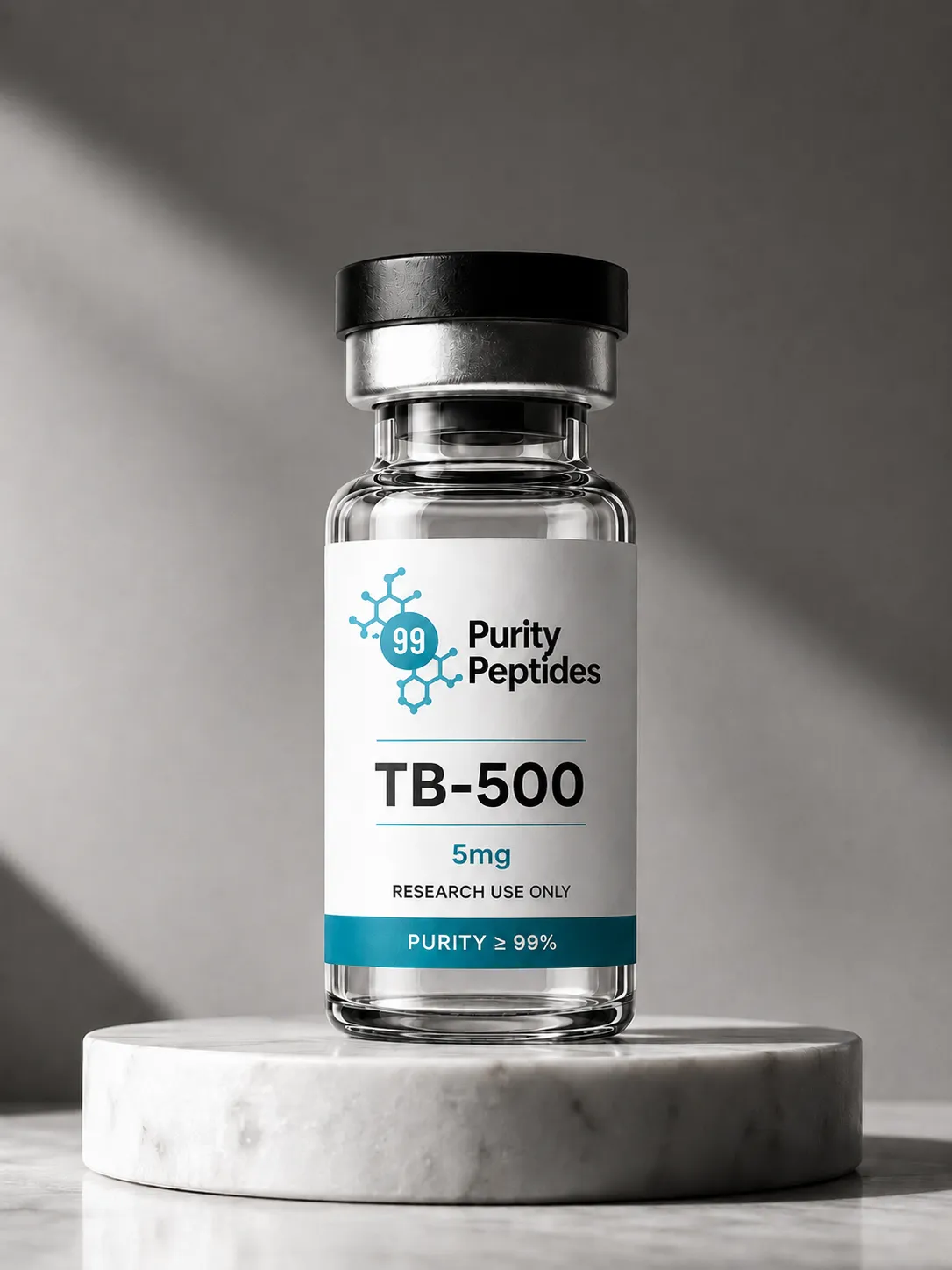
Quick Answer
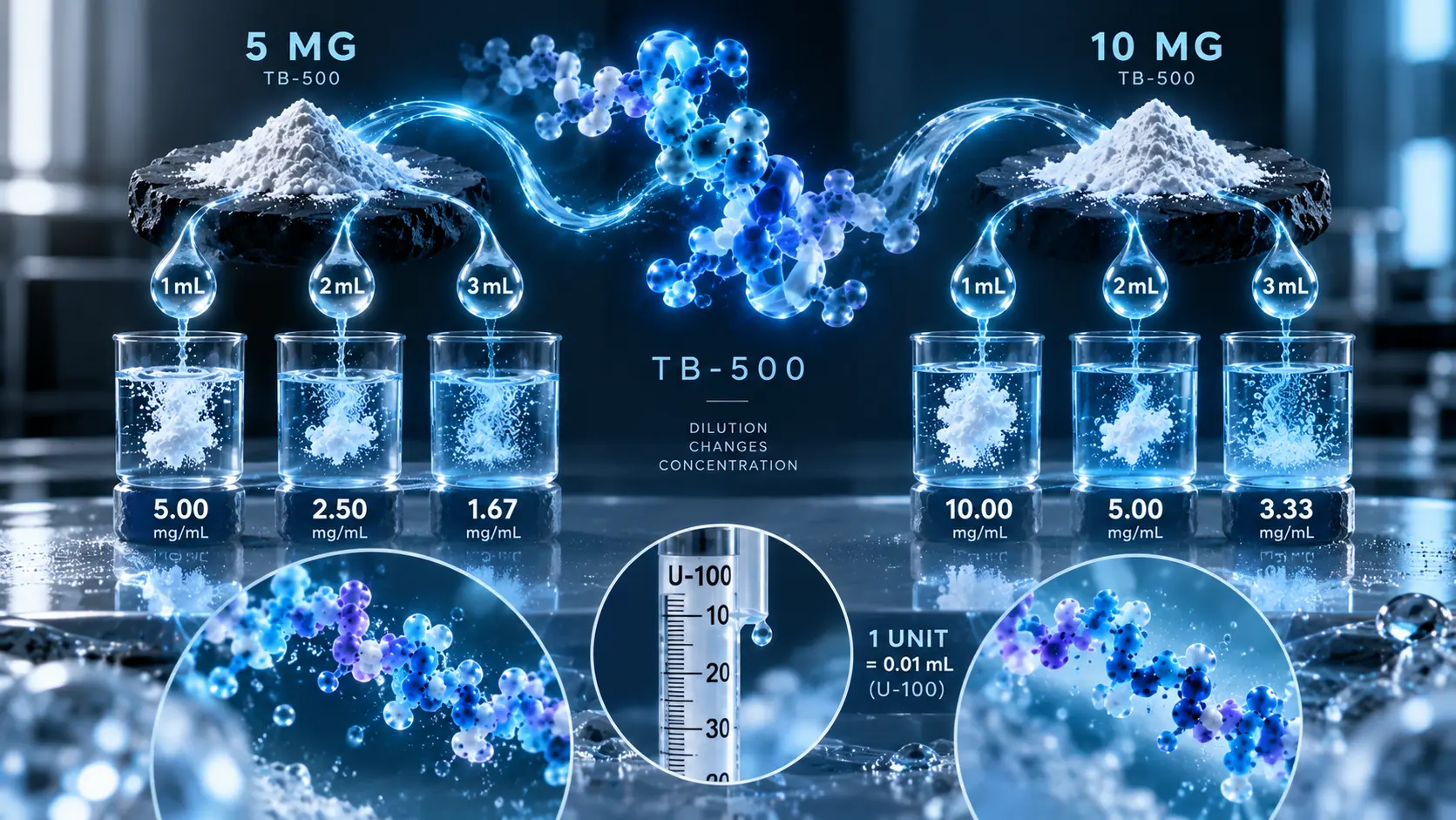
TB 500 reconstitution is division, not chemistry. Add 2 mL of bacteriostatic water to a 5 mg vial and the solution is 2.5 mg/mL, so one unit on a U-100 syringe barrel holds 25 mcg. The same 2 mL added to a 10 mg vial gives 5 mg/mL, and one unit holds 50 mcg. Every figure below is mg divided by mL.
Key Takeaways
- A 5 mg vial reconstituted with 1 mL, 2 mL or 3 mL of bacteriostatic water measures 5 mg/mL, 2.5 mg/mL and roughly 1.67 mg/mL.
- A 10 mg vial at the same three volumes measures 10 mg/mL, 5 mg/mL and roughly 3.33 mg/mL.
- One unit on a U-100 insulin syringe is 0.01 mL, so any U-100 barrel reads 100 units per millilitre regardless of what is dissolved in it.
- Thymosin beta-4 is a 43-residue protein in its mature form, N-terminally acetylated, with a calculated average mass near 4,963.5 Da. UniProt lists the 44-residue precursor at 5,053 Da before the initiator methionine is removed.
- The label "TB-500" is used in the research-chemical trade for Ac-LKKTETQ, an N-acetylated seven-residue fragment near 889 Da. Two peer-reviewed analytical laboratories confirmed that composition in 2012.
- Milligrams per millilitre is blind to molecular weight. Molar concentration is not: 2.5 mg/mL is about 2.81 mmol/L as the heptapeptide and about 0.50 mmol/L as the full protein, a 5.58-fold difference.
- The widely repeated 28-day figure is not printed on the Hospira Bacteriostatic Water label. It comes from USP General Chapter 797 for preserved multiple-dose containers, and it is a microbiological limit, not a stability measurement for any peptide.
- A PubMed search returned no published measurement of reconstituted TB-500 or thymosin beta-4 stability in bacteriostatic water. Vendor storage windows are convention.
Research Use Only. Everything on this page is laboratory preparation arithmetic. Products described are supplied for Research Use Only and are not for human or veterinary consumption, diagnosis or treatment. Nothing here is medical or health guidance, no amount for use in a person appears anywhere on this page, and no concentration below is presented as appropriate for such use.
How Much Bacteriostatic Water for a 5 mg or 10 mg Vial of TB-500?
Divide the milligrams in the vial by the millilitres of bacteriostatic water you add. That single operation produces every number on this page.
Concentration in mg/mL = mass in vial (mg) ÷ volume of diluent added (mL)
Lyophilized means freeze-dried to a solid cake, which is how the vial arrives. Reconstitution is the step that dissolves that cake into a liquid. Bacteriostatic water is water for injection containing benzyl alcohol as a preservative, at 9 mg/mL in the 30 mL plastic presentation and 11 mg/mL in the 20 mL glass presentation, with a pH of 5.7 [1].
Table 1. TB-500 reconstitution chart for 5 mg and 10 mg vials with bacteriostatic water volumes. All cells recomputed 27 September 2026.
Vial | BAC water added | Concentration (mg/mL) | Concentration (mcg/mL) | Units per mL (U-100) | Micrograms per unit (0.01 mL) |
|---|---|---|---|---|---|
5 mg | 1 mL | 5 mg/mL | 5,000 mcg/mL | 100 | 50 mcg |
5 mg | 2 mL | 2.5 mg/mL | 2,500 mcg/mL | 100 | 25 mcg |
5 mg | 3 mL | 1.667 mg/mL | 1,666.67 mcg/mL | 100 | 16.67 mcg |
10 mg | 1 mL | 10 mg/mL | 10,000 mcg/mL | 100 | 100 mcg |
10 mg | 2 mL | 5 mg/mL | 5,000 mcg/mL | 100 | 50 mcg |
10 mg | 3 mL | 3.333 mg/mL | 3,333.33 mcg/mL | 100 | 33.33 mcg |
Two cells do not resolve to clean decimals. Both 3 mL rows produce repeating values, 1.666… and 3.333…, and they are rounded for display only. Carry the unrounded figure if you are propagating it into a calculation.
Notice what the fifth column does. It never changes.
A U-100 insulin syringe is graduated so that 100 units fill 1 mL, which fixes one unit at 0.01 mL. That graduation is a property of the barrel, not of the solution inside it. So 2 mL of bacteriostatic water is 200 units of volume and 3 mL is 300 units, whatever the vial contained. Only the sixth column, the micrograms occupying each unit, responds to how much powder was dissolved.
The 5 mg vial at 1 mL and the 10 mg vial at 2 mL land on the same 5 mg/mL. Two different vials, two different volumes, one identical concentration. That coincidence is worth registering, because it is the point where careless record-keeping stops being recoverable from the vial alone.
What Does "TB-500" Actually Refer To?
"TB-500" is a trade label, not a chemical name, and the literature supports a narrower meaning than the label implies.
Thymosin beta-4 is a small, intrinsically disordered actin-binding protein. UniProt entry P62328 gives the human sequence as 44 amino acids with a mass of 5,053 Da, then records that the initiator methionine is removed and serine-2 is N-terminally acetylated [2]. The mature protein is therefore 43 residues, not 44, and the acetylated 43-residue form calculates to roughly 4,963.5 Da. PubChem holds that species as Timbetasin, the international nonproprietary name for synthetic thymosin beta-4, with molecular formula C212H350N56O78S [3]. That formula weighs 4,963.5 Da, which is an independent check on the sequence arithmetic.
What the research-chemical trade calls TB-500 is a much smaller molecule. In 2012 two independent laboratories characterised material sold under that name. Esposito and colleagues at Ghent University identified the contents as Ac-LKKTETQ, the N-terminally acetylated 17-23 fragment of human thymosin beta-4, by high-resolution Orbitrap mass spectrometry, then confirmed it against a fragment they synthesised themselves [4]. Ho and colleagues at the Hong Kong Jockey Club racing laboratory described the key ingredient of TB-500 the same way and built a detection method around it [5]. LKKTETQ sits at positions 17 to 23 of the mature 43-residue sequence, which is exactly the numbering both papers use. The acetylated heptapeptide calculates to 889.02 Da, and PubChem's TB500 acetate record carries formula C40H72N10O16, the 889.02 Da peptide plus one acetic acid [3].
So the gap between label and molecule is large.
Table 2. What the label says against what the primary literature and chemical registries record.
Item | Mature thymosin beta-4 | "TB-500" as characterised in the literature |
|---|---|---|
Residue count | 43 (after initiator Met removal) | 7 |
Sequence | SDKPDMAEIEKFDKSKLKKTETQEKNPLPSKETIEQEKQAGES | LKKTETQ, positions 17-23 |
N-terminus | Acetylated serine | Acetylated leucine |
Calculated average mass | ~4,963.5 Da | ~889.0 Da |
Registry identity | Timbetasin, PubChem CID 16132341 | Fequesetide as free peptide, CID 10169788; TB500 acetate, CID 155977548 |
Primary evidence | UniProt P62328, curated | Esposito 2012; Ho 2012, both by mass spectrometry |
Trade usage is inconsistent, and the inconsistency is usually in the product title rather than the description. This site's own listing is a fair example: the page title reads "Thymosin Beta-4", while the body copy states plainly that the material is a synthetic peptide fragment modelled after the biologically active region of thymosin beta-4. The description is accurate; the title is compressed. Other suppliers compress it the same way, and some genuinely do sell full-length material.
None of which you can resolve by reading a title. Match the identity on your own certificate of analysis for the lot in front of you, where the sequence, the mass-spectrometry result and the net peptide content are stated for that specific batch. Our guide on how to read a certificate of analysis walks through which fields settle identity, and the certificate library holds the batch documents themselves.
Does the Peptide's Identity Change the Numbers?
For milligrams per millilitre, no. For molar concentration, yes, by more than fivefold.
Mass concentration is identity-blind. Dissolve 5 mg of anything in 2 mL and you have 2.5 mg/mL, which is 2.5 g/L. The balance does not care what the molecule is. That is why Table 1 is valid no matter which species the vial holds, and it is why a reconstitution chart alone can never tell you what you are working with.
Molar concentration divides that mass by molecular weight, so identity enters directly.
Table 3. The same 5 mg in 2 mL, expressed both ways, computed from the masses verified above.
Quantity | As Ac-LKKTETQ (889.02 Da) | As acetylated thymosin beta-4 (4,963.5 Da) |
|---|---|---|
Mass concentration | 2.5 mg/mL | 2.5 mg/mL |
Molar concentration | 2.81 mmol/L | 0.504 mmol/L |
Micromolar | 2,812 µmol/L | 504 µmol/L |
Relative molecule count | 5.58x | 1x |
A researcher who prepares 2.5 mg/mL believing they hold the heptapeptide, and who actually holds full-length protein, is off by a factor of 5.58 in every molar calculation downstream. Binding stoichiometry, receptor occupancy estimates, assay dilution series, anything expressed per mole. The mass figure on the label stayed true the whole time. That is what makes the error quiet.
Anyone reporting findings in molar units should take the molecular weight from their own lot's mass-spectrometry data, not from a product title.
What Does "3ML" on the Vial Label Mean?
It is the vial's fill capacity, a glassware specification. It is not an instruction to add 3 mL.
Product titles in this category often concatenate strength and vial size, which is where the confusion starts. A listing reading "TB-500 5-10mg 3ML" is naming two separate things: the strengths available, 5 mg and 10 mg, and the 3 mL vial those strengths are packaged in. The number describes the container. Nothing about a 3 mL vial makes 3 mL the correct volume to add, and Table 1 gives 3 mL its own row precisely because it is one option among several rather than a default.
Vial capacity does set a ceiling. You cannot add more diluent than the vial holds, with headspace to swirl. Beyond that it carries no arithmetic meaning.
For vial sizes outside 5 mg and 10 mg, the peptide reconstitution chart covers 2 mg to 100 mg, and how much bacteriostatic water to reconstitute peptides sets out the ratio logic across compounds. For syringe scales other than U-100, including U-40, see the bacteriostatic water to insulin syringe unit conversion chart.
How Do You Reconstitute a TB-500 Vial, Step by Step?
Six steps, and the order matters more than the technique.
- Let the vial reach room temperature before opening anything. Condensation on cold glass introduces water you did not measure.
- Swab both the peptide vial stopper and the bacteriostatic water stopper with alcohol and let them dry. The USP label for bacteriostatic water directs aseptic technique for single or multiple entry and withdrawal from all containers [1].
- Draw your chosen volume of bacteriostatic water, reading the meniscus at eye level. Volume error here propagates into every concentration figure afterwards.
- Direct the stream against the inner glass wall, not onto the powder cake. A jet fired straight into lyophilized material drives foaming and shear.
- Swirl or roll the vial until the cake dissolves. Do not shake. Agitation is the standard route to aggregation and foaming in peptide solutions, and the same label instructs gentle mixing rather than vigorous agitation for reconstituted parenteral preparations [1].
- Inspect against light before use. The label directs inspection of reconstituted drugs for clarity and freedom from unexpected precipitation or discoloration [1]. Record the date, the volume added and the resulting concentration on the vial, because a reconstituted vial carries no other evidence of what is in it.
Step 6 is the one most often skipped and the only one that cannot be reconstructed later.
The site's peptide calculator and peptide reconstitution calculator run this arithmetic interactively if you prefer not to divide by hand.
Which Shelf-Life Clock Applies?
Two clocks run at once, and the shorter one governs. Neither is a measurement of this peptide.
The first clock belongs to the bacteriostatic water. USP General Chapter 797 sets the beyond-use date for an opened or needle-punctured multiple-dose container with antimicrobial preservatives at 28 days, unless the manufacturer specifies otherwise, cross-referencing Antimicrobial Effectiveness Testing in chapter 51 [6]. That is where the 28-day figure comes from, and the qualifier at the end of the sentence is the part most pages drop.
Here is the correction worth making. The 28 days is not printed on the bacteriostatic water label. We read the current Hospira Bacteriostatic Water for Injection labeling, revised May 2026, in full: it describes a multiple-dose container from which repeated withdrawals may be made, it instructs aseptic technique, and it says "Do not store reconstituted solutions of drugs for injection unless otherwise directed by the manufacturer of the solute." The phrase "28 days" does not appear anywhere in it [1]. Pages that attribute the number to the vial's own insert are citing the wrong document. Chapter 797 is also a sterile-compounding standard written for preparations intended for patients, so in a laboratory setting it is best read as the origin of a widely used convention rather than as a rule that governs research work.
The second clock belongs to the peptide, and this is where the published record runs out.
We searched PubMed for stability data on the reconstituted material. The search string ("thymosin beta 4"[tiab] OR LKKTETQ[tiab] OR "TB-500"[tiab]) AND (stability[tiab] OR degradation[tiab] OR "storage"[tiab]) AND (solution[tiab] OR aqueous[tiab] OR reconstituted[tiab] OR vial[tiab]) returned two records, neither of which measures shelf life in solution. Broader searches pairing the compound with "lyophilized", "reconstituted", "accelerated stability" and "forced degradation" returned nothing on point either. What does exist is adjacent: a 2015 doping-control method paper tested the stability of seventeen low-mass peptides including TB-500 in urine and concluded that −20 °C was the appropriate storage temperature for that matrix [7]. Urine is not bacteriostatic water, and a doping-control storage recommendation is not a vial shelf life.
So no published measurement exists for the product form sold. Any specific number of days for reconstituted TB-500 is convention, extrapolation from peptides in general, or a supplier's internal figure. We will not print one.
Table 4. What governs each clock, and how well.
Clock | Source of the figure | What it actually measures | Evidence grade |
|---|---|---|---|
Preserved diluent, 28 days | USP 797, multiple-dose containers [6] | Microbiological integrity after puncture | Published standard, but for compounding, not research, and manufacturer labeling overrides |
Peptide in solution | No published measurement located | Nothing measured for this form | None |
Peptide in urine, −20 °C | Thomas 2015 [7] | Analyte stability in a biological matrix | Peer-reviewed, wrong matrix for this question |
Lyophilized powder, long-term | Hannappel 2018 [8] | Thymosin beta-4 detectable in a fraction stored 37 years dry at room temperature, alongside truncated forms | Peer-reviewed, mass spectrometry, but a crude fraction and not a purity assay |
How We Graded the Evidence
Four tiers, applied above. A direct measurement on the product form in the diluent in question is the top tier, and nothing in this topic reaches it. Below that sits a measurement on the same molecule in a different matrix, such as the urine work. Below that, inference from peptide chemistry in general, which is reasoning rather than evidence. At the bottom, a figure that circulates widely with no traceable measurement behind it, which is where most published reconstituted shelf lives for this compound belong.
The Hannappel finding deserves a note on its limits. It examined thymosin fraction 5, a crude preparation, and detected intact thymosin beta-4 along with truncated forms of it after 37 years of dry storage at room temperature [8]. That the truncated forms were also present is the honest reading: material survived, and material degraded, and the study was not designed to quantify the ratio.
What This Page Does Not Cover
Preparation arithmetic and compound identity, and nothing beyond that.
This page does not discuss what TB-500 or thymosin beta-4 is studied for, what any experiment found, or what any concentration might be appropriate for. It states no amount for use in a person, sets out no schedule, and grades no concentration as correct. The site's TB-500 and thymosin beta-4 research background article covers what the compound is investigated for, which is deliberately out of scope here.
Storage practice past the arithmetic also sits elsewhere, in the reconstituted peptide stability and storage guide and the research peptide storage guidelines.
Where to Go Next
TB-500 reconstitution comes down to one division and one identity check, and the identity check is the half most charts omit. Confirm the sequence and net peptide content on your lot's certificate before you convert anything into molar units.
Materials referenced on this page are supplied for laboratory research with lot documentation: TB-500 in 5 mg and 10 mg presentations, and bacteriostatic water in more than one vial size. Batch certificates for tested lots are collected in the certificate library.
References
- Hospira, Inc. Bacteriostatic Water for Injection, USP. Prescribing information, revised May 2026. DailyMed, Set ID 87d6e9dc-fe3b-4593-ac9a-d7493d1959c7. https://dailymed.nlm.nih.gov/dailymed/fda/fdaDrugXsl.cfm?setid=87d6e9dc-fe3b-4593-ac9a-d7493d1959c7
- UniProt Consortium. Thymosin beta-4, Homo sapiens (TMSB4X). UniProtKB entry P62328, entry version 187, 2 September 2026. https://www.uniprot.org/uniprotkb/P62328/entry
- National Center for Biotechnology Information. PubChem Compound Summaries: Timbetasin, CID 16132341; Fequesetide (LKKTETQ), CID 10169788; TB500 acetate, CID 155977548. https://pubchem.ncbi.nlm.nih.gov/compound/16132341
- Esposito S, Deventer K, Goeman J, et al. Synthesis and characterization of the N-terminal acetylated 17-23 fragment of thymosin beta 4 identified in TB-500, a product suspected to possess doping potential. Drug Test Anal. 2012;4(9):733-8. PMID 22962027. https://doi.org/10.1002/dta.1402
- Ho ENM, Kwok WH, Lau MY, et al. Doping control analysis of TB-500, a synthetic version of an active region of thymosin β4, in equine urine and plasma by liquid chromatography-mass spectrometry. J Chromatogr A. 2012;1265:57-69. PMID 23084823. https://doi.org/10.1016/j.chroma.2012.09.043
- United States Pharmacopeia. General Chapter 797, Pharmaceutical Compounding, Sterile Preparations: Multiple-Dose Containers. https://www.usp.org/sites/default/files/usp/document/our-work/compounding/proposed-revisions-gc-797.pdf
- Thomas A, Görgens C, Guddat S, et al. Simplifying and expanding the screening for peptides <2 kDa by direct urine injection, liquid chromatography, and ion mobility mass spectrometry. J Sep Sci. 2016;39(2):333-41. PMID 26578461. https://doi.org/10.1002/jssc.201501060
- Hannappel E, Iavarone F, Castagnola M. Thymosin fraction 5 re-evaluated after 35 years by high-resolution mass spectrometry. Expert Opin Biol Ther. 2018;18(sup1):199-203. PMID 30063862. https://doi.org/10.1080/14712598.2018.1474196
- Rahaman KA, Muresan AR, Min H, et al. Simultaneous quantification of TB-500 and its metabolites in in-vitro experiments and rats by UHPLC-Q-Exactive orbitrap MS/MS and their screening by wound healing activities in-vitro. J Chromatogr B. 2024;1235:124033. PMID 38382158. https://doi.org/10.1016/j.jchromb.2024.124033
Frequently Asked Questions
How much bacteriostatic water do I add to a 5 mg TB-500 vial?
That is your choice, and the arithmetic follows from it. Adding 1 mL gives 5 mg/mL, 2 mL gives 2.5 mg/mL, and 3 mL gives about 1.67 mg/mL. No volume is more correct than another; they simply produce different concentrations. Pick the one that suits your measurement range, then record it on the vial, since a reconstituted vial holds no other record of what was added.
How much bacteriostatic water do I add to a 10 mg TB-500 vial?
The same three options give double the concentration of a 5 mg vial. One millilitre produces 10 mg/mL, 2 mL produces 5 mg/mL, and 3 mL produces roughly 3.33 mg/mL. Bear in mind that a 10 mg vial at 2 mL and a 5 mg vial at 1 mL both read 5 mg/mL, so labelling matters if both sit in the same rack.
What concentration is 5 mg of TB-500 in 2 mL?
2.5 mg/mL, which is 2,500 mcg/mL. On a U-100 insulin syringe, where one unit is 0.01 mL, each unit of that solution holds 25 mcg. Expressed in molar terms it is about 2.81 mmol/L if the material is the Ac-LKKTETQ heptapeptide, or about 0.504 mmol/L if it is full-length thymosin beta-4.
How many syringe units is 1 mL, 2 mL or 3 mL of bacteriostatic water?
On a U-100 insulin syringe, 100, 200 and 300 units respectively, because U-100 graduation fixes one unit at 0.01 mL. This is purely a volume conversion and has nothing to do with what is dissolved in the water. U-40 syringes use a different scale entirely, so check which barrel you are holding before converting.
How many micrograms is one syringe unit at a given concentration?
Multiply the concentration in mcg/mL by 0.01, since one U-100 unit is 0.01 mL. At 2,500 mcg/mL a unit holds 25 mcg; at 5,000 mcg/mL it holds 50 mcg; at 10,000 mcg/mL it holds 100 mcg. The figure changes only when the concentration changes, never when the syringe changes, provided the syringe stays U-100.
What is the difference between TB-500 and thymosin beta-4?
Size, mainly. Thymosin beta-4 is a 43-residue acetylated protein near 4,963.5 Da in its mature form. Material sold as TB-500 was characterised in 2012 by two laboratories as Ac-LKKTETQ, a seven-residue acetylated fragment near 889 Da corresponding to positions 17 to 23. Some suppliers use the names interchangeably in product titles, so the certificate of analysis settles it.
What does "3ML" on a TB-500 vial mean?
It is the vial's capacity, not a reconstitution instruction. Product titles frequently run the strength and the vial size together, so "5-10mg 3ML" means 5 mg and 10 mg strengths supplied in a 3 mL vial. Capacity sets an upper limit on how much diluent will physically fit with room to swirl, and carries no other arithmetic meaning.
Can I use sterile water instead of bacteriostatic water?
Chemically the concentration arithmetic is unchanged, since 5 mg in 2 mL is 2.5 mg/mL in either. The difference is preservative. Bacteriostatic water contains benzyl alcohol at 9 or 11 mg/mL depending on presentation, which is why it is supplied as a multiple-dose container permitting repeated withdrawals. Sterile Water for Injection is unpreserved and carries no such allowance.
Should the vial be shaken to dissolve it?
No. Swirl or roll it until the cake dissolves. Shaking drives foaming and shear at the air-liquid interface, the standard route to aggregation in peptide solutions. Bacteriostatic water labeling directs gentle mixing rather than vigorous agitation, and tells you to inspect the result for clarity and any unexpected precipitation or discoloration before use.
How long does reconstituted TB-500 last in the refrigerator?
No published measurement answers this. We searched PubMed for stability, degradation and storage data on TB-500, LKKTETQ and thymosin beta-4 in solution and found no study measuring shelf life for the reconstituted form. Figures circulating online are convention rather than data. The one clock with a documented basis is the preserved diluent's 28 days under USP 797, which measures microbiological integrity, not peptide intactness.
Can reconstituted TB-500 be frozen?
There is no published freeze-thaw stability study for this compound in bacteriostatic water, so any answer is inference rather than evidence. The nearest relevant measurement comes from doping-control work, where −20 °C was judged the appropriate storage temperature for TB-500 and sixteen other low-mass peptides in urine. Urine is a different matrix, and that finding does not transfer cleanly to a preserved aqueous vial.
How do I check what is actually in the vial?
Read the certificate of analysis for your specific lot, not the product title. The fields that settle identity are the stated sequence, the mass-spectrometry result confirming molecular weight, the HPLC purity figure and the net peptide content. A mass near 889 Da indicates the heptapeptide fragment; a mass near 4,963 Da indicates full-length thymosin beta-4. Titles compress; certificates do not.
Is there a TB-500 reconstitution calculator?
Yes, the site runs one, and it performs the same division shown in the chart above. A calculator is useful for avoiding transcription slips across several vials, though the underlying operation stays milligrams divided by millilitres. Whichever you use, note that no calculator can tell you the molecular weight of what is in your vial, which is the figure molar conversions depend on.
Does molecular weight change the mg/mL figure?
No, and that is worth being precise about. Mass concentration depends only on how many milligrams dissolved into how many millilitres, so 2.5 mg/mL is 2.5 mg/mL regardless of the molecule. Molecular weight enters only when converting to molar units, where it matters a great deal: the same 2.5 mg/mL differs 5.58-fold in molarity between the heptapeptide and the full protein.
Why do the 3 mL rows show repeating decimals?
Because 5 and 10 do not divide evenly by 3. A 5 mg vial in 3 mL is 1.666… mg/mL and a 10 mg vial in 3 mL is 3.333… mg/mL, displayed rounded to 1.667 and 3.333. If you are feeding these into further calculations, carry the unrounded value rather than the displayed one, since rounding early compounds through dilution series.