99Purity Peptides
Tienda
Categorías
COAsNosotrosBlogPreguntasContactoAfiliados
Comprar Ahora
Navegación
Top Formulations
View All in Category

Listo para elevar tu investigación.
Explora nuestro catálogo completo.

Explorar Catálogo
Category
Vial
Vial on Ice
Purity
Identity
99 Purity Peptides Logo

Purity You Can Trust.

Setting the gold standard in peptide synthesis with verified HPLC/MS testing for uncompromised results.

Stay ahead of the curve. Join 5,000+ top-tier labs getting exclusive formulations, early drop access, and breakthrough research news.

Explorar

  • Inicio
  • Nosotros
  • Tienda
  • Blog
  • Preguntas Frecuentes
  • COAs
  • Shipping Locations
  • Afiliados

Contacto

orders@99puritypeptides.com
support@99puritypeptides.com
+1 (843) 330-7365
@99puritypeptide

Contáctanos

Comunícate con nuestro equipo de soporte

Ver Catálogo

Ver todos los péptidos de investigación

99purity

Aviso Legal:El contenido de este sitio web no ha sido evaluado ni aprobado por la Administración de Alimentos y Medicamentos de EE. UU. (FDA). Los productos vendidos por 99 Purity Peptides se ofrecen únicamente con fines de investigación y laboratorio, y no están destinados a diagnosticar, tratar, curar o prevenir ninguna enfermedad. 99 Purity Peptides no es una farmacia de preparación magistral y no opera como una instalación de composición química según lo definido en la Sección 503A de la Ley Federal de Alimentos, Medicamentos y Cosméticos. Los productos no son para uso humano ni veterinario, y no están destinados a la ingestión, inyección ni ninguna forma de administración. Los niveles de pureza pueden variar según el producto y el lote; ciertos artículos pueden mostrar una pureza inferior al 99%.

Pay
Pay
PayPal
Zelle
VISA
AMEX
mastercard
+ more
99Purity Peptides © 2026·Política de Privacidad·Términos de Servicio·Política de Reembolso·Política de Uso en Investigación·Política de Envío·Aviso Médico·Política de Correcciones
Diseñado y Desarrollado por Belk Digital
Vista del producto 1
InicioTiendaPeptide BundlesMitochondrial Research Panel
Peptide Bundles

Mitochondrial Research Panel

$169.99

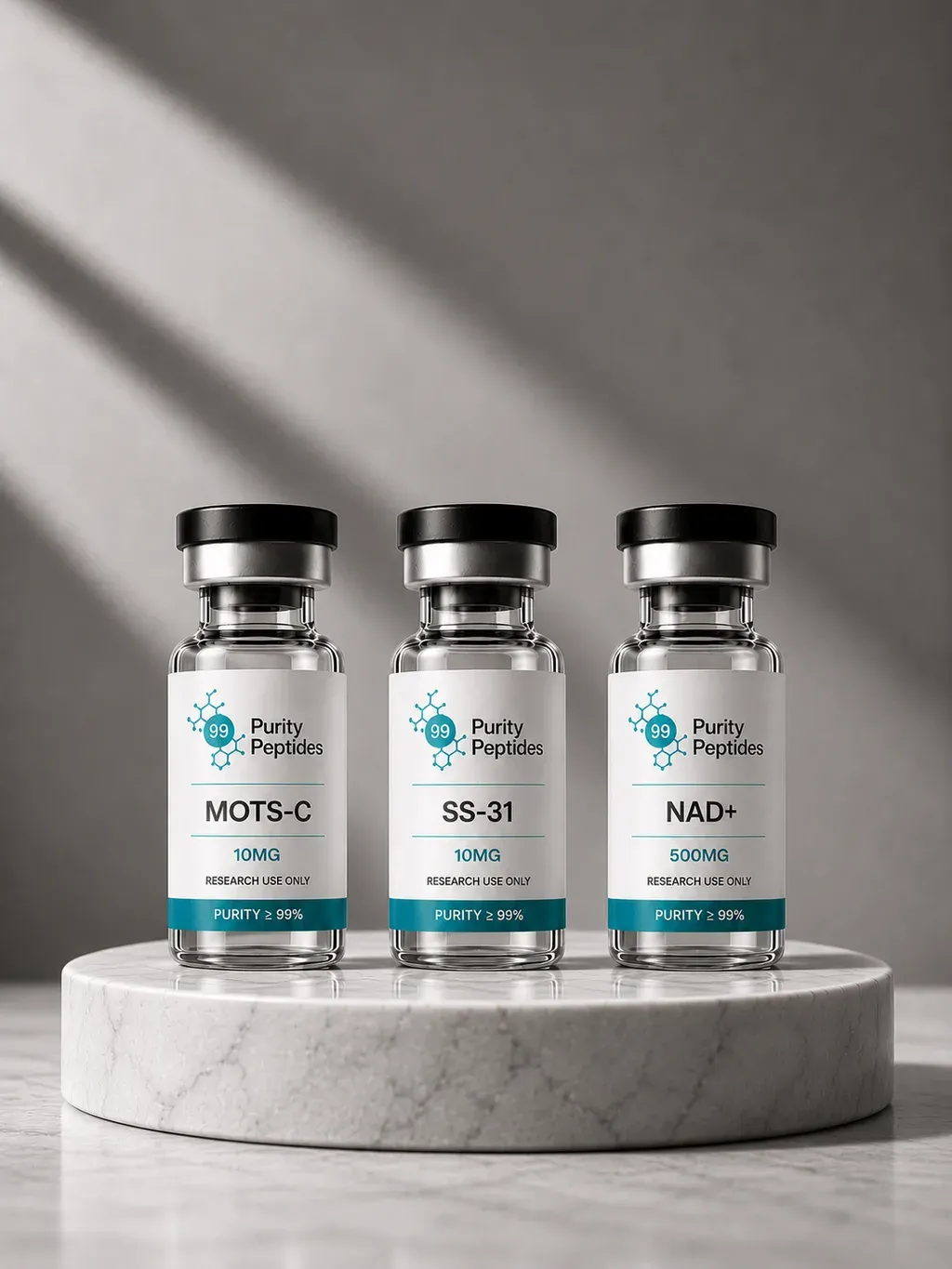
The Mitochondrial Research Panel supplies three compounds examined at different levels of mitochondrial function: MOTS-c at 10 mg, a peptide encoded in mitochondrial DNA; SS-31 at 10 mg, a synthetic peptide associating with the inner mitochondrial membrane; and NAD+ at 500 mg, a dinucleotide coenzyme central to electron transport. NAD+ is not a peptide, and the panel spans signal, membrane and substrate rather than one mechanism. For research use only.

Este Kit Incluye
In StockEnvío estándar gratis en pedidos de más de $300
1
Guaranteed Safe Checkout
Pay
Pay
PayPal
Zelle
VISA
AMEX
mastercard
+ more
Envío Rápido
99% Pureza
Probado por Terceros
Garantizado
99.9
Perfil del Compuesto

La
Ciencia.

≥99%

Certificado por HPLC

Pureza Verificada

Terceros

Análisis independiente

Probado en Laboratorio

Investigación

El más alto estándar

Calidad de Grado

COA

Trazabilidad completa

Documentado
Mitochondrial Research Panel
Product Profile

Overview

The Mitochondrial Research Panel brings together three compounds relevant to mitochondrial research at three different levels of description.

MOTS-c is a sixteen-residue peptide encoded within mitochondrial DNA, studied as a retrograde signal from mitochondrion to nucleus. SS-31, also known as elamipretide, is a synthetic tetrapeptide studied for its association with cardiolipin at the inner mitochondrial membrane. NAD+ is neither — it is a dinucleotide coenzyme, containing no amino acids and no peptide bonds, and functions as the redox carrier feeding the electron transport chain.

That structure is the panel’s rationale: a regulatory signal, a membrane environment, and a substrate. Three levels at which the same organelle can be examined, rather than three components of one mechanism. No synergy between them has been established, and no published study has examined the three together.

Two points matter for study design. First, the masses are not matched and cannot meaningfully be — compared on a molar basis, the three compounds differ by more than two orders of magnitude, because a stoichiometric cofactor and a signalling peptide are not comparable by mass. Second, supplying NAD+ to a system is not the same as raising mitochondrial NAD+, since NAD+ pools are compartmentalised and extracellular NAD+ does not readily cross membranes intact.

For Research Use Only. Not intended for human consumption, therapeutic use, veterinary use, or diagnostic applications.

The Mitochondrial Research Panel is a three-vial set containing MOTS-c (10 mg), SS-31 (10 mg) and NAD+ (500 mg). MOTS-c is a peptide encoded in mitochondrial DNA; SS-31 is a synthetic peptide associating with the inner mitochondrial membrane; NAD+ is a dinucleotide coenzyme, not a peptide. The panel spans signal, membrane and substrate rather than representing a single mechanism.

Key Takeaways

  • The Mitochondrial Research Panel contains MOTS-c at 10 mg, SS-31 at 10 mg and NAD+ at 500 mg, supplied lyophilized.
  • NAD+ is a dinucleotide coenzyme rather than a peptide; it contains no amino acids and no peptide bonds.
  • The three compounds represent three levels of mitochondrial function — a regulatory signal, a membrane environment, and a redox substrate.
  • The masses are not matched and cannot meaningfully be, since a stoichiometric cofactor and a signalling peptide differ by orders of magnitude on a molar basis.
  • Supplying NAD+ to a system is not equivalent to raising mitochondrial NAD+, because NAD+ pools are compartmentalised within the cell.
  • No published study has examined these three compounds together, and all are supplied strictly for laboratory research.

What’s Included in This Research Panel

CompoundMassMolecular classLevel examinedWhy it is included
MOTS-c10 mgPeptide, 16 residues, mtDNA-encodedSignallingMitochondrial-derived peptide studied as an outbound regulatory signal
SS-3110 mgPeptide, 4 residues, syntheticMembraneStudied for association with cardiolipin at the inner mitochondrial membrane
NAD+500 mgDinucleotide coenzyme — not a peptideSubstrateRedox carrier central to electron transport chain function

All three are supplied as lyophilized material with batch documentation.

NAD+ Is Not a Peptide

NAD+ — nicotinamide adenine dinucleotide — is a dinucleotide coenzyme. It consists of two nucleotides joined through a pyrophosphate bridge. It contains no amino acids, no peptide bonds, and belongs to a different molecular class than MOTS-c and SS-31 entirely.

This is stated first because NAD+ is routinely listed alongside research peptides, and search queries such as “NAD+ research peptide” reflect a misclassification that vendors reproduce rather than correct.

The distinction has practical consequences rather than being a terminological point:

  • Purity means something different. Peptide purity assessment addresses truncated sequences, deletion products and oxidation. A dinucleotide’s impurity profile concerns different degradation products entirely.
  • Storage failure modes differ. Peptides degrade through routes including oxidation, hydrolysis and aggregation. NAD+ is subject to pyrophosphate hydrolysis, a distinct chemical vulnerability.
  • Mass comparison is misleading. A coenzyme functioning stoichiometrically is not comparable by mass to a signalling peptide.

A researcher who treats NAD+ as a peptide will apply the wrong specification checks to it. See also the glutathione and NAD+ comparison.

Why These Three Compounds Are Grouped Together

The three compounds relate to mitochondrial function at three different levels rather than through a shared mechanism.

LevelCompoundWhat it represents
SignalMOTS-cA regulatory output of the organelle, encoded in mitochondrial DNA and acting outward on nuclear gene expression
StructureSS-31The membrane environment, through association with cardiolipin at the inner mitochondrial membrane
SubstrateNAD+The redox currency the electron transport chain operates on

These are three levels of description, not three parts of one mechanism. A signalling peptide, a membrane-associating peptide and a redox cofactor are studied with different methods and measured against different endpoints.

No synergy between the three has been established, and none is claimed here. The panel supplies materials relevant to a common research area, not a validated combination.

Where SS-31 and NAD+ relate to the same system

One connection is genuine and worth stating precisely.

NAD+ and its reduced form NADH are the electron donors feeding Complex I of the electron transport chain. That complex is embedded in the inner mitochondrial membrane — the same membrane whose organisation involves cardiolipin, the lipid SS-31 is studied for associating with.

So the two compounds relate to one system from different angles: SS-31 concerns the membrane environment in which the chain sits, NAD+ concerns the substrate supply feeding it. That describes a shared subject, not a demonstrated interaction.

How MOTS-c and SS-31 differMOTS-c is encoded within mitochondrial DNA and signals outward to the nucleus, while SS-31 is synthetic and is designed to move inward toward the inner membrane. They differ in origin, size, mechanism class and direction of action. The two-vial Mitochondrial Peptide Pair covers that comparison in full.
Aviso de InvestigaciónTodos los productos de cada categoría son únicamente para uso en investigación y no aptos para uso humano o veterinario, diagnóstico o tratamiento.
Sigue Explorando

También Considerado.

Mitochondrial Spray Pair

RESEARCH PEPTIDE

SS-31 and MOTS-c fall in different nasal absorption bands — one comfortably favourable, one considerably less so. The size gap is intrinsic to what each compound is.

Mitochondrial Spray Pair
From
$139.99

Copper Peptide Spray Comparator

RESEARCH PEPTIDE

Both copper tripeptides sit in the favourable nasal absorption range. Their published research is almost entirely topical, and no intranasal study bridges the two.

Copper Peptide Spray Comparator
From
$114.99

Neuropeptide Spray Comparator

RESEARCH PEPTIDE

10 mg is the bottle total, not the per-spray content. Both peptides sit under 1,000 Da, where nasal absorption is most favourable. Research use only.

Neuropeptide Spray Comparator
From
$109.99

Melanocortin Analog Comparator

RESEARCH PEPTIDE

Three analogs of one hormone across a five-receptor family. Linear, cyclic and a metabolite of the cyclic — compared by structure and receptor selectivity. RUO.

Melanocortin Analog Comparator
From
$134.99
Customer Reviews
0.0
0 Reviews
5
0
4
0
3
0
2
0
1
0
0 Reviews

No Reviews Yet

Be the first to share your experience with this product and help other researchers!
Educación e Investigación

Más Información.

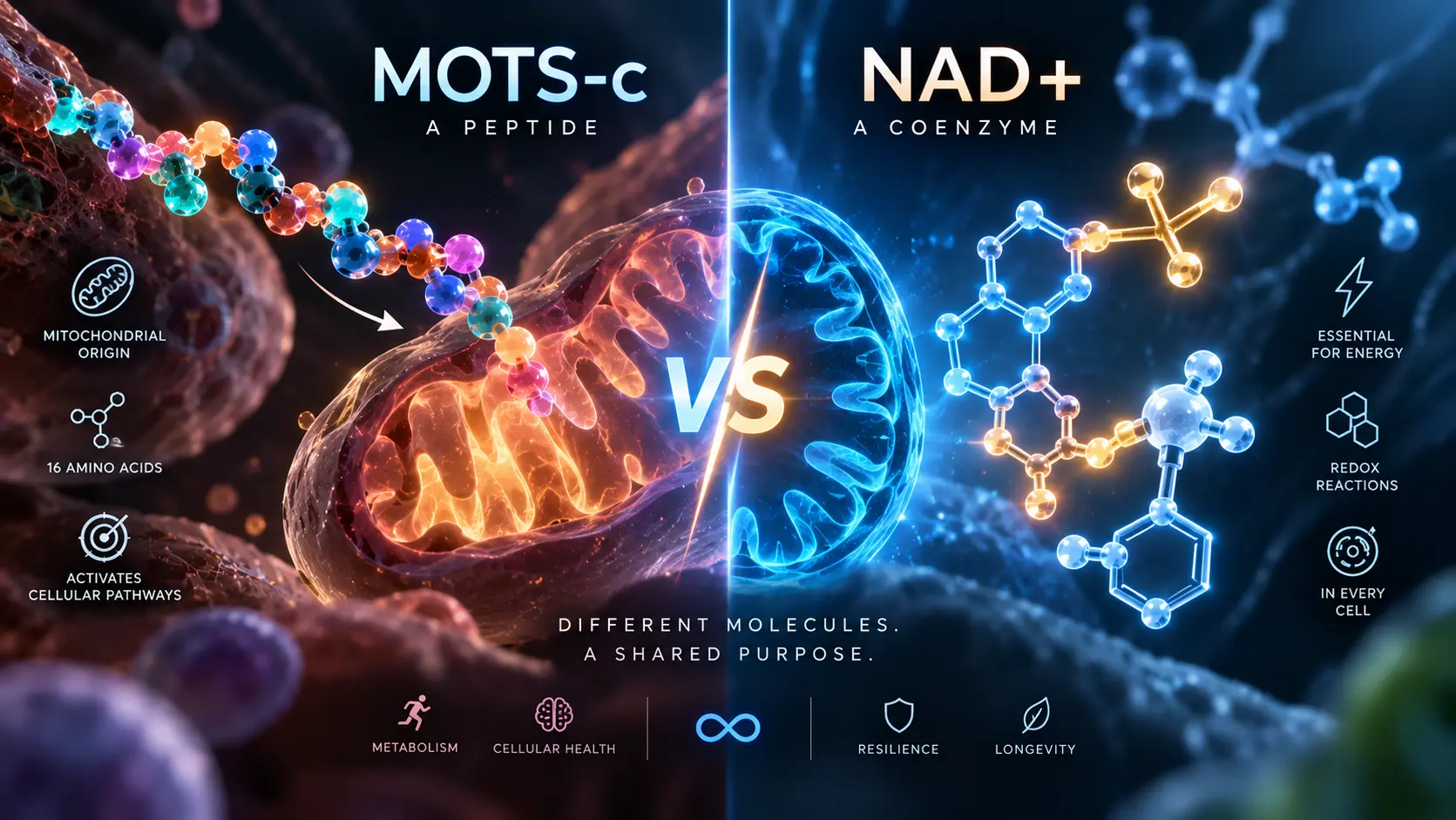
MOTS-c vs. NAD+: un péptido y una coenzima, comparados con honestidad
Product Guides
Sep 14, 20265 min read

MOTS-c vs. NAD+: un péptido y una coenzima, comparados con honestidad

MOTS-c vs. NAD+ comparados con honestidad: uno es péptido, el otro coenzima. Qué muestra la evidencia, y por qué el ensayo de MOTS-c 2026 debe verificarse.
MOTS-c y Humanin: Péptidos Mitocondriales Explicados
Product Guides
Jul 23, 20265 min read

MOTS-c y Humanin: Péptidos Mitocondriales Explicados

Investigación de MOTS-c y Humanin: cómo estos péptidos derivados de mitocondrias vinculan el metabolismo, el envejecimiento, y la supervivencia celular. Vea lo que realmente muestra la ciencia.

Aerosol nasal de GHK-Cu: ¿qué muestra realmente la investigación?
Product Guides
Oct 17, 20265 min read

Aerosol nasal de GHK-Cu: ¿qué muestra realmente la investigación?

Investigación sobre el aerosol nasal de GHK-Cu: tres estudios en ratones de un mismo laboratorio, sin datos en humanos y lo que aún se desconoce.

READ

(preguntas frecuentes)

Preguntas Frecuentes

01

What is included in the Mitochondrial Research Panel?

The panel includes MOTS-c at 10 mg, SS-31 at 10 mg and NAD+ at 500 mg, all supplied lyophilized with batch documentation. The three compounds relate to mitochondrial function at the signalling, membrane and substrate levels respectively. For research use only.
02

Is NAD+ a peptide?

No. NAD+ is a dinucleotide coenzyme, consisting of two nucleotides joined through a pyrophosphate bridge. It contains no amino acids and no peptide bonds. It is routinely listed alongside research peptides, but it belongs to a different molecular class than MOTS-c and SS-31.
03

Why is NAD+ sold alongside research peptides?

NAD+ is grouped with peptides by research area rather than by molecular class — all three compounds in this panel are relevant to mitochondrial research. The grouping is commercial convention, not chemistry, and NAD+ should be specified and handled as a coenzyme rather than as a peptide.
04

Does supplying NAD+ raise mitochondrial NAD+?

Not straightforwardly. Extracellular NAD+ does not readily cross cell membranes intact, and cells maintain distinct cytosolic, nuclear and mitochondrial NAD+ pools that are not freely interchangeable. Study designs assuming a single cellular NAD+ level may measure something different from what they intend.
05

Why is the NAD+ vial so much larger than the peptide vials?

Because mass parity across molecular classes is not equivalence. A coenzyme participating stoichiometrically in redox reactions is required in far greater molar quantity than a signalling peptide. At the masses supplied, the panel contains roughly 160 times more NAD+ than MOTS-c on a molar basis.
06

How do the three compounds relate to each other?

They represent three levels at which mitochondrial function can be examined: MOTS-c as a regulatory signal, SS-31 as a membrane-associating compound, and NAD+ as a redox substrate. This is a structure of description rather than a mechanism, and no synergy between them has been established.
07

How does this panel differ from the two-vial Mitochondrial Peptide Pair?

The pair contains MOTS-c and SS-31 and addresses how those two peptides differ mechanistically. This panel adds NAD+, which is a coenzyme rather than a peptide, extending the set from two peptides to three levels of mitochondrial description.
08

Have these three compounds been studied together?

No published study has examined MOTS-c, SS-31 and NAD+ together. Research exists on each individually, at very different evidence stages. Any expectation about combined behaviour is an extrapolation rather than a reported finding.
09

Is SS-31 the same as elamipretide?

Yes. SS-31, elamipretide and MTP-131 refer to the same compound. Elamipretide received FDA accelerated approval in September 2025 for a rare genetic condition. Material supplied here is research-grade and is not that approved pharmaceutical product.
10

Is NAD+ an approved drug?

No. NAD+ is a naturally occurring metabolite present in all cells and is not an approved drug. Material supplied here is research-grade and is not a supplement, food ingredient or medicinal product, and no therapeutic use is described for it.
11

Why does salt form matter for this panel?

Salt form determines molecular weight, and therefore how many moles a given mass contains. NAD+ is often supplied as a disodium salt and SS-31 as an acetate or trifluoroacetate salt, both of which lower the molar amount per milligram. For molar comparisons, salt form must be confirmed on the certificate.
12

Can purity figures be compared across the three compounds?

No. Peptide purity assessment addresses truncated sequences, deletion products and oxidation, while a dinucleotide's impurity profile involves different degradation products assessed by different methods. Each certificate should be reviewed on its own terms rather than compared across classes.
13

Do the three compounds require different storage?

All three are supplied lyophilized and can reasonably be stored under the same conditions, but they degrade through different routes. Peptides are subject to oxidation, hydrolysis and aggregation; NAD+ is separately subject to pyrophosphate hydrolysis. Equivalent storage does not imply equivalent stability.
14

Can these compounds be used on humans or animals?

No. All three are supplied for laboratory research only. They are not intended for human consumption, therapeutic use, veterinary use, or diagnostic applications, and no dosing, protocol or administration guidance is provided for them.