99Purity Peptides
Tienda
Categorías
COAsNosotrosBlogPreguntasContactoAfiliados
Comprar Ahora
Navegación
Top Formulations
View All in Category

Listo para elevar tu investigación.
Explora nuestro catálogo completo.

Explorar Catálogo
Category
Vial
Vial on Ice
Purity
Identity
99 Purity Peptides Logo

Purity You Can Trust.

Setting the gold standard in peptide synthesis with verified HPLC/MS testing for uncompromised results.

Stay ahead of the curve. Join 5,000+ top-tier labs getting exclusive formulations, early drop access, and breakthrough research news.

Explorar

  • Inicio
  • Nosotros
  • Tienda
  • Blog
  • Preguntas Frecuentes
  • COAs
  • Shipping Locations
  • Afiliados

Contacto

orders@99puritypeptides.com
support@99puritypeptides.com
+1 (843) 330-7365
@99puritypeptide

Contáctanos

Comunícate con nuestro equipo de soporte

Ver Catálogo

Ver todos los péptidos de investigación

99purity

Aviso Legal:El contenido de este sitio web no ha sido evaluado ni aprobado por la Administración de Alimentos y Medicamentos de EE. UU. (FDA). Los productos vendidos por 99 Purity Peptides se ofrecen únicamente con fines de investigación y laboratorio, y no están destinados a diagnosticar, tratar, curar o prevenir ninguna enfermedad. 99 Purity Peptides no es una farmacia de preparación magistral y no opera como una instalación de composición química según lo definido en la Sección 503A de la Ley Federal de Alimentos, Medicamentos y Cosméticos. Los productos no son para uso humano ni veterinario, y no están destinados a la ingestión, inyección ni ninguna forma de administración. Los niveles de pureza pueden variar según el producto y el lote; ciertos artículos pueden mostrar una pureza inferior al 99%.

Pay
Pay
PayPal
Zelle
VISA
AMEX
mastercard
+ more
99Purity Peptides © 2026·Política de Privacidad·Términos de Servicio·Política de Reembolso·Política de Uso en Investigación·Política de Envío·Aviso Médico·Política de Correcciones
Diseñado y Desarrollado por Belk Digital
Vista del producto 1
InicioTiendaPeptide BundlesGHRH Analog Comparator
Peptide Bundles

GHRH Analog Comparator

$204.99

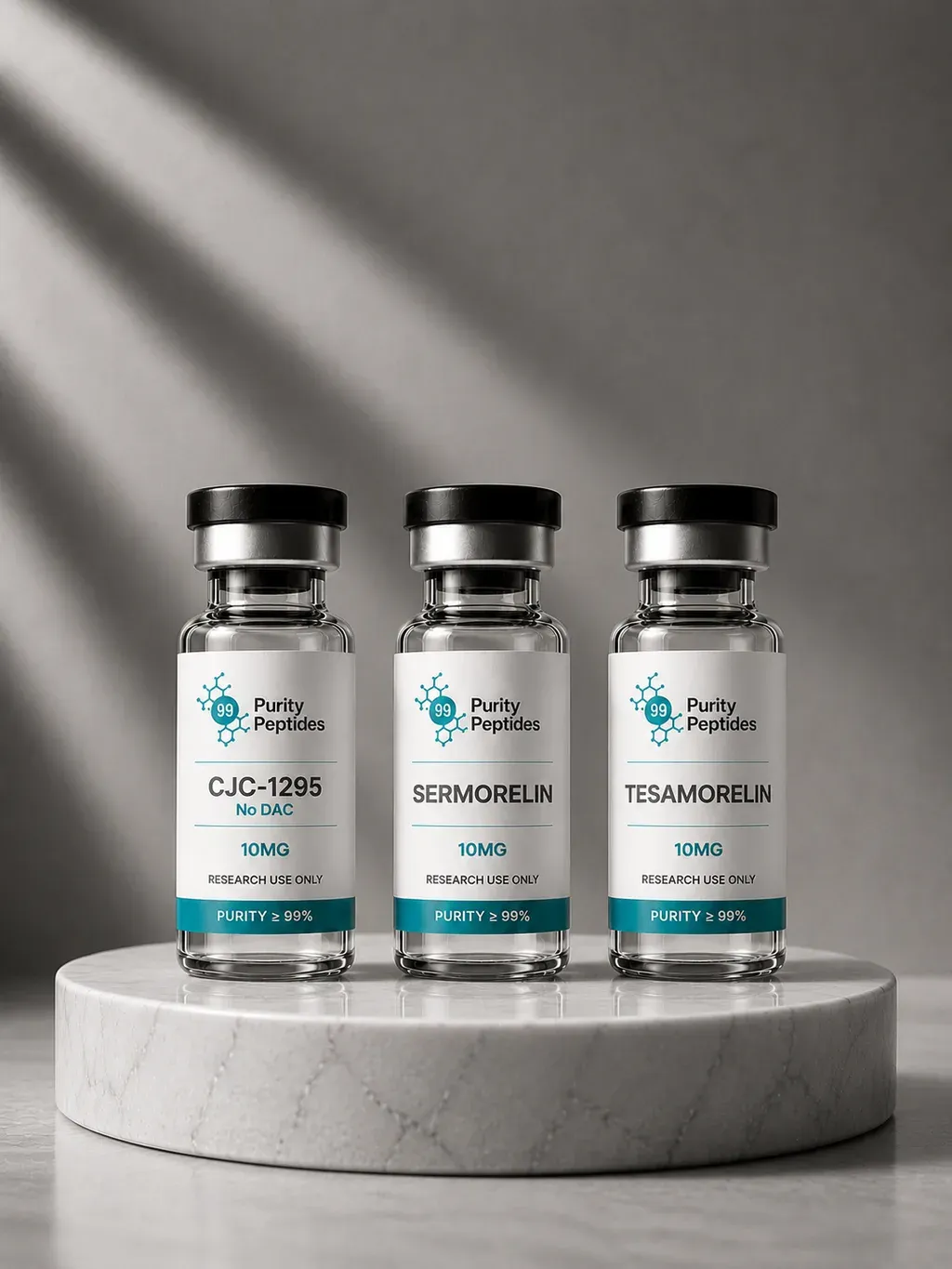
The GHRH Analog Comparator supplies three growth hormone-releasing hormone analogs at 10 mg each: sermorelin, the unmodified GHRH(1-29) sequence; CJC-1295 No DAC, the same sequence with four stabilising amino acid substitutions; and tesamorelin, the full-length GHRH(1-44) sequence with an N-terminal acyl group. All three act at the same receptor, so the set isolates modification strategy as the variable. For research use only.

Este Kit Incluye
In StockEnvío estándar gratis en pedidos de más de $300
1
Guaranteed Safe Checkout
Pay
Pay
PayPal
Zelle
VISA
AMEX
mastercard
+ more
Envío Rápido
99% Pureza
Probado por Terceros
Garantizado
99.9
Perfil del Compuesto

La
Ciencia.

≥99%

Certificado por HPLC

Pureza Verificada

Terceros

Análisis independiente

Probado en Laboratorio

Investigación

El más alto estándar

Calidad de Grado

COA

Trazabilidad completa

Documentado
GHRH Analog Comparator
Product Profile

Overview

The GHRH Analog Comparator brings together three analogs of growth hormone-releasing hormone at matched 10 mg mass. All three are agonists at the same receptor, which makes the set a comparison of modification strategy rather than of mechanism.

Native GHRH is proteolytically fragile, cleaved rapidly in plasma with dipeptidyl peptidase-4 acting at the N-terminus as a principal route. Each compound in this set represents a different response to that problem.

Sermorelin is GHRH(1-29) in amidated form — the native sequence, unmodified, and the reference against which the others are understood. CJC-1295 No DAC, also known as Mod GRF 1-29, is the same 29-residue sequence carrying four amino acid substitutions, each addressing a specific degradation route. Tesamorelin takes a different approach on two counts: it uses the full 44-residue GHRH sequence rather than the truncated form, and it carries a trans-3-hexenoyl group attached at the N-terminus rather than altering the sequence itself.

One point matters for study design. Tesamorelin is roughly fifty percent larger than the other two, so equal masses do not supply equal molar amounts. At 10 mg each, the two GHRH(1-29) analogs are closely matched on a molar basis while tesamorelin supplies approximately a third fewer moles.

All three vials are supplied lyophilized with batch documentation.

For Research Use Only. Not intended for human consumption, therapeutic use, veterinary use, or diagnostic applications.

The GHRH Analog Comparator is a three-vial set containing sermorelin, CJC-1295 No DAC and tesamorelin at 10 mg each. All three are agonists at the growth hormone-releasing hormone receptor, so mechanism is held constant. What differs is how each is stabilised against proteolytic cleavage: sermorelin is unmodified, CJC-1295 No DAC carries four amino acid substitutions, and tesamorelin carries an N-terminal acyl group.

Key Takeaways

  • The GHRH Analog Comparator contains sermorelin, CJC-1295 No DAC and tesamorelin, all at 10 mg, supplied lyophilized.
  • All three compounds are agonists at the same GHRH receptor, so the set isolates modification strategy rather than comparing mechanisms.
  • Sermorelin is the unmodified GHRH(1-29) sequence and functions as the reference compound in the set.
  • CJC-1295 No DAC, also called Mod GRF 1-29, carries four amino acid substitutions, each addressing a specific degradation route.
  • Tesamorelin uses the full-length GHRH(1-44) sequence with an N-terminal trans-3-hexenoyl group, differing from the other two in both length and modification type.
  • All three are supplied strictly for laboratory research and are not intended for human consumption, therapeutic use, veterinary use, or diagnostic applications.

What’s Included in This Research Set

CompoundMassAlso known asSequence basisModification
Sermorelin10 mgGRF(1-29), GHRH(1-29)GHRH(1-29), amidatedNone — native sequence
CJC-1295 No DAC10 mgMod GRF 1-29, Modified GRF (1-29)GHRH(1-29)Four amino acid substitutions
Tesamorelin10 mg—GHRH(1-44)N-terminal trans-3-hexenoyl group

All three vials are supplied as lyophilized powder with batch documentation.

One Receptor, Three Modification Strategies

The three compounds in this set share a receptor. They differ in how each is stabilised, which is what makes them useful held together.

The problem all three address: proteolytic cleavage

Native growth hormone-releasing hormone is short-lived in plasma. Dipeptidyl peptidase-4 cleaves it near the N-terminus, and additional proteolytic routes contribute to its rapid degradation. Any GHRH analog intended for extended study has to address that fragility.

The three compounds here represent three distinct engineering answers: leave the sequence alone, alter the sequence, or attach something to it.

Sermorelin — the unmodified reference

Sermorelin is GHRH(1-29) in amidated form: the first twenty-nine residues of human growth hormone-releasing hormone, unaltered. The 1-29 fragment retains receptor activity, which is why the truncated sequence is used rather than the full molecule.

Because it is unmodified, sermorelin carries the native sequence’s proteolytic vulnerability in full. That is precisely what makes it valuable in a comparator set — it is the baseline against which the other two modifications are measured. A comparison of engineered analogs without the unmodified parent has no reference point. See how sermorelin and CJC-1295 compare.

CJC-1295 No DAC — four targeted substitutions

CJC-1295 No DAC is the same GHRH(1-29) sequence as sermorelin, carrying four amino acid substitutions. The compound is also known as Mod GRF 1-29 and Modified GRF (1-29) — these names refer to the same material, not to different compounds.

The four substitutions are not arbitrary. Each addresses a specific degradation route:

  • D-alanine at position 2 — resists dipeptidyl peptidase-4 cleavage
  • Glutamine at position 8 — resists asparagine deamidation
  • Alanine at position 15 — associated with enhanced potency
  • Leucine at position 27 — removes an oxidation-prone methionine residue

Four modifications, four failure modes addressed. This is sequence engineering: the peptide itself is altered, and nothing is attached to it.

Tesamorelin — acylation, and the full-length sequence

Tesamorelin differs from the other two on two counts rather than one.

Sequence length. Tesamorelin is based on GHRH(1-44) — the full forty-four residue sequence — rather than the 1-29 fragment. It is therefore roughly fifty percent larger than the other two compounds in this set.

Modification type. Rather than substituting residues, tesamorelin carries a trans-3-hexenoyl group attached at the N-terminal tyrosine. The sequence is left intact and a chemical group is added to protect the vulnerable terminus.

That makes tesamorelin the clearest contrast in the set: a different stabilisation approach applied to a different starting sequence. See how tesamorelin and sermorelin compare.

DAC and No DAC: what the distinction meansDAC stands for Drug Affinity Complex — a chemical linker that binds covalently to serum albumin, so a DAC-bearing peptide remains in circulation far longer than one without. CJC-1295 with DAC and CJC-1295 without DAC are therefore different compounds. This set contains the No DAC form. Published studies of CJC-1295 frequently examined the DAC-bearing version, so data describing extended circulation generally does not describe the material in this set. The DAC form is listed separately.
Aviso de InvestigaciónTodos los productos de cada categoría son únicamente para uso en investigación y no aptos para uso humano o veterinario, diagnóstico o tratamiento.
Sigue Explorando

También Considerado.

Mitochondrial Spray Pair

RESEARCH PEPTIDE

SS-31 and MOTS-c fall in different nasal absorption bands — one comfortably favourable, one considerably less so. The size gap is intrinsic to what each compound is.

Mitochondrial Spray Pair
From
$139.99

Copper Peptide Spray Comparator

RESEARCH PEPTIDE

Both copper tripeptides sit in the favourable nasal absorption range. Their published research is almost entirely topical, and no intranasal study bridges the two.

Copper Peptide Spray Comparator
From
$114.99

Neuropeptide Spray Comparator

RESEARCH PEPTIDE

10 mg is the bottle total, not the per-spray content. Both peptides sit under 1,000 Da, where nasal absorption is most favourable. Research use only.

Neuropeptide Spray Comparator
From
$109.99

Melanocortin Analog Comparator

RESEARCH PEPTIDE

Three analogs of one hormone across a five-receptor family. Linear, cyclic and a metabolite of the cyclic — compared by structure and receptor selectivity. RUO.

Melanocortin Analog Comparator
From
$134.99
Customer Reviews
0.0
0 Reviews
5
0
4
0
3
0
2
0
1
0
0 Reviews

No Reviews Yet

Be the first to share your experience with this product and help other researchers!

Educación e Investigación

Más Información.

Bundles de Péptidos de Investigación: Cómo Comprobar si el Precio Es un Ahorro Real
Product Guides
Oct 5, 20265 min read

Bundles de Péptidos de Investigación: Cómo Comprobar si el Precio Es un Ahorro Real

Cómo comprobar si un bundle de péptidos es realmente más barato: divida entre los miligramos totales, compare viales sueltos el mismo día y lea el COA.
CJC-1295, Sermorelina y Tesamorelina: Tres Análogos de GHRH, Tres Posiciones Regulatorias
Product Guides
Oct 5, 20265 min read

CJC-1295, Sermorelina y Tesamorelina: Tres Análogos de GHRH, Tres Posiciones Regulatorias

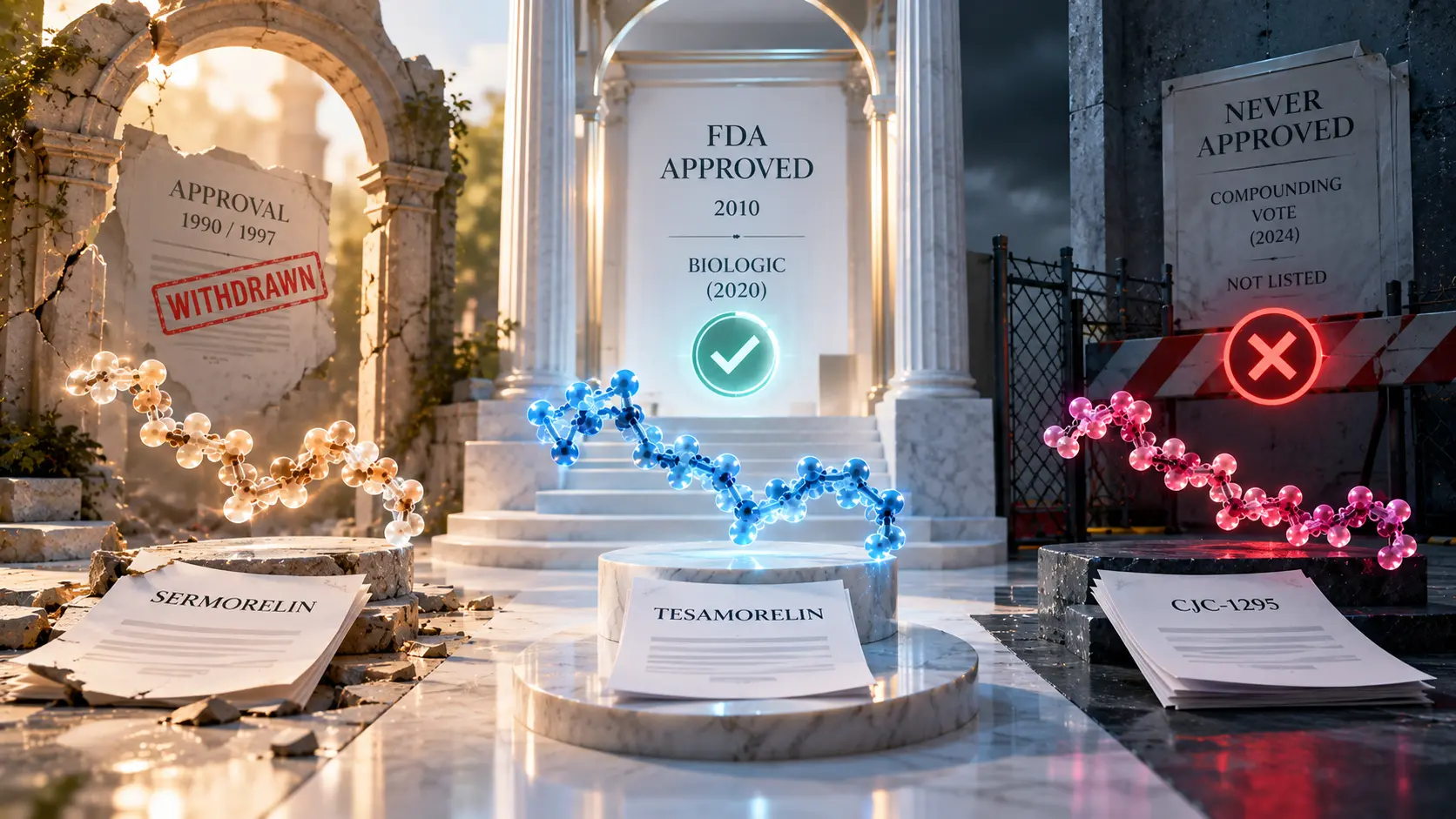
¿Son legales la sermorelina, la tesamorelina y el CJC-1295? Registros de la FDA, Registro Federal, DEA y WADA: uno aprobado, uno retirado, uno nunca aprobado.

Aerosol nasal de GHK-Cu: ¿qué muestra realmente la investigación?
Product Guides
Oct 17, 20265 min read

Aerosol nasal de GHK-Cu: ¿qué muestra realmente la investigación?

Investigación sobre el aerosol nasal de GHK-Cu: tres estudios en ratones de un mismo laboratorio, sin datos en humanos y lo que aún se desconoce.

READ

(preguntas frecuentes)

Preguntas Frecuentes

01

What is included in the GHRH Analog Comparator?

The set includes sermorelin, CJC-1295 No DAC and tesamorelin, each at 10 mg, supplied as lyophilized vials with batch documentation. All three are analogs of growth hormone-releasing hormone acting at the same receptor. For research use only.
02

What is the difference between sermorelin, CJC-1295 and tesamorelin?

All three act at the GHRH receptor and differ in how they are stabilised. Sermorelin is the unmodified GHRH(1-29) sequence. CJC-1295 No DAC is that sequence with four amino acid substitutions. Tesamorelin uses the full-length GHRH(1-44) sequence with an N-terminal acyl group.
03

Do all three compounds act on the same receptor?

Yes. All three are agonists at the growth hormone-releasing hormone receptor, a class B G protein-coupled receptor signalling through Gs, adenylate cyclase, cAMP, PKA and CREB. Receptor target is held constant across the set, which is why the comparison isolates structural modification.
04

What does DAC mean in CJC-1295?

DAC stands for Drug Affinity Complex, a chemical linker that binds covalently to serum albumin. Because albumin circulates for an extended period, a DAC-bearing peptide persists far longer than one without. This set contains the No DAC form, which does not carry that linker.
05

Is CJC-1295 No DAC the same as Mod GRF 1-29?

Yes. CJC-1295 No DAC, Mod GRF 1-29, Modified GRF (1-29) and "CJC-1295 without DAC" all refer to the same compound — the GHRH(1-29) sequence carrying four amino acid substitutions. Researchers encountering these names in separate sources are reading about one material.
06

What are the four substitutions in Mod GRF 1-29?

D-alanine at position 2, resisting dipeptidyl peptidase-4 cleavage; glutamine at position 8, resisting asparagine deamidation; alanine at position 15, associated with enhanced potency; and leucine at position 27, removing an oxidation-prone methionine. Each addresses a specific degradation route.
07

Why is sermorelin included if it is unmodified?

Because a comparison of engineered analogs requires the unmodified parent as a reference. Sermorelin carries the native sequence's proteolytic vulnerability in full, which is what makes it the baseline against which the effect of each modification strategy can be assessed.
08

Why is tesamorelin longer than the other two?

Tesamorelin is based on the full 44-residue GHRH sequence, while sermorelin and CJC-1295 No DAC use the truncated 29-residue fragment. The 1-29 fragment retains receptor activity, which is why it is commonly used; tesamorelin takes the alternative approach of retaining the full sequence.
09

Is GHRH(1-29) or GHRH(1-44) the full sequence?

GHRH(1-44) is the full-length sequence. GHRH(1-29) is a truncated fragment that retains receptor activity, which is why many analogs are built on it. Tesamorelin is the compound in this set using the full-length form.
10

Do the three vials contain equal molar amounts?

No. All three contain 10 mg, but tesamorelin is roughly fifty percent larger by molecular weight, so it supplies approximately a third fewer moles. The two GHRH(1-29) analogs are closely matched. For receptor comparisons, molar equivalence should be calculated rather than assumed from mass.
11

Is tesamorelin FDA approved?

Tesamorelin is the active ingredient in an FDA-approved product. The research material supplied here is not that product and carries no approved indication and is not manufactured or released to pharmaceutical standards.
12

Does published CJC-1295 research describe the No DAC form?

Frequently not. Much published CJC-1295 data examined the DAC-bearing version, particularly studies reporting extended circulation. Applying that data to the No DAC compound in this set would misstate it, and source material should be checked for which form was studied.
13

Have all three compounds been compared head to head?

No published study has compared the three under matched conditions. Research exists on each individually and on some pairings. This set supplies materials for such a comparison rather than reflecting a published one.
14

What should be verified on the certificates of analysis?

Confirm identity by mass spectrometry, purity, salt form and lot number for each vial. Identity confirmation matters particularly because sermorelin and CJC-1295 No DAC share twenty-five of twenty-nine residues, a difference a purity assay alone will not resolve.
15

Can these compounds be used on humans or animals?

No. All three vials are supplied for laboratory research only. They are not intended for human consumption, therapeutic use, veterinary use, or diagnostic applications, and no dosing, protocol or administration guidance is provided for them.