Quick Answer
To check a bundle, divide its price by the total milligrams of every component. Then add up the single-vial prices for the same components, on the same day, and divide by the same milligrams. The lower figure is cheaper per milligram. However, price per milligram measures cost only. It says nothing about purity or quality.
A research peptide bundles price is easy to read and hard to judge. The product page shows one number, while the value depends on three others: how many milligrams you receive, what those vials cost separately, and what the documentation proves. This guide gives you a repeatable method. It also works three live examples from our own catalogue, with prices dated 5 October 2026, so you can see the arithmetic rather than take a savings claim on trust.
Key Takeaways
- Price per milligram equals the bundle price divided by the total milligrams of all components.
- A fair comparison uses single-vial prices for the same components, captured on the same date.
- On 5 October 2026, all three worked examples cost less as bundles than the matching vials bought separately: $14.99 less (BPC/TB), $29.98 less (KLOW) and $19.98 less (GHRH).
- The saving is about 9 to 11 percent of the single-vial total, and it disappears for anyone who needs only one component of a bundle.
- Discounts that apply only to single vials can reverse the result, so compare final checkout totals.
- Price per milligram does not measure purity, identity or actual vial content. The certificate of analysis is the check for those.
Research Use Only
Every compound discussed here is supplied for laboratory research use only. None is intended for human or veterinary consumption, diagnosis or treatment. This page covers price arithmetic and documentation checks. It gives no use, dosing, preparation or administration information.
Research Peptide Bundles Price: How Do You Check It Yourself?
First, gather four things: the bundle price, the stated mass of each component, the price of each matching single vial and the date. With those in hand, the check takes about five minutes.
- Record the date. Prices change. As a result, a comparison only holds when every price comes from the same day.
- Write down the bundle price. Specifically, use the price on the product page, not a banner or a "from" figure on a listing.
- List every component and its stated mass. Take these from the product description, rather than the product name. For blends, note the mass of each compound inside the vial.
- Add the total milligrams. Sum every component across every vial in the bundle.
- Calculate the bundle price per milligram. Divide the bundle price by the total milligrams.
Then price the same components as single vials
- Find the matching single vials. Match compound, mass and format exactly. For example, a 10 mg vial is not a match for a 5 mg vial.
- Add the single-vial prices. Then divide that sum by the same total milligrams.
- Compare the two figures. In addition, compare the totals in dollars, since that is what you actually pay.
- Check what changes at checkout. After all, shipping, discounts and payment fees can move the final number.
How Do You Calculate Price per Milligram?
The formula is simple: price ÷ total milligrams = price per milligram. For example, a $204.99 bundle containing three 10 mg vials holds 30 mg in total. Therefore, its price per milligram is $204.99 ÷ 30, which is about $6.83.
Blends, however, need one extra step. A blend vial lists several masses, and you add all of them. For instance, a vial labelled "5/5 mg" in BPC-157/TB-500 notation holds 5 mg of each compound. In other words, that makes 10 mg in total, not 5 mg. Reading the label as a single figure halves the true mass and doubles the apparent price per milligram.
Finally, round only at the end. Rounding each step can shift the result by a cent or two, which matters when two options are close.
Is a Peptide Bundle Cheaper Than Single Vials?
Sometimes, and you can check each case.
Worked examples, priced 5 October 2026
The table below applies the method to three bundles. All prices were read from live product pages on 5 October 2026. Single-vial prices are for one vial at the matching size, before any discount.
Bundle | Bundle price | Component milligrams (from product description) | Bundle price per total mg | Sum of single-vial prices, same components | Difference |
|---|---|---|---|---|---|
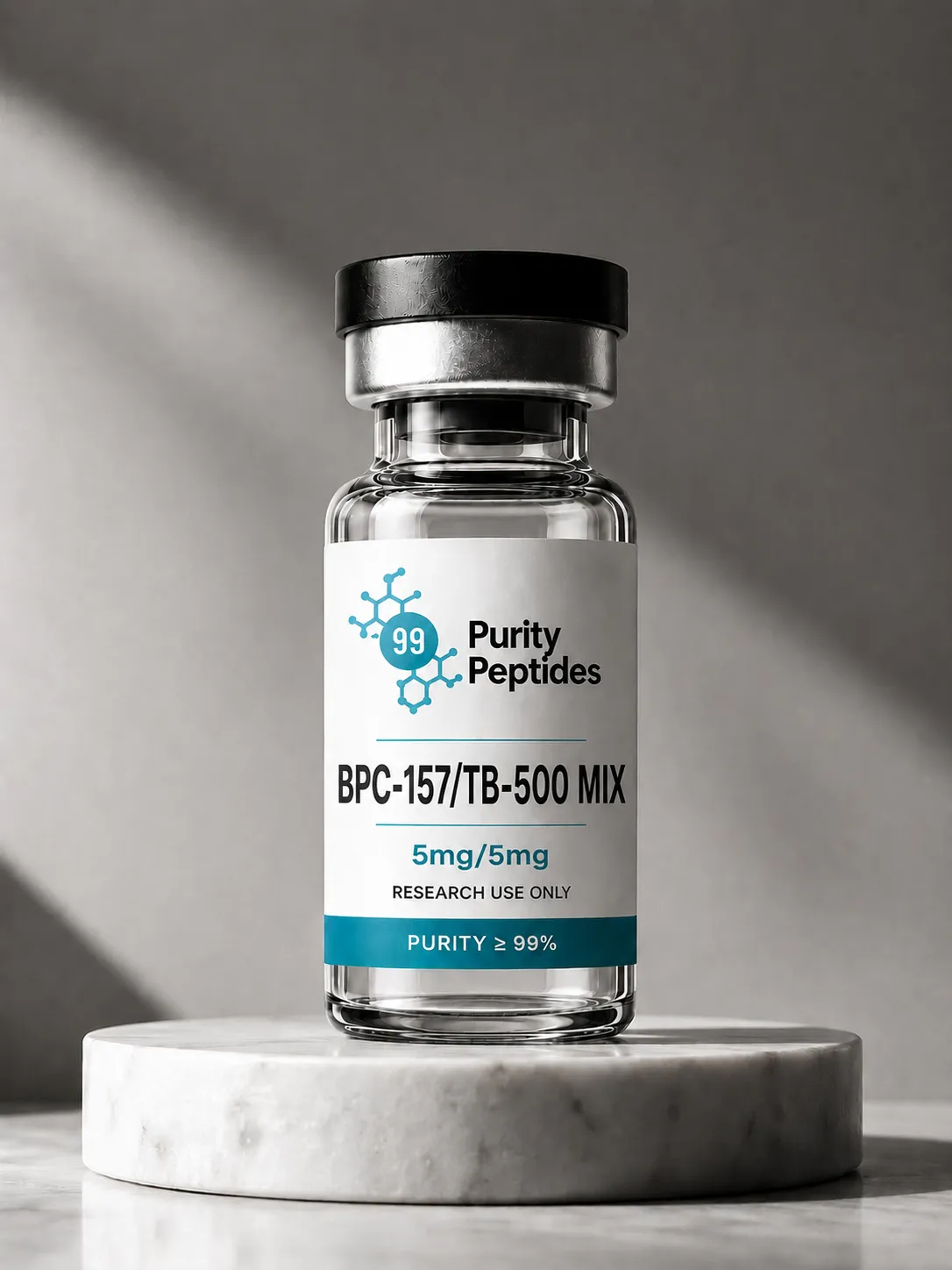
BPC/TB Blend Strength Comparator | $149.99 | One 5/5 mg vial (10 mg) + one 10/10 mg vial (20 mg) = 30 mg | $5.00 | $69.99 (5/5 mg) + $94.99 (10/10 mg) = $164.98 ($5.50 per mg) | Bundle $14.99 lower (9.1%) |
KLOW Component-Control Set | $234.99 | GLOW 70 mg + KPV 10 mg + KLOW 80 mg = 160 mg | $1.47 | $94.99 + $59.99 + $109.99 = $264.97 ($1.66 per mg) | Bundle $29.98 lower (11.3%) |
GHRH Analog Comparator | $204.99 | Sermorelin 10 mg + CJC-1295 No DAC 10 mg + tesamorelin 10 mg = 30 mg | $6.83 | $69.99 + $79.99 + $74.99 = $224.97 ($7.50 per mg) | Bundle $19.98 lower (8.9%) |
Prices in USD, captured 5 October 2026. Percentages are the difference divided by the sum of single-vial prices. Shipping is excluded.
What the three results show
All three bundles cost less than their parts on 5 October 2026, but by different margins. The BPC/TB saving is the smallest, at $14.99 on a $164.98 total. The break-even check still helps when one price is in doubt. For the BPC/TB set, the bundle is cheaper only if the 10/10 mg single costs more than $80.00 (the bundle price minus the 5/5 mg single). At the $94.99 single price, the bundle is $14.99 cheaper.
The BPC/TB set, step by step
The same method, applied to one bundle from start to finish:
- Date: 5 October 2026.
- Bundle price: $149.99, read from the product page.
- Components: one 5/5 mg vial (5 mg BPC-157 and 5 mg TB-500, 10 mg in total) and one 10/10 mg vial (20 mg in total), 30 mg in all.
- Bundle price per milligram: $149.99 ÷ 30 mg = $5.00.
- Single vials, same components: 5/5 mg at $69.99 and 10/10 mg at $94.99, a total of $164.98.
- Single-vial price per milligram: $164.98 ÷ 30 mg = $5.50.
- Difference: $164.98 − $149.99 = $14.99, or 9.1% of the single-vial total.
- Checkout: no discount applied, and shipping excluded.
The bundle wins on this date, but only by a few dollars per vial. A buyer who needs only the 5/5 mg vial would find that the bundle is not cheaper at all.
When the answer reverses
A discount on single vials can flip the result. Verified service members and veterans can request a one-time 20% discount on single peptides, which excludes kits and bundles. Applied to the GHRH singles, 20% off gives $179.98, which is $25.01 less than the $204.99 bundle, so the singles win. Applied to the KLOW singles, 20% off gives $211.98, which is $23.01 less than the $234.99 bundle, so the singles win again. A buyer who qualifies should compare the discounted singles with the bundle, not the list prices. In short, compare final checkout totals, not list prices.
What Does Price per Milligram Not Tell You?
Price per milligram is a cost figure. It is useful; still, it hides several things that matter more to a study.
Different vial sizes break the match
A 10 mg vial and a 20 mg vial of the same compound often carry different prices per milligram. As a result, comparing a bundle against the wrong size gives a false answer. So always match the exact mass in the bundle.
Total-mass averaging blurs the components
A single price per total milligram treats every milligram as equal. However, components rarely cost the same to make. In the KLOW set, for instance, 100 of the 160 milligrams are GHK-Cu, split across the two blends. So the average says little about what you pay for KPV, the 10 mg compound that defines the set.
Equal mass is not equal amount
Milligrams measure weight, not the number of molecules. Tesamorelin has 44 amino acids, against 29 for sermorelin. So 10 mg of tesamorelin contains fewer molecules than 10 mg of sermorelin. If your study compares compounds molecule for molecule, price per mole is the better unit.
Fill volume is not content
Vial descriptions sometimes state a volume, such as "3ML". In practice, that figure describes the vial, not the peptide inside it. Price per milligram should always use stated mass, and the mass should then be checked against the lot documentation.
Purity and identity are invisible in the price
A price cannot tell you whether a vial contains the right peptide, at the stated purity, in the stated amount. In fact, two vials at the same price can differ on all three. For background, see why peptide purity matters in laboratory research.
A lower price is not a quality signal
A cheaper price per milligram is not evidence of lower quality. Equally, a higher price is not evidence of higher quality. Instead, price reflects packaging, volume and margin decisions. Quality, meanwhile, is a separate question, answered by documents. Our guide on how to read a certificate of analysis walks through what those documents should contain.
What Should You Check Before Buying a Bundle?
Use the product page and the certificate of analysis, not the marketing copy. Here is a practical list.
Checks on the product page
- The component list and masses. Confirm every vial and its stated mass in the product description. For blends, confirm each compound's mass.
- The exact compound form. After all, names can hide differences. For example, the GHRH page separates CJC-1295 No DAC from the DAC form, which is a different compound.
Checks on the certificate of analysis
- The test type on each certificate. A sterility or endotoxin report is useful, but it is not a purity or identity test. Look for a chromatographic purity result and a mass spectrometry identity result.
- Per-component data for blends. A blend certificate should identify each compound separately. By contrast, a single aggregate figure cannot confirm the stated ratio.
- Lot numbers that match. The lot on the certificate should match the lot on the vial you receive.
- The testing laboratory. Note who ran the test and whether the laboratory states accreditation. The recognised standard for testing laboratory competence is ISO/IEC 17025:2017 [1].
- The price date. Record when you captured each price, so the comparison can be repeated.
- Whether you need every vial. Above all, a bundle is only cheaper for you if you would have bought all of its contents anyway.
For a broader buyer checklist, see how to choose high-purity research peptides.
If You Only Need One Component
Most buyers do not need every vial in a bundle, and the saving only counts if you would have bought all of them anyway. Two examples from the worked table show what happens when you need one component.
- KLOW set: if your study needs only the KPV vial, the bundle costs $234.99 and the KPV single costs $59.99. The bundle is 3.9 times the price of the one vial you need.
- GHRH set: if your study needs only sermorelin, the bundle costs $204.99 and the sermorelin single costs $69.99. The bundle is 2.9 times the price.
These figures show why the component list matters more than the headline discount. A saving on the full set becomes a loss when you use only one vial. Before you compare, write down which vials your study design actually needs, then run the method on that list alone.
What This Page Does Not Establish
This page is a method for checking cost. Because it is deliberately narrow, its limits are worth stating plainly.
- It does not say any bundle is a good or bad buy. Instead, that depends on what your study needs.
- It does not measure purity, identity or quality. Only lot documentation can address those.
- It does not show that compounds sold together work together. Rather, bundles are a packaging choice. For what the published evidence does and does not show about combinations, see peptide stacking: what the research evidence shows.
- It gives no use, dosing, preparation or administration information of any kind.
- Its worked prices are a snapshot from 5 October 2026. Naturally, they will change, so rerun the method before relying on them.
Running the Check on Our Bundles
The arithmetic above works on any catalogue, including ours. Before ordering, you can review lot documentation in our batch certificates library.
The three bundles used as worked examples are each a research material supplied with lot documentation:
- BPC-157 / TB-500 Blend: 5/5 mg and 10/10 mg Vials
- KPV in KLOW: Component-Control Set with GLOW and KPV
- Sermorelin vs CJC-1295 vs Tesamorelin: GHRH Comparator
All three are for research use only and are not for human or veterinary use.
A price per milligram assumes the label amount is what the vial holds. Vial fill accuracy explains why measured content can differ, and peptide salt forms explains why powder weight is not peptide weight.
References
- International Organization for Standardization. ISO/IEC 17025:2017, General requirements for the competence of testing and calibration laboratories. https://www.iso.org/standard/66912.html
Frequently Asked Questions
Are research peptide bundles cheaper than single vials?
Sometimes, but not automatically. Instead, you confirm it by adding the single-vial prices for the same components on the same date and comparing that total with the bundle price. On 5 October 2026, all three worked examples were cheaper as bundles: by $14.99, $29.98 and $19.98.
How do you calculate price per milligram for a peptide bundle?
Divide the bundle price by the total milligrams of every component in every vial. For a blend, add each compound's stated mass first. For example, a $204.99 bundle of three 10 mg vials holds 30 mg, so its price per milligram is about $6.83. Next, repeat the calculation for the matching single vials.
Does a lower price per milligram mean better quality?
No. A lower price per milligram means lower cost per unit of stated mass, and nothing more. In other words, it is not evidence of better or worse quality. Purity, identity and actual content are established by testing documented on a certificate of analysis for the specific lot, not by price.
What is a "strength comparator" bundle?
A strength comparator bundle supplies the same material at two or more strengths in one order. The BPC/TB Blend Strength Comparator, for example, contains the BPC-157/TB-500 blend at 5/5 mg and 10/10 mg. Because the sizes differ, price it against single vials of each exact strength.
What should a certificate of analysis show?
A useful certificate shows the lot number, the testing laboratory, test dates, the methods used and the results. For purity, look for a chromatographic result such as HPLC. For identity, look for mass spectrometry. Blend certificates should report each compound separately. A sterility or endotoxin report alone does not confirm purity.
Why do bundle vial sizes differ from single-vial sizes?
Bundles are often built around a comparison, such as two strengths or a matched set, so they may use sizes chosen for that design. Single vials are usually sold in standard sizes. When sizes differ, a direct price comparison breaks down, so match the exact mass before comparing.
Are "save 15%" bundle claims verifiable?
Only if you can rebuild the arithmetic. A savings percentage needs a stated baseline: which single vials, at which sizes, on which date. Without those, the claim cannot be checked. With them, you can recalculate it in minutes using the method on this page and today's prices.
What should I check before buying a peptide bundle?
Check the component list and masses, the exact compound forms, the test types on each certificate, per-component data for blends, matching lot numbers, the testing laboratory and the price date. Finally, confirm you would have bought every vial in the bundle anyway. Otherwise, the saving may not apply to you.
Does bundle price affect purity?
No. Purity is a property of the material in a specific lot, established by analytical testing. After all, packaging vials together at a different price does not change what is in them. To compare purity between a bundle and single vials, compare the certificates for the lots you would receive.
How do I compare two bundles with different contents?
Calculate price per milligram for each bundle, but treat that only as a rough guide. Then compare each bundle against its own single-vial total, which shows the saving each one offers. If the contents differ, the better question is which bundle contains what your study needs.
Is a bundle worth it if I only need one component?
Usually not on price alone. A bundle's saving only counts if you would have bought every vial in it. If you need one compound, compare the bundle total with the single vial you actually need. Often the single vial costs far less in dollars, even when its price per milligram is higher.
Why does price per milligram not measure purity?
Price per milligram combines two numbers, the price and the stated mass. However, neither is a measurement of purity. Purity comes from analytical testing of a specific lot, usually by chromatography, and identity comes from mass spectrometry. A price can be calculated without any testing at all.
What is lot documentation?
Lot documentation is the set of test records tied to one production batch, identified by a lot number. It typically includes a certificate of analysis with test methods, results, dates and the testing laboratory. Because results apply to a specific lot, the lot on the document should match the lot on your vial.
Where can I see batch certificates for 99 Purity Peptides products?
Our batch certificates are listed in the certificates library at 99puritypeptides.com/certificates, and many product pages link a certificate directly. Check which tests each document covers and whether its lot number matches the vial you would receive. For a bundle, check the certificate for each component vial.
Should I compare peptide prices from different dates?
No. Prices change, so a comparison mixing dates can show a saving or a loss that never existed. Capture every price on the same day and record that date. Our worked examples all use prices from 5 October 2026, and they should be rechecked before relying on them.