Last reviewed: September 2026

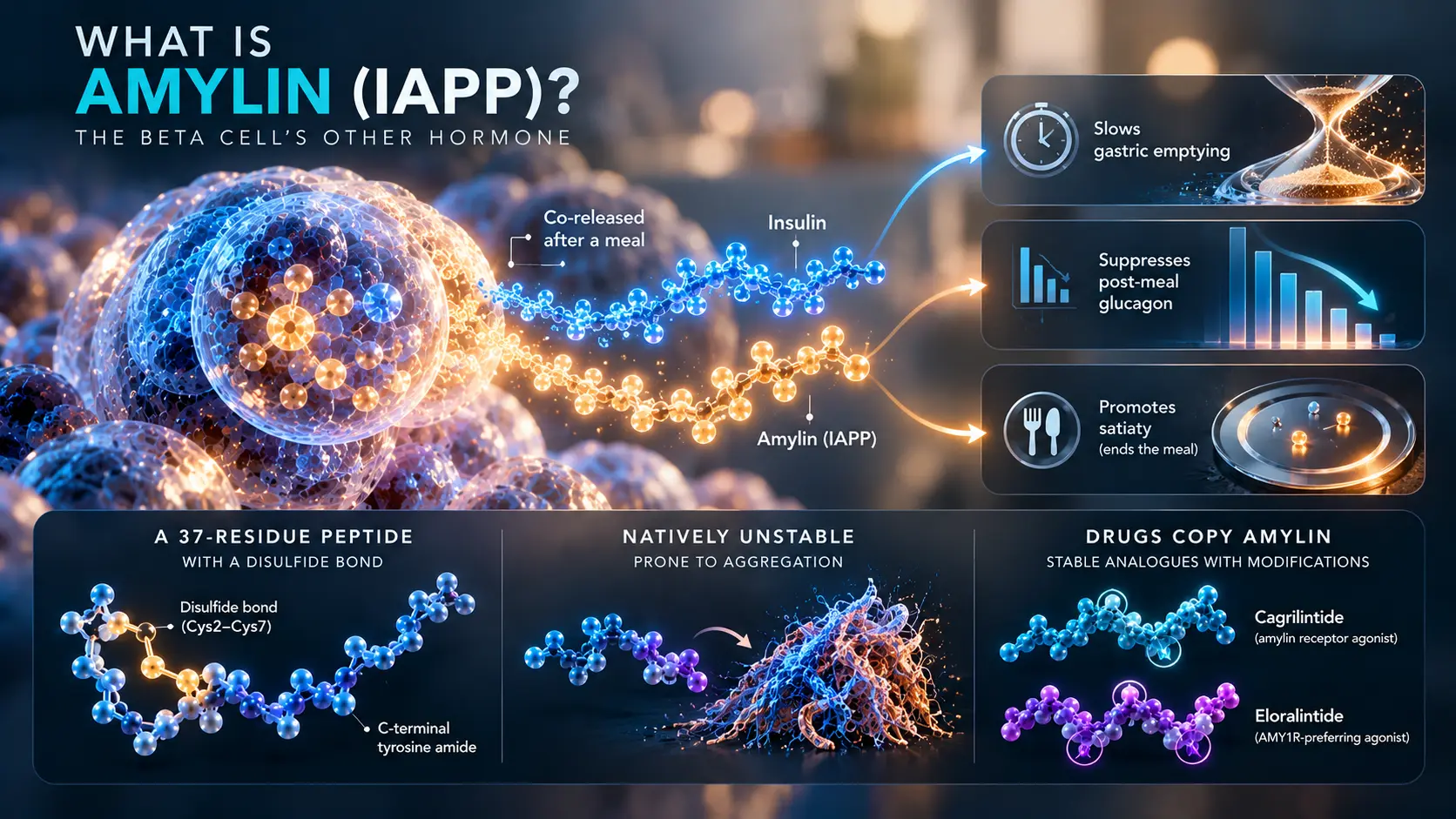
Quick Answer: What is amylin? It is a 37-amino-acid hormone, also called islet amyloid polypeptide or IAPP, stored in the same granule as insulin and released with it after a meal [1][2]. Insulin clears glucose from blood. Amylin paces how fast nutrients arrive, slowing gastric emptying, suppressing post-meal glucagon, and ending the meal [2][3].
Key Takeaways
- Mature human amylin is 37 residues long, carries a disulfide bond between cysteine 2 and cysteine 7, and ends in an amidated tyrosine, giving an average mass near 3,903 Da [1][2].
- The peptide is made in pancreatic beta cells, packed into the insulin secretory granule, and co-secreted with insulin [2].
- Amylin receptors are not standalone proteins. Each is the calcitonin receptor paired with one of three receptor activity-modifying proteins, producing AMY1, AMY2 and AMY3 [5].
- WHO's naming rules define the stem "-lintide" as amylin receptor agonists, including dual amylin and calcitonin receptor agonists [6].
- Nine "-lintide" names sit on WHO's list, not the three usually quoted: pramlintide, amlintide, davalintide, cagrilintide, petrelintide, eloralintide, colulintide, lenbelintide and batelintide [6].
- Native human amylin is one of the most aggregation-prone sequences known, which is why no drug uses it unchanged [2].
- Pramlintide (Symlin, NDA 021332) was approved by the FDA on 16 March 2005. Its three formulations are now listed as Discontinued [7].
- Cagrilintide is a non-selective amylin receptor agonist. Eloralintide preferentially activates AMY1R, about 12-fold over the calcitonin receptor in human cell assays [11].
Research Use Only. 99 Purity Peptides supplies compounds for laboratory research only. Nothing here is medical, dosing or health advice, and nothing sold is for human or veterinary consumption. This page describes a hormone and the molecules modelled on it. It recommends no compound for any outcome, in any person.
How we graded the evidence. Identity facts come first from database records, meaning UniProt and the FDA's own application files, because those are structural and regulatory records rather than interpretation. Mechanism comes from peer-reviewed reviews and primary pharmacology papers, with the species stated every time. Naming comes only from WHO's stem documents. Where a number appears in vendor pages but not in a primary source, we leave it out and say so.
What Is Amylin, and Where Does It Come From?
Amylin is a 37-residue peptide hormone made in the beta cells of the pancreatic islet, the same cells that make insulin [1][2]. Its formal name is islet amyloid polypeptide, abbreviated IAPP. Both names describe the same molecule, and the second one is a warning about its chemistry.
How Big Is Amylin, Exactly?
The structural record is unusually clean. UniProt entry P10997 lists an 89-residue precursor, from which the mature peptide is cut at positions 34 to 70 [1]. That mature chain carries two modifications worth knowing. A disulfide bond links cysteine 2 to cysteine 7, and the C-terminal tyrosine is amidated rather than left as a free acid [1][2].
Property | Verified value | Source |
|---|---|---|
Mature length | 37 amino acids | UniProt P10997, PEPTIDE 34..70 [1] |
Average mass | ~3,903 Da | Calculated from the UniProt sequence; 3,903.6 expected in [2] |
Disulfide bond | Cys2 to Cys7 | UniProt P10997 [1] |
C-terminus | Tyrosine amide | UniProt P10997 [1] |
Gene and organism | IAPP, Homo sapiens | UniProt P10997 [1] |
Cellular origin | Pancreatic beta cell | Wang et al. 2014 [2] |
Storage | Insulin secretory granule | Wang et al. 2014 [2] |
Those numbers are worth pinning down, because vendor pages disagree about them. We calculated the mass ourselves from the UniProt sequence, applying the amidation and the disulfide bond, and reached 3,903.3 Da. The Raleigh group reports an expected mass of 3,903.6 for synthetic human IAPP [2]. Agreement to within a fraction of a dalton is the level of confirmation an identity claim deserves.
Is Amylin Really the "Third" Pancreatic Hormone?
One popular label deserves correcting here. Amylin is often called the "third pancreatic hormone." The islet holds several hormone-secreting cell types, though. Beta cells make insulin, alpha cells make glucagon, and delta cells make somatostatin [14]. No ordering of those cell types puts amylin in third place. Calling it the beta cell's second hormone describes the biology far better.
Co-secretion is the fact that matters most for understanding the drugs. Amylin is not released on its own schedule. It sits inside the insulin granule and leaves the cell when insulin leaves the cell [2]. One stimulus, one granule, two hormones.
That single detail explains a clinical observation. Amylin is deficient in both type 1 and type 2 diabetes, alongside insulin [2]. Replacing only one of the two replaces only half of what the beta cell used to do.
What Does Amylin Actually Do?
Amylin controls the rate at which nutrients enter the circulation, rather than controlling their disposal once there [3][4]. Three distinct actions carry out that job. It slows gastric emptying, it suppresses glucagon secretion after a meal, and it brings the meal to an end by promoting satiation [3][4].
How Does Amylin Reach the Brain?
The satiation effect has a specific address in the brain. Peripheral amylin acts directly on the area postrema, a brainstem region outside the blood-brain barrier [3][4]. From there the signal passes to the nucleus of the solitary tract and the lateral parabrachial nucleus, then on to hypothalamic targets [3]. Reviews of this work are largely built on rodent studies, and the authors say so [3][4].
Receptor architecture is where amylin stops resembling a normal hormone. There is no gene for an amylin receptor. Each amylin receptor is the calcitonin receptor bound to one of three receptor activity-modifying proteins, giving AMY1, AMY2 and AMY3 [5]. Change the accessory protein and you change what the same receptor responds to.
Insulin | Amylin | GLP-1 | |
|---|---|---|---|
Source cell | Pancreatic beta cell | Pancreatic beta cell, same granule [2] | Enteroendocrine cells of the gut |
Core job | Clears glucose into tissues | Paces nutrient entry and ends the meal [3][4] | Amplifies glucose-driven insulin release |
Receptor | Insulin receptor, a tyrosine kinase | Calcitonin receptor plus RAMP1, 2 or 3 [5] | GLP-1 receptor, a class B GPCR |
Acts on glucagon | No direct suppression | Suppresses it after a meal [3][4] | Suppresses it |
Main satiety route | Not a satiety hormone | Area postrema and brainstem relays [3][4] | Incretin axis and vagal signalling |
How Does That Differ From Insulin and GLP-1?
Two comparisons fall out of that grid. Against insulin, amylin is the pacing signal rather than the clearing signal, which is why the two are complementary rather than redundant. Set beside GLP-1, the entry point is the difference. GLP-1 starts in the gut and works largely through the incretin axis. Amylin starts in the same cell as insulin and signals through the brainstem [3][4][5].
One caveat belongs here rather than buried later. The AMY1 receptor responds about as well to CGRP as it does to amylin [5]. "Amylin receptor" names a complex, not an exclusive relationship, and selectivity claims built on that name deserve scrutiny.
Why Do So Many Amylin Drugs End in "-lintide"?
They share the ending because WHO assigns it. The 2024 WHO stem book, with its addendum of 6 February 2026, defines "-lintide" as "amylin receptor agonists including dual amylin / calcitonin receptor agonists" [6]. A name ending that way has been placed in the amylin family by the body that governs drug names.
Our naming guide covers how stems work in general, including how "-lintide" nests inside the broader peptide stem "-tide". Rather than repeat that, this section adds the part that guide leaves out: the full roster.
Which Drugs Actually Carry the Stem?
Three "-lintide" drugs appear in our own naming guide. WHO's stem list carries nine of them [6].
INN | WHO proposed INN list | What this article verified about it |
|---|---|---|
pramlintide | 74 | FDA-approved 2005; all formulations now Discontinued [7] |
amlintide | 76 | Listed by WHO only; not researched here |
davalintide | 101 | Listed by WHO only; not researched here |
cagrilintide | 123 | Non-selective amylin receptor agonist, Novo Nordisk [8][11] |
petrelintide | 129 | Long-acting human amylin analogue, Zealand Pharma [12] |
eloralintide | 131 | AMY1R-preferring agonist, Eli Lilly [11] |
colulintide | 132 | Listed by WHO only; not researched here |
lenbelintide | 133 | Listed by WHO only; not researched here |
batelintide | 134 | Listed by WHO only; not researched here |
Read the list numbers as a timeline. Pramlintide entered at list 74 and batelintide at list 134, so the amylin naming family has kept growing across roughly sixty proposed-INN cycles. Five of these nine names will be unfamiliar even to people following the field closely.
A stem is a family label and nothing more. It tells you which receptor system a molecule was named for. Approval status, potency, selectivity and purity all sit outside what "-lintide" can tell you. Our peptide drug names guide works through that limit in detail.
Why Wasn't Native Amylin Ever Used Directly as a Drug?
Because human amylin clumps. The Raleigh group calls it "one of the most aggregation prone naturally occurring sequences known," and that single property has shaped every amylin drug since [2].
Aggregation is not a formulation nuisance alone. Human IAPP forms amyloid in the islets in type 2 diabetes, and those deposits track with reduced beta-cell mass. The aggregation process itself kills cultured beta cells [2]. A hormone that destroys the cell that makes it is a difficult starting molecule.
How Did Pramlintide Get Around It?
Nature had already supplied the fix. Rat IAPP differs from the human sequence at six positions, five of them between residues 20 and 29. Three of those five are prolines, sitting at positions 25, 28 and 29 [2]. Proline breaks beta-sheet structure, and rat IAPP forms no amyloid [2].
Pramlintide is that observation turned into a drug. It is human amylin with alanine 25, serine 28 and serine 29 each replaced by proline, borrowed straight from the rat sequence [2]. Those three changes make the human peptide non-amyloidogenic under normal conditions while keeping its activity [2].
The FDA's own record is admirably specific. Symlin, pramlintide acetate, application NDA 021332, was approved on 16 March 2005 as a new molecular entity [7].
Here the record diverges from what most pages say. Drugs@FDA lists all three Symlin formulations with a marketing status of "Discontinued" [7]. Papers written earlier describe pramlintide as commercially available, and that description was accurate when written [5][8]. It no longer matches the FDA's own file. Discontinued is a marketing status in the FDA's database. It records that the products are no longer marketed, and it does not state a reason.
What Problem Did Pramlintide Leave Behind?
Solving aggregation also created a second problem, and this is the part competitor explainers skip. Pramlintide is more soluble at acidic pH and is formulated that way, while insulin is formulated near neutral pH [2]. The mismatch prevents co-formulating the two in one product [2]. A patient therefore needed separate injections, and the field inherited a clear design target.
Look at what came next with that target in mind. Zealand Pharma describes petrelintide as a long-acting human amylin analogue "that can be formulated at about neutral pH," reached by optimising chemical stability while retaining potency [12]. Twenty years after pramlintide, the stated goal is the co-formulation that pramlintide could not support.
Where Do Cagrilintide and Eloralintide Fit?
Both are engineered amylin analogues, and they differ in the thing that matters most: receptor selectivity. Cagrilintide activates amylin receptors and the calcitonin receptor at comparable potency. Eloralintide leans toward AMY1R instead [11].
What Separates the Two Chemically?
Cagrilintide came out of a Novo Nordisk programme aimed squarely at the aggregation problem. The development paper opens on it. Novo Nordisk's team calls amylin's fibril-forming tendency the hallmark that makes the molecule "a challenging drug design effort" [8]. Their answer was a stable, lipidated, long-acting analogue [8]. Lipidation is the same trick that gives semaglutide its duration: a fatty-acid chain that binds albumin and slows clearance.
Eloralintide is a different design with a different aim. Lilly's discovery paper reports about 12-fold greater potency at human AMY1R than at the calcitonin receptor, and about 11-fold over AMY3R, measured in cells each expressing a single human receptor [11]. That same paper describes cagrilintide, by contrast, as a non-selective amylin receptor agonist [11]. The two are not interchangeable, and any page treating them as one thing has lost the distinction the chemistry was built around.
Compound | Structure | Change versus native human amylin | Status, verified |
|---|---|---|---|
Amylin (IAPP) | 37 residues, Cys2–Cys7 disulfide, amidated C-terminus [1] | Reference molecule | Endogenous hormone; clinical use of the native peptide called impractical [2] |
Pramlintide | 37 residues [2] | Proline at 25, 28 and 29, taken from rat IAPP [2] | FDA-approved 16 March 2005; formulations now Discontinued [7] |
Cagrilintide | Lipidated long-acting analogue [8] | Backbone stabilised against fibrils, plus an albumin-binding fatty-acid chain [8] | Investigational; non-selective at amylin receptors [11] |
Eloralintide | 37-residue lipidated analogue [11] | AMY1R-preferring, ~12-fold over the calcitonin receptor in human cells [11] | Investigational [11] |
Petrelintide | Long-acting human amylin analogue [12] | Stabilised for formulation near neutral pH [12] | Investigational [12][13] |
What Have the Trials Tested So Far?
Trial programmes exist for all three investigational compounds, and their designs are public. A Phase 2 dose-finding trial at 57 sites across ten countries randomised 706 participants to cagrilintide, with a further 99 to liraglutide and 101 to placebo [9]. The Phase 3 REDEFINE 1 trial randomised 3,417 adults to cagrilintide with semaglutide, either agent alone, or placebo [10]. That fixed-dose pairing is what CagriSema means. Eloralintide's first-in-human study enrolled 48 healthy participants [11]. Petrelintide has published single-ascending-dose and multiple-ascending-dose Phase 1 trials [13].
We are describing what these studies tested, not what they found. Outcome figures for these compounds sit outside the scope of a page like this one. Our cagrilintide and semaglutide comparison and eloralintide guide handle the trial record directly. Broader pipeline context sits in our 2026 GLP-1 pipeline overview.
A Correction to One of Our Own Pages
One correction belongs on our own site. An earlier 99 Purity Peptides page, the cagrilintide appetite and fat loss guide, describes cagrilintide as a GIP receptor agonist. Primary sources do not support that. Novo Nordisk's development paper presents cagrilintide as an amylin analogue [8], and Lilly's discovery paper names it a non-selective amylin receptor agonist [11]. Correcting our own page is more useful than correcting a competitor's.
What This Page Does Not Cover
Several things sit outside what we will state, and the reasons differ.
No dosing, preparation or administration information appears anywhere on this page, for amylin or for any analogue named here. None of these compounds is offered for use in a person.
Outcome claims are absent for the same reason. Trial sizes and designs are reported because they describe the state of the evidence. Weight, glucose and tolerability results are left to the primary papers and to the pages linked above.
Species boundaries are real limits, not caution. Much of the mechanistic picture for amylin's satiation effect rests on rodent work, and the reviews cited say so plainly [3][4]. Receptor selectivity figures for eloralintide come from engineered cell lines expressing one human receptor at a time, which is a clean experiment and not a prediction about people [11].
Numbers We Deliberately Left Out
The co-secretion ratio deserves a specific flag. Amylin and insulin come from the same granule under the same stimulus [2], and that much is well supported. A single fixed molar ratio between them is often quoted, but we could not trace one consistent figure to a primary source, so this page states the co-secretion and omits the number.
Cagrilintide's exact substitution set and the position of its acyl chain are also absent here. The development paper reports them, but not in the portion we could read directly. We do not restate structural detail we have not seen [8]. Petrelintide's residue-level changes are omitted for the same reason [12].
Where to Read Next
Anyone asking what is amylin usually arrives from a drug name rather than from endocrinology, and the hormone rewards the detour. One molecule explains a whole drug family. A hormone that clumps, a rat sequence that does not, three prolines, and sixty INN cycles later a naming stem with nine members on it.
For the naming system itself, our peptide drug names guide sets out how stems are assigned and what they cannot tell you. On the compounds themselves, the eloralintide guide and the cagrilintide and semaglutide comparison go further into the published trials than this page does.
Laboratories working on amylin receptor pharmacology can find cagrilintide in our catalogue as research material with lot documentation: cagrilintide and cagrilintide spray. Lot records sit in our certificate library.
References
- UniProt Consortium. Islet amyloid polypeptide, IAPP_HUMAN, accession P10997. UniProtKB. Accessed September 2026. https://www.uniprot.org/uniprotkb/P10997/entry
- Wang H, Abedini A, Ruzsicska B, et al. Rationally designed, nontoxic, nonamyloidogenic analogues of human islet amyloid polypeptide with improved solubility. Biochemistry. 2014;53(37):5876-84. PMID: 25140605. PMCID: PMC4172205. doi:10.1021/bi500592p. https://doi.org/10.1021/bi500592p
- Lutz TA. Control of energy homeostasis by amylin. Cell Mol Life Sci. 2011;69(12):1947-65. PMID: 22193913. doi:10.1007/s00018-011-0905-1. https://doi.org/10.1007/s00018-011-0905-1
- Lutz TA. Amylinergic control of food intake. Physiol Behav. 2006;89(4):465-71. PMID: 16697020. doi:10.1016/j.physbeh.2006.04.001. https://doi.org/10.1016/j.physbeh.2006.04.001
- Hay DL, Garelja ML, Poyner DR, et al. Update on the pharmacology of calcitonin/CGRP family of peptides: IUPHAR Review 25. Br J Pharmacol. 2018;175(1):3-17. PMID: 29059473. PMCID: PMC5740251. doi:10.1111/bph.14075. https://doi.org/10.1111/bph.14075
- World Health Organization. The use of stems in the selection of International Nonproprietary Names (INN) for pharmaceutical substances, 2024 edition, with cumulative addendum INN Working Document 26.638, 6 February 2026. https://cdn.who.int/media/docs/default-source/international-nonproprietary-names-%28inn%29/addendum-stembook2025-202602.pdf
- US Food and Drug Administration. Drugs@FDA: SYMLIN (pramlintide acetate), application NDA 021332, original approval 16 March 2005. Accessed September 2026. https://www.accessdata.fda.gov/scripts/cder/daf/index.cfm?event=overview.process&ApplNo=021332
- Kruse T, Hansen JL, Dahl K, et al. Development of cagrilintide, a long-acting amylin analogue. J Med Chem. 2021;64(15):11183-11194. PMID: 34288673. doi:10.1021/acs.jmedchem.1c00565. https://doi.org/10.1021/acs.jmedchem.1c00565
- Lau DCW, Erichsen L, Francisco AM, et al. Once-weekly cagrilintide for weight management in people with overweight and obesity: a multicentre, randomised, double-blind, placebo-controlled and active-controlled, dose-finding phase 2 trial. Lancet. 2021;398(10317):2160-2172. PMID: 34798060. doi:10.1016/S0140-6736(21)01751-7. https://doi.org/10.1016/S0140-6736(21)01751-7
- Garvey WT, Blüher M, Osorto Contreras CK, et al. Coadministered cagrilintide and semaglutide in adults with overweight or obesity. N Engl J Med. 2025;393(7):635-647. PMID: 40544433. doi:10.1056/NEJMoa2502081. https://doi.org/10.1056/NEJMoa2502081
- Briere DA, Qu H, Lansu K, et al. Eloralintide (LY3841136), a novel amylin receptor agonist for the treatment of obesity: from discovery to clinical proof of concept. Mol Metab. 2025;102:102271. PMID: 41109426. PMCID: PMC12640043. doi:10.1016/j.molmet.2025.102271. https://doi.org/10.1016/j.molmet.2025.102271
- Fischer Munch H, Just R, Mosolff Mathiesen J, et al. Development of petrelintide: a potent, stable, long-acting human amylin analogue. J Med Chem. 2025;68(22):23925-23940. PMID: 41217931. PMCID: PMC12670398. doi:10.1021/acs.jmedchem.5c01185. https://doi.org/10.1021/acs.jmedchem.5c01185
- Brændholt Olsen M, Griffin J, Hövelmann U, et al. Safety, tolerability, pharmacokinetics, and pharmacodynamics of petrelintide for weight management: two randomized, controlled phase 1 trials. Diabetes Obes Metab. 2026;28(7):5915-5925. PMID: 42017294. PMCID: PMC13243934. doi:10.1111/dom.70753. https://doi.org/10.1111/dom.70753
- Kim A, Kilimnik G, Guo C, et al. Computer-assisted large-scale visualization and quantification of pancreatic islet mass, size distribution and architecture. J Vis Exp. 2011;(49):2471. PMID: 21403638. PMCID: PMC3197293. doi:10.3791/2471. https://doi.org/10.3791/2471
Frequently Asked Questions
What is amylin?
Amylin is a 37-amino-acid hormone made in the beta cells of the pancreas and released with insulin after a meal. Its formal name is islet amyloid polypeptide. It slows gastric emptying, suppresses glucagon secretion after eating, and signals satiation through the brainstem. Cagrilintide, eloralintide and pramlintide are all engineered copies of it.
What does IAPP stand for?
IAPP stands for islet amyloid polypeptide, the formal name for the hormone commonly called amylin. UniProt lists islet amyloid polypeptide as the recommended name and amylin as an alternative, so the two terms refer to one molecule. The "amyloid" part records a real property: the human sequence readily forms amyloid fibrils, which is why every amylin drug is a modified version.
What does amylin do in the body?
Amylin regulates how quickly nutrients reach the bloodstream after eating. Three actions do that work: slowing the rate at which the stomach empties, suppressing glucagon release after a meal, and promoting the satiation that ends eating. Published reviews place the satiation effect at the area postrema in the brainstem, with signals relayed onward to hypothalamic targets.
Where is amylin produced?
Amylin is produced in the beta cells of the pancreatic islets, the same cells that produce insulin. It is not simply made nearby. The peptide is stored inside the insulin secretory granule itself and leaves the cell when insulin does. That shared packaging is why beta-cell loss reduces both hormones together rather than one at a time.
Is amylin the same as insulin?
No. They are different molecules with different jobs, released from the same cell at the same time. Insulin moves glucose out of the blood and into tissue. Amylin does not do that. It controls the pace of the meal response instead, slowing gastric emptying and suppressing glucagon, so nutrients arrive at a rate insulin can handle.
Is amylin the same as GLP-1?
No, and the differences run deep. GLP-1 is an incretin released from cells in the gut, and it works largely by amplifying glucose-driven insulin secretion. Amylin comes from the pancreatic beta cell itself and acts through the brainstem. Their receptors are unrelated too: GLP-1 has its own receptor, while amylin receptors are calcitonin receptors paired with accessory proteins.
What does "-lintide" mean in a drug name?
Under WHO naming rules, "-lintide" marks amylin receptor agonists, including dual amylin and calcitonin receptor agonists. The stem is assigned by WHO's International Nonproprietary Names programme, so a name ending that way has been formally placed in the amylin family. Nine such names are currently listed. The ending says nothing about approval status, potency, selectivity or quality.
Why can't native amylin be used as a drug directly?
Human amylin aggregates too readily. Researchers describe it as among the most aggregation-prone natural sequences known, and it forms amyloid deposits in the pancreatic islets in type 2 diabetes. The aggregation process is toxic to cultured beta cells. A peptide that clumps in the vial and harms the cells it targets cannot be formulated or stored reliably without modification.
What was the first amylin analogue drug?
Pramlintide, sold as Symlin, was the first. The FDA approved it on 16 March 2005 under application NDA 021332 as a new molecular entity. Its design borrows from rat amylin, which does not form amyloid: three proline substitutions at positions 25, 28 and 29 make the human peptide non-amyloidogenic. FDA records now list all three Symlin formulations as discontinued.
Is cagrilintide an amylin analogue?
Yes. Novo Nordisk's published development work describes cagrilintide as a stable, lipidated, long-acting amylin analogue, designed specifically around amylin's tendency to form fibrils. A fatty-acid chain binds albumin and extends its duration. Some sources incorrectly describe cagrilintide as a GIP receptor agonist. Primary literature does not support that, and the amylin classification is the one to trust.
Is eloralintide an amylin analogue?
Yes. Eloralintide, development code LY3841136, is a lipidated amylin analogue from Eli Lilly. What sets it apart is receptor preference. In cells expressing one human receptor at a time, it activated the amylin 1 receptor roughly 12-fold more potently than the calcitonin receptor. Preference is not exclusivity, and it still activates the calcitonin receptor at higher concentrations.
What is the difference between cagrilintide and eloralintide?
Selectivity is the main difference. Cagrilintide is non-selective across amylin receptors and the calcitonin receptor, while eloralintide leans toward the amylin 1 receptor by roughly 12-fold in human cell assays. They also come from different companies, Novo Nordisk and Eli Lilly, and from separate design programmes. No published trial has compared the two directly in people.
What is CagriSema?
CagriSema is Novo Nordisk's fixed-dose combination of two separate molecules, cagrilintide and the GLP-1 receptor agonist semaglutide, given together in one injection. The pairing puts an amylin-pathway agent alongside an incretin-pathway agent. Its Phase 3 REDEFINE 1 trial randomised 3,417 adults to the combination, either agent alone, or placebo. It is not a single blended peptide.
How many amino acids does amylin have?
Mature human amylin has 37 amino acids. UniProt entry P10997 records an 89-residue precursor, with the mature peptide spanning positions 34 to 70. Two features complete the structure: a disulfide bond between cysteine 2 and cysteine 7, and an amidated tyrosine at the C-terminus. Calculated from that sequence, the average mass is about 3,903 daltons.
Why is amylin described as the "third pancreatic hormone"?
The label is popular shorthand, and it does not survive close reading. The pancreatic islet contains several hormone-secreting cell types, including beta cells for insulin, alpha cells for glucagon and delta cells for somatostatin, so amylin is not third in any meaningful ordering. A more accurate description is the beta cell's second hormone, co-packaged and co-released with insulin.