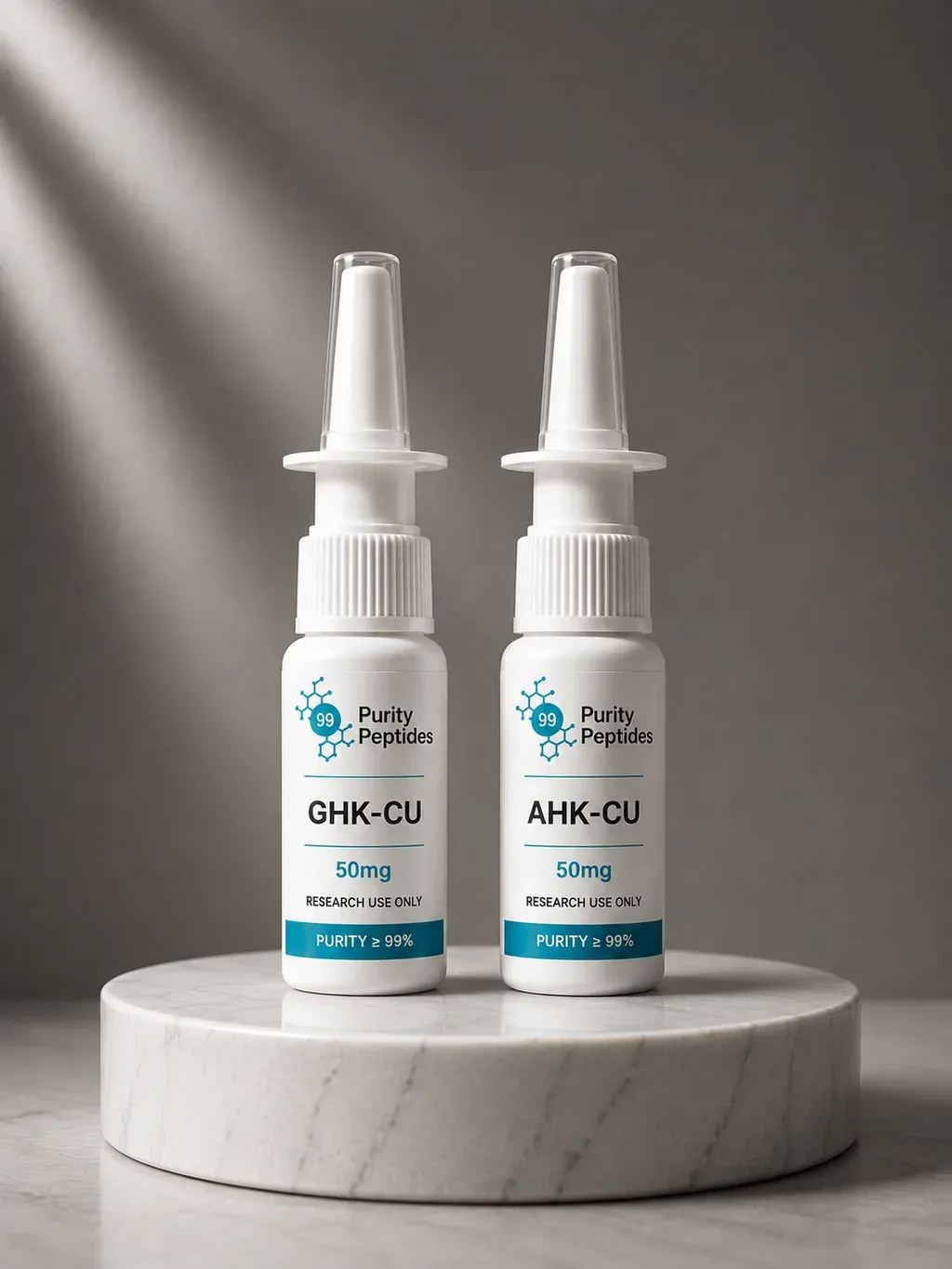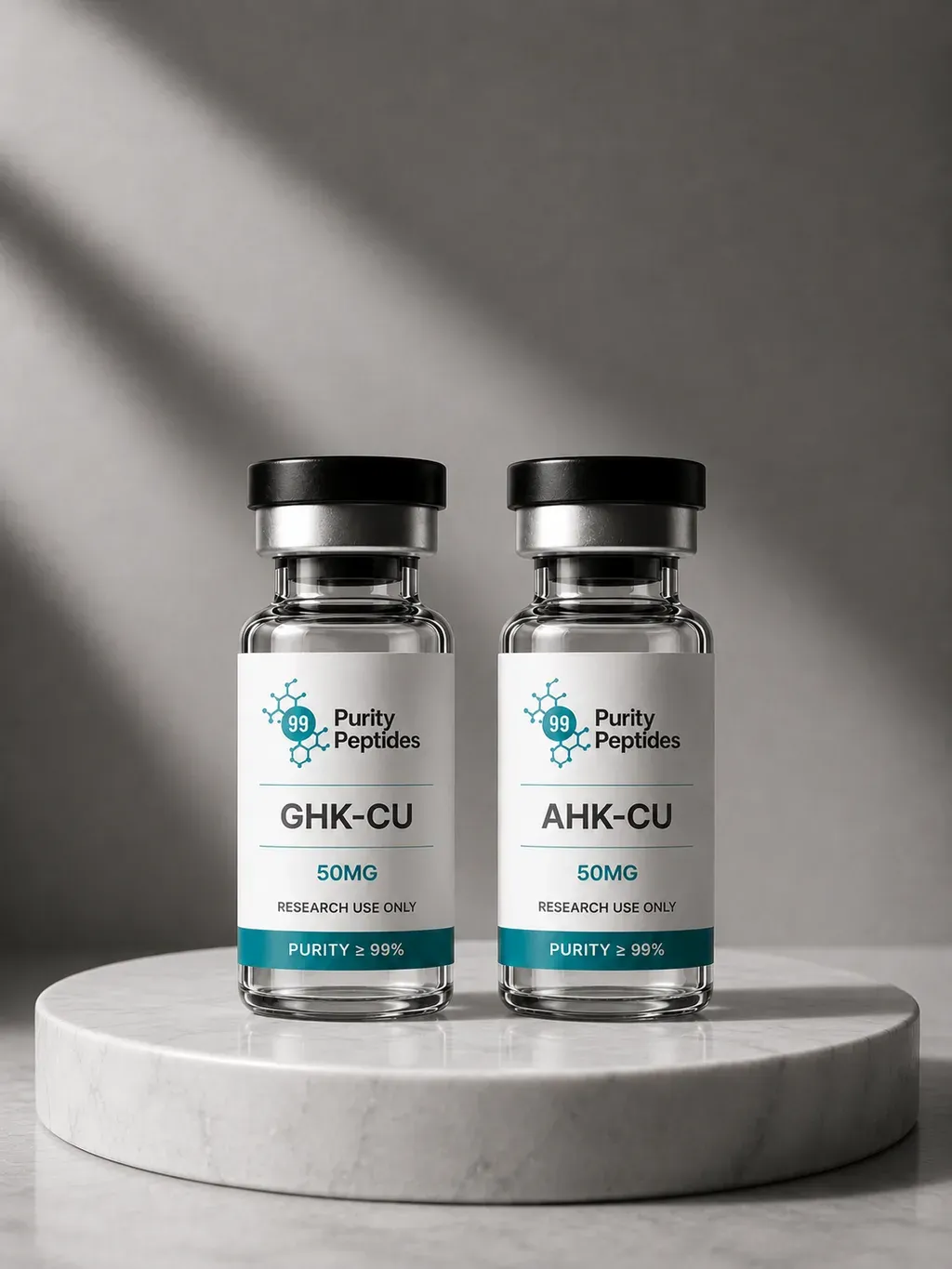
The Copper Peptide Comparator supplies GHK-Cu and AHK-Cu as matched 50 mg research vials. The two copper-binding tripeptides differ at a single position — glycine in GHK-Cu, alanine in AHK-Cu — at a residue that participates directly in copper coordination. The pair supports structure-activity comparison between a well-characterised endogenous peptide and its synthetic analog. Supplied lyophilized. For research use only.
HPLC certified
Independent analysis
Highest standard
Full traceability
The Copper Peptide Comparator brings together the two most frequently compared copper-binding tripeptides at matched mass. GHK-Cu, designated Copper Tripeptide-1, is the copper(II) complex of glycyl-histidyl-lysine. AHK-Cu, designated Copper Tripeptide-3, is the copper(II) complex of alanyl-histidyl-lysine. The peptides differ at position 1 alone.
That substitution replaces glycine with alanine — a difference of one methyl group. Its position matters: the N-terminal residue’s α-amino nitrogen participates directly in copper coordination, so the change sits at a coordinating residue rather than remote from the metal centre. Few peptide pairs offer a structure-activity comparison this narrow.
The two compounds are not, however, equally characterised. GHK-Cu occurs naturally in human plasma and carries a substantial published literature covering matrix biology, tissue-repair models and gene-expression research. AHK-Cu is a synthetic analog with a smaller literature concentrated in topical and formulation contexts, and several widely repeated claims about it have not been independently established.
That asymmetry is a reason to hold both rather than a reason to avoid either. A compound with a limited evidence base is difficult to interpret without a well-characterised reference, and GHK-Cu serves as that reference.
Both vials are supplied lyophilized as pale blue powder, with batch documentation including copper content and identity confirmation.
For Research Use Only. Not intended for human consumption, therapeutic use, veterinary use, or diagnostic applications.
The Copper Peptide Comparator is a two-vial research pair containing GHK-Cu (Copper Tripeptide-1) and AHK-Cu (Copper Tripeptide-3) at 50 mg each. Both are copper(II) complexes of tripeptides that differ at a single position — glycine in GHK-Cu, alanine in AHK-Cu. The pair supports structure-activity comparison between an endogenous, well-characterised copper peptide and a synthetic analog with a narrower evidence base.
| Compound | Mass | Designation | Peptide sequence | Why it is included |
|---|---|---|---|---|
| GHK-Cu | 50 mg | Copper Tripeptide-1 | Glycyl-histidyl-lysine, Cu(II) complex | The well-characterised reference compound in copper peptide research |
| AHK-Cu | 50 mg | Copper Tripeptide-3 | Alanyl-histidyl-lysine, Cu(II) complex | The synthetic analog differing at a single residue |
Both vials are supplied as lyophilized powder with batch documentation. Copper complexes of these tripeptides present as pale blue solids; colour is a general visual characteristic of the complex rather than a purity indicator.
GHK-Cu and AHK-Cu are compared because they are close structural relatives. Both are copper(II) complexes of a three-residue peptide ending in histidine and lysine. They differ at position 1 only, where GHK-Cu carries glycine and AHK-Cu carries alanine. Every other structural feature, including the histidine that anchors copper binding, is shared.
Alanine differs from glycine by a single methyl group. In most peptides a substitution that small, at a terminal position, would be unremarkable.
Here it is not, because of where it sits. In copper(II) complexes of these tripeptides, coordination involves the N-terminal α-amino nitrogen, the deprotonated backbone amide nitrogen, and the imidazole nitrogen of the histidine residue. The substituted position is therefore part of the coordination environment rather than remote from it.
That makes GHK-Cu and AHK-Cu something close to a minimal pair — two compounds separated by one atom-scale change at a functionally significant site. Structure-activity comparisons rarely get narrower, and matched 50 mg vials are what make the comparison practical to run.
The two compounds also differ in origin, and this is not a minor distinction.
GHK-Cu occurs naturally. The tripeptide was first isolated from human plasma, and reported plasma concentrations decline substantially with age. GHK-Cu is therefore studied as an endogenous factor with a physiological context of its own.
AHK-Cu does not occur naturally. It is a synthetic analog designed around the GHK scaffold. Any research on AHK-Cu describes a laboratory compound rather than a naturally present one — which is relevant when interpreting comparisons between them, since only one of the two has a baseline biological presence to be compared against.
GHK-Cu and AHK-Cu are frequently presented as interchangeable options separated only by research focus. They are not equally characterised, and a comparison built on the assumption that they are will misread its own results.
GHK-Cu carries a substantial published literature spanning matrix biology, tissue-repair models, copper coordination chemistry and gene-expression research, accumulated over decades and available through indexed journals.
AHK-Cu carries a much smaller literature, weighted toward topical and cosmetic-formulation contexts. Several claims about AHK-Cu that circulate widely — including assertions about comparative penetration and distinct gene-expression behaviour — trace substantially to industry and supplier sources rather than to independently replicated published work.
Be the first to share your experience with this product and help other researchers!

GHK-Cu nasal spray research reviewed: three mouse studies from one lab, no human data, and what is still unknown about absorption and tolerability.
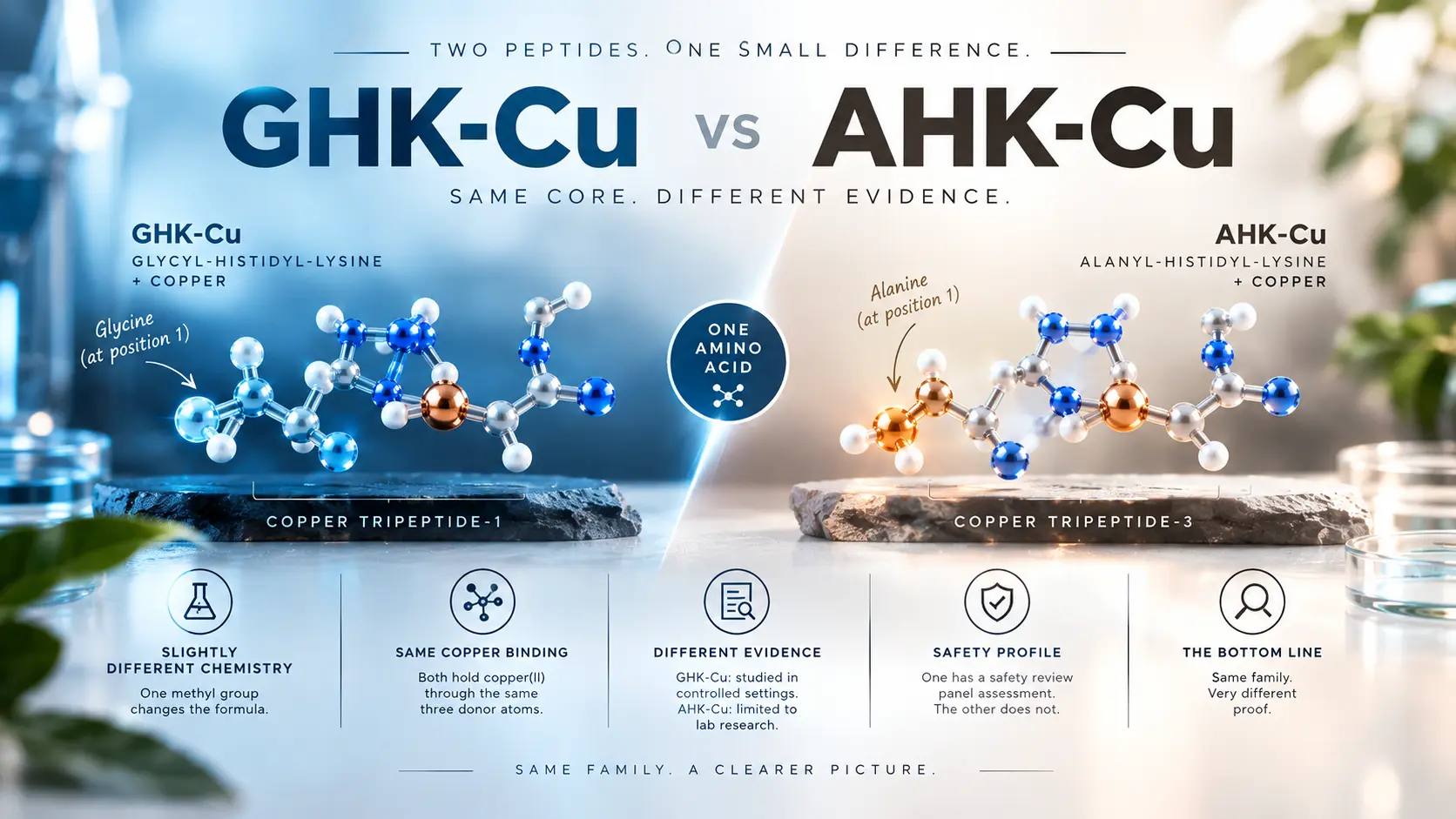
AHK-Cu vs GHK-Cu: one methyl group apart, but not one tier of evidence. A sourced comparison of the chemistry, hair and skin data, and marketing claims.
AHK-Cu nasal spray 50mg explained: Copper Tripeptide-3 structure, GHK-Cu differences, COA checks and honest research limits. Research use only.
(faqs)