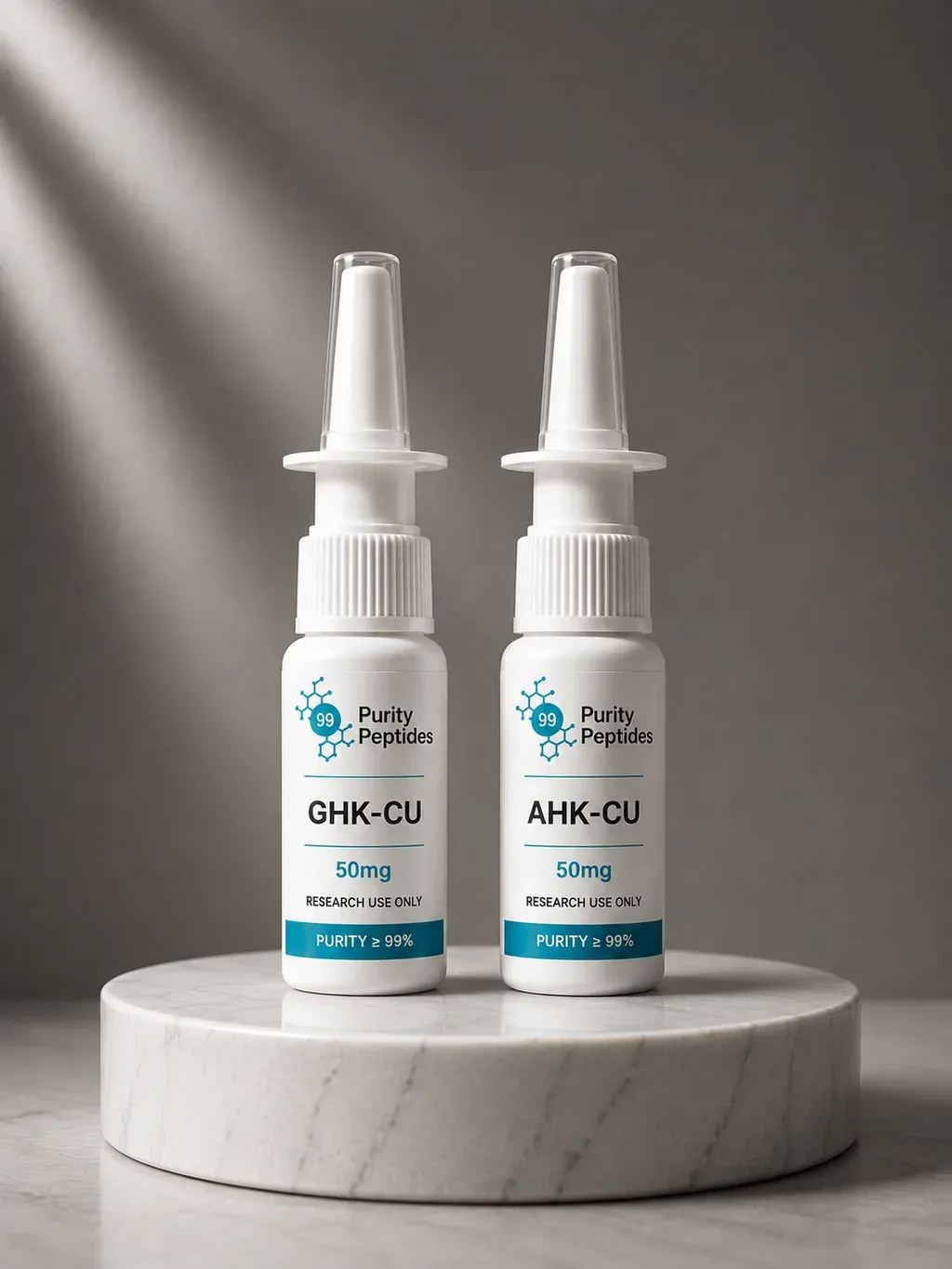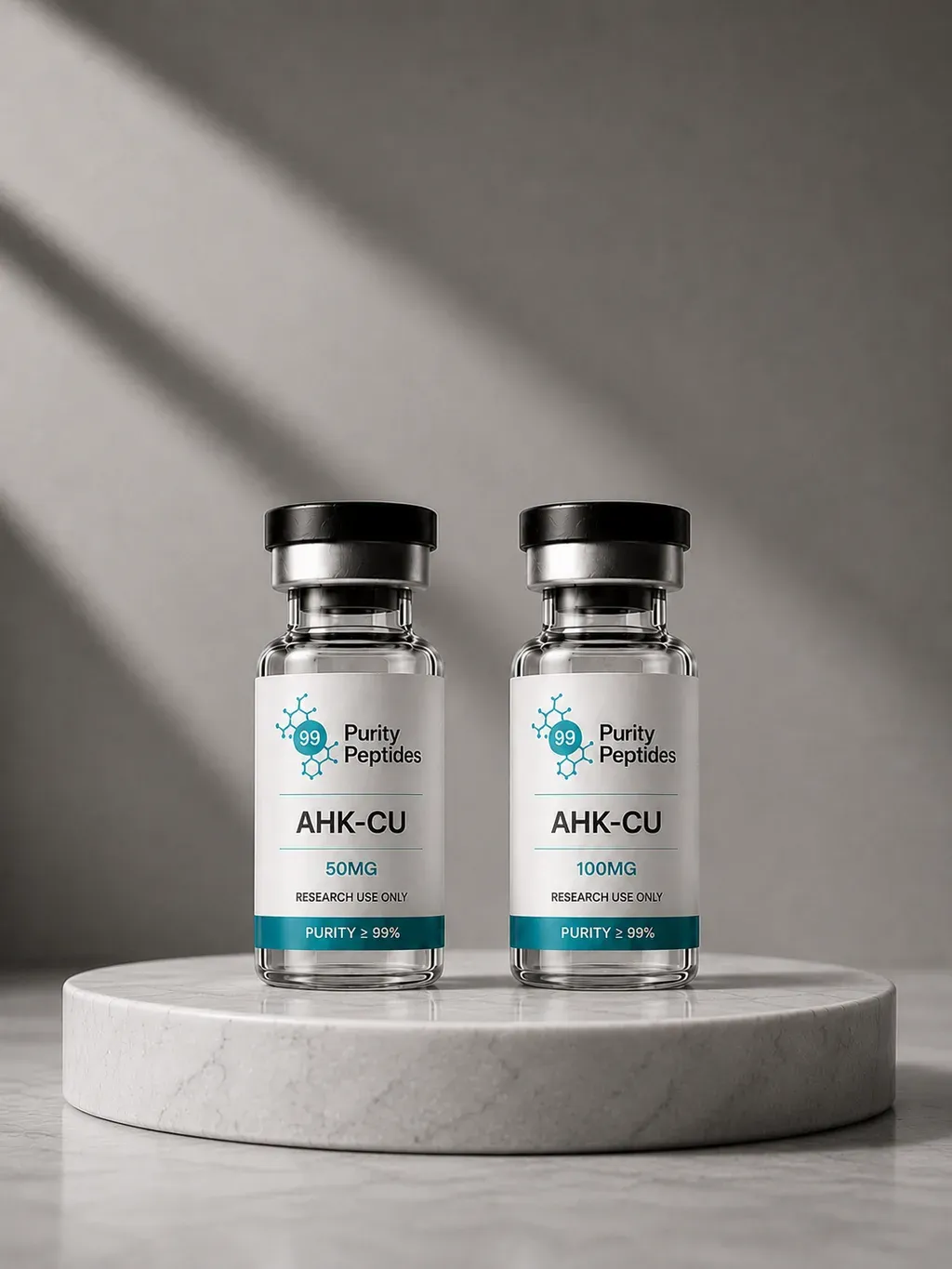
The AHK-Cu Research Pair supplies the copper tripeptide at two fill masses — 50 mg and 100 mg, 150 mg in total. Both vials contain the same compound to the same specification; only the quantity per vial differs. Two fill masses allow a target concentration to be reached at two different prepared volumes. For research use only.
HPLC certified
Independent analysis
Highest standard
Full traceability
The AHK-Cu Research Pair contains two lyophilized vials of AHK-Cu, also designated Copper Tripeptide-3, at 50 mg and 100 mg. The two vials hold the same compound, produced to the same specification. Fill mass is the only difference between them.
Supplying both masses together serves a practical purpose rather than a comparative one. With a single fill mass, target concentration and prepared volume are locked together — choosing one determines the other. Holding both masses allows a given concentration to be reached at two different volumes, so the amount of solution prepared can be matched to what a given experiment requires without serial dilution.
AHK-Cu is a copper(II) complex of the tripeptide alanyl-histidyl-lysine, a synthetic analog of the more extensively studied GHK-Cu. Its published literature is considerably narrower than GHK-Cu’s, and researchers should treat reported characterisations accordingly.
Both vials are supplied as pale blue lyophilized powder with batch documentation.
For Research Use Only. Not intended for human consumption, therapeutic use, veterinary use, or diagnostic applications.
The AHK-Cu Research Pair contains two vials of AHK-Cu, also designated Copper Tripeptide-3, at 50 mg and 100 mg — 150 mg in total. Both vials hold the same compound to the same specification, differing only in fill mass. Two masses allow a target concentration to be prepared at two different volumes without serial dilution.
| Vial | Fill mass | Compound | Designation |
|---|---|---|---|
| AHK-Cu 50 mg | 50 mg | AHK-Cu, copper(II) complex of alanyl-histidyl-lysine | Copper Tripeptide-3 |
| AHK-Cu 100 mg | 100 mg | AHK-Cu, copper(II) complex of alanyl-histidyl-lysine | Copper Tripeptide-3 |
| Total | 150 mg |
Both vials are supplied as pale blue lyophilized powder with batch documentation.
The 50 mg and 100 mg vials contain identical material. Same compound, same specification, same production process — only the quantity of powder in the vial differs.
This is worth stating explicitly because vial size is sometimes assumed to indicate grade or preparation differences. It does not. A 100 mg vial of AHK-Cu is not a different product from a 50 mg vial, and neither is formulated for a different research area.
Fill mass is a practical variable. It determines the concentration range a single vial can reach and how much solution one reconstitution produces. It does not affect what the compound is.
Neither fill mass is preferable in general. The choice depends on the work:
Lyophilized material is more stable than material in solution, so retaining the unused vial in its lyophilized state until required is generally preferable to reconstituting more than an experiment needs.
Be the first to share your experience with this product and help other researchers!
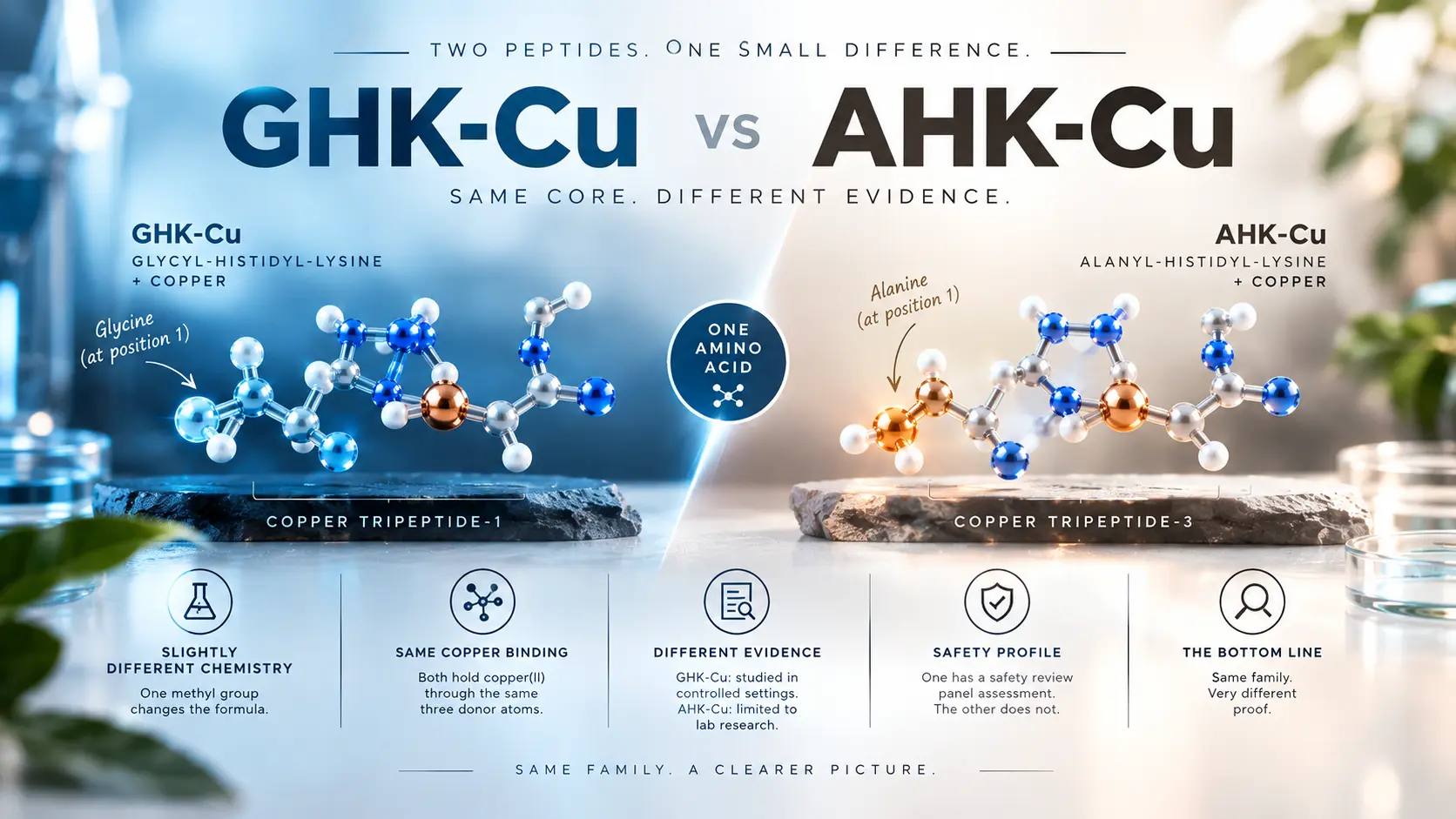
AHK-Cu vs GHK-Cu: one methyl group apart, but not one tier of evidence. A sourced comparison of the chemistry, hair and skin data, and marketing claims.
AHK-Cu nasal spray 50mg explained: Copper Tripeptide-3 structure, GHK-Cu differences, COA checks and honest research limits. Research use only.

GHK-Cu nasal spray research reviewed: three mouse studies from one lab, no human data, and what is still unknown about absorption and tolerability.
(faqs)