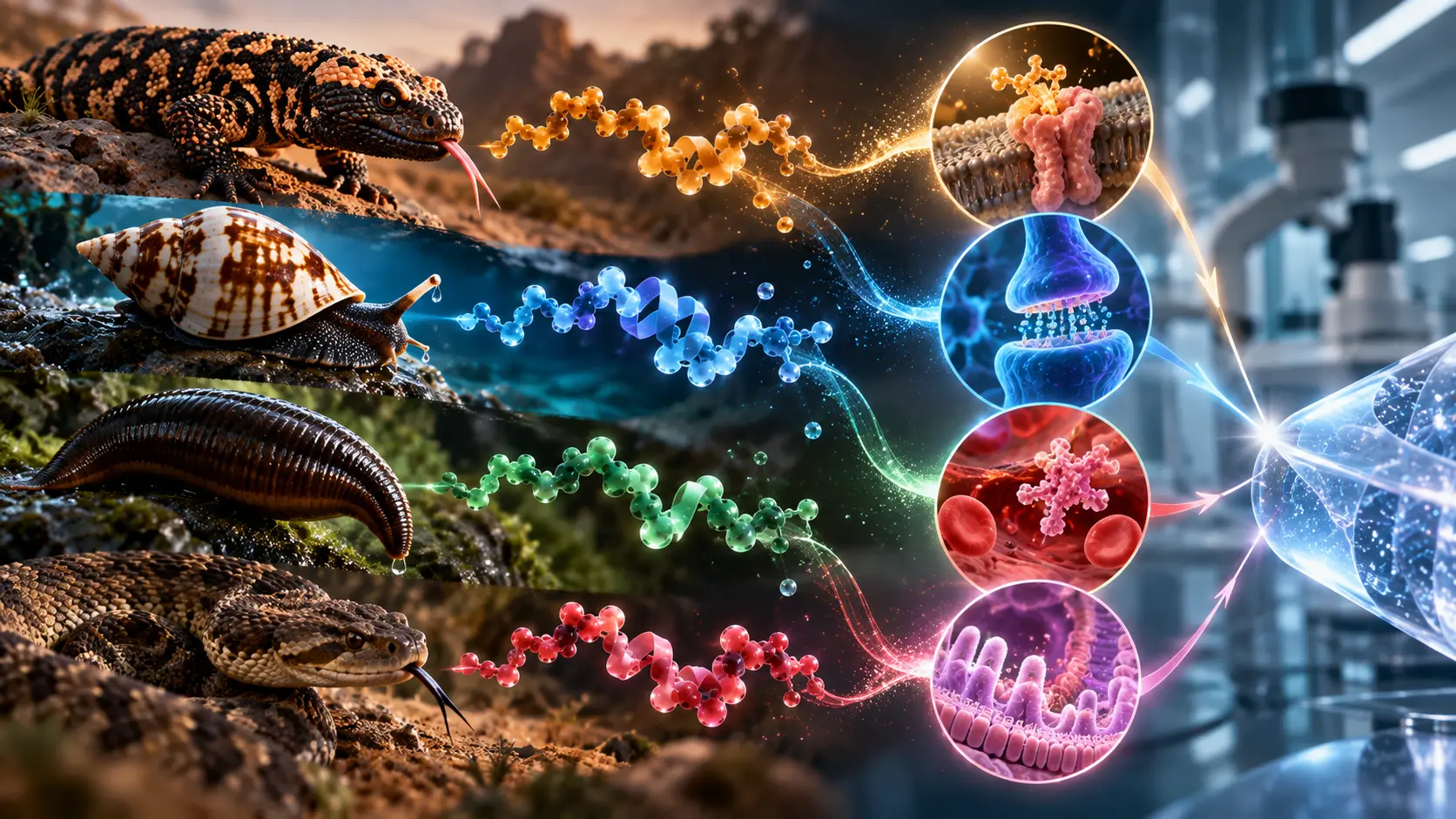
Last reviewed: September 2026
Quick Answer
Drugs from venom are a small but real category of approved medicines, and the most repeated story about them is wrong. Semaglutide, sold as Ozempic and Wegovy, is an engineered analogue of human GLP-1 carrying two amino acid substitutions and a fatty diacid side chain, designed by chemists at Novo Nordisk [2]. Nothing in it was extracted from a lizard. The Gila monster link belongs to a different drug, exenatide, a synthetic copy of exendin-4, a 39-amino-acid peptide isolated from Heloderma suspectum venom in 1992 [1].
Key Takeaways
- Exendin-4 was isolated from Gila monster venom by John Eng and colleagues and reported in 1992. The peptide is 39 amino acids long [1].
- Exenatide, the synthetic version of that peptide, was first approved in the United States on April 28, 2005, making it the first GLP-1 receptor agonist to reach the market [4].
- Semaglutide differs from human GLP-1 by two substitutions, Aib at position 8 and arginine at position 34, with a C18 diacid attached at lysine 26 [2]. Its starting scaffold was human, not reptilian.
- FDA withdrew approval of Byetta, Bydureon and Bydureon BCise as of September 3, 2025, after the applicant reported the products were no longer marketed [5].
- Ziconotide is a synthetic equivalent of ω-conotoxin MVIIA from the cone snail Conus magus. FDA approved it on December 28, 2004, for intrathecal use only [8, 9].
- Bivalirudin is a 20-amino-acid analogue of hirudin, a 65-amino-acid protein from the salivary glands of the medicinal leech. FDA approved it in December 2000 [11, 12].
- Captopril grew out of Bothrops jararaca venom research but is not a peptide. It is a single mercaptopropionyl-proline molecule with a molecular weight of 217.29 [14].
- Eptifibatide is a cyclic heptapeptide modelled on barbourin, a rattlesnake disintegrin. FDA approved it on May 18, 1998 [15, 16].
Research Use Only
Everything sold on this site is supplied for laboratory research use only. It is not for human or veterinary consumption, and nothing here is medical advice, dosing guidance or a treatment recommendation. This article describes the history and pharmacology of approved drugs developed by pharmaceutical companies and regulators. It does not describe any product sold on this site, and it makes no claim that any compound sold here treats any condition.
Is Ozempic Really Made From Gila Monster Venom?
No. Semaglutide, the active molecule in Ozempic and Wegovy, was built from the human hormone GLP-1, not from lizard venom. The medicinal chemistry paper that describes its discovery is explicit about the starting point. Semaglutide carries two changes relative to human GLP-1, an α-aminoisobutyric acid at position 8 and arginine at position 34, and it is derivatised at lysine 26 with a linker and a C18 fatty diacid that binds albumin and stretches the half-life [2]. FDA approved Ozempic on December 5, 2017 [3].
So where did the lizard story come from? It came from exenatide, a genuinely venom-derived drug in the same receptor class. The two share a target and share nothing else. Exenatide is the synthetic form of a peptide that a lizard makes. Semaglutide is a redesigned human hormone that happens to hit the same receptor.
The popular version collapses one lineage into the other. Most pages repeating it never name exenatide at all, which is the tell. If a page says "Ozempic comes from the Gila monster" without mentioning exendin-4 or exenatide, it has copied a headline rather than a source.
One more correction sits underneath the first. Exendin-4 is usually described as a saliva peptide. The isolation paper describes it as a component of Heloderma suspectum venom [1]. Gila monster venom is produced in modified glands in the lower jaw and delivered by grooved teeth, so "saliva" is not absurd, but the primary literature says venom, and the distinction matters in an article about venom-derived drugs.
Drug | Where the sequence started | Venom-derived? | Current US status |
|---|---|---|---|
Exenatide (Byetta, Bydureon) | Exendin-4 from Gila monster venom | Yes, direct copy | Brand approvals withdrawn September 3, 2025 [5]; a generic was approved November 21, 2024 [6] |
Lixisenatide (Adlyxin) | Exendin-4, minus proline 38, plus six lysines | Yes, engineered from the venom peptide [7] | Approved July 2016; reported as no longer marketed in the US [17] |
Semaglutide (Ozempic, Wegovy) | Human GLP-1 [2] | No | Approved December 5, 2017 [3] |
Liraglutide | Human GLP-1 [2] | No | Approved |
Tirzepatide | Human GIP scaffold with GLP-1 activity | No | Approved |
How Did a Lizard Toxin Become the First GLP-1 Drug?
The route ran through a search for a second peptide, not through a search for a diabetes drug. Eng and colleagues had already identified exendin-3 in Heloderma horridum venom, which prompted a hunt for a relative in Heloderma suspectum. Using a sequencing assay for peptides with an N-terminal histidine, they pulled out a 39-amino-acid peptide and named it exendin-4. It differs from exendin-3 at only two positions [1].
What made it a drug candidate was a quirk of position 2. Human GLP-1 carries alanine there, and the enzyme dipeptidyl peptidase-4 cleaves it within about two minutes. Exendin-4 carries glycine instead, so the enzyme cannot do the same job, and the peptide survives long enough to be useful [1, 18].
Amylin Pharmaceuticals and Eli Lilly took the synthetic version through development. Byetta reached approval on April 28, 2005 as the first GLP-1 receptor agonist [4]. A once-weekly formulation, Bydureon, followed.
Then the venom peptide lost. AstraZeneca stopped marketing both products, and FDA withdrew approval of Byetta, Bydureon and Bydureon BCise as of September 3, 2025 [5]. A generic exenatide pen referencing Byetta had been approved in November 2024, so the molecule is still available [6], but the branded originals are gone from the schedule. Lixisenatide followed a similar arc. Sanofi's version removed proline 38 from exendin-4 and added six lysine residues at the C-terminus, changes the FDA review describes as protecting the peptide from DPP-4 and extending its time in circulation [7]. It was approved in July 2016 and has since been withdrawn from the US market [17].
Our reading of the record is blunt. The venom peptide proved the receptor was druggable, and then engineered human analogues did the job better and replaced it. That is not a failure of venom pharmacology. It is what a good lead compound is supposed to do, and the site's GLP-1 peptide pipeline guide tracks where the class went next.
What Did a Cone Snail Give Us?
A cone snail gave us ziconotide, the only N-type calcium channel blocker ever approved as a drug. The molecule is a synthetic equivalent of ω-conotoxin MVIIA, a component of the venom that Conus magus fires into fish [8]. Baldomero Olivera's laboratory at the University of Utah purified MVIIA and MVIIB from Conus magus venom and achieved total synthesis of MVIIA, work published in 1987 [9].
Ziconotide is 25 amino acids with six cysteines forming three disulfide bridges, a compact and rigid shape that is typical of conotoxins. It blocks neuronal N-type voltage-gated calcium channels, now usually written as Ca(v)2.2, with high selectivity and no opioid activity [8]. FDA approved it on December 28, 2004 for the management of severe chronic pain in patients for whom intrathecal therapy is warranted [10].
Here is the part most general-audience pages skip. Ziconotide cannot be swallowed, injected into a vein or given under the skin. It has to be infused directly into the intrathecal space, usually through an implanted pump. A 2017 review in the British Journal of Pharmacology describes the practical consequence plainly, noting that the delivery route, a narrow therapeutic index and serious neurological side effects have confined its use to exceptional circumstances [11].
Our read is that ziconotide is the strongest proof that venom can produce a first-in-class mechanism and the strongest proof that mechanism alone is not enough. It works. Almost nobody gets it.
What Did the Leech Give Us?
The leech gave us hirudin, and hirudin gave us three approved anticoagulants. It also breaks the frame of this article, which is worth saying out loud. Hirudo medicinalis is not venomous. Hirudin is a 65-amino-acid protein secreted by the leech's salivary glands to keep host blood flowing while it feeds [12]. Pages that file the leech under "venom" are being loose with a word that has a specific meaning.
Three descendants reached the US market. Lepirudin, a recombinant hirudin differing from the natural protein by one residue and a missing sulfate group, was approved in 1998 and later withdrawn by its manufacturer [13]. Desirudin, another recombinant hirudin, followed in 2003. Bivalirudin, approved in December 2000, is the one still in wide use [12].
Bivalirudin is the interesting piece of chemistry. Rather than reproducing the leech protein, its designers kept the two things that mattered and threw away the rest. FDA's own chemistry review describes it as a single-chain linear 20-amino-acid peptide analogue of hirudin, built from the active-site-binding domain and the fibrinogen-binding domain joined by a linker [12]. The label gives the full sequence, beginning with a D-phenylalanine and running through a four-glycine spacer to a hirudin-derived tail [14].
Drug | What it is | Length | US approval | Where it stands |
|---|---|---|---|---|
Hirudin | The natural leech protein | 65 aa [12] | Never approved as an extract | Research and historical use only |
Lepirudin (Refludan) | Recombinant hirudin, one residue changed [13] | 65 aa | 1998 | Withdrawn by the manufacturer |
Desirudin | Recombinant hirudin, two N-terminal residues changed | 65 aa | 2003 | Little used |
Bivalirudin (Angiomax) | Synthetic truncated analogue [12] | 20 aa | December 2000 [14] | Still in routine use |
Cutting a 65-residue protein to 20 residues cost affinity. That turned out to be the point. Weaker, reversible binding gave clinicians a drug they could stop, which a near-irreversible thrombin inhibitor does not offer.
Which Snake Venom Drugs Are Actually Peptides?
One of the three famous snake venom drugs is a peptide. The other two are not, and the difference gets erased on almost every page that lists them together.
Captopril is the one most often miscategorised. Its lineage is real and well documented. Sérgio Ferreira described a bradykinin-potentiating factor in Bothrops jararaca venom in 1965 [19]. Those bradykinin-potentiating peptides inhibited angiotensin-converting enzyme, and one of them, the nonapeptide teprotide, lowered blood pressure in people but could not be given by mouth. Miguel Ondetti and David Cushman at Squibb worked out which fragment of the peptide did the work, then built a small molecule around it. Captopril was approved by FDA in 1981 [20]. The finished drug is chemically named 1-[(2S)-3-mercapto-2-methylpropionyl]-L-proline, with a molecular weight of 217.29 [15]. It contains one amino acid residue. Calling it a peptide, or calling it "made from snake venom", misdescribes both the molecule and the achievement, which was designing a small molecule that imitated a peptide.
Eptifibatide is the genuine snake-derived peptide. Researchers at COR Therapeutics screened venom disintegrins for selective inhibitors of the platelet fibrinogen receptor and found barbourin in the venom of the southeastern pygmy rattlesnake, Sistrurus miliarius barbouri. Barbourin carries a Lys-Gly-Asp motif where most disintegrins carry Arg-Gly-Asp, and that single substitution gives it selectivity for the αIIbβ3 integrin over related integrins [16]. The drug distils that motif into a cyclic heptapeptide containing six amino acids and one mercaptopropionyl residue, closed by a disulfide bridge [15]. FDA approved Integrilin on May 18, 1998 [17].
Tirofiban is where we part company with the standard account. Venom reviews routinely list it as derived from echistatin, a disintegrin from the saw-scaled viper Echis carinatus. The label calls it a non-peptide antagonist of the platelet GP IIb/IIIa receptor, molecular weight 495.08 [21]. The founding medicinal chemistry paper from Merck is titled "Non-peptide fibrinogen receptor antagonists. 1. Discovery and design of exosite inhibitors" and frames the work around replacing the Arg-Gly-Asp sequence of fibrinogen [22]. Fibrinogen is the natural ligand, not a venom protein. Echistatin may well have informed the program, and we cannot rule it out from the published abstract, but the direct evidence for a venom origin is weaker than the review literature implies. We grade that lineage as contested rather than established.
Why Does Venom Make Such Good Medicine?
Venom is a library that has already been screened. A venomous animal cannot afford a slow or scattershot toxin, so selection has spent millions of years optimising its peptides to bind receptors, ion channels and enzymes quickly, tightly and selectively. Many venom peptides are also disulfide-rich, which locks them into rigid shapes that resist proteases and hold a binding surface steady. Those are exactly the properties a medicinal chemist spends years trying to engineer [23].
The counterweight is just as consistent. A toxin is optimised to disable prey in minutes, not to circulate safely in a patient for a week. Stability, half-life, delivery route and immune response are all problems the animal never had to solve, and every venom-derived approval is a story about solving them.
Exendin-4 makes the point cleanly. The peptide arrived with the DPP-4 problem already solved, which is why it became a drug at all. What it did not arrive with was a useful duration of action, so exenatide had to be injected twice a day. Lixisenatide bolted six lysines onto the tail to buy more time [7]. Semaglutide went further and abandoned the venom scaffold entirely, using a human sequence with an albumin-binding diacid to reach once-weekly dosing [2]. Each step traded away more of the original toxin, and each step worked better. The site's peptide half-life chart shows how wide that spread ends up being.
Natural molecule | Liability it arrived with | Engineering fix | What it cost |
|---|---|---|---|
Exendin-4 (Gila monster) | Short duration despite DPP-4 resistance | None in exenatide; twice-daily injection | Lost to once-weekly competitors [5] |
Exendin-4, second attempt | Same | Six C-terminal lysines added, proline 38 removed [7] | Still once-daily; withdrawn from US market [17] |
ω-Conotoxin MVIIA (cone snail) | Cannot cross into the CNS from blood | Delivered by intrathecal pump [10] | Use restricted to a narrow patient group [11] |
Hirudin (leech) | 65 residues, near-irreversible, renally cleared | Cut to a 20-residue reversible analogue [12] | Much weaker binding, deliberately |
Teprotide (pit viper BPPs) | Not orally active | Replaced with a small molecule, captopril [20] | Stopped being a peptide at all [15] |
Which Venom-Derived Drugs Are Approved, at a Glance?
Six lineages account for nearly every approved drug that traces back to a venom or a venomous-animal secretion. The table below is restricted to rows we verified against a regulator record or the original literature, and it marks peptide status explicitly for every row, because that is where most published tables go wrong.
Animal | Source molecule | Drug | Is the drug a peptide? | Target | First US approval |
|---|---|---|---|---|---|
Gila monster (Heloderma suspectum) | Exendin-4, 39 aa [1] | Exenatide | Yes, synthetic copy | GLP-1 receptor | April 28, 2005 [4] |
Gila monster (Heloderma suspectum) | Exendin-4, modified [7] | Lixisenatide | Yes, 44 aa analogue | GLP-1 receptor | July 2016 [7] |
Cone snail (Conus magus) | ω-Conotoxin MVIIA, 25 aa [9] | Ziconotide | Yes, synthetic equivalent | N-type (Ca(v)2.2) calcium channel [8] | December 28, 2004 [10] |
Medicinal leech (Hirudo medicinalis) | Hirudin, 65 aa [12] | Lepirudin | Yes, recombinant hirudin [13] | Thrombin | 1998 [13] |
Medicinal leech (Hirudo medicinalis) | Hirudin, 65 aa [12] | Bivalirudin | Yes, 20 aa analogue [12] | Thrombin, catalytic site and exosite [14] | December 2000 [14] |
Pygmy rattlesnake (Sistrurus miliarius barbouri) | Barbourin, KGD disintegrin [16] | Eptifibatide | Yes, cyclic heptapeptide [15] | Platelet GP IIb/IIIa (αIIbβ3) | May 18, 1998 [17] |
Brazilian pit viper (Bothrops jararaca) | Bradykinin-potentiating peptides [19] | Captopril | No, small molecule, MW 217.29 [15] | Angiotensin-converting enzyme | 1981 [20] |
Saw-scaled viper (Echis carinatus), contested | Echistatin, RGD disintegrin | Tirofiban | No, non-peptide, MW 495.08 [21] | Platelet GP IIb/IIIa | 1998 [21] |
How we graded the evidence
Three grades sit behind that table. Direct means the drug is the venom peptide or a near copy of it, with an isolation paper naming the species, as with exenatide and ziconotide. Designed from means the published medicinal chemistry record names a specific venom molecule as the starting structure, as with bivalirudin, eptifibatide and captopril. Contested means venom is credited in review articles while the founding chemistry paper points somewhere else, which is the situation with tirofiban. A drug's venom lineage is only as good as the paper that first describes the chemistry, and secondary reviews inherit each other's errors freely. The site's FDA-approved peptides reference uses the same grading.
What the Evidence Does Not Establish
A venom origin says nothing about safety. Ziconotide is derived from a fish-killing toxin and carries neurological risks serious enough to restrict its use [11]. Exenatide came from the same evolutionary pressure and was given to millions of outpatients. The origin story predicts neither outcome, and any page implying that "natural" venom peptides are gentler is inverting the evidence.
The approved list is also smaller than it looks, and it is shrinking. Lepirudin was withdrawn by its manufacturer [13]. Both branded exenatide products lost their approvals in 2025 [5]. Lixisenatide left the US market [17]. Counting every drug ever approved from a venom lineage produces a longer list than counting the ones a patient could actually receive today.
Most venom peptides never get near a patient. Dalazatide, an analogue of a sea anemone toxin that blocks the Kv1.3 potassium channel, completed early-phase trials in psoriasis and has not been approved. Tozuleristide, a scorpion chlorotoxin joined to a fluorescent dye for tumour imaging, completed enrolment in a pivotal trial in 2022 and remains investigational. We searched Drugs@FDA, the Federal Register and the sponsor's own press releases in September 2026 and found no approval for either. Preclinical promise in this field converts to approval at a rate that would embarrass most therapeutic areas.
Nothing above transfers to unapproved compounds. An approval record for exenatide tells you what regulators concluded about exenatide, on a specific manufacturing process, at specific doses tested in specific trials. It establishes nothing about research chemicals with related sequences, and nothing about compounds that have never been through a trial at all.
Where to Read Next
For where the GLP-1 class is heading after the venom peptide left it behind, the GLP-1 peptide pipeline guide covers the current candidates. For the full regulator-anchored list of approved peptide drugs and how each one is classified, see the FDA-approved peptides reference. Two comparison pieces go deeper on the molecules that replaced exenatide, one on cagrilintide versus semaglutide and one on semaglutide versus tirzepatide. The peptide half-life chart sets the engineering numbers side by side.
References
- Eng J, Kleinman WA, Singh L, et al. Isolation and characterization of exendin-4, an exendin-3 analogue, from Heloderma suspectum venom. Further evidence for an exendin receptor on dispersed acini from guinea pig pancreas. J Biol Chem. 1992;267(11):7402-7405. PMID: 1313797. https://pubmed.ncbi.nlm.nih.gov/1313797/
- Lau J, Bloch P, Schäffer L, et al. Discovery of the once-weekly glucagon-like peptide-1 (GLP-1) analogue semaglutide. J Med Chem. 2015;58(18):7370-7380. doi:10.1021/acs.jmedchem.5b00726. PMID: 26308095. https://pubmed.ncbi.nlm.nih.gov/26308095/
- US Food and Drug Administration. NDA 209637 approval letter, Ozempic (semaglutide) injection. December 5, 2017. https://www.accessdata.fda.gov/drugsatfda_docs/appletter/2017/209637Orig1s000ltr.pdf
- US Food and Drug Administration, Division of Pharmacovigilance. Exenatide pediatric postmarketing pharmacovigilance review. 2025. https://www.fda.gov/media/189567/download
- Food and Drug Administration. Teva Branded Pharmaceutical Products R&D, Inc., et al.; Withdrawal of Approval of 39 New Drug Applications. 90 FR 36440. August 4, 2025. https://www.federalregister.gov/documents/2025/08/04/2025-14683/teva-branded-pharmaceutical-products-randd-inc-et-al-withdrawal-of-approval-of-39-new-drug
- Amneal Pharmaceuticals, Inc. Amneal resubmits DHE autoinjector new drug application and receives U.S. FDA approval of exenatide, its first generic injectable GLP-1 agonist. November 21, 2024. https://investors.amneal.com/news/press-releases/press-release-details/2024/Amneal-Resubmits-DHE-Autoinjector-New-Drug-Application-and-Receives-U.S.-FDA-Approval-of-Exenatide-its-First-Generic-Injectable-GLP-1-Agonist/default.aspx
- US Food and Drug Administration. Summary review, NDA 208471, Adlyxin (lixisenatide) injection. 2016. https://www.accessdata.fda.gov/drugsatfda_docs/nda/2016/208471Orig1s000SumR.pdf
- Miljanich GP. Ziconotide: neuronal calcium channel blocker for treating severe chronic pain. Curr Med Chem. 2004;11(23):3029-3040. PMID: 15578997. https://pubmed.ncbi.nlm.nih.gov/15578997/
- Olivera BM, Cruz LJ, de Santos V, et al. Neuronal calcium channel antagonists. Discrimination between calcium channel subtypes using omega-conotoxin from Conus magus venom. Biochemistry. 1987;26(8):2086-2090. PMID: 2441741. https://pubmed.ncbi.nlm.nih.gov/2441741/
- Sanford M, et al. Safety and efficacy of intrathecal ziconotide in the management of severe chronic pain. Ther Clin Risk Manag. doi:10.2147/tcrm.s4438. https://www.tandfonline.com/doi/full/10.2147/tcrm.s4438
- Patel R, Montagut-Bordas C, Dickenson AH. Calcium channel modulation as a target in chronic pain control. Br J Pharmacol. 2017. doi:10.1111/bph.13789. PMC5980588. https://www.ncbi.nlm.nih.gov/pmc/articles/PMC5980588/
- US Food and Drug Administration. Chemistry review, NDA 211215, Angiomax RTU (bivalirudin) injection. 2019. https://www.accessdata.fda.gov/drugsatfda_docs/nda/2019/211215Orig1s000ChemR.pdf
- US Food and Drug Administration. Refludan (lepirudin rDNA for injection) prescribing information, NDA 020807. 2006. https://www.accessdata.fda.gov/drugsatfda_docs/label/2006/020807s011lbl.pdf
- US Food and Drug Administration. Angiomax (bivalirudin) for injection prescribing information, NDA 020873. 2000. https://www.accessdata.fda.gov/drugsatfda_docs/label/2000/20873lbl.pdf
- US Food and Drug Administration. Integrilin (eptifibatide) injection prescribing information, NDA 020718. 1998. https://www.accessdata.fda.gov/drugsatfda_docs/label/1998/20718lbl.pdf
- Scarborough RM. Development of eptifibatide. Am Heart J. 1999;138(6 Pt 1):1093-1104. https://pubmed.ncbi.nlm.nih.gov/12724691/
- US Food and Drug Administration. Drug approval package, Integrilin (eptifibatide) injection, application 20-718, approval date May 18, 1998. https://www.accessdata.fda.gov/drugsatfda_docs/nda/98/20718_Integrilin.cfm
- Yap MKK, et al. Exendin-4 from Heloderma suspectum venom: from discovery to its latest application as type II diabetes combatant. Basic Clin Pharmacol Toxicol. 2019. doi:10.1111/bcpt.13169. https://onlinelibrary.wiley.com/doi/full/10.1111/bcpt.13169
- Ferreira SH. A bradykinin-potentiating factor (BPF) present in the venom of Bothrops jararaca. Br J Pharmacol Chemother. 1965;24(1). PMC1704050. https://www.ncbi.nlm.nih.gov/pmc/articles/PMC1704050/
- Hawgood BJ. Sérgio Ferreira and Bothrops jararaca at the Royal College of Surgeons, London. PMC10535891. https://www.ncbi.nlm.nih.gov/pmc/articles/PMC10535891/
- US Food and Drug Administration. Aggrastat (tirofiban hydrochloride) prescribing information, NDAs 020912 and 020913. 2016. https://www.accessdata.fda.gov/drugsatfda_docs/label/2016/020912s024,020913s022lbl.pdf
- Hartman GD, Egbertson MS, Halczenko W, et al. Non-peptide fibrinogen receptor antagonists. 1. Discovery and design of exosite inhibitors. J Med Chem. 1992;35(24):4640-4642. doi:10.1021/jm00102a020. PMID: 1469694. https://pubmed.ncbi.nlm.nih.gov/1469694/
- Pennington MW, Czerwinski A, Norton RS. Peptide therapeutics from venom: current status and potential. Bioorg Med Chem. 2018;26(10):2738-2758. doi:10.1016/j.bmc.2017.09.029. PMID: 28988749. https://pubmed.ncbi.nlm.nih.gov/28988749/
Frequently Asked Questions
Is Ozempic made from Gila monster venom?
No. Semaglutide, the drug in Ozempic, is an analogue of human GLP-1 with two amino acid substitutions and a fatty diacid attached at lysine 26. It was designed by chemists at Novo Nordisk and manufactured synthetically. No part of it is extracted from a lizard. The venom connection people are remembering belongs to exenatide, an older drug in the same class.
What is the Gila monster Ozempic connection?
The connection is indirect and runs through the receptor, not the molecule. A peptide in Gila monster venom, exendin-4, activates the human GLP-1 receptor, and its synthetic version, exenatide, became the first approved GLP-1 receptor agonist in 2005. Semaglutide came later and hits the same receptor, but it was built from the human hormone rather than from the venom peptide.
What is exenatide, and where does it come from?
Exenatide is a synthetic copy of exendin-4, a 39-amino-acid peptide isolated from the venom of the Gila monster, Heloderma suspectum. It activates the GLP-1 receptor and was approved in the United States on April 28, 2005 for type 2 diabetes. FDA withdrew approval of the branded versions in September 2025 after they stopped being marketed, though a generic pen remains approved.
Who discovered exendin-4?
John Eng, an endocrinologist at the Veterans Affairs Medical Center in the Bronx, with colleagues W.A. Kleinman, L. Singh, G. Singh and J.P. Raufman. They published the isolation in the Journal of Biological Chemistry in April 1992. Their earlier work on exendin-3 in Heloderma horridum venom prompted the search. The paper describes the source as venom rather than saliva.
What drugs are made from venom?
Approved examples include exenatide and lixisenatide from Gila monster venom, ziconotide from cone snail venom, eptifibatide from pygmy rattlesnake venom, and captopril from Brazilian pit viper venom research. Bivalirudin and lepirudin come from leech salivary protein, which is not strictly venom. Several of these have since been discontinued, so the list of drugs a patient can currently receive is shorter.
What drugs come from snake venom?
Three are usually named. Captopril came out of research on bradykinin-potentiating peptides in Bothrops jararaca venom, but the finished drug is a small molecule. Eptifibatide is a cyclic heptapeptide modelled on barbourin from the southeastern pygmy rattlesnake, approved in May 1998. Tirofiban is often credited to saw-scaled viper venom, though the original chemistry paper describes it as designed from fibrinogen.
Is captopril a peptide?
No. Captopril is a single small molecule, 1-[(2S)-3-mercapto-2-methylpropionyl]-L-proline, with a molecular weight of 217.29. It contains one amino acid residue, proline, joined to a thiol-bearing side chain. The peptides that inspired it, including the nonapeptide teprotide, were real venom peptides, but the drug that emerged deliberately stopped being one so it could be taken by mouth.
What is ziconotide, and where does it come from?
Ziconotide is a 25-amino-acid peptide with three disulfide bridges, chemically identical to ω-conotoxin MVIIA from the venom of the marine cone snail Conus magus. It blocks N-type voltage-gated calcium channels on pain-signalling neurons. FDA approved it on December 28, 2004 for severe chronic pain, and it is given only by infusion into the intrathecal space.
Is cone snail venom used as medicine?
One component of it is. Ziconotide, a synthetic copy of a single conotoxin, is the only cone snail peptide ever approved as a drug. Raw venom is not used medically, and the rest of the cone snail toxin library, which runs to thousands of distinct peptides, is used mainly as research tools for studying ion channels rather than as treatments.
What is bivalirudin, and where does it come from?
Bivalirudin is a synthetic 20-amino-acid peptide that inhibits thrombin directly. It was designed from hirudin, a 65-amino-acid anticoagulant protein from the salivary glands of the medicinal leech, keeping the active-site-binding and fibrinogen-binding regions and linking them with a short glycine spacer. FDA approved it in December 2000, and it is still used during percutaneous coronary intervention.
Are leeches still used in medicine?
Yes, in a narrow surgical role. Live medicinal leeches are used after reconstructive and microsurgical procedures to relieve venous congestion in grafts and reattached tissue. That use is separate from the drugs derived from leech chemistry. Hirudin itself is no longer given as a leech extract, and its recombinant descendants, lepirudin and desirudin, have largely been displaced by bivalirudin.
Why is venom a good source of drugs?
Because evolution has already done the screening. Venom peptides are selected to bind receptors, ion channels and enzymes quickly and selectively, and many are held in rigid disulfide-bonded shapes that resist digestion by proteases. A single venom can therefore contain hundreds of potent, target-specific molecules, which is a far better starting point than a random chemical library.
Are natural toxins safe as medicines?
Natural origin tells you nothing about safety. Ziconotide comes from a toxin that paralyses fish and carries neurological risks serious enough to restrict its use to specialist settings. Exenatide came from the same kind of evolutionary pressure and was prescribed widely. Safety is established by trials and regulatory review of a specific molecule at specific doses, not by where the sequence came from.
How does a toxin become an approved drug?
Someone isolates and sequences the active component, confirms which receptor or channel it hits, then fixes the properties evolution never needed. That usually means improving stability, extending half-life, solving delivery and reducing immune reactions. Often the final drug is a trimmed analogue or a small molecule rather than the toxin itself. The whole route commonly takes two to four decades.
Are there venom-derived peptides still in development?
Yes, though few advance. Dalazatide, an analogue of a sea anemone toxin that blocks the Kv1.3 potassium channel, completed early-phase trials in psoriasis. Tozuleristide pairs chlorotoxin from scorpion venom with a fluorescent dye to mark tumour tissue during surgery, and completed enrolment in a pivotal trial in 2022. Neither had been approved as of September 2026.