
If you've searched “KLOW peptide” recently, you've probably noticed the problem before you noticed the peptide: no two sources agree on exactly what it is. One page treats it like a skincare ingredient. Another calls it a wellness stack. A third lists a precise four-component formula down to the milligram. For a California researcher trying to source this material responsibly — or simply trying to make sense of what's being discussed in local biotech circles — that inconsistency is the real obstacle.
This guide is meant to clear it up. KLOW peptide research has been drawing fast-growing interest across California's research and biotech community, from San Diego to the Bay Area, and understanding what it actually is — a fixed-ratio, four-component research blend, not a single molecule, and not an approved medicine — is the necessary first step. Below, we walk through the KLOW peptide composition, compare it to the related GLOW blend, explain how to read a certificate of analysis (COA), and lay out plainly what current research does and does not support.
What Is KLOW? A Research-Use Peptide Blend, Defined
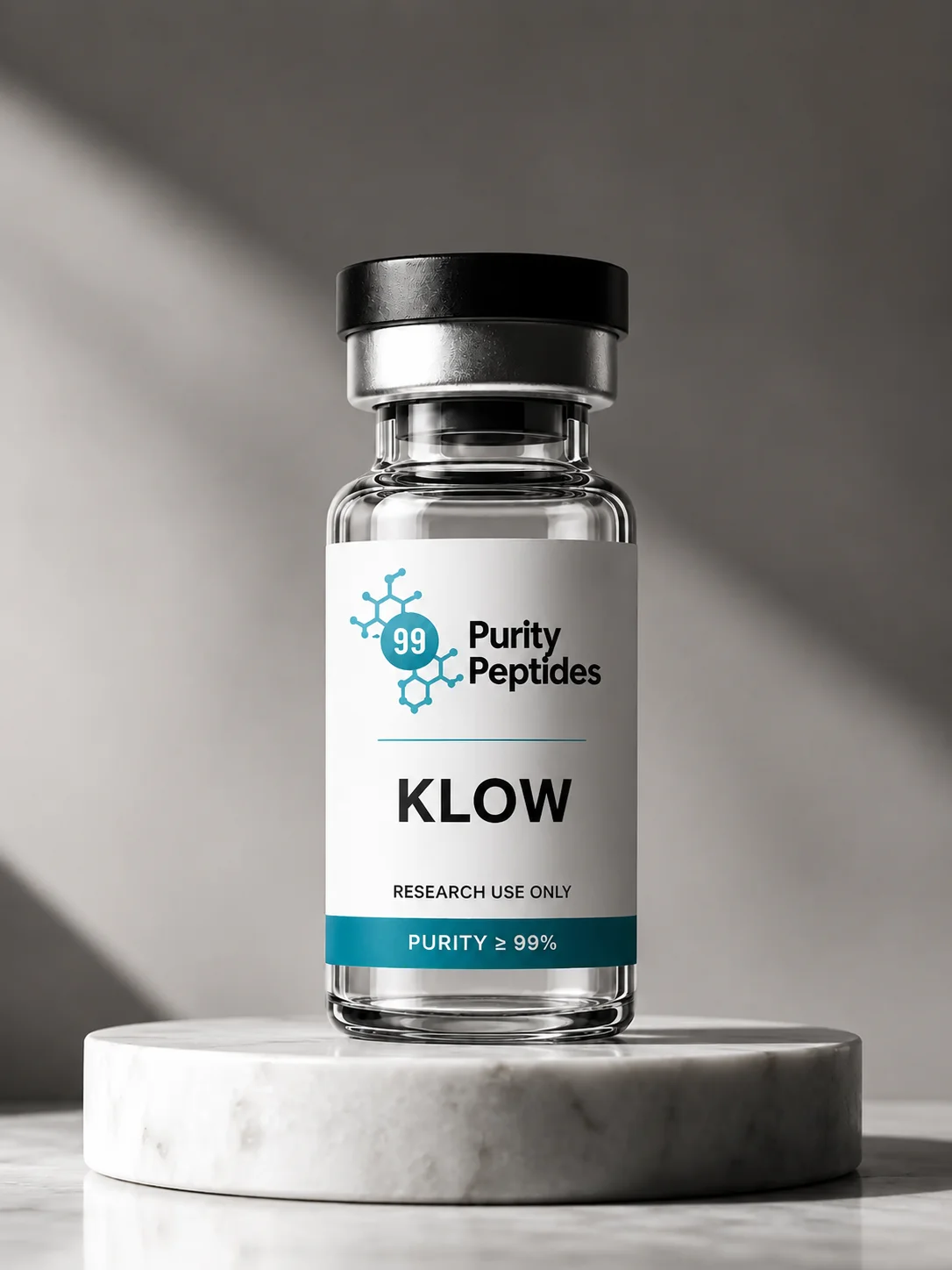
KLOW is a name used by peptide suppliers for a fixed-ratio, four-peptide research blend that combines GHK-Cu, BPC-157, TB-500, and KPV in a single vial. It is sold as a research-use-only material intended for laboratory and preclinical study — not as an approved medicine, a dietary supplement, or an over-the-counter wellness product.
It helps to understand that “KLOW” is not a scientific or regulatory name. It's an informal, vendor-created label — similar to how “GLOW” refers to a related three-peptide blend (more on that comparison below). Because there is no standardized definition, the exact composition, total peptide content, and even which components are included can vary from one supplier to the next. That variability is precisely why lot-specific documentation matters more here than it would for a single, well-characterized compound.
Key definition “Research use only” (RUO) describes a product's intended and labeled use — laboratory and preclinical research by qualified personnel. It is a labeling and commercial category, not a safety certification or a legal clearance for human use. |
Why KLOW Is Appearing in California's Wellness Conversation
California is home to one of the world's densest research and biotechnology ecosystems — the San Diego life-sciences corridor, the South San Francisco and greater Bay Area biotech cluster, and university-affiliated research programs across Los Angeles and Sacramento. That concentration of laboratories, researchers, and life-science professionals is one reason peptide research blends like KLOW surface so often in California-focused search and social conversation.
At the same time, individual components of KLOW have separately become popular topics in biohacking and skincare-adjacent communities: GHK-Cu is widely discussed in cosmetic-science literature, while BPC-157 and TB-500 circulate frequently in injury-recovery and longevity forums. That crossover has pulled a four-component blend like KLOW into general “wellness” conversation, even though the products themselves are sold and labeled for research use only.
It's an important distinction to hold onto: rising search interest and marketing visibility reflect cultural and commercial attention, not clinical validation. A compound trending in wellness discussion is not the same as a compound with established human safety or efficacy data — a point we return to later in this guide.
What Peptides Are in KLOW? Four Components Explained
Most vendors describing an 80mg KLOW research blend list four components in a roughly 50/10/10/10 milligram split: GHK-Cu, BPC-157, TB-500, and KPV. That ratio is common but not universal — always confirm the labeled composition against the product's own certificate of analysis rather than assuming any figure quoted online applies to a specific batch.
Component | Chemical Identity | Typical Share (80mg blend) | Primary Research Focus |
|---|---|---|---|
BPC-157 | Synthetic 15-amino-acid peptide (pentadecapeptide) | ~50mg | GI and musculoskeletal tissue models (mostly animal studies) |
GHK-Cu | Copper-binding tripeptide (Gly-His-Lys) | ~10mg | Extracellular matrix & connective-tissue signaling (in vitro) |
TB-500 | Synthetic fragment associated with thymosin beta-4 | ~10mg | Actin regulation and cell-migration research |
KPV | Tripeptide (Lys-Pro-Val) derived from alpha-MSH | ~10mg | Inflammatory-signaling pathway research (in vitro) |
GHK-Cu
GHK-Cu is a naturally occurring copper-binding tripeptide that has been studied since the 1970s in connective-tissue and wound-signaling research. Much of the published literature is in vitro and dermatological in focus, examining how the peptide interacts with fibroblasts and extracellular matrix remodeling. It's one of the more extensively documented components in this blend, though the great majority of that work remains preclinical.
BPC-157
BPC-157 is a synthetic pentadecapeptide sometimes described as related to a gastric-protective protein sequence. It has an extensive animal-model literature exploring gastrointestinal and musculoskeletal tissue repair. It is not FDA-approved for any use, and human clinical trial data remain limited — a regulatory picture covered in more detail below.
TB-500
TB-500 refers to a synthetic peptide fragment associated with thymosin beta-4, a protein studied for its role in actin regulation and cell migration. Research interest centers on wound-healing and tissue-remodeling models, again primarily at the cellular and animal-model stage rather than in controlled human trials.
KPV
KPV (Lysine-Proline-Valine) is a tripeptide derived from the C-terminal sequence of alpha-melanocyte-stimulating hormone (alpha-MSH). It has drawn research attention for anti-inflammatory signaling activity in vitro, studied independently of alpha-MSH's pigmentation-related effects.
Before you rely on any composition figure Composition can vary by supplier, and not every vendor's “KLOW” includes all four peptides in the same ratio. Cross-check the labeled composition against the lot-specific COA before designing any research protocol around it. |
KLOW vs. GLOW: What's the Difference?
GLOW is a related three-peptide research blend combining GHK-Cu, BPC-157, and TB-500 — the same three components found in KLOW, minus one. KLOW is, in effect, GLOW with a fourth peptide, KPV, added for its anti-inflammatory research profile.
Feature | KLOW | GLOW |
|---|---|---|
Components | GHK-Cu, BPC-157, TB-500, KPV | GHK-Cu, BPC-157, TB-500 |
Common total labeling | 80mg (varies by supplier) | ~70mg (varies by supplier) |
Added research angle | Inflammatory-pathway research via KPV | Tissue-remodeling focus only |
Evidence for the combination itself | Limited — not independently studied | Limited — not independently studied |
Intended use | Research use only | Research use only |
The practical takeaway is the same for both blends: component-level literature exists for GHK-Cu, BPC-157, TB-500, and KPV individually, but neither the three-peptide GLOW combination nor the four-peptide KLOW combination has been independently evaluated as a single formulation in controlled studies. Our full KLOW vs. GLOW comparison walks through the practical differences in more depth.
What the Research Actually Shows — and Doesn't
Key takeaway Evidence for individual KLOW components does not equal evidence for the KLOW combination. No published, controlled studies have evaluated the four-peptide blend as a single formulation, and none of its components is FDA-approved for human use. |
Each of KLOW's four components has its own preclinical or in vitro literature, summarized above. What doesn't exist, as of this writing, is a peer-reviewed study evaluating GHK-Cu, BPC-157, TB-500, and KPV together, at any specific ratio, as a combined formulation. Component-level findings are a reasonable starting point for a literature review — they are not proof that a blended product performs the same way, at the same doses, in combination.
The regulatory picture has also been shifting. In April 2026, the FDA removed BPC-157, TB-500, and KPV from the restricted “Category 2” bulk drug substances list it had previously used to flag compounding limitations. In July 2026, the agency's Pharmacy Compounding Advisory Committee (PCAC) reviewed BPC-157-related bulk substances and issued an advisory recommendation regarding possible inclusion on the 503A Bulks List. Neither step amounts to FDA approval, and neither authorizes marketing these peptides as approved drugs, supplements, or finished medicines. They are procedural developments in an ongoing regulatory review — useful context for researchers tracking the space, but not a green light for human use.
This is also why “research use only” labeling should never be read as a safety endorsement. It describes how a product is sold and intended to be used — by qualified personnel, in a laboratory setting — not whether it has been proven safe or effective for any other purpose.
How to Evaluate a KLOW Certificate of Analysis (COA)
A certificate of analysis is the single most useful document for evaluating any research peptide, including a multi-component blend like KLOW. Our purity verification guide covers how to audit any supplier's COA in more detail. Because KLOW combines four separate peptides, a single “overall purity” figure is less informative than a component-by-component breakdown — an aggregate number can mask an inaccurate ratio between the four peptides even when it looks reassuring on its own.
- Match the lot number printed on the vial or label to the lot number on the COA — a COA for the wrong lot tells you nothing about the product in hand.
- Verify the identity-confirmation method, typically LC-MS (liquid chromatography–mass spectrometry), and check that it confirms each expected peptide sequence.
- Check the purity method — usually HPLC (high-performance liquid chromatography) — and review the reported percentage for each individual component, not just an overall figure.
- Confirm the test date and the name of the testing laboratory; independent third-party testing generally carries more weight than in-house-only results.
- Cross-check the labeled composition (for example, 50mg / 10mg / 10mg / 10mg) against what the COA actually reports for that specific lot.
What California Researchers Should Look for in a Research Supplier
Because so much of California's research and biotech activity is institutional — university labs, contract research organizations, and biotech startups across San Diego, the Bay Area, and Los Angeles — buyers in this market often need documentation that goes beyond a basic product listing. A supplier checklist worth applying to any KLOW research peptide source:
- Lot-specific COA issued with every batch, not a generic or stock document
- Clearly disclosed identity (LC-MS) and purity (HPLC) testing methods
- Transparent, accurate labeling of the exact composition
- An explicit research-use-only intended-use statement on the product page
- Documented storage, handling, and shipping practices
- Identifiable, responsive contact information and business details
- No therapeutic, medical, or wellness claims anywhere on the listing
Suppliers who serve California's research market well tend to treat documentation as a baseline expectation, not an upsell — institutional buyers will ask for a COA, and often a safety data sheet (SDS), before a purchase order is even considered. Our buyer's guide to choosing high-purity research peptides covers this checklist for the wider research-peptide category, not just KLOW.
Research-Use-Only Disclaimer
KLOW and its individual components — GHK-Cu, BPC-157, TB-500, and KPV — are discussed and sold strictly for research, educational, and laboratory purposes. None of these compounds is approved by the FDA for human or veterinary use, and none is a dietary supplement, drug, or cosmetic. They are not intended to diagnose, treat, cure, or prevent any disease. Nothing in this article constitutes medical advice, and no claim of safety or efficacy for human use is made or implied. Handling should be limited to qualified personnel in appropriate laboratory settings, consistent with applicable institutional and legal requirements.
Key Takeaways
- KLOW is a vendor-created name for a four-peptide research blend — GHK-Cu, BPC-157, TB-500, and KPV — not a single molecule or an approved medicine.
- Composition varies by supplier; always confirm against a lot-specific COA rather than a generic figure found online.
- GLOW is the related three-peptide blend (without KPV); KLOW adds KPV for its inflammatory-pathway research profile.
- Component-level research exists for each peptide individually, but no published study has evaluated the KLOW combination as a formulation.
- BPC-157, TB-500, and KPV's removal from an FDA restricted list in April 2026 is a procedural update, not approval for human use.
- A trustworthy supplier provides a lot-specific COA with component-by-component identity (LC-MS) and purity (HPLC) results.
- KLOW is labeled and intended strictly for qualified research use — not for human or veterinary administration.
Sourcing KLOW for California Research
99 Purity Peptides ships KLOW research material with lot-matched analytical documentation to laboratories and researchers across California, including the San Diego, Bay Area, and Los Angeles research corridors referenced above.
Related resources
Resource | What it covers |
|---|---|
Product specification and current lot documentation | |
Full composition breakdown, per-component mass | |
Mechanism, per-component literature, dosing math | |
Structural and research-application differences | |
Lot-matched HPLC and mass spectrometry documentation | |
Delivery estimates and regional shipping details |
Frequently Asked Questions
What is KLOW peptide?
KLOW is a name used by research-peptide suppliers for a fixed-ratio, four-component research blend combining GHK-Cu, BPC-157, TB-500, and KPV. It is sold for laboratory research use only and is not an approved medicine or supplement.
What peptides are in KLOW?
A typical KLOW blend contains four components: GHK-Cu, BPC-157, TB-500, and KPV, commonly labeled in roughly a 50mg / 10mg / 10mg / 10mg split within an 80mg total. Exact composition varies by supplier.
Is KLOW the same as GLOW?
No. GLOW is a related three-peptide blend of GHK-Cu, BPC-157, and TB-500. KLOW contains those same three peptides plus a fourth, KPV.
Is KLOW FDA-approved?
No. None of KLOW's four components is FDA-approved for human use. BPC-157, TB-500, and KPV were removed from an FDA restricted bulk-substances list in April 2026, but that procedural change is not drug approval.
Is KLOW intended for human use?
No. KLOW is labeled and sold as a research-use-only material intended for qualified laboratory and preclinical research, not for human or veterinary administration.
How can I verify KLOW's purity?
Request the lot-specific certificate of analysis (COA) and confirm it reports both an identity test (typically LC-MS) and a purity test (typically HPLC) for each of the four components individually.
Does research on individual peptides prove the KLOW blend works?
No. Component-level studies on GHK-Cu, BPC-157, TB-500, and KPV do not establish how those peptides behave when combined. No published study has evaluated the KLOW combination as a single formulation.
What should a KLOW certificate of analysis include?
A credible COA should include the matching lot number, the identity-testing method, purity results for each component, the test date, and the name of the testing laboratory.
Why is KLOW gaining attention in California specifically?
California's dense biotech and research ecosystem — spanning San Diego, the Bay Area, and Los Angeles — combined with growing biohacking-community interest in its individual components, has driven rising search and commercial visibility for blends like KLOW.
Can KLOW composition vary between suppliers?
Yes. Because “KLOW” is a vendor-created name rather than a standardized formulation, the ratio, total content, and even which components are included can differ from one supplier to another.
What is the research context for KPV in KLOW?
KPV is studied in vitro for anti-inflammatory signaling activity, independent of its parent hormone alpha-MSH's pigmentation-related effects.
What are the main evidence limitations for KLOW?
The primary limitation is that no controlled, peer-reviewed study has evaluated the four-peptide combination itself; available literature covers the individual components, mostly in animal or in vitro models.