Florida searches for “KLOW peptide” have picked up fast, and what comes back is confusing. Some pages present it as a Florida peptide therapy program. Others sell it as a research compound with a certificate of analysis and nothing else. If you're trying to work out what KLOW peptide actually is, whether the benefit claims hold up, what it costs in Florida, and what a legitimate supplier should show you before you buy, the answers are scattered across clinic marketing pages and research-vendor listings that rarely agree with each other.
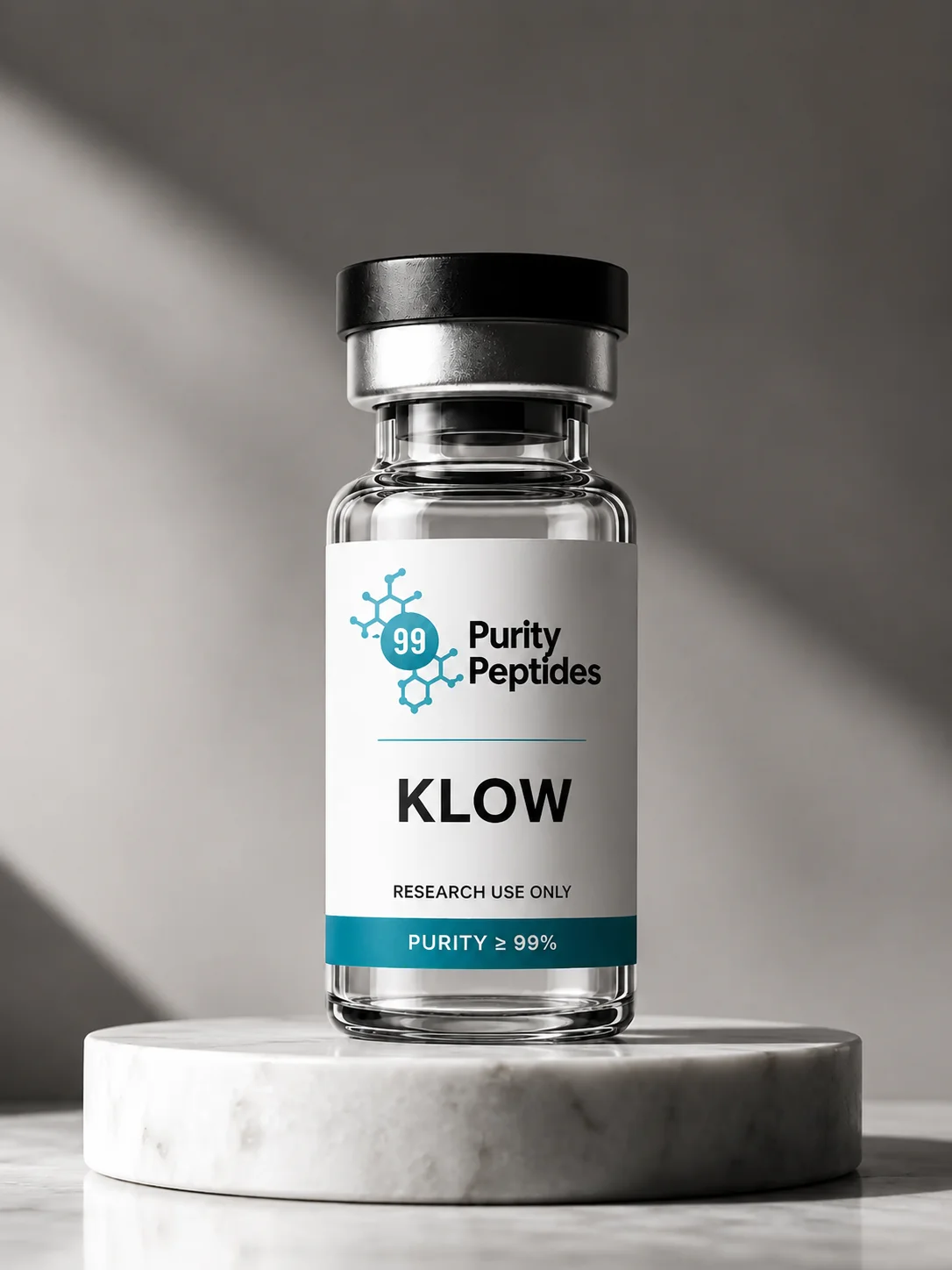
This guide pulls that apart. We'll define KLOW peptide and its commonly reported components, walk through what published research actually supports versus what's still preclinical or unproven, compare how Florida clinics and research suppliers talk about pricing, and give you a practical checklist for verifying a KLOW peptide COA before you spend money. See our full KLOW composition breakdown for the exact per-component mass on our own lot documentation.
Before you read on KLOW peptide products sold as research use only are not approved by the FDA for human use. This guide is written for research and educational purposes. Nothing here is medical advice, and nothing here should be read as a treatment recommendation. |
What Is KLOW Peptide?
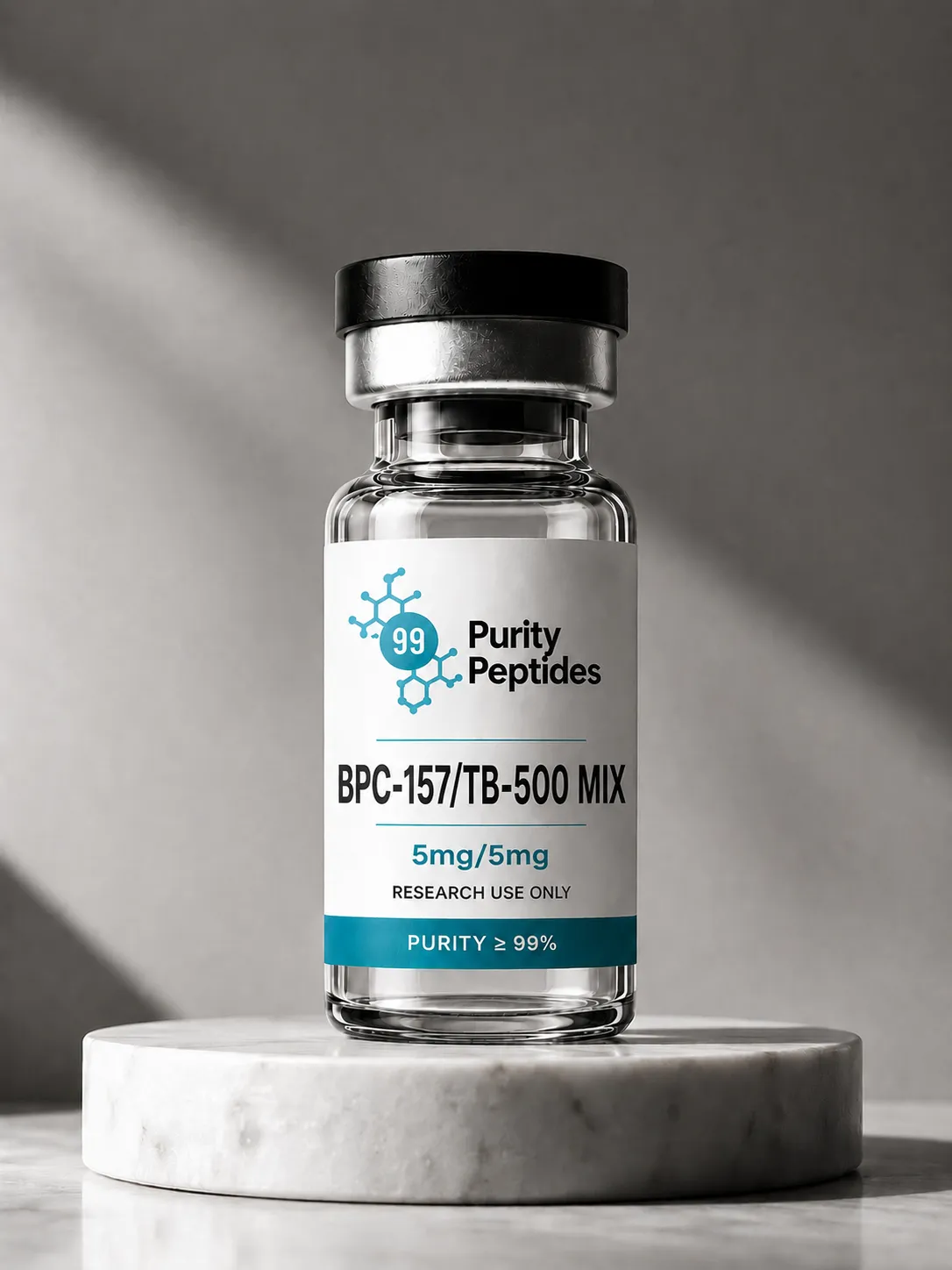
KLOW is the name used across Florida clinic pages and research-peptide vendor listings for a multi-peptide blend commonly associated with four components: BPC-157, TB-500 (marketed as a thymosin beta-4 fragment), GHK-Cu, and KPV. There is no single regulated formula for KLOW — exact ratios and concentrations vary by seller, so any specific product should be checked against its own certificate of analysis before you rely on it.
Because “KLOW” isn't a standardized pharmaceutical name, the same label can mean slightly different things depending on which supplier or clinic is using it. That's common in the compounded and research-peptide space, but it means the name alone tells you less than you'd expect. What matters is what a specific batch actually contains, not what the product is called.
The Four Components Commonly Associated with KLOW
Component | What It Is | Research Context |
|---|---|---|
A synthetic peptide derived from a protein sequence found in gastric juice. | Studied mostly in animal and cell-based (in vitro) models related to tissue and gut research; human clinical evidence remains limited. | |
Often marketed as a fragment related to thymosin beta-4, a naturally occurring peptide. | Studied in laboratory settings for cell migration and actin regulation; distinct from full-length thymosin beta-4 human research. | |
A naturally occurring copper-binding tripeptide. | Studied in dermatology and wound-model research; some human dermatological studies exist for GHK-Cu itself, separate from the KLOW blend. | |
A tripeptide derived from alpha-MSH. | Studied in preclinical inflammatory-signaling research. |
Key point Component evidence is not blend evidence. Even where one ingredient has published research behind it, that doesn't mean the combined KLOW blend has been studied as a single product. |
Verifying What's Actually in a Specific KLOW Product
Because formulas vary by seller, treat the label as a starting point, not a guarantee:
- Check the label claims against a current, batch-matched certificate of analysis (COA).
- Confirm the stated concentration per vial rather than assuming a standard dose.
- Ask the supplier for the batch number tied to the product you're viewing.
- Cross-check which identity testing method was used — HPLC, LC-MS, or both.
KLOW Peptide Benefits: What Research Supports vs. What It Doesn't
Most of what's written online about KLOW peptide benefits actually describes benefits attributed to its individual components in preclinical research — not the blend itself. No published human clinical trial has evaluated the four-peptide KLOW combination as a single product, so any claim about the blend's effects is, at best, an extrapolation from separate ingredient-level studies.
Evidence Tiers, Component by Component
Research Area | Evidence Level | What This Means |
|---|---|---|
Tissue/gut-related research interest (BPC-157) | Preclinical (animal, in vitro) | Not evidence of an effect in humans. |
Cell migration research (TB-500 fragment) | Preclinical (cell-based) | Distinct from full-length thymosin beta-4 human data. |
Skin-related research (GHK-Cu) | Some human dermatological research exists for GHK-Cu itself | Doesn't establish outcomes for the injectable KLOW blend. |
Inflammatory signaling research (KPV) | Preclinical | Early-stage research only. |
KLOW blend as a combined product | No published human clinical trials identified | Any “benefits” language about the blend itself is not clinically established. |
Key point If a page states that KLOW treats an injury, reverses aging, or heals joints, that's a claim the current published research doesn't support for the combined blend — regardless of how confident the wording sounds. |
What Florida Clinics Are Saying About “KLOW Peptide Therapy”
A pattern shows up across current Florida search results: wellness clinics in South Florida, Miami, and Doral offer “KLOW peptide therapy” as part of a supervised program, typically bundled with a consultation. Research-peptide vendors based in Tampa, Miami, and Boca Raton sell what they describe as the same blend, but positioned strictly as a research product with a COA and lab-testing documentation, explicitly not intended for human use.
Where You'll See It | How It's Framed |
|---|---|
Clinic wellness pages (South Florida, Miami, Doral) | Positioned as a supervised program alongside consultation and monitoring. |
Research-peptide vendor listings (Tampa, Miami, Boca Raton) | Positioned as a research-use-only compound with COA and lab-testing documentation. |
Key point “Therapy” is clinic marketing language tied to a supervised service. A research-use-only product and a clinic program are two different business models with different regulatory obligations — don't assume the two are interchangeable just because they share a name. |
Is KLOW Peptide FDA Approved?
No. KLOW, as a blend, is not FDA-approved for any use. Its associated components — including TB-500 and other bulk substances discussed in this space — have been identified by the FDA as substances that may present significant safety risks when compounded for human use. Products sold as “research use only” are intended for laboratory and research settings, not for human consumption.
Regulatory attention in this category is active rather than settled. The FDA's Pharmacy Compounding Advisory Committee has continued to review bulk substances connected to peptides like BPC-157, KPV, and TB-500, and FDA warning letters in this space have made clear that a “research use only” label does not shield a seller from enforcement if the surrounding marketing implies a product is meant for human use.
Key point A research-use-only disclaimer is a labeling statement, not a safety guarantee. It doesn't change what's actually known — or not known — about a product's effects in people. |
KLOW Peptide Cost in Florida: Clinic Pricing vs. Research Supplier Pricing
Pricing for anything sold under the KLOW name varies widely depending on whether you're looking at a clinic program or a research-supplier listing, and figures change often. Treat the ranges below as a general market snapshot rather than a quote.
Channel | Typical Positioning | What's Usually Included | Price Range Observed (Aug 2026) |
|---|---|---|---|
Florida wellness clinic program | Clinic-supervised, “therapy” framing | Consultation, monitoring, dispensing | Roughly $250–$600+ per month, clinic-reported and highly variable |
Research-peptide vendor | Research-use-only product | Vial(s), COA, batch documentation | Varies by concentration and vendor — check the current listing alongside its COA |
Key point Treat every price you see online as a snapshot, not a guarantee. Confirm current pricing, concentration, and the matching COA directly with the seller before comparing across suppliers. |
How to Read a KLOW Peptide COA: HPLC, LC-MS, Purity, and Batch Traceability
A certificate of analysis (COA) is a lab report showing what was actually measured in a specific batch of product — identity, purity, and sometimes contaminant screening. A COA is only useful if it matches the exact batch you're holding. Our purity verification guide covers this same nine-point audit for any research-peptide supplier, not just KLOW.
Five Steps to Verify a KLOW COA
- Confirm the COA's batch number matches the batch number printed on your specific product.
- Check the identity test method — HPLC and/or LC-MS — and confirm it identifies each labeled peptide.
- Look for a stated purity percentage, not just a generic pass/fail statement.
- Confirm the COA is dated and issued by an independent, named testing lab, not only an in-house claim from the seller.
- Cross-check that the COA reflects the exact product you're viewing, not a generic or outdated file reused across multiple listings.
Quick Definitions
- HPLC (high-performance liquid chromatography): a lab method used to separate and measure the components in a sample, commonly used to assess purity.
- LC-MS (liquid chromatography–mass spectrometry): a lab method that identifies compounds by mass, commonly used to confirm a peptide's identity.
KLOW Peptide vs. BPC-157 Alone vs. BPC-157 + TB-500
Because KLOW combines four ingredients, it's worth comparing it against simpler research-peptide combinations that are also common in this market. Our KLOW vs. GLOW comparison covers the closest related blend in more depth.
Product | Components | What to Know |
|---|---|---|
BPC-157 alone | Single peptide | The most-studied single component in this group; still preclinical for the peptide itself. |
BPC-157 + TB-500 | Two peptides | A common two-peptide research combination; still no published combined-product human trials. |
KLOW (BPC-157 + TB-500 + GHK-Cu + KPV) | Four peptides | The broadest ingredient list of the three — and the broadest evidence gap for blend-level claims. |
Florida Buyer Checklist: How to Compare Research Peptide Suppliers
If you're evaluating research-peptide suppliers serving Florida, the documentation matters more than the marketing copy. See our buyer's guide to choosing high-purity research peptides for the full sourcing checklist.
What to Look For
- Clear “research use only” labeling on the product page and packaging.
- A current, batch-matched COA — not a generic file reused across products.
- A named, independent third-party testing lab behind the COA.
- A transparent shipping, storage, and return policy.
- Verifiable company and contact information.
- No explicit or implied human dosing instructions on the product page.
Common Mistakes to Avoid
- Assuming the lowest price automatically means the best value.
- Treating a customer testimonial as if it were clinical evidence.
- Assuming a “research use only” label alone verifies purity or identity.
- Skipping the step of matching a COA to the specific batch number on your product.
KLOW Peptide Side Effects and What's Not Yet Known
Because no published clinical trial has tested the combined KLOW blend, there is no established human side-effect profile for the product as sold. Component-level preclinical research doesn't translate into a human safety profile, and unregulated research chemicals carry additional risk from unknown purity, contamination, or mislabeling.
This article does not provide dosing or administration guidance, and it isn't a substitute for professional medical advice. If you're weighing any product in this category for yourself, that conversation belongs with a licensed healthcare professional — not a blog post or a product listing.
Key Takeaways
- KLOW is an unstandardized name for a four-peptide blend — commonly BPC-157, TB-500, GHK-Cu, and KPV — and the exact formula varies by seller.
- Component-level preclinical research does not equal evidence for the combined blend; no published human trial has tested KLOW as a single product.
- KLOW is not FDA-approved, and “research use only” labeling is a legal disclaimer, not a safety guarantee.
- Florida clinics market KLOW as a supervised “therapy” program; research suppliers sell it strictly as a research-use-only compound — these are different offerings.
- Pricing varies widely between clinic programs and research suppliers, and third-party figures should always be treated as a snapshot.
- A trustworthy supplier provides a current, batch-matched COA from a named independent lab, not just a label claim.
Sourcing KLOW for Florida Research
99 Purity Peptides ships KLOW research material with lot-matched analytical documentation to laboratories and researchers across Florida, including the Miami, Tampa, and Orlando research hubs referenced above.
Related resources
Resource | What it covers |
|---|---|
Product specification and current lot documentation | |
Full composition breakdown, per-component mass | |
Mechanism, per-component literature, dosing math | |
Structural and research-application differences | |
Lot-matched HPLC and mass spectrometry documentation | |
Delivery estimates and regional shipping details |
Frequently Asked Questions
What is KLOW peptide?
KLOW is an unstandardized name used for a multi-peptide research blend commonly associated with BPC-157, TB-500, GHK-Cu, and KPV. Formulas vary by seller, so a specific product's contents should always be checked against its own certificate of analysis.
What is KLOW peptide used for in research?
In research settings, the individual components of KLOW are studied in areas like tissue biology, cell migration, dermatology, and inflammatory signaling. The combined KLOW blend itself has not been evaluated in published human clinical research.
What ingredients are commonly found in KLOW?
Listings commonly cite four components: BPC-157, TB-500 (marketed as a thymosin beta-4 fragment), GHK-Cu, and KPV. Exact ratios and concentrations differ between suppliers.
Is KLOW FDA approved?
No. KLOW is not FDA-approved as a blend, and its associated components have been flagged by the FDA in connection with safety concerns for human compounding. Research-use-only products are not intended for human consumption.
Is KLOW intended for human use?
Products labeled research use only are intended for laboratory and research settings, not human use. Clinic programs that offer KLOW as a wellness therapy operate under a different model than research-only suppliers.
Does KLOW have human clinical evidence?
No published human clinical trial has evaluated the combined four-peptide KLOW blend. Some individual components have limited human or preclinical research, but that doesn't establish evidence for the blend as a whole.
What is the difference between blend-level and component-level evidence?
Component-level evidence comes from studying one ingredient on its own. Blend-level evidence would come from studying the combined product as sold. KLOW currently has component-level research at most, not blend-level clinical evidence.
How should researchers verify KLOW purity?
Request a current certificate of analysis matched to the exact batch number on the product, confirm the identity testing method used (HPLC and/or LC-MS), and check that results come from a named, independent testing lab.
What is a KLOW COA?
A certificate of analysis (COA) is a lab document reporting what was measured in a specific batch, including identity and purity results. It's only meaningful if it corresponds to the exact batch you have.
How much does KLOW cost in Florida?
Pricing varies by channel. Clinic wellness programs typically bundle consultation and monitoring into a monthly fee, while research suppliers price by vial and concentration. Always confirm current pricing directly with the seller, since figures change.
Why do prices vary between clinics and research suppliers?
Clinic pricing usually includes consultation, supervision, and dispensing as part of a service. Research-supplier pricing reflects the product and its documentation only, without a clinical service attached.
What does “research use only” mean?
It means a product is labeled and intended for laboratory or research settings, not for human consumption. It's a legal and marketing designation, not a certification of safety for human use.
How does KLOW differ from BPC-157 alone?
BPC-157 alone is a single-ingredient research peptide, while KLOW combines it with three additional components. More ingredients does not mean more established evidence — the evidence gap widens as more ingredients are combined without blend-specific studies.
Where can I find KLOW research information in Florida?
Look for suppliers that publish current, batch-matched COAs, name their testing labs, and clearly separate research-use-only positioning from clinical or treatment claims.