Quick Answer
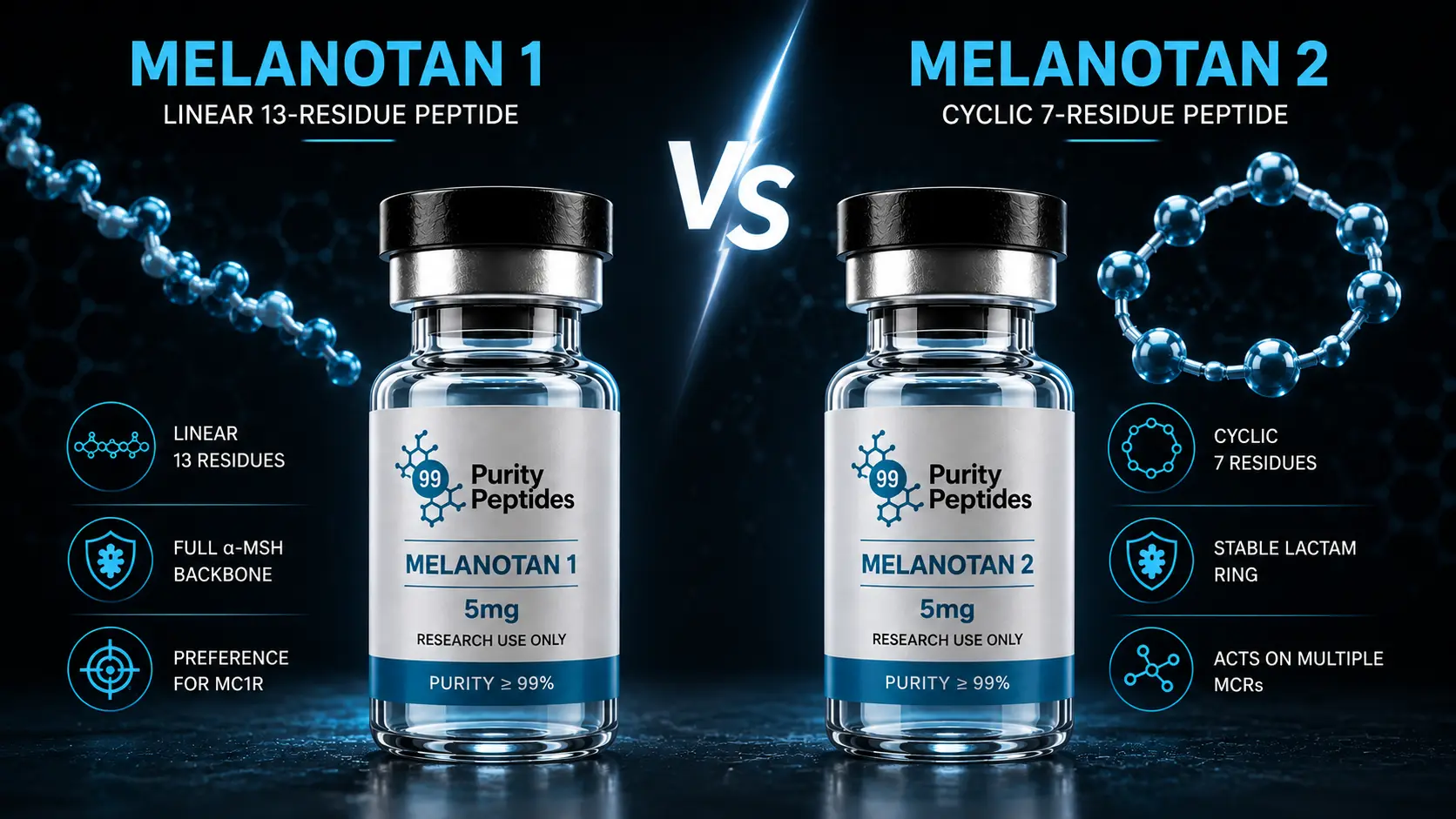
Melanotan 1 and Melanotan 2 are both synthetic analogues of alpha-melanocyte-stimulating hormone (α-MSH), and both contain the identical His-D-Phe-Arg-Trp core that melanocortin receptors recognize. The difference is the scaffold built around that core. Melanotan 1 (afamelanotide) is a linear 13-residue peptide of 1,646.9 Da that keeps the full α-MSH backbone. Melanotan 2 is a cyclic 7-residue lactam of 1,024.2 Da that discards everything outside the binding region and locks the remainder into a constrained ring. Both bind multiple melanocortin receptor subtypes rather than one.
⚠️ Research Use Only
All compounds discussed on this page are supplied by 99 Purity Peptides for laboratory and analytical research exclusively. They are not for human or veterinary use, ingestion, injection, or administration of any kind, and are not intended to diagnose, treat, cure, or prevent any disease. Nothing here is medical, dosing, or health guidance. Afamelanotide is separately available as an approved pharmaceutical product under a different manufacturer, formulation, and regulatory authorization; that product is not what is sold here, and the two must not be conflated.
Key Takeaways
- Both compounds share the conserved His-D-Phe-Arg-Trp message sequence, the minimal region required for melanocortin receptor agonism. Their structural divergence sits entirely outside that core.
- Melanotan 1 is linear and 13 residues (C₇₈H₁₁₁N₂₁O₁₉, 1,646.9 Da, CAS 75921-69-6). Melanotan 2 is cyclic and 7 residues (C₅₀H₆₉N₁₅O₉, 1,024.2 Da, CAS 121062-08-6).
- The widely repeated claim that MT-1 is "MC1R-selective" overstates the pharmacology. Published binding data show nanomolar affinity at MC1R, MC3R, MC4R, and MC5R, with a strong preference for MC1R rather than exclusivity.
- Melanotan 2 is consistently characterized in the peer-reviewed literature as a non-selective melanocortin receptor agonist, and its MC3R/MC4R activity is why a distinct central-signaling research literature exists for it.
- Afamelanotide is an approved drug; Melanotan 2 is not. The FDA approved SCENESSE (afamelanotide) on October 8, 2019 for a rare photosensitivity disorder. Melanotan 2 has never been approved in any jurisdiction.
- The approved product is a controlled-release implant, not lyophilized powder. Formulation, not just molecule, defines its regulatory identity.
- Independent analysis of gray-market MT-2 vials found actual peptide content of 4.32–8.84 mg against a 10 mg label, which is why lot-specific COA verification matters more here than in most compound classes.
What Is Melanotan? The Shared Origin
Both compounds descend from the same parent molecule: alpha-melanocyte-stimulating hormone. α-MSH is a linear 13-residue peptide cleaved from pro-opiomelanocortin (POMC), with the sequence Ac-Ser-Tyr-Ser-Met-Glu-His-Phe-Arg-Trp-Gly-Lys-Pro-Val-NH₂ and a molecular weight of 1,664.9 Da. It signals through a family of five G protein-coupled receptors designated MC1R through MC5R.
Native α-MSH has two practical problems as a research tool. It degrades quickly under enzymatic attack, and its methionine at position 4 carries an oxidation-prone thioether. Both Melanotan compounds were designed at the University of Arizona in the 1980s to address exactly these liabilities, and both solved them the same way.
Which part of the molecule actually does the binding?
Receptor recognition concentrates in a four-residue stretch. Structure-activity work on the melanocortin "message" sequence identified Ac-His-D-Phe-Arg-Trp-NH₂ as a minimal tetrapeptide retaining agonist activity at both hMC1R and hMC4R.[1] Everything else in α-MSH modulates affinity, stability, and distribution rather than supplying the core pharmacophore.
That fact explains the entire MT-1 versus MT-2 divergence. Two design teams kept the same message sequence and made opposite decisions about what to do with the rest of the molecule.
Melanotan 1 (Afamelanotide): Sequence and Mechanism
Melanotan 1 preserves the full α-MSH backbone and changes two residues. Its sequence is Ac-Ser-Tyr-Ser-Nle-Glu-His-D-Phe-Arg-Trp-Gly-Lys-Pro-Val-NH₂, which is why the compound is also written as [Nle⁴, D-Phe⁷]-α-MSH, or NDP-α-MSH.
The two substitutions are deliberate and each addresses a specific failure mode. Norleucine replaces methionine at position 4, removing the sulfur atom and with it the oxidation pathway that limits native α-MSH stability. The molecular formula shifts from C₇₇H₁₀₉N₂₁O₁₉S to C₇₈H₁₁₁N₂₁O₁₉, and the mass drops from 1,664.9 Da to 1,646.9 Da. Inverting L-phenylalanine to D-phenylalanine at position 7 confers resistance to proteolytic cleavage while improving receptor engagement.
Is Melanotan 1 really MC1R-selective?
Not in the strict pharmacological sense, and the imprecision on this point is widespread across competing pages. Compiled binding data for NDP-α-MSH report Ki values of 0.085 nM at MC1R, 0.4 nM at MC3R, 3.8 nM at MC4R, and 5.1 nM at MC5R.[2] Peer-reviewed characterization describes the analogue as possessing nanomolar efficacy at every melanocortin subtype except MC2R.[1]
Sub-nanomolar affinity at MC1R alongside single-digit nanomolar affinity at MC4R represents roughly a 45-fold preference. Preference is meaningful, and it is not the same claim as selectivity. Where MC1R dominates the observed pharmacology, expression pattern does much of the work: MC1R sits peripherally on melanocytes, while MC3R and MC4R are concentrated in the central nervous system behind the blood-brain barrier.
The approved product and the research material are not the same thing
The afamelanotide vs Melanotan distinction is a naming problem with real regulatory weight. The FDA approved SCENESSE (afamelanotide) on October 8, 2019 under NDA 210797, sponsored by Clinuvel Pharmaceuticals, to increase pain-free light exposure in adult patients with a history of phototoxic reactions from erythropoietic protoporphyria (EPP).[3][4] EPP is a rare inherited disorder in which reduced ferrochelatase activity causes protoporphyrin IX to accumulate. The application carried Priority Review and Orphan Drug designations. European authorization preceded it, with EU commercial marketing beginning June 22, 2016.[4]
That approved product is a 16 mg bioresorbable implant placed subcutaneously by a trained clinician every two months.[3] The distinction between molecule and formulation matters analytically as well as legally: the peptide itself has a short circulating half-life of roughly 30 minutes, whereas the controlled-release implant produces an apparent half-life near 15 hours with a median Tmax of 36 hours.[3]
99 Purity Peptides supplies lyophilized Melanotan 1 as research material. It is not SCENESSE, carries no approved indication, and has no therapeutic authorization of any kind. This separation follows the same pattern applied elsewhere on this site to Tesamorelin and its approved counterpart.
Melanotan 2: Sequence and Mechanism
Melanotan 2 discards the α-MSH backbone and cyclizes what remains. Its sequence is Ac-Nle-cyclo[Asp-His-D-Phe-Arg-Trp-Lys]-NH₂, formally written as Ac-Nle⁴-Asp⁵-His⁶-D-Phe⁷-Arg⁸-Trp⁹-Lys¹⁰-α-MSH(4-10)-NH₂.[5]
The design keeps residues 4 through 10 of α-MSH and deletes the rest. A side-chain lactam bridge then links the aspartate carboxyl to the lysine ε-amino group, closing the fragment into a ring.[6] Melanotan 2 retains the same Nle and D-Phe substitutions found in Melanotan 1, so both compounds carry identical stability modifications around an identical binding core.
What does the lactam bridge accomplish?
Cyclization restricts conformational freedom. A linear peptide samples many shapes in solution, and only some present the pharmacophore correctly to the receptor. Locking the backbone into a ring reduces the entropic penalty of binding and simultaneously removes accessible termini that exopeptidases would otherwise attack. The result is a molecule of 1,024.2 Da, roughly 62% the mass of Melanotan 1, that was characterized on introduction as a superpotent cyclic melanotropin.
Which receptors does Melanotan 2 activate?
Published work consistently describes Melanotan 2 as a non-selective melanocortin receptor agonist with activity spanning MC1R, MC3R, MC4R, and MC5R.[7] In rodent neuroscience literature it is most often labelled simply as an MC3R/MC4R agonist, reflecting which receptors dominate in the tissue under study.[8]
The mechanistic consequence follows directly from receptor distribution. MC1R sits on peripheral melanocytes. MC3R and MC4R are expressed predominantly in the rodent brain, while MC1R, MC2R, and MC5R appear mainly in the periphery.[7] A compound with meaningful potency at the central subtypes therefore generates a research literature that a peripherally-weighted compound does not.
Side-by-Side Comparison Table
The table below sets out the MT-1 vs MT-2 differences that matter for study design. Read as a melanocortin receptor peptide comparison, the pattern is consistent: shared pharmacophore, divergent scaffold, divergent regulatory standing.
Attribute | Melanotan 1 (Afamelanotide) | Melanotan 2 |
|---|---|---|
Sequence | Ac-Ser-Tyr-Ser-Nle-Glu-His-D-Phe-Arg-Trp-Gly-Lys-Pro-Val-NH₂ | Ac-Nle-cyclo[Asp-His-D-Phe-Arg-Trp-Lys]-NH₂ |
Residue count | 13 (tridecapeptide) | 7 (heptapeptide) |
Structural class | Linear α-MSH analogue | Cyclic lactam α-MSH(4-10) analogue |
Conserved message core | His-D-Phe-Arg-Trp | His-D-Phe-Arg-Trp (identical) |
Molecular formula | C₇₈H₁₁₁N₂₁O₁₉ | C₅₀H₆₉N₁₅O₉ |
Molecular weight | 1,646.9 Da | 1,024.2 Da |
CAS number | 75921-69-6 | 121062-08-6 |
Substitutions vs α-MSH | Nle⁴, D-Phe⁷ | Nle⁴, Asp⁵, D-Phe⁷, Lys¹⁰ plus cyclization; residues 1-3 and 11-13 deleted |
Reported receptor affinity | Ki 0.085 nM (MC1R), 0.4 nM (MC3R), 3.8 nM (MC4R), 5.1 nM (MC5R)[2] | Non-selective across MC1R, MC3R, MC4R, MC5R; subtype-specific Ki values vary by assay system |
Receptor characterization | Nanomolar efficacy at all subtypes except MC2R; strong MC1R preference | Non-selective agonist; MC3R/MC4R activity dominant in CNS models |
Regulatory status | Approved as SCENESSE (FDA, Oct 8 2019; EU marketing from Jun 22 2016) | No approval in any jurisdiction |
Approved formulation | 16 mg subcutaneous controlled-release implant | None |
Peptide half-life | ~30 min (peptide); ~15 h apparent (implant) | Not established in controlled human PK studies |
Primary research context | MC1R signaling, melanogenesis pathways, photobiology, cAMP/PKA cascades | Melanocortin receptor pharmacology, central MC3R/MC4R signaling, energy balance models |
Notable derivative | — | Bremelanotide (PT-141), a metabolite differing by a C-terminal carboxyl in place of the amide |
99PP research formats |
Why Receptor Selectivity Matters
Receptor breadth is the single variable that best explains why these two compounds accumulated different research literatures. The reasoning is mechanistic rather than anecdotal, and it holds regardless of what any individual study reports.
MC1R activation on melanocytes couples to Gs, raising intracellular cAMP and activating protein kinase A. That cascade converges on MITF and downstream pigmentation genes. A compound weighted toward MC1R therefore generates research clustered in pigment cell biology, photobiology, and GPCR signaling.
MC3R and MC4R sit elsewhere. MC4R in particular has a well-established regulatory role in energy homeostasis and food intake, and much of what is known about it came from central administration of Melanotan 2 itself. Initial studies implicating MC4R in feeding behavior were built on central delivery of MT-II into rodents.[9] Later knockout work sharpened the attribution: in mice lacking MC4R, centrally administered MT-II failed to alter consumption, while MC3R-null animals retained the response.[7]
The mechanism, stated precisely
Melanotan 2 is studied more broadly than Melanotan 1 because it engages centrally-expressed receptor subtypes with sufficient potency to serve as a pharmacological probe for those pathways. That is a statement about which receptors a molecule can interrogate in a research model. It is not a claim about outcomes, effects, or anything observable in a person, and nothing on this page should be read that way.
This same property drove a downstream development program. Bremelanotide, formerly PT-141, is a metabolite of Melanotan 2 that differs by carrying a C-terminal carboxyl where MT-2 carries an amide, giving it a molecular weight of about 1,025.2 Da. Palatin Technologies discontinued Melanotan 2 development in 2000 and pursued bremelanotide instead. 99 Purity Peptides supplies PT-141 as research material for laboratories running comparative melanocortin work.
What the Published Research Actually Covers for Each
The two evidence bases are asymmetric, and the asymmetry runs deeper than volume. One compound completed a regulated development program. The other did not.
Melanotan I research
Afamelanotide carries the more rigorous record. Efficacy for the approved indication rested on two parallel-group, placebo-controlled trials. The first enrolled 93 subjects, 48 of whom received the active implant, followed for 180 days. The second followed 74 patients for 270 days.[4] The pivotal results were published in the New England Journal of Medicine in 2015.[10] Pharmacokinetic parameters are characterized in the approved labeling.[3]
Outside the EPP indication, the linear analogue appears widely as a reference agonist in receptor pharmacology. Radiolabelled ¹²⁵I-NDP-α-MSH is a standard competing ligand in melanocortin binding assays, which is a large part of why its affinity profile is so well documented. It also appears in neuroinflammation work, including studies of MC4R-mediated modulation of microglial activation.[11]
Melanotan II research
The Melanotan II research record is thinner where it counts and substantial where it does not. On the substantial side, MT-II is one of the best-characterized tools in melanocortin neuroscience. Rodent studies using central or site-specific delivery have mapped MC3R/MC4R contributions to ingestive behavior and related pathways, including microinjection work in the nucleus accumbens.[8]
On the thin side, human data barely exist. The compound reached a pilot phase-I study in three volunteers published in 1996.[5] No phase III program was completed, and no regulatory agency has approved it. Where a controlled clinical record would sit, the literature instead contains published case reports describing serious adverse events following unsupervised use, including rhabdomyolysis with renal dysfunction[12] and priapism.[13] Additional reports describe melanoma and nevus changes following melanotropic peptide use, though causation remains unestablished.
Note
Stating this honestly is the point. The absence of a controlled human dataset for Melanotan 2 is a documented feature of the literature, not an omission from this page. Any source presenting MT-2 as having a validated human safety or efficacy profile is describing something that has not been published.
Reconstitution and Storage
Concentration math is identical for both compounds because it depends only on mass and volume, not on sequence. Divide the labeled vial mass by the volume of solvent added:
Concentration (mg/mL) = vial mass (mg) ÷ solvent volume (mL)
For the 10 mg vials both compounds ship in:
Solvent added | Resulting concentration |
|---|---|
1 mL | 10 mg/mL |
2 mL | 5 mg/mL |
3 mL | 3.33 mg/mL |
5 mL | 2 mg/mL |
Two sequence-specific stability notes are worth carrying into storage decisions. Melanotan 1 has no methionine, since norleucine replaced it, so the classic +16 Da methionine oxidation signature will not appear on a clean lot. Both compounds retain tryptophan, however, and Trp is independently oxidation-susceptible. Light protection therefore matters for both. Melanotan 2's cyclic backbone also removes the free termini that exopeptidases target, which is a stability advantage the linear compound does not have.
Lyophilized material stores at -20°C or below in a dry, dark environment. Reconstituted solution has a substantially shorter usable window under refrigeration, and repeated freeze-thaw cycles degrade both compounds. Aliquot rather than cycling a single vial.
The full mg-to-mL reference across every vial size lives on the peptide reconstitution chart, and complete degradation-pathway and cold-chain guidance sits in the peptide storage guidelines. The peptide calculator handles the arithmetic directly.
Purity & COA Verification
This compound class has a documented authenticity problem, which makes lot-specific verification more than a formality. A 2015 study in Drug Testing and Analysis used LC-UV-MS/MS to analyze Melanotan 2 vials purchased from three online shops, each labeled as containing 10 mg. Measured peptide content ranged from 4.32 to 8.84 mg, with every vial falling short of its label. Vials from two of the three shops carried unidentified impurities at 4.1–5.9%.[14]
That finding is worth sitting with. Under-filled vials do not merely waste material. They silently corrupt any concentration calculation performed downstream, because the arithmetic above assumes the label is accurate.
A usable Certificate of Analysis should report HPLC purity as peak area percentage, mass-spectrometric identity confirmation against the theoretical molecular weight (1,646.9 Da for MT-1, 1,024.2 Da for MT-2), and net peptide content separate from purity. Purity and content are different measurements, and a lot can be 99% pure while containing appreciably less peptide than the label states once counterions and residual moisture are accounted for.
Field-by-field guidance on reading these documents is covered in how to read a certificate of analysis. Lot-specific COAs for stocked material are published in the certificates library.
Choosing Between Them for Research
Framed as Melanotan 2 vs Melanotan 1, the two are not interchangeable, and the choice follows from what a study needs to interrogate. A protocol examining MC1R-dominant signaling, melanogenesis pathways, or cAMP/PKA cascades in pigment cell models has a natural fit in the linear tridecapeptide, which also carries the better-documented affinity profile and the more rigorous clinical record. A protocol probing central melanocortin pharmacology across multiple receptor subtypes has a natural fit in the cyclic heptapeptide, with the caveat that its human evidence base is genuinely limited.
For compound-specific depth beyond this head-to-head, the MT-1 research guide and the MT-2 research guide cover each in full, and the MT-2 spray guide addresses that format specifically.
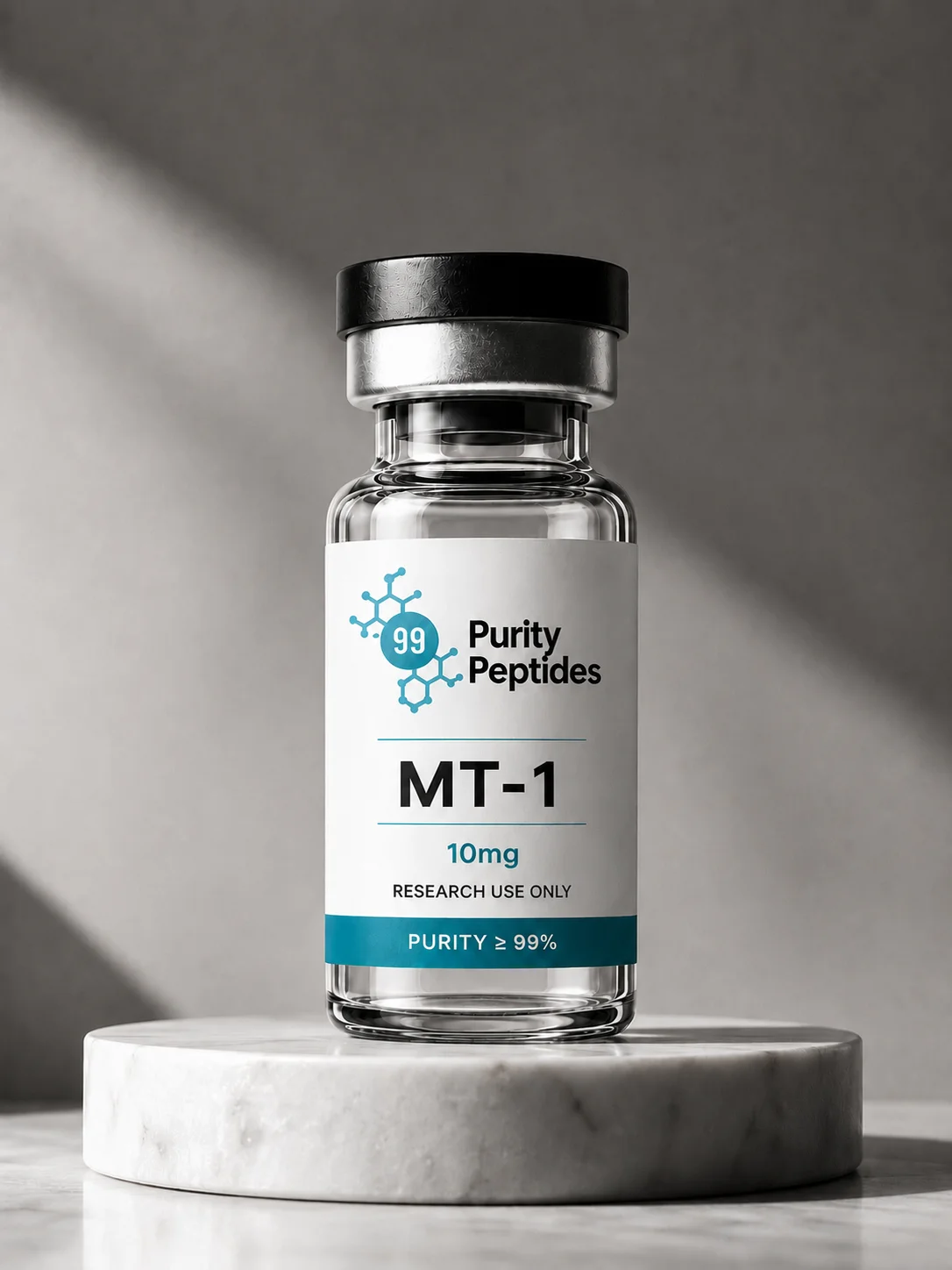
Both compounds are stocked as ≥99% HPLC-verified lyophilized material: MT-1 10mg and MT-2 10mg (Melanotan II), alongside the Melanotan 1 Spray format. Every lot ships with analytical documentation, and every item is supplied strictly for laboratory research. Neither compound is approved for human or veterinary use, and neither should be used outside a controlled research setting.
Frequently Asked Questions
Is Melanotan 2 stronger than Melanotan 1?
"Stronger" is not a well-defined comparison across two molecules with different receptor profiles. Melanotan 2 is smaller and cyclized, which increases conformational efficiency at its targets, and it engages central MC3R and MC4R more prominently in research models. Melanotan 1 shows higher reported affinity at MC1R specifically, with a Ki of 0.085 nM. Neither is uniformly more potent.
Is afamelanotide the same as Melanotan 1?
They are the same molecule under different names. Afamelanotide is the International Nonproprietary Name for [Nle⁴, D-Phe⁷]-α-MSH, sold as research material under the label Melanotan 1 or MT-1. The names are not interchangeable in a regulatory sense, though. SCENESSE is an approved pharmaceutical implant made by a licensed manufacturer, and research-grade MT-1 powder is neither that product nor approved for any use.
Why does Melanotan 2 affect appetite in research models?
Melanotan 2 activates MC4R, a receptor with an established regulatory role in energy homeostasis and food intake. Much of the foundational MC4R feeding literature was generated using central administration of MT-II in rodents. Knockout studies confirmed the attribution: MC4R-null mice did not respond to central MT-II, while MC3R-null mice did. This describes rodent research models only.
What is the difference between Melanotan 1 and 2 at the sequence level?
Melanotan 1 is Ac-Ser-Tyr-Ser-Nle-Glu-His-D-Phe-Arg-Trp-Gly-Lys-Pro-Val-NH₂, a linear 13-residue peptide. Melanotan 2 is Ac-Nle-cyclo[Asp-His-D-Phe-Arg-Trp-Lys]-NH₂, a cyclic 7-residue peptide covering only α-MSH residues 4 through 10. Both contain the identical His-D-Phe-Arg-Trp core, so the divergence lies entirely in the surrounding scaffold.
Is Melanotan 1 actually MC1R-selective?
Not strictly. Compiled binding data report nanomolar or sub-nanomolar affinity at MC1R, MC3R, MC4R, and MC5R, and peer-reviewed characterization describes nanomolar efficacy at every subtype except MC2R. The compound shows a strong preference for MC1R, roughly 45-fold over MC4R, which is meaningfully different from selectivity. Receptor expression patterns account for much of the apparent MC1R dominance.
Which melanocortin receptors does Melanotan 2 activate?
Melanotan 2 is characterized in published literature as a non-selective melanocortin receptor agonist active at MC1R, MC3R, MC4R, and MC5R. Activity at MC2R, the adrenocorticotropic receptor, is minimal for this ligand class. In rodent neuroscience work it is frequently described more narrowly as an MC3R/MC4R agonist, reflecting which subtypes dominate in brain tissue.
Is Melanotan 2 FDA approved?
No. Melanotan 2 has never received approval from the FDA or any other regulatory agency, for any indication, in any jurisdiction. No phase III program was completed. Its published human record consists of a small 1996 pilot phase-I study and subsequent case reports of adverse events following unsupervised use. It is supplied strictly as research material.
Why is Melanotan 1 thirteen amino acids and Melanotan 2 only seven?
The two designs answered the same question differently. Melanotan 1 retained the complete α-MSH backbone and modified two residues for stability. Melanotan 2 deleted residues 1 through 3 and 11 through 13, keeping only the region containing the receptor-binding core, then cyclized the fragment. Truncation plus cyclization produced a smaller, conformationally constrained molecule at 1,024.2 Da versus 1,646.9 Da.
What does the lactam bridge in Melanotan 2 do?
The bridge links the aspartate side-chain carboxyl to the lysine ε-amino group, closing the peptide into a ring. Cyclization restricts the conformations the backbone can adopt, which lowers the entropic cost of receptor binding and contributes to the compound's characterization as a superpotent melanotropin. It also eliminates the free termini that exopeptidases would otherwise cleave.
Is PT-141 related to Melanotan 2?
Directly. Bremelanotide, formerly PT-141, is a metabolite of Melanotan 2 that differs by a single functional group: a C-terminal carboxyl in place of MT-2's amide, giving a molecular weight near 1,025.2 Da against MT-2's 1,024.2 Da. Palatin Technologies halted Melanotan 2 development in 2000 and advanced bremelanotide instead.
Which compound has more published human research?
Melanotan 1, by a wide margin. Afamelanotide completed a controlled development program including two placebo-controlled trials enrolling 93 and 74 subjects respectively, with results published in the *New England Journal of Medicine*. Melanotan 2's human record consists of a three-subject pilot phase-I study from 1996 and subsequent adverse-event case reports, with no completed controlled efficacy trials.
Do MT-1 and MT-2 have different molecular weights?
Substantially. Melanotan 1 is 1,646.9 Da with the formula C₇₈H₁₁₁N₂₁O₁₉. Melanotan 2 is 1,024.2 Da with the formula C₅₀H₆₉N₁₅O₉. Melanotan 2 is roughly 62% the mass of Melanotan 1. Both figures should be confirmed against the mass-spectrometry section of the lot-specific Certificate of Analysis before use as an identity reference.
Why do both compounds contain D-phenylalanine?
Both inherited the same design solution. Substituting D-phenylalanine for the native L-phenylalanine at position 7 confers resistance to proteolytic degradation while improving receptor engagement, since proteases recognize L-amino acid stereochemistry. The same logic explains the shared norleucine-for-methionine substitution, which removes an oxidation-prone sulfur atom from the sequence.
Should MT-1 and MT-2 vials be stored differently?
Storage conditions are essentially the same: lyophilized material at -20°C or below, dry, dark, with reconstituted solution refrigerated and used within a short window. Two sequence differences are worth noting. Melanotan 1 contains no methionine, so it lacks that oxidation pathway. Both retain tryptophan, which is independently oxidation-sensitive, so light protection applies to each.