Last reviewed: September 2026
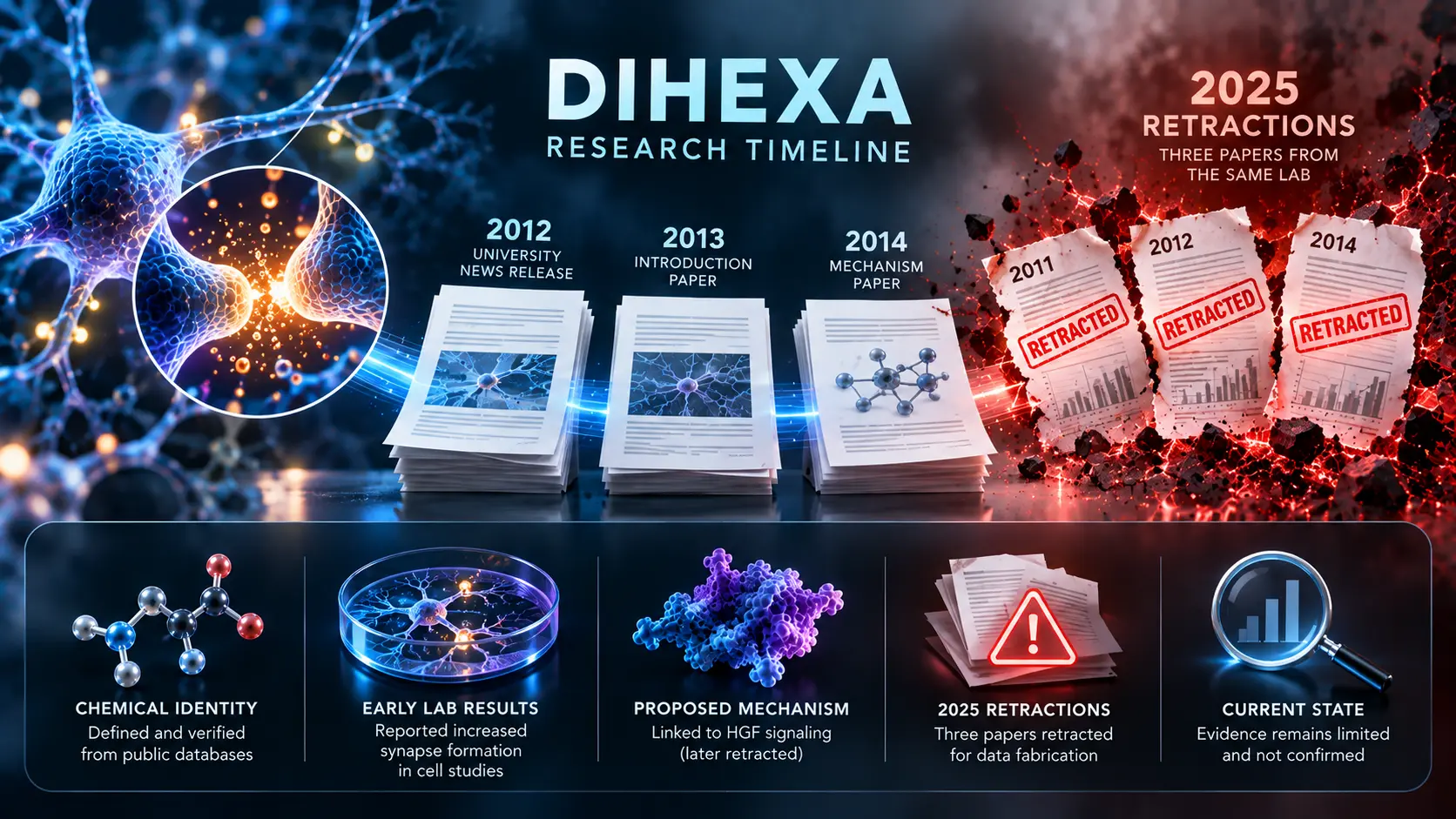
Quick Answer: Dihexa research comes mostly from one Washington State University lab. In April 2025, a journal retracted its 2014 paper tying dihexa (N-hexanoic-Tyr-Ile-(6) aminohexanoic amide) to hepatocyte growth factor (HGF) signaling. The notice cites falsified or fabricated data. A popular claim that dihexa beats brain-derived neurotrophic factor (BDNF) ten million-fold came from a 2012 press release, not a published comparison.
Key Takeaways
- The Journal of Pharmacology and Experimental Therapeutics (JPET) retracted Benoist et al. 2014 (PMID 25187433) in its April 2025 issue. The notice cites falsified and/or fabricated data in Figures 1B and 2A/C [1][2].
- That notice names two authors, Leen H. Kawas and Joseph W. Harding, as "solely responsible." Many online summaries mention only Kawas [2].
- The same JPET issue (volume 392, issue 4) retracted two earlier HGF papers from the same lab, published in 2011 and 2012 [6][7].
- McCoy et al. 2013, the paper that introduced dihexa, is not retracted. It has carried a Notice of Concern since September 2021 [4][5].
- The "seven orders of magnitude more powerful than BDNF" line appears in a Washington State University news release dated October 11, 2012 [9]. A 2021 Alzheimer's Drug Discovery Foundation review states the two were "not directly compared in the publication" [10].
- Dihexa's formula, C27H44N4O5, and molecular weight of about 504.67 g/mol come from PubChem (CID 129010512). Neither depends on any retracted paper [11].
- A September 2026 search of ClinicalTrials.gov for "dihexa" returned zero registered studies [20].
- Independent groups report mixed animal results. A 2024 study of 40 rats found dihexa did not protect against a toxin-induced movement and memory deficit [13].
Research Use Only. 99 Purity Peptides supplies dihexa strictly for laboratory research. It is not for human or veterinary consumption. Nothing on this page is medical, dosing or health advice. No statement here suggests dihexa is safe or effective for any use in a person or animal.
Is Dihexa Really "Millions of Times More Potent" Than BDNF?
No published experiment we could find supports that claim as it is usually stated. The number traces to a university news release, not to a measured comparison in a peer-reviewed paper.
On October 11, 2012, Washington State University (WSU) announced the first dihexa paper. The release said the team "found Dihexa to be seven orders of magnitude more powerful than BDNF." That result came from "bench assays using living nerve cells." The release then translated that into plain terms: "it would take 10 million times as much BDNF to get as much new synapse formation as Dihexa" [9].
The paper behind the release is McCoy et al., published in JPET's 2013 volume 344 after online release in October 2012 [4]. Its abstract calls dihexa orally active and able to cross the blood-brain barrier. It also calls the compound "synaptogenic." Synaptogenic means it promotes the formation of new synapses, the contact points between nerve cells. The abstract never mentions BDNF [4].
Reviewers at the Alzheimer's Drug Discovery Foundation (ADDF) reached the same conclusion in 2021. Their report noted the press-release figure, then added: "effects of BDNF and dihexa were not directly compared in the publication" [10].
So what did the lab actually measure? According to the ADDF summary of McCoy 2013, cultured rat hippocampal neurons were treated with dihexa for five days. Treated neurons had 41 spines per 50 µm of dendrite, against 15 in vehicle controls, nearly a threefold difference [10]. Dendritic spines are the small bumps where most excitatory synapses form. That is a real, narrow measurement in a dish of rat cells.
Even a genuine head-to-head at that endpoint would not mean "ten million times better." Three problems stand in the way.
Potency is not efficacy. Molar potency tells you the concentration at which something acts. It says nothing about how large or useful the effect is. A compound that acts at 10⁻¹² molar (picomolar) can still produce a small effect.
The two molecules work through different receptors. BDNF signals mainly through the TrkB receptor. Dihexa was proposed to work through HGF and its receptor, c-Met, a proposal that now sits in retracted papers. Comparing concentrations across unrelated receptor systems tells you little about either one.
A dish is not an animal. Spine counts in cultured neurons cannot predict effects in a living body. There, absorption, distribution and clearance all change the picture. No study has translated this in vitro ratio into any organism-level outcome.
What Did the 2014 Mechanism Paper Claim?
The 2014 paper claimed to explain why dihexa worked, by tying its effects to the HGF/c-Met system. Everything in this section describes what the now-retracted paper reported, not established fact.
Benoist and eight co-authors published the paper in JPET in 2014 (volume 351, issue 2, pages 390 to 402) [1]. They framed it around a gap: angiotensin IV-related molecules looked procognitive in animals, but nobody had a validated mechanism of action [1].
HGF is a growth factor best known for roles in tissue repair and development. Its receptor, c-Met, is a receptor tyrosine kinase, meaning it switches on signaling by adding phosphate groups to proteins. The paper's abstract reported the following [1]:
- Dihexa bound HGF "with high affinity."
- Dihexa and its parent compound, norleucine¹-angiotensin IV (Nle¹-AngIV), triggered c-Met phosphorylation when low, "subthreshold" HGF levels were present.
- Both compounds boosted HGF-dependent cell scattering, a standard cell-culture readout of HGF activity.
- Both induced new dendritic spines and synapses in hippocampal neurons, similar to HGF itself.
- An HGF antagonist and a short hairpin RNA against c-Met blocked those effects.
- In rats, an HGF antagonist infused into the brain's ventricles blocked oral dihexa's effect in the Morris water maze. That maze is a swimming test of spatial learning.
PubMed's indexing lists Sprague-Dawley rats, HEK293 cells and Madin-Darby canine kidney cells among the paper's models [1]. No part of the work involved people.
This paper mattered more than its length suggests. It supplied the mechanism most vendor pages we reviewed still repeat: dihexa "activates HGF/c-Met." Remove this paper, and that sentence loses its main published support.
Has That Paper Been Retracted?
Yes. JPET retracted the 2014 paper in its April 2025 issue, with the notice posted online on April 29, 2025 [2].
The retraction notice is indexed as PMID 40312093, DOI 10.1016/j.jpet.2025.103567, and PMC13095468. It states:
"This article has been retracted at the request of the Editor. Following an investigation by Washington State University, Figures 1B, 2A/C, and data in the subsequent erratum submission for the article have been found to contain falsified and/or fabricated data and Leen H. Kawas and Joseph W. Harding were found to be solely responsible." [2]
Two details in that wording get lost in most retellings. First, the notice names Harding, the senior author, alongside Kawas. Second, it covers data in a later erratum submission, not only the original figures.
The retraction did not arrive out of nowhere. In September 2021, JPET attached Notices of Concern to four papers from this lab [3][5]. Three of those four were retracted in April 2025. One was not.
Paper (first author, year) | Topic | Notice of Concern | Status, September 2026 | Original PMID |
|---|---|---|---|---|
Kawas, 2011 | HGF dimerization-domain mimics as anticancer agents | September 2021 | Retracted April 2025 | 21859930 |
Kawas, 2012 | Angiotensin IV analogs as HGF/Met modifiers | September 2021 | Retracted April 2025 | 22129598 |
McCoy, 2013 | Metabolically stabilized analogs, including dihexa | September 2021 | Not retracted; notice still attached | 23055539 |
Benoist, 2014 | HGF/c-Met dependence of procognitive effects | September 2021 | Retracted April 2025 | 25187433 |
McCoy's row is the one most likely to be misreported. Its PubMed record carries no "Retracted Publication" tag as of this review [4]. Calling it retracted would be exactly the kind of error this page exists to correct.
There is also a business history behind the lab. Harding and co-author John W. Wright list M3 Biotechnology, Inc. as an affiliation on the papers [1][2]. On January 6, 2025, the US Department of Justice announced that Athira Pharma, the company M3 became, agreed to pay $4,068,698 [10][18]. The deal resolved allegations that Athira did not disclose misconduct allegations to the National Institutes of Health in grant applications. Those allegations said Kawas "falsified and manipulated scientific images" in her dissertation and papers [18]. The Justice Department stressed that "the claims resolved by the settlement are allegations only" [18].
Some online reports go further and state that WSU revoked Kawas's doctorate. We could not find a WSU statement or any other institutional record confirming that. That detail is therefore not repeated here as fact.
What Does the Retraction Actually Change?
A retraction removes a paper's findings from the scientific record. The publisher is saying the work can no longer be relied on, and here it names the reason as falsified or fabricated data.
It does not automatically make every claim about dihexa false. A claim can be true even when one paper supporting it was faked. What changes is narrower and more practical.
Any claim that rests specifically on the 2014 paper's data has lost that support. The HGF-binding claim and the c-Met dependence claim sit in that category. They may still turn out true, but no surviving peer-reviewed source from this lab establishes them.
Claims resting on other papers need their own check. The McCoy 2013 spine and memory data were not retracted. Still, they came from the same lab, share authors, and carry an unresolved Notice of Concern [5]. A careful reader treats them as flagged, not cleared.
Some claims never depended on this lab at all, and those are unaffected. The chemical identity of the molecule is one example.
One further point matters for anyone reading secondary summaries. The notice lists specific figures. It does not say every experiment in the paper was falsified, and it does not comment on dihexa's biology. Extending it that far overstates what the journal actually said.
What Still Stands in Dihexa Research, and What Doesn't
Work on dihexa did not end with the retractions, but what survives is thinner and more scattered than the popular story. Sorting it by source makes that plain.
Chemical identity stands. PubChem lists dihexa as CID 129010512, formula C27H44N4O5 [11]. We independently computed the molecular weight from that structure at 504.67 g/mol. That matches the 504.7 figure ADDF reported from PubChem [10]. The molecule is a short modified peptide: a hexanoyl cap, then tyrosine, then isoleucine, then a 6-aminohexanoic amide tail.
The parent-compound work has no integrity flag. Benoist et al. 2011 studied C-terminal truncated Nle¹-AngIV analogs in rats [8]. It reported that tetra- and tripeptide fragments reversed scopolamine-induced water maze deficits. The paper also found procognitive activity tracked with spine number and spine-head size. PubMed shows no notice or retraction on it [8]. It does come from the same laboratory and predates dihexa itself.
Outside groups have tested dihexa, with mixed results. These studies matter most because they do not share the retracted lab's data.
Study | Group | Model | What it reported | Tie to the WSU lab |
|---|---|---|---|---|
Mathapati et al., 2016 [14] | University of Oslo | Human stem cells in culture | Used dihexa as an HGF substitute to mature hepatocyte-like cells | None listed |
Pan et al., 2022 [15] | Southern Medical University and Chinese Academy of Sciences | Human stem cells in culture | Dihexa, with vitamin C and forskolin, replaced growth factors in liver-cell specification | None listed |
Sun et al., 2021 [12] | China Pharmaceutical University | APP/PS1 transgenic mice | Better water maze scores; effects linked to PI3K/AKT signaling | None listed |
Wells et al., 2024 [13] | Whitworth University | 40 male Wistar rats, 3-nitropropionic acid model | Dihexa "did not protect" against motor or memory deficits | None listed |
Uribe et al., 2015 [16] | Washington State University | Larval zebrafish hair cells | Protection from aminoglycoside toxicity, reduced by an HGF antagonist | Kawas and Harding are co-authors |
The two stem-cell papers are the most interesting entries here. They offer indirect, independent evidence of HGF-like activity in a dish, because dihexa could stand in for a growth factor. Neither shows that dihexa binds HGF, and neither says anything about neurons.
Animal results are split. One independent mouse study reported benefit, and one independent rat study reported none. A 2018 systematic review by Ho and Nation examined cognitive-deficit models. In eight of nine such studies, angiotensin IV and its analogs improved performance [17]. That review pooled several different compounds, so it says little about dihexa alone.
What no longer stands is the specific mechanism: high-affinity HGF binding and c-Met dependence as presented in the 2014 figures. The 2011 and 2012 HGF-dimerization papers that set up that framework are retracted too [6][7].
How Do the Competing Potency Figures Compare?
The figures disagree because most of them are copies of copies, and some of the copying went wrong. Only one of them has a traceable origin.
Figure seen online | Stated as | Earliest primary source we found | What that source measured | Peer-reviewed comparison? |
|---|---|---|---|---|
Seven orders of magnitude | 10,000,000-fold | WSU news release, October 11, 2012 [9] | "New synapse formation" in bench assays with living nerve cells | No; ADDF says not directly compared in McCoy 2013 [10] |
Seven orders of magnitude | 1,000,000-fold | None; an arithmetic slip | Nothing; 1,000,000 is six orders of magnitude | No |
Roughly 100,000-fold | Five orders of magnitude | None found | Unknown | No |
Active at picomolar concentrations | 10⁻¹² M | McCoy 2013, as summarized by ADDF [4][10] | Spine changes in cultured rat hippocampal neurons | Single lab; paper under Notice of Concern [5] |
We searched all 18 PubMed records returned for "dihexa" in September 2026 and found no source for the 100,000-fold number. The 1,000,000 version appears to come from someone converting "seven orders of magnitude" incorrectly.
Our position is simple. The ten million figure is a press-release translation of an assay the paper did not report as a direct comparison. Neither of the other two numbers has any source at all.
How we graded the evidence
Each claim received one grade based on its best surviving source.
- A: Verifiable from a public database or reproduced by independent groups, with no integrity flags.
- B: Supported by at least one peer-reviewed group outside the WSU lab.
- C: Rests on the WSU lab alone, in work that is not retracted but is under a Notice of Concern, or on mixed independent results.
- D: Rests on retracted work or on no primary source at all.
Claim about dihexa | Best surviving source | Integrity status of that source | Evidence type | Grade |
|---|---|---|---|---|
Formula C27H44N4O5, about 504.67 g/mol | PubChem CID 129010512 [11] | Not applicable | Database record | A |
Can replace HGF in some stem-cell culture protocols | Mathapati 2016; Pan 2022 [14][15] | No flags | Cell culture, two independent groups | B |
Binds HGF with high affinity and needs c-Met to work | Benoist 2014 [1] | Retracted [2] | Cell culture and rat | D |
Increases dendritic spines in rat neurons | McCoy 2013 [4] | Notice of Concern [5] | Cell culture | C |
Improves memory-task scores in impaired rodents | McCoy 2013; Sun 2021; Wells 2024 [4][12][13] | Flagged plus mixed independent results | Animal model | C |
Crosses the blood-brain barrier | McCoy 2013, radiolabel study summarized by ADDF [10] | Notice of Concern [5] | Rat | C |
Orally active | McCoy 2013 [4] | Notice of Concern [5] | Rat | C |
A specific oral bioavailability percentage | None found | Not applicable | None | D |
Ten million times more potent than BDNF | WSU news release [9] | Not peer-reviewed | Press statement | D |
Nothing on dihexa earns an A beyond its chemical identity. That is the honest summary of the file.
What the Evidence Does Not Establish
Dihexa research establishes a molecule, a narrow set of rodent and cell findings, and a mechanism story that has lost its main support. Everything beyond that is open.
No human data exist. ClinicalTrials.gov lists no registered study of dihexa [20]. ADDF reported the same in 2021: "No studies in humans have been published to date" [10].
A related clinical program is not dihexa. Athira's later candidate, fosgonimeton (ATH-1017), is a separate compound. Alzforum describes it as possibly related to dihexa. Athira announced on September 3, 2024, that its Phase 2/3 LIFT-AD trial missed its primary endpoint [19]. Neither that failure nor any of that trial's data can be read across to dihexa.
No validated mechanism exists. With the 2014 paper retracted, the HGF/c-Met explanation is a hypothesis. The independent PI3K/AKT finding from Sun 2021 is one mouse study [12].
Nobody has independently replicated the spine data. We found no outside group that repeated the hippocampal spine counts.
Pharmacokinetics rest on rats and one lab. ADDF reports a rat half-life of about 12.7 days after intravenous administration, drawn from McCoy 2013. After intraperitoneal administration, the figure was 8.8 days [10]. Those figures come from the flagged paper and describe rats only.
Long-term safety has not been studied. ADDF states: "No studies in animals or humans have examined the long-term safety of dihexa" [10]. The same review raises a theoretical concern. HGF/c-Met signaling is active in many cancers, so a compound that amplifies it would need specific study [10].
These gaps are not a verdict that dihexa does nothing. They are a statement of what nobody has shown.
How Should You Check a Dihexa Claim Before Relying on It?
Start with the primary record, not the summary. Search PubMed for the paper a claim cites, then look at the article type line for "Retracted Publication" or a linked Notice of Concern. That single step would have caught every retraction discussed here.
For identity questions, compare a supplier's certificate against PubChem's formula and mass. Our guide on how to read a certificate of analysis walks through the identity and purity fields line by line. Lot documents are collected on our certificates page.
This review has a companion piece. Our 2026 peptide purity recalls review applies the same method, checking claims against primary sources, to product quality. New readers may also want our explainer on what research peptides are and the research peptide glossary for terms used here.
For laboratories studying this molecule, Dihexa Spray is listed as a research material. Check the lot's certificate against the identity data above before using it in any experiment.
The short version of dihexa research in 2026 is this: a real molecule, an inflated potency slogan, and a mechanism paper the journal has withdrawn. Read every claim with those three facts in mind.
References
- Benoist CC, Kawas LH, Zhu M, et al. The procognitive and synaptogenic effects of angiotensin IV-derived peptides are dependent on activation of the hepatocyte growth factor/c-Met system. J Pharmacol Exp Ther. 2014;351(2):390-402. PMID 25187433. DOI 10.1124/jpet.114.218735. Retracted. https://pubmed.ncbi.nlm.nih.gov/25187433/
- Benoist CC, Kawas LH, Zhu M, et al. Retraction notice to "The Procognitive and Synaptogenic Effects of Angiotensin IV-Derived Peptides Are Dependent on Activation of the Hepatocyte Growth Factor/c-Met System" [J Pharmacol Exp Ther 351 (2014) 390-402]. J Pharmacol Exp Ther. 2025;392(4):103567. PMID 40312093. DOI 10.1016/j.jpet.2025.103567. https://pmc.ncbi.nlm.nih.gov/articles/PMC13095468/
- Notice of Concern: Benoist CC, Kawas LH, Zhu M, et al. (2014). J Pharmacol Exp Ther. 2021;378(3):311. PMID 34551987. https://pubmed.ncbi.nlm.nih.gov/34551987/
- McCoy AT, Benoist CC, Wright JW, et al. Evaluation of metabolically stabilized angiotensin IV analogs as procognitive/antidementia agents. J Pharmacol Exp Ther. 2013;344(1):141-154. PMID 23055539. DOI 10.1124/jpet.112.199497. https://pubmed.ncbi.nlm.nih.gov/23055539/
- Notice of Concern: McCoy AT, Benoist CC, Wright JW, et al. (2013). J Pharmacol Exp Ther. 2021;378(3):313. PMID 34551989. https://pubmed.ncbi.nlm.nih.gov/34551989/
- Kawas LH, McCoy AT, Yamamoto BJ, et al. Development of angiotensin IV analogs as hepatocyte growth factor/Met modifiers. J Pharmacol Exp Ther. 2012;340(3):539-548. PMID 22129598. Retraction notice: J Pharmacol Exp Ther. 2025;392(4):103566, PMID 40312092. https://pubmed.ncbi.nlm.nih.gov/40312092/
- Kawas LH, Yamamoto BJ, Wright JW, et al. Mimics of the dimerization domain of hepatocyte growth factor exhibit anti-Met and anticancer activity. J Pharmacol Exp Ther. 2011;339(2):509-518. PMID 21859930. Retraction notice: J Pharmacol Exp Ther. 2025;392(4):103568, PMID 40312094. https://pubmed.ncbi.nlm.nih.gov/40312094/
- Benoist CC, Wright JW, Zhu M, et al. Facilitation of hippocampal synaptogenesis and spatial memory by C-terminal truncated Nle1-angiotensin IV analogs. J Pharmacol Exp Ther. 2011;339(1):35-44. PMID 21719467. DOI 10.1124/jpet.111.182220. https://pubmed.ncbi.nlm.nih.gov/21719467/
- Washington State University Communications. Prospective Alzheimer's drug builds new brain cell connections. WSU News. October 11, 2012. https://archive.news.wsu.edu/news/2012/10/11/prospective-alzheimer%C2%92s-drug-builds-new-brain-cell-connections/
- Alzheimer's Drug Discovery Foundation. Cognitive Vitality Report: Dihexa. Last updated August 13, 2021. https://www.alzdiscovery.org/uploads/cognitive_vitality_media/Dihexa_1.pdf
- National Center for Biotechnology Information. PubChem Compound Summary for CID 129010512, Dihexa. https://pubchem.ncbi.nlm.nih.gov/compound/129010512
- Sun X, Deng Y, Fu X, et al. AngIV-analog dihexa rescues cognitive impairment and recovers memory in the APP/PS1 mouse via the PI3K/AKT signaling pathway. Brain Sci. 2021;11(11):1487. PMID 34827486. DOI 10.3390/brainsci11111487. https://pubmed.ncbi.nlm.nih.gov/34827486/
- Wells RG, Azzam AF, Hiller AL, et al. Effects of an angiotensin IV analog on 3-nitropropionic acid-induced Huntington's disease-like symptoms in rats. J Huntingtons Dis. 2024;13(1):55-66. PMID 38489193. DOI 10.3233/JHD-231507. https://pubmed.ncbi.nlm.nih.gov/38489193/
- Mathapati S, Siller R, Impellizzeri AAR, et al. Small-molecule-directed hepatocyte-like cell differentiation of human pluripotent stem cells. Curr Protoc Stem Cell Biol. 2016;38:1G.6.1-1G.6.18. PMID 27532814. DOI 10.1002/cpsc.13. https://pubmed.ncbi.nlm.nih.gov/27532814/
- Pan T, Wang N, Zhang J, et al. Efficiently generate functional hepatic cells from human pluripotent stem cells by complete small-molecule strategy. Stem Cell Res Ther. 2022;13(1):159. PMID 35410439. DOI 10.1186/s13287-022-02831-1. https://pubmed.ncbi.nlm.nih.gov/35410439/
- Uribe PM, Kawas LH, Harding JW, et al. Hepatocyte growth factor mimetic protects lateral line hair cells from aminoglycoside exposure. Front Cell Neurosci. 2015;9:3. PMID 25674052. DOI 10.3389/fncel.2015.00003. https://pubmed.ncbi.nlm.nih.gov/25674052/
- Ho JK, Nation DA. Cognitive benefits of angiotensin IV and angiotensin-(1-7): a systematic review of experimental studies. Neurosci Biobehav Rev. 2018;92:209-225. PMID 29733881. DOI 10.1016/j.neubiorev.2018.05.005. https://pubmed.ncbi.nlm.nih.gov/29733881/
- US Department of Justice, Office of Public Affairs. Athira Pharma Inc. agrees to pay $4M to settle False Claims Act allegations related to scientific research misconduct. January 6, 2025. https://www.justice.gov/archives/opa/pr/athira-pharma-inc-agrees-pay-4m-settle-false-claims-act-allegations-related-scientific
- Alzforum. Therapeutics: Fosgonimeton. Accessed September 2026. https://www.alzforum.org/therapeutics/fosgonimeton
- ClinicalTrials.gov. Search results for "dihexa." Accessed September 29, 2026. https://clinicaltrials.gov/search?term=dihexa
Frequently Asked Questions
Is dihexa more potent than BDNF?
No peer-reviewed study we found measured dihexa and brain-derived neurotrophic factor side by side and reported dihexa as more potent. The claim comes from a 2012 Washington State University news release. A 2021 Alzheimer's Drug Discovery Foundation review notes the two were not directly compared in the published paper. Potency at one cell-culture endpoint would not show greater usefulness anyway.
What does "10 million times more potent than BDNF" mean, and is it true?
It means the 2012 press release claimed BDNF needed ten million times the concentration to produce the same new-synapse effect in a lab assay. It is not established. The published paper does not report that comparison, and the lab's later mechanism paper was retracted. Even if measured, a concentration ratio at one narrow endpoint says nothing about effects in a living animal.
Has any dihexa study been retracted?
Yes. In April 2025, the Journal of Pharmacology and Experimental Therapeutics retracted three papers from the Washington State University group behind dihexa. The key one is Benoist et al. 2014, which proposed the HGF/c-Met mechanism. Two earlier HGF papers from 2011 and 2012 were also retracted. The 2013 paper that introduced dihexa was not retracted but carries a 2021 Notice of Concern.
What did the retracted 2014 dihexa paper claim?
The paper reported that dihexa bound hepatocyte growth factor with high affinity and triggered its receptor, c-Met, in cell culture. It also claimed dihexa increased synapses in rat hippocampal neurons. An HGF blocker placed in rats' brains reportedly stopped oral dihexa's effect on a water maze test. All of these are now retracted claims, not established findings.
Why was the dihexa paper retracted?
The retraction notice says the paper was retracted at the Editor's request after a Washington State University investigation. That investigation found falsified and/or fabricated data in Figures 1B and 2A/C and in a later erratum submission. It named Leen H. Kawas and Joseph W. Harding as solely responsible. The notice does not comment on dihexa's biology beyond those data.
Does a retraction mean dihexa doesn't work?
Not necessarily. A retraction withdraws one paper's findings because its data cannot be trusted. It does not prove the opposite of what the paper claimed. It does mean the HGF/c-Met mechanism has lost its main published support. Independent animal studies since then are mixed, with one mouse study reporting benefit and one rat study reporting none.
What is dihexa's molecular structure?
Dihexa is N-hexanoic-Tyr-Ile-(6) aminohexanoic amide, a modified tripeptide-like molecule. PubChem lists it as CID 129010512, with formula C27H44N4O5. Its molecular weight works out to about 504.67 g/mol. The structure runs from a hexanoyl cap to tyrosine, then isoleucine, then a 6-aminohexanoic amide tail. These identity facts do not depend on any retracted paper.
How is dihexa related to angiotensin IV?
Dihexa is a synthetic descendant of angiotensin IV, a six-residue fragment of the angiotensin hormone family. Researchers worked from the analog Nle¹-angiotensin IV and traced its activity to three residues, Nle-Tyr-Ile. They then modified both ends of that core. Per the 2013 paper, the aim was better metabolic stability and better passage across gut and blood-brain barriers.
Is dihexa the same as Nle1-AngIV?
No. Nle¹-angiotensin IV is the parent peptide, a six-residue analog with norleucine in the first position. Dihexa keeps only a short Tyr-Ile core and adds a hexanoyl group at one end and an aminohexanoic amide at the other. The two share a lineage and were tested together in the retracted 2014 paper, but they are different molecules.
What is the HGF/c-Met system dihexa was said to activate?
Hepatocyte growth factor is a signaling protein involved in tissue repair and development. Its receptor, c-Met, sits on cell surfaces and switches on growth and survival pathways. The claim that dihexa amplifies this system came mainly from the now-retracted 2014 paper. Independent stem-cell labs have used dihexa as an HGF substitute, which is indirect support only.
Has dihexa been tested in humans?
No human trials of dihexa appear in the published record or on ClinicalTrials.gov, which returned zero studies for "dihexa" in September 2026. The Alzheimer's Drug Discovery Foundation reported the same in 2021. A separate compound, fosgonimeton, reached a Phase 2/3 trial that missed its primary endpoint in 2024. Its results cannot be applied to dihexa.
What is synaptogenesis, and how was it measured in dihexa studies?
Synaptogenesis is the formation of new synapses, the junctions where nerve cells pass signals. In dihexa work, labs mostly counted dendritic spines, small protrusions that host synapses, on cultured rat hippocampal neurons. The 2013 paper reported 41 spines per 50 micrometers of dendrite in treated neurons, against 15 in controls. That paper now carries a Notice of Concern.
Why do different sources give different potency figures for dihexa?
Most sources copy each other rather than a paper. The ten million figure comes from a 2012 press release translating "seven orders of magnitude." Some pages wrongly convert that to one million, which is six orders. A 100,000-fold figure also circulates, but no source for it appears among PubMed's dihexa records. None reflects a published side-by-side test.
Is any dihexa work unaffected by the retraction?
Yes. Outside groups in Oslo and Guangzhou used dihexa in stem-cell differentiation protocols. A China Pharmaceutical University team reported memory-test benefits in transgenic mice in 2021. A Whitworth University team found no protective effect in 40 rats in 2024. The chemical identity in PubChem also stands on its own. None of these studies involved people.
How can I check a peptide research claim myself?
Find the paper the claim cites and look it up on PubMed. Check the article type for "Retracted Publication" and look for linked notices of concern or retraction. Read the abstract to confirm it says what the claim says. For compound identity, compare a supplier's certificate of analysis against the formula and mass in PubChem.