Last reviewed: September 2026
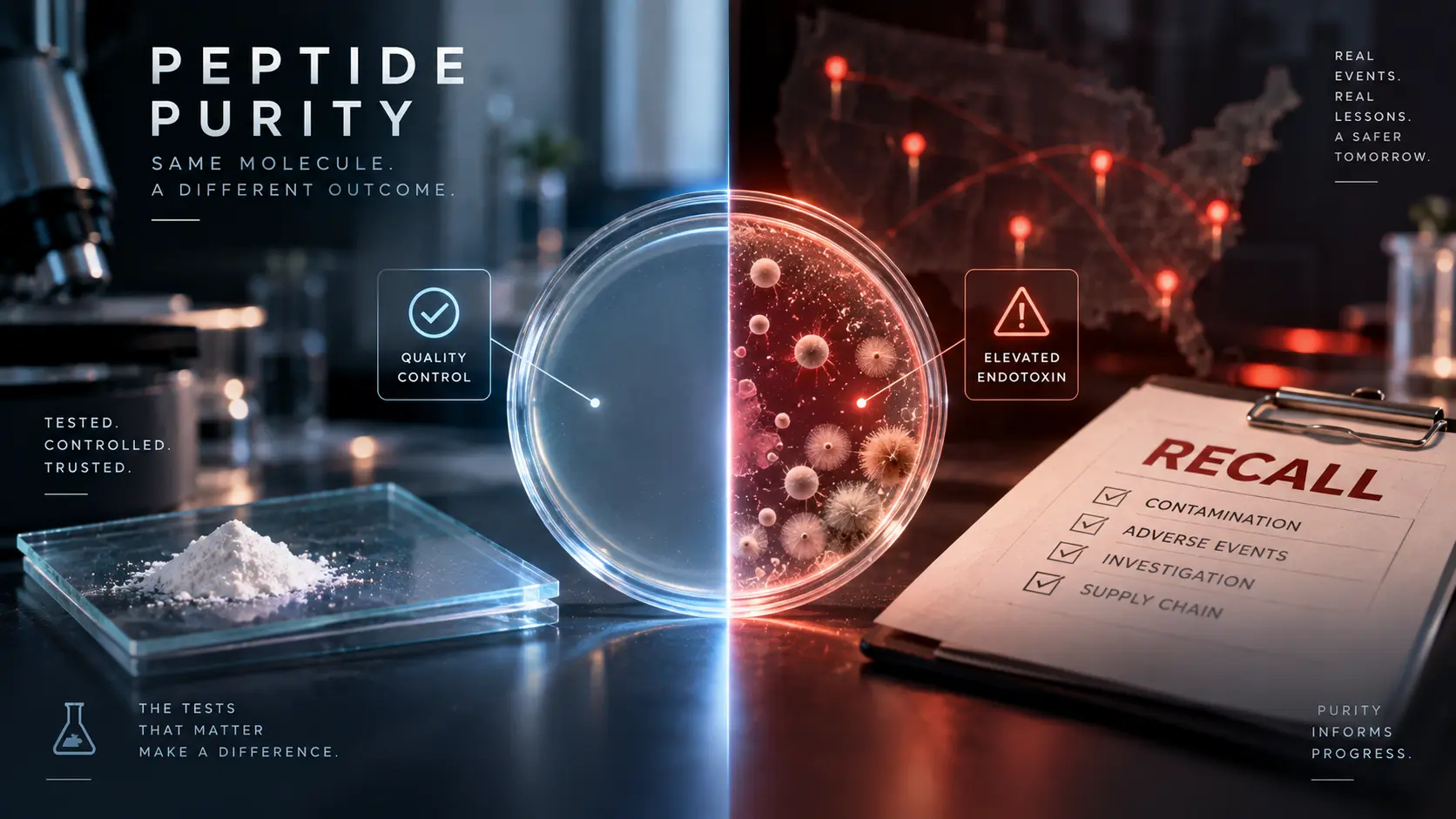
Quick Answer: The 2026 peptide purity recall wave was three voluntary recalls of compounded injectable glutathione, a tripeptide, by Texas pharmacies. They ran from August 5 to September 9, 2026. Each followed findings of elevated bacterial endotoxin. The FDA tied reported illnesses to a single dietary-supplement-grade glutathione lot. Endotoxin survives the steps that kill bacteria, so only a lot-specific bacterial endotoxin test catches it before use.
Key Takeaways
- Victory Medical Center Pharmacy (Austin) recalled three lots of compounded glutathione 200 mg/mL on August 5, 2026, distributed in Texas, Florida and New York [1].
- Optimal Balance Pharmacy (Houston) recalled one lot on August 19, 2026, 14 days later, distributed to 14 states [2].
- Centric Compounding LLC (Houston) recalled six lots of glutathione, Myer's Cocktail and Tri-Immune Boost on September 9, 2026, after nine adverse-event reports [3].
- On August 27, 2026, the FDA reported at least 30 patients with adverse events [4]. It traced their glutathione to Medisca Inc. lot #229536, labeled dietary supplement grade [4].
- By its September 15, 2026 update, the CDC counted more than 25 ill people in at least four states, with at least three hospitalized [5].
- In a 2015 Australian cluster, the glutathione passed chemistry and microbiological testing yet failed endotoxin testing in every sample [7].
- Matthew Kawa, owner of Paradigm Peptides, was sentenced on July 30, 2026, to 70 months in federal prison [10].
- A certificate of analysis catches endotoxin only if the lab ran a bacterial endotoxin test on that lot. It must report a number against a limit.
Research Use Only. 99 Purity Peptides supplies compounds strictly for in-vitro laboratory research. Nothing sold on this site is for human or veterinary use. This article is not medical, dosing or health advice. The recalled products discussed here were compounded prescription drugs, a separate regulatory category from research-use-only material.
What Happened in the 2026 Peptide Purity Recalls?
Three Texas compounding pharmacies recalled injectable glutathione over elevated endotoxin between August 5 and September 9, 2026. That window is 35 days, measured from the first company announcement to the third. Every product involved was a compounded prescription drug, not a research-use-only (RUO) compound.
Glutathione is a tripeptide, which is why the story travelled as "peptide" news. The regulatory chain is different, though. Licensed pharmacies compounded these vials for patients, and wellness clinics or home delivery put them into people.
The first signal came from public health, not the pharmacies. In July 2026 the Texas Department of State Health Services alerted the CDC [5]. Patients had fallen ill after IV glutathione at an outpatient wellness clinic.
Date (2026) | Event | Who | Lots and scope | Primary record |
|---|---|---|---|---|
July | Illness cluster reported to CDC | Texas Dept. of State Health Services | One outpatient wellness clinic | CDC [5] |
Aug 5 | Recall, patient level | Victory Medical Center Pharmacy, Austin | Lots 1980571, 1981940, 1984345; TX, FL, NY | FDA-posted notice [1] |
Aug 19 | Recall, patient level (FDA posted Aug 20) | Optimal Balance Pharmacy, Houston | Lot LG342009076; 14 states | FDA-posted notice [2] |
Aug 20 | Supplier warns its U.S. customers | Medisca Inc. | Dietary supplement grade glutathione | FDA alert [4] |
Aug 27 | Compounding alert | FDA | At least 30 patients; Medisca lot #229536 | FDA alert [4] |
Sep 9 | Recall, consumer level (FDA posted Sep 13) | Centric Compounding LLC, Houston | 6 lots across 3 products; nationwide | FDA-posted notice [3] |
Sep 15 | Situation page update | CDC | More than 25 ill, at least 4 states | CDC [5] |
Optimal Balance listed 14 states of distribution: Arizona, Colorado, Florida, Illinois, Louisiana, Michigan, New York, Nevada, Oklahoma, Pennsylvania, Texas, Utah, Vermont and Washington [2]. Victory's notice title says "nationwide," yet its body names only three states [1]. Centric shipped to patients by home delivery and to prescribers across the country [3].
The reported reactions read like a pharmacology textbook entry on endotoxin. Victory listed fever, chills, severe headache, nausea, vomiting, tachycardia, blood pressure changes, body aches and injection-site reactions [1]. The CDC reported one critically ill patient who needed intensive care for shock and abnormal blood clotting [5].
Where the secondary coverage gets it wrong
Several widely shared summaries drift from the primary notices. Corrections matter here, because this is a story about documents that say more than they prove.
Claim in circulation | What the primary record shows |
|---|---|
"Three recalls in one month" | Company announcements ran August 5 to September 9, which is 35 days [1][3]. |
The second pharmacy recalled "days later" | Optimal Balance announced 14 days after Victory [1][2]. |
Two recalls happened "in July and August" [14] | Both earlier recalls were announced in August 2026 [1][2]. |
All three pharmacies used the Medisca lot [15] | Centric's notice names no supplier [3]. The FDA alert naming Medisca predates Centric's recall by 13 days [4]. |
The two early recalls came from the same Medisca lot [16] | The FDA alert ties adverse-event pharmacies to lot #229536 and separately notes two Texas recalls. It does not state that those two recalls used that lot [4]. The link is plausible, not published. |
Centric was "hit with" a recall | Centric's recall was voluntary, conducted with FDA's knowledge [3]. |
FDA and CDC case counts conflict | They count differently. FDA cited at least 30 patients with adverse events [4]; CDC cited more than 25 ill people in its outbreak count [5]. |
How we graded the evidence. Strong means a primary regulator document, a company notice posted by the FDA, or a Department of Justice record. Moderate means a named news outlet reporting directly from court proceedings or filings. Weak means a secondary summary that cites neither. Every claim in this article rests on strong evidence unless the text says otherwise.
What Is Endotoxin Contamination, Actually?
Endotoxin is lipopolysaccharide (LPS), a structural molecule from the outer membrane of gram-negative bacteria such as Escherichia coli, Pseudomonas and Klebsiella [8]. It is part of the bacterium itself, not a substance the cell secretes. According to FDA's inspection guidance, LPS release happens after the cell dies and breaks apart [8].
Contamination therefore needs only one thing: bacteria growing somewhere upstream. A process water system, a raw material or a solution used during synthesis will do. FDA investigators noted decades ago that when a raw material caused a pyrogen problem, it was usually the active drug substance [8].
The Australian glutathione cluster fits that pattern. Investigators concluded that gram-negative bacteria most likely grew in a solution used to synthesise the glutathione at the overseas manufacturer [7].
Why a few nanograms matter
LPS is dangerous because the human immune system is built to spot it. The lipid A portion binds the TLR4-MD-2 receptor complex on innate immune cells [9]. That binding activates NF-κB and drives production of inflammatory cytokines such as TNF-α and IL-6 [9]. The review supporting this mechanism summarises cell-culture and structural studies, not clinical trials.
Injected, the result is a fever-and-shock syndrome rather than an infection. FDA lists fever, chills, muscle pain, headache, nausea, vomiting, low blood pressure, shock and death as possible effects [4]. No live organism is required for any of it.
Regulators express endotoxin in Endotoxin Units (EU). FDA's formula sets the limit for a product as K divided by M [8]. K is 5.0 EU per kilogram, the approximate threshold pyrogen dose for humans and rabbits. M is the maximum dose per kilogram given in one hour. For FDA's own worked example, a product with a maximum dose of 10 mL/kg gets a limit of 0.5 EU/mL [8].
That formula carries a quiet consequence. Limits depend on dose and route, so there is no universal "safe" endotoxin number for a material. A result only means something next to the limit it was tested against.
Why Doesn't Sterility Testing Alone Catch This?
Sterility testing looks for living organisms, and endotoxin is not alive. A batch can be filtered or heat-treated until nothing grows, while the LPS from dead cells stays exactly where it was. FDA's guidance states that endotoxins are not removed by sterilizing or microbiological filters [8].
Heat does not solve it either. Glassware is depyrogenated at temperatures such as 250 °C for 45 minutes [8], conditions no peptide survives. For a finished drug or ingredient, FDA's advice is blunt: keep endotoxin out, because removing it later is difficult [8].
Sterile is not clean.
The Australian investigation shows this in real samples. Regulators tested the glutathione powder and the prepared infusions and found no chemistry quality issues and no microbiological contamination [7]. Endotoxin testing then found high levels in all seven unused vials and in the powder sample [7]. That is an observational case series of seven patients, so it shows mechanism and sequence, not incidence.
A 2019 U.S. precedent points the same way. FDA's own lab found excessive endotoxin in glutathione powder samples, with some results as high as five times the dose-based limit [6].
Test | Question it answers | Would it have flagged the recalled lots? |
|---|---|---|
HPLC purity | What share of the material is the target molecule? | No. LPS is a trace contaminant and does not change the purity percentage. |
Mass spectrometry identity | Is the molecule the right one? | No. Glutathione would confirm correctly. |
Sterility test | Is anything alive in the sample? | Not reliably. The Australian samples showed no microbial contamination [7]. |
Rabbit pyrogen test | Does the sample cause fever in rabbits? | Possibly, but FDA documented its limited sensitivity and variability [8]. |
Bacterial endotoxin test (LAL) | How many EU are present, against what limit? | Yes. Endotoxin testing is how both the 2015 and 2019 glutathione problems were confirmed [6][7]. |
Limulus Amebocyte Lysate (LAL) assays use a clotting reagent from horseshoe crab blood cells that reacts to endotoxin. FDA recognises four LAL formats: gel-clot, turbidimetric, colorimetric and chromogenic [8]. Each must be validated against the specific product, because some samples interfere with the reaction [8]. A result reported without method or validation is weaker than it looks.
What Does the Criminal Case Add to This Picture?
The criminal case shows the other way a purity promise fails: not contamination, but fabrication. On July 30, 2026, U.S. District Judge Cristal C. Brisco sentenced Matthew J. Kawa, 48, of Grant Park, Illinois, to 70 months in prison [10]. That is five years and ten months, followed by one year of supervised release.
Kawa owned Paradigm Peptides, which shipped from Michigan City, Indiana [11]. He and his sister, Jennifer L. Stechkober, pleaded guilty on December 10, 2025 [11]. The charge for both was introducing unapproved new drugs into interstate commerce with intent to defraud and mislead [10]. Kawa also pleaded guilty to illegally importing merchandise into the United States [10].
Stechkober received a sentence of 16 months. Both were ordered to pay $78,317.52 in restitution, and the court entered a $5 million money judgment against Kawa [10].
According to the U.S. Attorney's Office, the business falsely claimed FDA registration, U.S. manufacturing in its own labs, and quality testing [10]. In reality, Kawa imported the products from Asia, including China and India, and did not test them before sale [10]. Many products sold as SARMs were actually testosterone [10]. He kept selling after FDA warning letters in 2020 and 2022, reaching more than 54,000 customers from 2019 to 2024 [10].
The forged-certificate detail comes from CBS News, not from the DOJ release. CBS reported that Kawa admitted forging laboratory certificates to lend credibility to his peptides [12]. The same report quotes his plea deal: he knew the products "were being marketed and sold for human consumption" [12]. That undercuts the research-only label he had relied on.
Glutathione recalls | Paradigm Peptides case | |
|---|---|---|
Regulatory category | Compounded prescription drugs | Unapproved drugs sold under an RUO label |
Failure mode | Contamination of a real ingredient | Misrepresentation and untested product |
What the paperwork did | Ingredient was labeled dietary supplement grade [4] | Certificates were forged, per CBS reporting [12] |
What would have caught it | A lot-specific endotoxin test on an injectable-appropriate ingredient | Independent identity testing by a lab the buyer can verify |
Legal outcome to date | Voluntary recalls; FDA investigation ongoing [3][4] | 70-month federal sentence [10] |
Put side by side, the two stories cancel out the easy answers. Licensure did not stop the first failure. A research-use disclaimer and a polished certificate did not stop the second.
What Should a Certificate of Analysis Actually Show?
A useful certificate ties one specific lot to named tests, stated limits, numeric results and a method for each. The CDC spelled this out for compounders during the glutathione investigation [5]. Its listed tests are identity, assay, purity, microbial limits and enumeration, and bacterial endotoxin [5].
The 2019 case shows how a certificate can be technically present and practically useless. Letco's certificate for the glutathione was a translated copy of the foreign manufacturer's certificate [6]. The manufacturer's invoice said the ingredient was for dietary supplement use only; the certificate did not [6].
COA element | What good looks like | Red flag |
|---|---|---|
Lot number | Matches the vial label exactly | Missing, generic, or reused across products |
Testing laboratory | Named lab with an address and accreditation number | "Third-party tested" with no lab named |
Identity | Mass spectrometry with observed versus expected mass | A name only, with no data |
Purity | HPLC percentage with the chromatogram and method | A round number with no trace |
Bacterial endotoxin | Numeric EU result, stated limit, LAL method | "Pass," "N/A," or absent |
Sterility | Method and result, where the material is sold sterile | Claimed on the label but not on the certificate |
Grade or intended use | States what the material is manufactured for | Silent, as in the 2019 Letco case [6] |
Dates and sign-off | Test date, report date, analyst or approver | Undated, or dated before the lot existed |
For the full field-by-field walkthrough, see our guide on how to read a certificate of analysis. Lot documentation for our own materials sits in the certificate library.
The endotoxin row carries the most weight in this story. None of the other rows would have separated a contaminated glutathione lot from a clean one.
What a Certificate of Analysis Cannot Guarantee
A certificate only covers what was tested, on the sample tested, at the time it was tested. Attributes nobody measured are simply absent from it. Contamination introduced after testing, during filling, shipping or handling, is invisible to it too.
Forgery defeats the whole system, whatever a real one would have shown. The Paradigm customers who read "tested by third-party labs" had no way to know the claim was false from the document itself [12].
That is why verifying the lab matters as much as reading the numbers. ISO/IEC 17025 is the international standard for testing-lab competence, and accreditation under it applies to a defined scope of tests [13]. A lab accredited for food microbiology is not thereby accredited for peptide endotoxin testing. Look up the certificate number in the accreditation body's public directory. Then confirm the specific test on your certificate appears in that scope.
Regulators add one more caution for anyone leaning on paperwork. The CDC and FDA both told compounders not to rely on testing alone [5][6]. Quality has to be built into sourcing and every production step. Testing samples a lot; it does not guarantee every unit in it.
What the Evidence Does Not Establish
The public record leaves several questions open, and it is worth being plain about them.
- Nobody has published the root cause of the 2026 contamination. Nobody has disclosed where in Medisca's supply chain the endotoxin entered.
- Centric Compounding's recall has not been publicly tied to Medisca lot #229536. Its notice names no ingredient supplier [3].
- The CDC calls the illnesses "likely" linked to endotoxin [5]. Clinical endotoxin testing of patients was not reported, and in the 2015 Australian cluster it was unavailable [7].
- Case counts are provisional, and both agencies say numbers may change as the investigation continues [4][5].
- FDA recall classifications for the three recalls had not been posted in the sources reviewed for this article.
- Nothing here shows that RUO research peptides in general carry endotoxin, or that any company other than those named had a contamination or fraud problem.
- The forged-certificate admission is reported by CBS News [12]. We did not review the plea agreement itself, and the DOJ release does not mention certificates [10].
Where Should You Go Next on Purity and Lot Documentation?
This article is the news companion to our purity guides, not a replacement for them. Start with why peptide purity matters for the reasons purity matters in a lab setting. The testing methods themselves are covered in understanding peptide purity. On the process side, how peptide labs ensure purity covers release testing, including endotoxin assays.
If you are checking a specific claim of 99% or higher, our 99% purity verification guide explains what that number can and cannot support. When you are ready to check a lot, compare the vial label against the documents in our certificate library.
References
- Victory Medical Center Pharmacy. Victory Medical Center Pharmacy issues voluntary nationwide recall of certain lots of compounded glutathione 200 mg/mL multi-dose vials due to elevated endotoxin levels. Company announcement posted by U.S. Food and Drug Administration. August 5, 2026. https://www.fda.gov/safety/recalls-market-withdrawals-safety-alerts/victory-medical-center-pharmacy-issues-voluntary-nationwide-recall-certain-lots-compounded
- Optimal Balance Pharmacy. Optimal Balance Pharmacy issues voluntary nationwide recall of certain lots of compounded glutathione 200 mg/mL multi-dose vials due to elevated endotoxin levels. Company announcement posted by U.S. Food and Drug Administration. August 19, 2026 (FDA publish date August 20, 2026). https://www.fda.gov/safety/recalls-market-withdrawals-safety-alerts/optimal-balance-pharmacy-issues-voluntary-nationwide-recall-certain-lots-compounded-glutathione-200
- Centric Compounding LLC. Centric Compounding issues nationwide recall of glutathione, Myer's Cocktail, and Tri-Immune Boost due to elevated endotoxin levels. Company announcement posted by U.S. Food and Drug Administration. September 9, 2026 (FDA publish date September 13, 2026). https://www.fda.gov/safety/recalls-market-withdrawals-safety-alerts/centric-compounding-issues-nationwide-recall-glutathione-myers-cocktail-and-tri-immune-boost-due
- U.S. Food and Drug Administration. FDA reminds compounders not to use dietary supplement grade glutathione for injectables. August 27, 2026. https://www.fda.gov/drugs/human-drug-compounding/fda-reminds-compounders-not-use-dietary-supplement-grade-glutathione-injectables
- Centers for Disease Control and Prevention. Adverse events linked to injectable glutathione compounded with dietary supplement grade ingredient: current situation. Updated September 15, 2026. https://www.cdc.gov/healthcare-associated-infections/current-situation/index.html
- U.S. Food and Drug Administration. FDA highlights concerns with using dietary ingredient glutathione to compound sterile injectables. Compounding alert, June 7, 2019. https://www.fda.gov/drugs/human-drug-compounding/fda-highlights-concerns-using-dietary-ingredient-glutathione-compound-sterile-injectables
- Johnstone T, Quinn E, Tobin S, et al. Seven cases of probable endotoxin poisoning related to contaminated glutathione infusions. Epidemiol Infect. 2018;146(7):931-934. PMID: 29673413. DOI: 10.1017/S0950268818000420. https://pubmed.ncbi.nlm.nih.gov/29673413/
- U.S. Food and Drug Administration. Bacterial endotoxins/pyrogens. Inspection Technical Guide No. 40. March 20, 1985. https://www.fda.gov/inspections-compliance-enforcement-and-criminal-investigations/inspection-technical-guides/bacterial-endotoxinspyrogens
- Maeshima N, Fernandez RC. Recognition of lipid A variants by the TLR4-MD-2 receptor complex. Front Cell Infect Microbiol. 2013;3:3. PMID: 23408095. DOI: 10.3389/fcimb.2013.00003. https://pubmed.ncbi.nlm.nih.gov/23408095/
- U.S. Attorney's Office, Northern District of Indiana. Illinois man and Indiana woman sentenced respectively to 70 months and 16 months in prison for selling unapproved drugs in interstate commerce. U.S. Department of Justice press release. July 30, 2026. https://www.justice.gov/usao-ndin/pr/illinois-man-and-indiana-woman-sentenced-respectively-70-months-and-16-months-prison
- U.S. Attorney's Office, Northern District of Indiana. United States v. Matthew Kawa: case information. U.S. Department of Justice. https://www.justice.gov/usao-ndin/united-states-v-matthew-kawa
- Gilbert D, Yamaguchi A, Geller L. Judge sentences peptide vendor to nearly 6 years in prison for "an incredible trail of harm." CBS News. July 30, 2026. https://www.cbsnews.com/news/peptides-seller-prison-sentence-unapproved-drugs/
- American Association for Laboratory Accreditation (A2LA). Scope of accreditation to ISO/IEC 17025:2017, certificate number 4054.01 (Massachusetts State Public Health Laboratory), example of a defined accreditation scope. https://www.mass.gov/doc/iso-accreditation-certificate/download
- MedShadow Foundation. FDA recalls and warnings: third glutathione recall issued over endotoxin contamination. September 2026. https://medshadow.org/drug-updates-recalls/fda-recalls-and-warnings/third-glutathione-injection-recall-endotoxin-contamination/
- NewsNation. Glutathione recall from Texas pharmacy amid larger contamination issue. September 2026. https://www.newsnationnow.com/health/third-pharmacy-recall-glutathione/
- Partnership for Safe Medicines. September 16, 2026: Third Texas peptide compounder hit with recall. https://www.safemedicines.org/2026/09/september-16-2026.html
Frequently Asked Questions
What peptide recalls happened in 2026?
Three Texas compounding pharmacies recalled injectable glutathione, a tripeptide, over elevated bacterial endotoxin in 2026. Victory Medical Center Pharmacy in Austin announced first on August 5. Optimal Balance Pharmacy in Houston followed on August 19. Centric Compounding in Houston announced on September 9, and its recall also covered Myer's Cocktail and Tri-Immune Boost vials. All three were voluntary recalls of compounded prescription drugs, not research-use-only compounds.
What is endotoxin contamination?
Endotoxin contamination means a product carries lipopolysaccharide, a molecule from the outer membrane of gram-negative bacteria. The molecule is mostly released when bacterial cells die and break apart. Contamination usually starts upstream, in process water, a raw material or a synthesis solution where bacteria grew. The bacteria can be long dead by the time the product is packaged, but their endotoxin stays in the material.
Why is endotoxin contamination dangerous if injected?
The immune system is built to detect endotoxin. Its lipid A portion binds the TLR4-MD-2 receptor complex, which triggers a surge of inflammatory signals. Injected directly, that can produce fever, chills, low blood pressure and, at high enough levels, shock or death, according to the FDA. No live infection is needed for this to happen. The reaction is to the bacterial fragment itself, which is why sterile-looking products can still cause it.
Does sterility testing catch endotoxin contamination?
Sterility testing does not reliably catch it. A sterility test asks whether anything in the sample is alive, and endotoxin is not alive. In a 2015 Australian cluster, glutathione powder and infusions showed no microbiological contamination, yet endotoxin testing found high levels in every sample. FDA guidance also notes that sterilizing filters do not remove endotoxin. Only a dedicated bacterial endotoxin test measures it.
What test detects bacterial endotoxin in a peptide product?
The standard method is the bacterial endotoxin test, usually run as a Limulus Amebocyte Lysate (LAL) assay. FDA recognises gel-clot, turbidimetric, colorimetric and chromogenic formats. The result is reported in Endotoxin Units against a limit calculated for that product. Each method must be validated for the specific material, because some samples interfere with the reaction and can hide a real contamination signal.
Which compounding pharmacies issued peptide recalls in 2026?
Three pharmacies appear in FDA-posted recall notices. They are Victory Medical Center Pharmacy in Austin, plus Optimal Balance Pharmacy and Centric Compounding LLC, both in Houston, Texas. All three cited elevated endotoxin in compounded glutathione products. The FDA separately named Medisca Inc. as the supplier of the glutathione lot tied to reported adverse events. Centric's own notice does not name its supplier.
What happened in the peptide certificate-of-analysis fraud case?
Matthew Kawa, owner of Paradigm Peptides, pleaded guilty to introducing unapproved new drugs into interstate commerce with intent to defraud. He also pleaded guilty to illegal importation. Prosecutors said the business falsely claimed U.S. manufacturing and quality testing while importing untested products from Asia. CBS News reported that Kawa admitted forging laboratory certificates. Many products sold as SARMs were actually testosterone.
How long was the sentence in the peptide fraud case?
Paradigm Peptides owner Matthew Kawa received 70 months in federal prison, or five years and ten months. One year of supervised release follows. Judge Cristal C. Brisco of the U.S. District Court for the Northern District of Indiana imposed it on July 30, 2026. His sister and co-defendant, Jennifer Stechkober, received 16 months. The court also entered a $5 million money judgment against Kawa.
What should a real certificate of analysis include?
A real certificate ties one lot number to named tests, stated limits, numeric results and a method for each. For peptide material that usually means mass spectrometry for identity and HPLC for purity. Where the material is sold for applications that require it, add bacterial endotoxin and sterility results. The testing lab should be named with an accreditation number you can look up.
Can a certificate of analysis be faked?
Yes, a certificate can be faked. It is a document, and documents can be forged, altered or copied from another lot. The owner of Paradigm Peptides admitted forging laboratory certificates, according to CBS News reporting on his case. Warning signs include no named lab and a lot number that does not match the vial. Missing chromatograms and results without a method or limit are others.
How can a buyer verify a lab's accreditation?
Find the lab's accreditation certificate number, then look it up in the accrediting body's public directory, such as A2LA's. ISO/IEC 17025 accreditation covers a defined scope of tests, not everything the lab does. Check that the specific method on your certificate, such as a bacterial endotoxin test, appears in that scope. Accreditation for food microbiology says nothing about peptide endotoxin testing.
Is compounded glutathione the same as an RUO research peptide?
No, the two are different products. Compounded glutathione is a prescription drug prepared by a licensed pharmacy for a named patient under state and federal compounding rules. Research-use-only material is sold for in-vitro laboratory work and is not for human or veterinary use. They sit in different regulatory and supply categories. The shared lesson is analytical: neither label proves a lot is free of endotoxin.
Does a "sterile" label mean a product has no endotoxin?
A sterile label only means no living organisms were detected. Endotoxin comes from bacterial cell walls and persists after the bacteria die, so a sterile product can still carry a harmful endotoxin load. Filtration does not remove it either. The heat needed to destroy it, such as 250 °C for 45 minutes on glassware, would also destroy a peptide.
What is the LAL test?
The LAL test uses Limulus Amebocyte Lysate, an extract of horseshoe crab blood cells. It clots or changes colour in the presence of endotoxin. The assay replaced much of the older rabbit fever test because it is more sensitive and more reproducible, according to FDA inspection guidance. Results are reported in Endotoxin Units and compared with a limit set for that product.
How do endotoxin recalls typically get discovered?
They are usually discovered through sick patients, not paperwork. In 2026, the Texas health department alerted the CDC in July, before the first recall. Australia's 2015 cluster began when a hospital flagged an unexplained sepsis-like case. Adverse-event reports then prompt endotoxin testing of unused product and the source ingredient, which confirms the problem and triggers recalls.