Last reviewed: September 2026
Quick Answer
Larazotide peptide, also called larazotide acetate or AT-1001, is a synthetic eight-amino-acid peptide that was developed as an oral tight-junction regulator for celiac disease. It is the only celiac disease drug candidate ever to reach a Phase 3 trial. That trial was stopped in June 2022, after an interim analysis found the treatment effect too small to pursue. Larazotide has no FDA approval for any condition and is not sold as a supplement or a research compound by peptide vendors. Research on it continues, but in post-COVID conditions rather than celiac disease.
Key Takeaways
- Larazotide acetate is an octapeptide with the sequence GGVLVQPG, engineered around a receptor-binding motif shared by cholera zonula occludens toxin and human zonulin [1].
- Four randomized placebo-controlled trials in celiac disease enrolled 21, 86, 184 and 342 patients between 2007 and 2015 [3][4][5][6].
- Only one of those four trials met its primary endpoint: the 342-patient Phase 2b study, at the 0.5 mg dose, using a symptom scale rather than a permeability marker [6].
- The Phase 3 CeDLara trial (NCT03569007) started on 29 May 2019, randomized 307 patients against a 525-patient target, and was terminated on 21 July 2022 [8].
- Termination followed a futility analysis, not a safety signal. The sponsor said the extra patients needed for a significant result were too many to justify continuing [9].
- Sponsor 9 Meters Biopharma spent $1,651,492 on larazotide in Q1 2022 and $30,261 in Q1 2023, then filed for Chapter 7 bankruptcy later that year [17].
- A 12-child Phase 2a trial published in Science Translational Medicine in July 2025 reported faster symptom resolution in post-COVID MIS-C, reopening the compound in a new indication [14].
- Larazotide patent rights passed from 9 Meters to Interlude Biopharma Co. effective 8 January 2024, per USPTO assignment records [18].
Research Use Only. This article reviews published scientific literature for educational purposes. Larazotide is an investigational drug. It is not approved by the FDA, is not a dietary supplement, and is not available for purchase. 99 Purity Peptides does not sell larazotide and does not plan to. Nothing here is medical, dosing or health advice, and no dosing guidance is provided.
What Is Larazotide?
A synthetic peptide of eight amino acids, larazotide carries the sequence GGVLVQPG and acts on intestinal tight junctions [1][2]. The literature also calls it larazotide acetate, AT-1001 and INN-202. Its full chemical descriptor is H-Gly-Gly-Val-Leu-Val-Gln-Pro-Gly-OH, and the acetate salt carries CAS number 881851-50-9.
The origin story is usually told badly. Most summaries say larazotide is "a fragment of cholera toxin," which is not what the primary source reports.
In 2001, Di Pierro and colleagues at the University of Maryland compared two proteins [1]. One was the zonula occludens toxin of Vibrio cholerae. The other was human zonulin, its eukaryotic counterpart. They found a shared eight-residue motif, with only four of the eight positions identical between them. To test whether that motif drove receptor binding, the team built a synthetic octapeptide containing it and named the peptide FZI/0 [1]. That octapeptide is the molecule we now call larazotide.
The distinction is not a pedantic one. Larazotide was engineered from a binding motif rather than cleaved from a toxin. It was designed to occupy the zonulin receptor, not to activate it.
Property | Value |
|---|---|
Sequence | GGVLVQPG (Gly-Gly-Val-Leu-Val-Gln-Pro-Gly) |
Length | 8 residues, single chain, no disulfide bonds |
Other names | Larazotide acetate, AT-1001, INN-202, FZI/0 |
CAS (acetate salt) | 881851-50-9 |
Molecular target | Zonulin receptor, as a competitive antagonist |
Route studied in humans | Oral capsule, taken before meals |
Site of action | Intestinal lumen and epithelium, not systemic circulation |
Naming matters for anyone searching the literature. Papers before roughly 2008 use AT-1001, papers from the Innovate Biopharmaceuticals era sometimes use INN-202, and the 2001 discovery paper uses FZI/0. Searching only for "larazotide" will miss the earliest and most mechanistically important work.
How Does Larazotide Regulate the Intestinal Barrier?
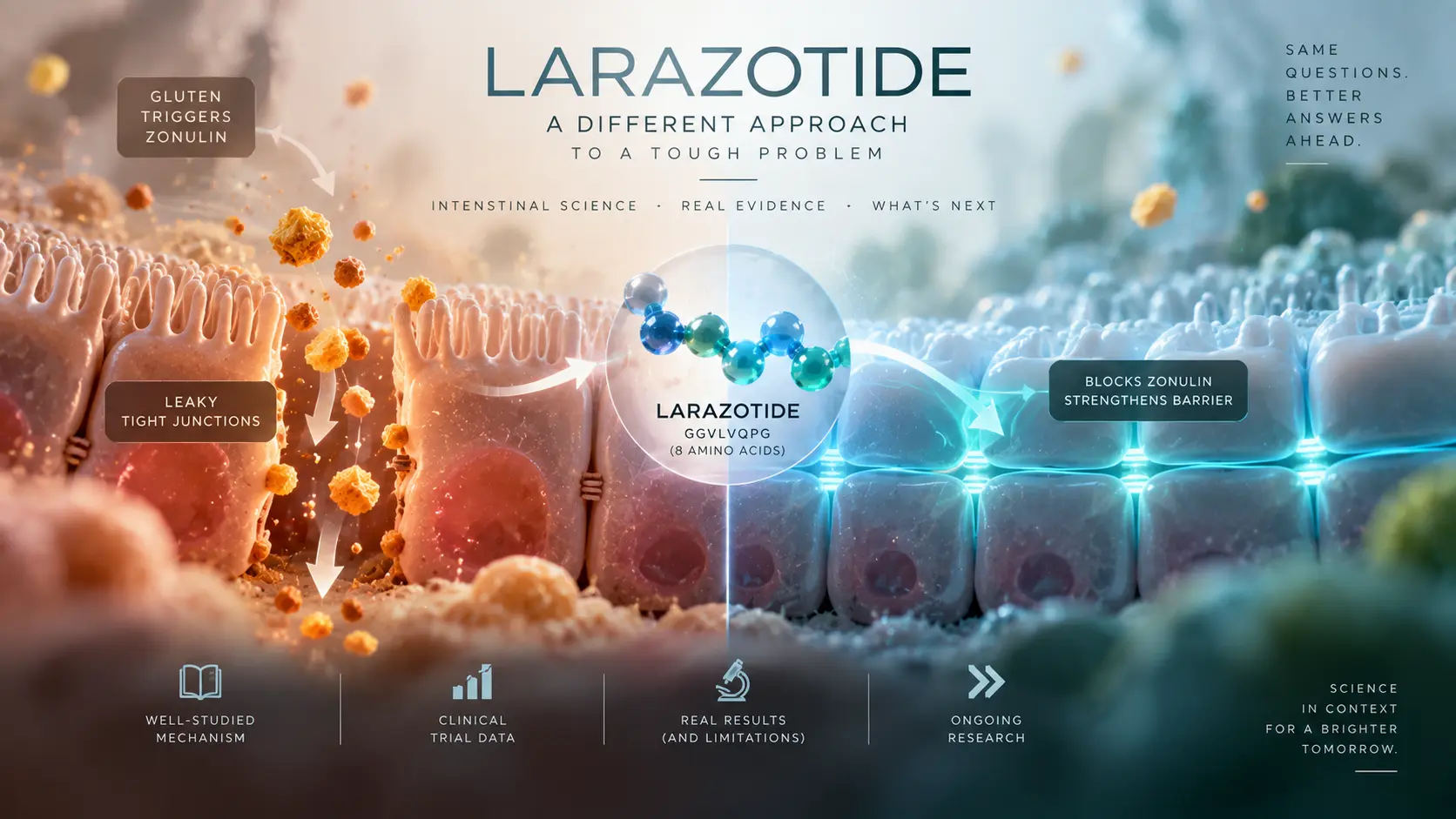
Larazotide blocks the zonulin signalling pathway that pulls intestinal tight junctions open [2]. It competes for the receptor rather than sealing the junction directly. The 2021 mechanism review by Slifer and colleagues is the clearest published account of how that works [2].
Tight junctions are protein complexes that stitch adjacent epithelial cells together at their apical edge. These complexes are not static structures. An actin ring runs beneath each junction, and contraction of that ring physically widens the gap between cells.
Zonulin is the signal that triggers that contraction. In celiac disease, gliadin exposure raises zonulin release and the actin ring tightens. Junction proteins redistribute, and the paracellular space opens wide enough for gluten peptides to slip through. They reach the lamina propria below, where the immune reaction begins.
Larazotide interrupts that sequence at two described points. First, it antagonises the zonulin receptor and reduces zonulin-driven permeability increases [2]. Published work associates it with redistribution and rearrangement of tight-junction proteins and actin filaments back toward a closed configuration [2]. Second, more recent work links larazotide to inhibition of myosin light chain kinase [2]. That enzyme phosphorylates myosin and drives the actin contraction, so inhibiting it reduces filament tension and lets junctions close.
One implication is easy to miss. Larazotide does not degrade gluten, block T cells, or suppress the immune response. It only narrows the door those peptides walk through. That is why every trial tested it alongside a gluten-free diet rather than instead of one.
Animal work supports the mechanism independently of the human trials. In ischemia-injured porcine jejunum mounted in Ussing chambers, larazotide at 1 micromolar raised transepithelial electrical resistance above injured controls [13]. It also improved localization of claudin-4, a sealing junction protein. Neither 0.1 nor 10 micromolar produced that effect. That was an early hint of the non-linear dose behaviour that would later shape the human trials.
What Does the Clinical Trial Record Actually Show?
The record shows four published randomized placebo-controlled trials, one positive primary endpoint out of four, and a Phase 3 trial that stopped short. Laid out in order, the pattern is clearer than any individual paper suggests.
How We Graded the Evidence
Each trial below is graded on three criteria, applied identically. First, was the primary endpoint prespecified and met, as opposed to a secondary or exploratory finding reported after the fact. Second, was the sample large enough that a null result is informative rather than merely underpowered. Third, was the endpoint a clinical outcome that patients feel, or a surrogate marker such as a permeability ratio. A trial scores well only when it meets a prespecified clinical endpoint in an adequately powered sample.
Year | Lead author | Design | Patients | Primary endpoint | Met? | Grade |
|---|---|---|---|---|---|---|
2007 | Paterson [3] | Inpatient, double-blind, single dose, acute gluten challenge | 21 (14 active, 7 placebo) | Safety and tolerability | Yes, for safety | Weak. Tiny sample, surrogate efficacy measures only |
2012 | Leffler [4] | Outpatient, dose-ranging, 14-day gluten challenge at 2.4 g/day | 86 | Urinary lactulose/mannitol ratio | No | Weak. Surrogate endpoint, and the marker proved too variable to read |
2013 | Kelly [5] | Outpatient, 6-week gluten challenge | 184 | Urinary lactulose/mannitol ratio | No | Moderate. Adequate size, but the same failed surrogate endpoint |
2015 | Leffler [6] | Phase 2b, 4-week placebo run-in, 12-week treatment, persistent symptoms on a gluten-free diet | 342 | Average on-treatment CeD-GSRS symptom score | Yes, at 0.5 mg only | Strong. Prespecified clinical endpoint, adequately powered |
2019 to 2022 | CeDLara [8][9] | Phase 3, randomized, double-blind, multicenter | 307 randomized | Symptom responder rate | Terminated at interim analysis | Decisive negative. Largest trial, stopped for futility |
The two gluten-challenge trials deserve separating, because secondary sources routinely merge them. Leffler 2012 enrolled 86 patients for 14 days at four dose levels [4]. Kelly 2013 enrolled 184 patients for six weeks at three dose levels [5]. Different sizes, different durations, different dose panels, different papers. Anyone citing "the 2012 gluten challenge study of 184 patients" has combined the two.
Both of those trials missed the same target. Leffler 2012 reported that lactulose/mannitol measurements were highly variable in outpatients [4]. The gluten challenge itself did not raise the ratio significantly above the gluten-free control. When your challenge fails to move the marker, the drug cannot be shown to prevent the movement. Kelly 2013 likewise found no significant difference in the permeability ratio [5].
Symptoms behaved better than permeability, though inconsistently. In the 86-patient trial, the 0.25 mg and 4 mg arms significantly limited gluten-induced symptom worsening [4][11]. Neither the 1 mg nor the 8 mg arm did. Only the 1 mg arm showed a significant symptom reduction in the 184-patient trial [11]. Those are not the same doses, which is exactly the problem.
The 342-patient Phase 2b study is the one that earned the Phase 3 programme. Patients on a gluten-free diet for at least 12 months were randomized to 0.5, 1 or 2 mg three times daily, or to placebo [6]. The 0.5 mg arm met the primary symptom endpoint by both prespecified analyses. Higher doses did nothing. That inverted pattern, where the lowest dose beats every larger one, does have a proposed explanation. Brush border aminopeptidase clips glycine residues off larazotide, producing the fragments GVLVQPG and VLVQPG [13][18]. Those fragments competitively inhibit the parent peptide, so raising the dose raises the inhibitor concentration alongside it [18].
Two findings from that trial are frequently over-reported. A 26% reduction in symptomatic days and an improvement in headache and tiredness were exploratory endpoints, not the primary result [6]. Separately, the FDA's own draft guidance advises against percentage-change-from-baseline endpoints for symptom instruments [10]. That makes the headline 26% figure the weakest number in the paper rather than the strongest.
A systematic review and meta-analysis pooled four randomized trials covering 626 patients [7]. It concluded that larazotide was safe and better than placebo for gastrointestinal symptoms during gluten challenge. The authors stopped well short of calling it a cure. That review carries a 2022 journal date and a July 2021 online date, which is why some citations list it as 2021.
Why Can Larazotide Be Taken Orally?
Larazotide works orally because it never needs to reach the bloodstream. Almost every other therapeutic peptide does. Its target sits on the luminal surface of the gut epithelium, so the intestine is the destination rather than an obstacle.
Most peptides fail orally for a specific reason. Gastric acid and pancreatic proteases break them apart. Whatever survives still has to cross the epithelium intact to reach circulation. A peptide acting systemically therefore needs both protection and absorption, and few achieve either.
Larazotide inverts that requirement almost completely. Clinical development reported that neither the peptide nor its metabolites were detectable in human serum using sensitive assays [9]. The FDA accepted that result as grounds for waiving a thorough QT study. Non-absorption was treated as a feature of the design, not a failure of it.
Delivery still had to be engineered carefully. A porcine study of a delayed-release clinical formulation tracked concentrations in intestinal fluid using liquid chromatography with tandem mass spectrometry [12]. Release was targeted to the mid duodenum and jejunum, where celiac damage concentrates. Releasing the peptide too early in the stomach would waste it.
Durability inside the gut is genuinely limited. An enzyme degradation assay using brush border aminopeptidase M generated peptide fragments from larazotide [13]. That confirms it is cleaved during transit. The compound does not so much survive the gut as act faster than the gut destroys it. This is a different and less flattering claim than the one usually made for it.
Is Larazotide FDA-Approved?
No, larazotide has never been approved by the FDA for celiac disease or for any other condition. As of September 2026 there is no approved drug for celiac disease at all. The FDA's April 2022 draft guidance states plainly that "the only treatment for CeD is a strict, lifelong gluten-free diet" [10].
The regulatory path got as far as it reasonably could. Larazotide held FDA Fast Track designation for celiac disease and completed an End of Phase 2 meeting [9]. It then entered the first Phase 3 trial any celiac drug had ever reached.
That trial was CeDLara, registered as NCT03569007 and internally as CeD-LA-3001. It began on 29 May 2019 in adults with persistent symptoms on a gluten-free diet. Two larazotide arms, 0.25 mg and 0.5 mg three times daily, ran against placebo across roughly 100 sites. Planned enrollment was set at 525 patients. The registry records 307 actually enrolled, completion on 21 July 2022, and an overall status of terminated [8].
The stated reason was statistical futility. An interim analysis ran once the first half of the target population finished the 12-week double-blind phase [9]. Reviewing it, an independent statistician concluded that the extra patients needed for a significant difference were too many to justify continuing. The sponsor announced discontinuation on 21 June 2022. No safety problem was reported at any point.
There is a regulatory irony buried in the timing. The FDA published its celiac drug development guidance in April 2022, two months before CeDLara stopped [10]. That guidance asks for co-primary endpoints covering both symptoms and mucosal histology, with statistical significance required on both. It also recommends a placebo-controlled treatment period of at least 52 weeks.
CeDLara was not built to that specification, because the specification did not exist when the trial was designed in 2018 and 2019.
Element | FDA April 2022 draft guidance [10] | CeDLara as designed [8] |
|---|---|---|
Primary endpoint structure | Co-primary clinical and histologic endpoints | Symptom responder rate alone |
Histology requirement | Endoscopy with biopsy at week 52 | Not a primary endpoint |
Controlled treatment period | At least 52 weeks | 12-week double-blind efficacy phase |
Symptom endpoint form | Advises against percentage change from baseline | Responder threshold on a symptom domain |
Even a clear win on its own terms would have left the programme short of what the agency had just asked for. That is a scheduling problem as much as a scientific one, and it is rarely mentioned in coverage of the failure.
What happened next was corporate rather than scientific. Sponsor 9 Meters Biopharma reported larazotide research spending of $1,651,492 in the first quarter of 2022 [17]. The same quarter of 2023 recorded $30,261, a drop that documents a programme already closed. Later that year, the company ceased operations and filed a voluntary Chapter 7 petition in the Eastern District of North Carolina.
The compound itself did not stop. In July 2025, a team led by Yonker at Mass General Brigham published a new Phase 2a trial [14]. It was randomized, double-blind and placebo-controlled, in 12 children hospitalized with post-COVID multisystem inflammatory syndrome. Median age was 5.7 years, treatment ran four times daily for three weeks, and follow-up continued for 24 weeks.
Children receiving larazotide showed faster resolution of gastrointestinal symptoms and faster clearance of SARS-CoV-2 spike antigen from blood [14]. They also returned to usual activities sooner. No larazotide-related adverse events were reported. A further Phase 2a trial in Long COVID, planning 48 children and adults, is registered as NCT05747534 with Massachusetts General Hospital as sponsor [15].
Ownership of the asset moved on as well. USPTO assignment records show 9 Meters Biopharma transferring its larazotide patent interest to Interlude Biopharma Co., effective 8 January 2024 and recorded on 21 May 2024 [18]. Interlude is the renamed Ebris Pharma Co., a Florida company, and it lists larazotide acetate as its lead candidate.
Searching ClinicalTrials.gov in September 2026, we found no recruiting or active registered trial of larazotide in celiac disease. The celiac programme is effectively dormant, though the asset has an owner and the molecule itself is still being studied elsewhere.
How Does Larazotide Compare to Other Gut-Related Research Peptides?
Larazotide is the outlier in this space because it has a multi-trial, placebo-controlled human record. The research peptides readers usually meet for gut work do not. That single difference matters more than any mechanistic comparison.
Larazotide | BPC-157 | KPV | |
|---|---|---|---|
Size | 8 residues | 15 residues | 3 residues |
Proposed mechanism | Zonulin receptor antagonism, tight-junction closure | Multiple proposed pathways including angiogenesis and growth factor signalling | Anti-inflammatory fragment of alpha-MSH, NF-kB modulation |
Published randomized placebo-controlled human trials | 4 in celiac disease, plus 1 in MIS-C [3][4][5][6][14] | None identified | None identified |
Largest randomized human sample | 342 [6] | Not applicable | Not applicable |
Reached Phase 3 | Yes, terminated for futility [8] | No | No |
Dominant evidence type | Human randomized trials | Rodent models, largely from one research group | Cell culture and rodent models |
The asymmetry is documented, not asserted. A 2025 systematic review of BPC-157 in orthopaedic sports medicine screened 544 articles published between 1993 and 2024 [16]. Of the 36 studies it included, 35 were preclinical and exactly one was clinical. We searched PubMed and ClinicalTrials.gov in September 2026 for human efficacy data on BPC-157 and KPV. Neither search returned a completed, published, randomized placebo-controlled efficacy trial for any indication.
That comparison cuts in an uncomfortable direction, and it is worth saying out loud. Larazotide has the strongest human evidence in this neighbourhood, and its pivotal trial still failed. Anyone treating preclinical tight-junction data as a reliable predictor of human benefit now has a well-documented counterexample.
Mechanistic detail on those compounds sits in our guide to KPV and gut, skin and immune research. The KPV versus BPC-157 in gut research covers the pairing. Neither compound has the trial record described above, and neither page claims otherwise.
What the Evidence Does Not Establish
Larazotide has not been shown to treat celiac disease. Four randomized trials produced one met primary endpoint, and the trial designed to confirm that result was stopped before it could.
Several specific claims are unsupported by the published record.
The zonulin hypothesis remains unproven as a drug target in humans. Blocking the pathway produced no reliable change in measured intestinal permeability in either gluten-challenge trial [4][5]. That is the outcome the mechanism predicts most directly.
Dose-response behaviour was never resolved in the clinic. Across three trials the effective dose moved between 0.25 mg, 1 mg and 0.5 mg [4][6][11]. Higher doses performed no better than placebo in every case. The fragment-inhibition explanation is plausible and supported by tissue work, but it was never tested prospectively in a human trial [13][18].
The MIS-C result is preliminary by any standard. Twelve children in a single-centre Phase 2a study establishes feasibility and short-term safety, not efficacy [14]. Treating it as proof that larazotide works for long COVID runs well ahead of what the authors claim.
Long-term safety in adults is uncharacterized. Trials reported tolerability comparable with placebo across the programme [4]. Headache and urinary tract infection were the most common adverse events in the 86-patient study. The FDA recommends a 52-week controlled exposure period for chronic celiac therapies [10], and no larazotide trial ran that long.
None of this establishes that larazotide is inactive. It establishes that the question was left open when the money ran out. That is a different conclusion, and a more honest one.
Where to Read Next on Gut-Barrier Peptides
Larazotide is not sold as a research compound, so there is no product to point to here. The useful next step is context rather than a catalogue. Readers tracking how investigational status differs from approval status can start with our guide to the legal status of peptides. A companion piece covers which peptides have actually been FDA-approved.
For anyone evaluating the research compounds that are available, documentation is where real differences show up. Our walkthrough on how to read a certificate of analysis covers what a purity figure does and does not tell you. The published certificates show that format applied to real lots.
One closing observation is worth making here. The most clinically advanced peptide in gut-barrier research has the thinnest plain-language coverage online. Compounds with no human trials at all have hundreds of pages written about them. That ratio is worth noticing when you assess any peptide's evidence base.
References
- Di Pierro M, Lu R, Uzzau S, et al. Zonula occludens toxin structure-function analysis: identification of the fragment biologically active on tight junctions and of the zonulin receptor binding domain. J Biol Chem. 2001;276(22):19160-19165. doi:10.1074/jbc.M009674200. https://www.jbc.org/article/S0021-9258(19)67052-3/fulltext
- Slifer ZM, Krishnan BR, Madan J, et al. Larazotide acetate: a pharmacological peptide approach to tight junction regulation. Am J Physiol Gastrointest Liver Physiol. 2021;320(6):G983-G989. doi:10.1152/ajpgi.00386.2020. PMID: 33881350. https://pubmed.ncbi.nlm.nih.gov/33881350/
- Paterson BM, Lammers KM, Arrieta MC, et al. The safety, tolerance, pharmacokinetic and pharmacodynamic effects of single doses of AT-1001 in coeliac disease subjects: a proof of concept study. Aliment Pharmacol Ther. 2007;26(5):757-766. doi:10.1111/j.1365-2036.2007.03413.x. PMID: 17697209. https://pubmed.ncbi.nlm.nih.gov/17697209/
- Leffler DA, Kelly CP, Abdallah HZ, et al. A randomized, double-blind study of larazotide acetate to prevent the activation of celiac disease during gluten challenge. Am J Gastroenterol. 2012;107(10):1554-1562. doi:10.1038/ajg.2012.211. PMID: 22825365. https://pubmed.ncbi.nlm.nih.gov/22825365/
- Kelly CP, Green PHR, Murray JA, et al. Larazotide acetate in patients with coeliac disease undergoing a gluten challenge: a randomised placebo-controlled study. Aliment Pharmacol Ther. 2013;37(2):252-262. doi:10.1111/apt.12147. PMID: 23163616. https://pubmed.ncbi.nlm.nih.gov/23163616/
- Leffler DA, Kelly CP, Green PHR, et al. Larazotide acetate for persistent symptoms of celiac disease despite a gluten-free diet: a randomized controlled trial. Gastroenterology. 2015;148(7):1311-1319.e6. doi:10.1053/j.gastro.2015.02.008. PMID: 25683116. https://pmc.ncbi.nlm.nih.gov/articles/PMC4446229/
- Hoilat GJ, Altowairqi AK, Ayas MF, et al. Larazotide acetate for treatment of celiac disease: a systematic review and meta-analysis of randomized controlled trials. Clin Res Hepatol Gastroenterol. 2022;46(1):101782. doi:10.1016/j.clinre.2021.101782. PMID: 34339872. https://pubmed.ncbi.nlm.nih.gov/34339872/
- ClinicalTrials.gov. A Phase 3, Randomized, Double-Blind, Placebo Controlled Study to Evaluate the Efficacy and Safety of Larazotide Acetate for the Relief of Persistent Symptoms in Patients With Celiac Disease on a GFD. Identifier NCT03569007. https://clinicaltrials.gov/study/NCT03569007
- 9 Meters Biopharma, Inc. Form 8-K, Exhibit 99.1: 9 Meters Biopharma Announces Interim Analysis of Phase 3 Study of Larazotide for Celiac Disease Does Not Support Trial Continuation. 21 June 2022. https://www.sec.gov/Archives/edgar/data/1551986/000155198622000046/ex-991pressreleasedated621.htm
- US Food and Drug Administration. Celiac Disease: Developing Drugs for Adjunctive Treatment to a Gluten-Free Diet. Draft Guidance for Industry. CDER/CBER, April 2022. https://www.fda.gov/media/157682/download
- Khaleghi S, Ju JM, Lamba A, et al. The potential utility of tight junction regulation in celiac disease: focus on larazotide acetate. Therap Adv Gastroenterol. 2016;9(1):37-49. doi:10.1177/1756283X15616576. https://pmc.ncbi.nlm.nih.gov/articles/PMC4699279/
- Enomoto H, Yeatts J, Carbajal L, et al. In vivo assessment of a delayed release formulation of larazotide acetate indicated for celiac disease using a porcine model. PLoS One. 2021;16(4):e0249179. doi:10.1371/journal.pone.0249179. PMID: 33844694. https://pubmed.ncbi.nlm.nih.gov/33844694/
- Slifer ZM, Hernandez L, Pridgen TA, et al. Larazotide acetate induces recovery of ischemia-injured porcine jejunum via repair of tight junctions. PLoS One. 2021;16(4):e0250165. doi:10.1371/journal.pone.0250165. PMID: 33886649. https://pmc.ncbi.nlm.nih.gov/articles/PMC8061941/
- Yonker LM, Kane AS, Swank Z, et al. Viral spike antigen clearance and augmented recovery in children with post-COVID multisystem inflammatory syndrome treated with larazotide. Sci Transl Med. 2025;17(809):eadu4284. doi:10.1126/scitranslmed.adu4284. PMID: 40737433. https://pubmed.ncbi.nlm.nih.gov/40737433/
- ClinicalTrials.gov. Phase 2a Randomized, Double-Blind, Placebo-Controlled, Multi-Center Study to Evaluate the Safety and Efficacy of Larazotide (AT1001) for the Treatment of Long COVID in Children and Adults. Identifier NCT05747534. https://clinicaltrials.gov/study/NCT05747534
- Vasireddi N, Hahamyan H, Salata MJ, et al. Emerging use of BPC-157 in orthopaedic sports medicine: a systematic review. HSS J. 2025;21(4):485-495. doi:10.1177/15563316251355551. PMID: 40756949. https://pubmed.ncbi.nlm.nih.gov/40756949/
- 9 Meters Biopharma, Inc. Form 10-Q for the quarterly period ended 31 March 2023. US Securities and Exchange Commission. https://www.sec.gov/Archives/edgar/data/1551986/000155198623000038/nmtr-20230331.htm
- US Patent and Trademark Office. Assignment records for US patent application 17/996,228, "Larazotide derivatives comprising D-amino acids" (publication US20230218706A1). Assignment from 9 Meters Biopharma, Inc. to Interlude Biopharma Co., reel/frame 067486/0564, effective 8 January 2024, recorded 21 May 2024. https://assignment.uspto.gov/patent/index.html#/patent/search/resultFilter?searchInput=20230218706
Frequently Asked Questions
What is larazotide?
Larazotide is a synthetic peptide of eight amino acids, sequence GGVLVQPG, developed as an oral treatment for celiac disease. It works on the tight junctions between intestinal cells rather than on gluten or the immune system. It is also known as larazotide acetate, AT-1001 and INN-202. It is an investigational drug, not an approved medicine and not a supplement.
Is larazotide a peptide?
Yes. Larazotide is a genuine peptide, a single chain of eight amino acids with no disulfide bonds or chemical modifications. That makes it one of the shortest peptides ever taken into a Phase 3 clinical trial. Its small size is part of why it can be given in an oral capsule, since it acts inside the gut rather than needing to enter the bloodstream.
What is larazotide's mechanism of action?
Larazotide acts as a zonulin receptor antagonist. Zonulin is a signalling protein that causes intestinal tight junctions to open by contracting the actin ring beneath them. By occupying the receptor, larazotide blunts that signal, and published work associates it with redistribution of junction proteins and with inhibition of myosin light chain kinase, the enzyme driving the contraction.
Is larazotide a supplement?
No. Larazotide is an investigational pharmaceutical that was developed under an FDA Investigational New Drug application and tested in registered clinical trials. It has never been marketed as a dietary supplement, and it does not meet the definition of one. Products advertised online as "larazotide supplements" are not the compound studied in the trials described in this article.
Has larazotide been tested in human clinical trials?
Yes, extensively. Four randomized placebo-controlled trials in celiac disease were published between 2007 and 2015, enrolling 21, 86, 184 and 342 patients. A Phase 3 trial randomized a further 307 patients before being stopped in 2022. A separate 12-child trial in post-COVID multisystem inflammatory syndrome was published in 2025. That is a larger human dataset than almost any research peptide.
What phase of clinical trials has larazotide reached?
Phase 3, making it the only celiac disease drug candidate ever to get that far. The trial, called CeDLara, began in May 2019 and was terminated in July 2022. It did not complete, so no Phase 3 efficacy result was ever established. Larazotide has since been studied in Phase 2a trials for post-COVID conditions rather than celiac disease.
Is larazotide FDA-approved?
No. Larazotide holds no FDA approval for any indication, and as of September 2026 no drug is approved for celiac disease. It received FDA Fast Track designation, which speeds review of promising candidates but is not approval or any indication of eventual success. The FDA's own draft guidance states that a strict lifelong gluten-free diet remains the only treatment.
Does larazotide reduce symptoms during a gluten challenge?
Partly, and inconsistently. In the 86-patient trial, the 0.25 mg and 4 mg arms significantly limited gluten-induced symptom worsening while 1 mg and 8 mg did not. In the 184-patient trial, only the 1 mg arm showed a significant symptom reduction. Neither trial met its primary endpoint, which measured intestinal permeability rather than symptoms.
Does larazotide help people already on a gluten-free diet?
The 342-patient Phase 2b trial suggested it might, and the Phase 3 trial designed to confirm that did not. In the Phase 2b study, patients on a gluten-free diet for at least 12 months had fewer symptoms on the 0.5 mg dose than on placebo. The follow-up Phase 3 trial in the same population was stopped for futility in 2022.
Is larazotide taken orally or injected?
Orally, as a capsule taken before meals in all published celiac trials. It was never developed as an injectable. This is unusual among peptides, most of which are injected because digestion destroys them before they can be absorbed. Larazotide's oral route reflects its target, which sits on the gut lining itself.
Why can larazotide be taken orally when many peptides cannot?
Because it does not need to reach the bloodstream. Most peptides are injected so they can act on distant tissues, which requires surviving digestion and crossing the intestinal wall intact. Larazotide's target is on the gut lining, so the intestine is the destination. Clinical testing found neither the peptide nor its metabolites detectable in human serum.
What did the early larazotide gluten-challenge trials find?
The 2007 inpatient study in 21 subjects found a roughly 70% rise in intestinal permeability after gluten in the placebo group and none in the treated group, alongside fewer gastrointestinal symptoms. Later outpatient trials could not reproduce the permeability finding, because the lactulose/mannitol marker proved too variable outside a controlled hospital setting to measure reliably.
How is larazotide different from BPC-157 or KPV?
Evidence, mainly. Larazotide has four published randomized placebo-controlled trials in celiac disease and reached Phase 3. A 2025 systematic review screening 544 BPC-157 articles found only one clinical study among 36 included. KPV's published record is similarly preclinical. Larazotide also differs mechanistically, targeting tight-junction closure rather than tissue repair or general inflammation.
What side effects did the larazotide trials report?
Reported tolerability was comparable with placebo across the celiac programme. In the 86-patient trial the most common adverse events were headache and urinary tract infection, and no serious adverse events occurred. The 2025 MIS-C trial reported no larazotide-related adverse events across 24 weeks of follow-up. Long-term safety beyond trial durations has not been characterized.
Can you buy larazotide?
No. Larazotide is an investigational drug that was never approved or marketed, so there is no legitimate commercial source, prescription or otherwise. It is not sold as a supplement or as a research compound by peptide suppliers, including 99 Purity Peptides. Anything advertised under the name should be treated with considerable scepticism about its identity and origin.