Last reviewed: September 2026

Quick Answer
Research on IGF-1 cancer risk finds a small but consistent positive association between higher circulating insulin-like growth factor 1 (IGF-1) and later diagnosis of prostate, colorectal and breast cancer. Effect sizes are modest, mostly odds ratios and hazard ratios between 1.08 and 1.49. All this evidence concerns IGF-1 the body makes itself, and association is not causation.
Key Takeaways
- The Renehan et al. 2004 meta-regression in The Lancet pooled 21 studies (26 datasets, 3,609 cases, 7,137 controls) and reported an odds ratio of 1.49 (95% CI 1.14–1.95) for prostate cancer and 1.65 (95% CI 1.26–2.08) for premenopausal breast cancer, comparing the 75th with the 25th percentile of IGF-1 [1].
- A 2010 pooled analysis of individual data from 17 prospective studies (4,790 cases, 9,428 controls) put breast cancer risk at an odds ratio of 1.28 (95% CI 1.14–1.44) for the highest versus lowest fifth of IGF-1, and found the association confined to oestrogen-receptor-positive tumours [2].
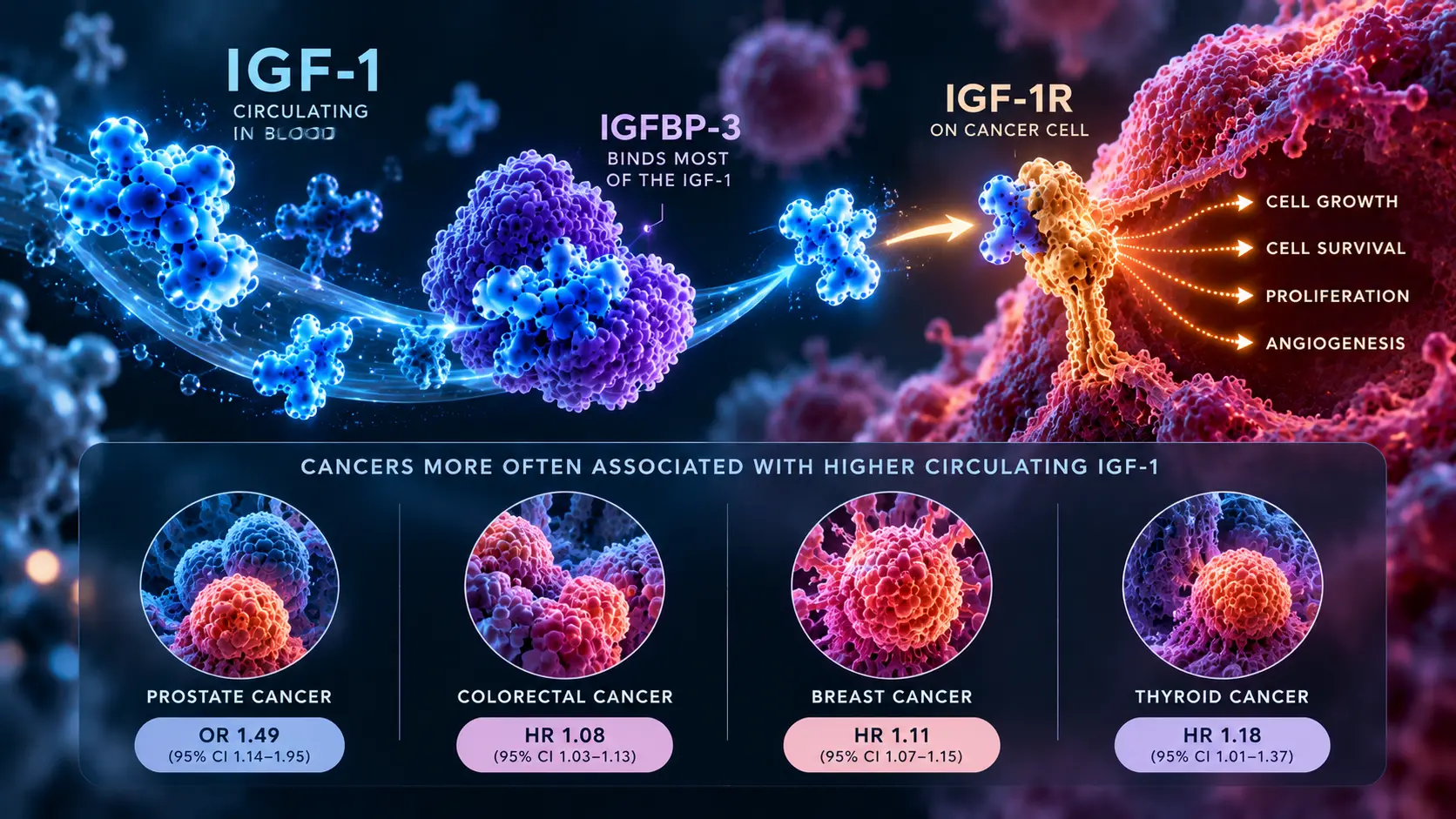
- UK Biobank analysis of 394,388 participants reported hazard ratios per 5 nmol/L higher IGF-1 of 1.08 (95% CI 1.05–1.12) for prostate, 1.08 (95% CI 1.03–1.13) for colorectal, 1.11 (95% CI 1.07–1.15) for breast and 1.18 (95% CI 1.01–1.37) for thyroid cancer [3].
- Mendelian randomization using 416 genetic variants supported a causal association for colorectal cancer but returned inconsistent or null results for prostate and breast cancer [4].
- The BUPA nested case-control study (1,051 men with cancer, 3,142 controls) plus its own meta-analysis concluded IGF-1 has no useful role in cancer screening, and reported no association with lung cancer at an odds ratio of 1.02 (95% CI 0.80–1.31) [5].
- Circulating IGF-1 is produced mainly by the liver under growth hormone control, and liver-derived IGF-1 makes up a major part of what is measured in blood [6].
- No published study examines the cancer risk of the synthetic analogue IGF-1 LR3 in people. PubMed searches for the analogue's names combined with cancer terms return only cell-culture and animal work.
Research Use Only
Every compound referenced on this site is supplied for laboratory research use only. Nothing here is for human or veterinary consumption, and nothing in this article is medical advice, dosing guidance or a health claim. This page reviews published epidemiology about IGF-1 the body produces naturally. It is a caution piece, not a recommendation about any product.
Where Does Circulating IGF-1 Come From?
Most of the IGF-1 measured in a blood sample is made by the liver in response to growth hormone. IGF-1 is expressed in nearly every tissue in the body, but hepatic expression dwarfs the rest, and liver-derived IGF-1 makes up a major share of the circulating pool [6]. Local tissues also make their own IGF-1 for their own use, which acts on neighbouring cells rather than travelling through the bloodstream.
That distinction matters more than it first appears. Work with liver-specific IGF-1 knockout mice showed that local tissue IGF-1 can substitute for liver IGF-1 in maintaining normal long-bone growth, but cannot replace it for a long list of other functions, including growth hormone secretion itself, cortical bone mass, kidney size, prostate size and tumour progression in some models [6]. Circulating IGF-1 and tissue IGF-1 are not interchangeable.
IGF-1 does its work by binding the type 1 IGF receptor (IGF-1R), a receptor tyrosine kinase found on a wide range of cell types [7]. Binding proteins in blood control how much free IGF-1 is actually available to that receptor, and the most abundant of these is insulin-like growth factor binding protein 3 (IGFBP-3). Almost every epidemiological study in this field measures both.
Keep that architecture in mind for the rest of this page. Every number below describes people whose own liver set their own IGF-1 level over years. None of it describes what happens when an IGF-1 analogue is introduced from outside.
What Did the Landmark 2004 Meta-Analysis Find?
The 2004 meta-regression by Renehan and colleagues found modest, site-specific associations, with the clearest signals in prostate and premenopausal breast cancer. Published in The Lancet, it pooled 21 eligible studies covering 26 datasets, 3,609 cases and 7,137 controls, and examined prostate, colorectal, premenopausal and postmenopausal breast, and lung cancer [1].
Rather than comparing crude high and low groups, the authors normalised each study's IGF-1 measurements to a percentile scale and reported the odds ratio comparing the 75th percentile with the 25th.
Association reported | Odds ratio (75th vs 25th percentile) | 95% confidence interval |
|---|---|---|
IGF-1 and prostate cancer | 1.49 | 1.14–1.95 |
IGF-1 and premenopausal breast cancer | 1.65 | 1.26–2.08 |
IGFBP-3 and premenopausal breast cancer | 1.51 | 1.01–2.27 |
Two findings inside that paper get quoted far less often than the headline numbers, and both should temper how the headline is read. Associations were larger when plasma samples were used than when serum was used, and larger in conventional case-control studies than in studies nested inside prospective cohorts [1]. Nested designs draw blood before anyone is diagnosed, which is exactly the design least vulnerable to the disease itself altering the measurement. When the better design gives the smaller number, that is a signal worth respecting.
The authors said as much in their own conclusion, describing the associations as modest and variable between sites [1]. Vendor pages that cite this paper as showing IGF-1 "causes" cancer are citing a source that says something considerably more careful.
One more point of precision. The abstract record reports significant summary associations only for the three rows above. Colorectal, lung and postmenopausal breast cancer were examined, and no significant summary odds ratio for them appears in the record. We have not stated figures for those sites because we could not open the full text to confirm them, and a number you cannot check is a number you should not publish.
Have More Recent Studies Confirmed That Association?
Later and larger studies broadly confirmed the direction of the association while shrinking its size and changing its shape. Three matter most.
The Endogenous Hormones and Breast Cancer Collaborative Group pooled individual participant data from 17 prospective studies across 12 countries in 2010, covering 4,790 breast cancer cases and 9,428 matched controls [2]. Women in the highest fifth of IGF-1 had an odds ratio of 1.28 (95% CI 1.14–1.44, p<0.0001) compared with the lowest fifth. Adjusting for IGFBP-3 did not change it.
That pooled analysis also complicated the 2004 picture in two specific ways. The association did not vary significantly by menopausal status, which cuts against the premenopausal-only pattern Renehan reported. It did vary sharply by tumour biology, with an odds ratio of 1.38 (95% CI 1.14–1.68) for oestrogen-receptor-positive tumours against 0.80 (95% CI 0.57–1.13) for oestrogen-receptor-negative tumours, p for heterogeneity 0.007 [2]. An IGF-1 association that exists for one tumour subtype and not another is a more interesting finding than a blanket one.
UK Biobank supplied the largest single prospective dataset. Analysis of 394,388 cancer-free participants, followed for a mean of 6.9 years and using repeat measurements from up to 14,149 people to correct for regression dilution, tested 30 cancer sites at once [3].
Cancer site | Hazard ratio per 5 nmol/L higher IGF-1 | 95% confidence interval |
|---|---|---|
Thyroid | 1.18 | 1.01–1.37 |
Breast | 1.11 | 1.07–1.15 |
Colorectal | 1.08 | 1.03–1.13 |
Prostate | 1.08 | 1.05–1.12 |
Higher IGF-1 was associated with reduced risk of ovarian and liver cancer in that same analysis [3]. Nominal associations with melanoma, multiple myeloma, oral cancer and oesophageal squamous cell carcinoma did not survive correction for multiple testing, which is the correct way to treat them.
Against these positive findings sits the BUPA study, and it deserves more attention than it gets. Morris and colleagues measured IGF-1, IGF-2 and IGFBP-3 in stored serum from 1,051 men with cancer and 3,142 controls, examined 14 cancers, and ran their own meta-analysis alongside [5]. Their pooled odds ratios comparing highest with lowest quartile were 1.31 (95% CI 1.03–1.67) for prostate, 1.37 (95% CI 1.05–1.78) for colorectal and 1.02 (95% CI 0.80–1.31) for lung cancer. No statistically significant association appeared for IGFBP-3 at any site.
Their conclusion was blunt and is frequently misquoted. IGF-1, IGF-2 and IGFBP-3 measurements have no value in cancer screening, though IGF-1 and IGF-2 may be of aetiological significance for colorectal and prostate cancer [5]. That is not a null result for the association. It is a null result for the clinical usefulness of measuring it, which is a different claim, and pages that present BUPA as debunking the IGF-1 link have misread it.
What Does Mendelian Randomization Add to the Picture?
Mendelian randomization tests whether genetically predicted lifetime IGF-1 levels associate with cancer, which sidesteps the reverse-causation problem that observational studies cannot escape. People inherit their gene variants at conception, long before any tumour exists. If a variant that raises IGF-1 also raises cancer incidence, an undiagnosed tumour cannot be the explanation.
Larsson and colleagues applied this in 2020 using 416 single-nucleotide polymorphisms robustly associated with serum IGF-1, drawing outcome data from large consortia, UK Biobank and the BioBank Japan Project [4]. The results were not uniform, and the uneven pattern is the finding.
Cancer site | Dataset | Odds ratio per SD higher genetically predicted IGF-1 | 95% CI | Significant? |
|---|---|---|---|---|
Colorectal | UK Biobank | 1.11 | 1.01–1.22 | Yes |
Colorectal | BioBank Japan | 1.22 | 1.09–1.36 | Yes |
Prostate | UK Biobank | 1.10 | 1.01–1.21 | Yes |
Prostate | Prostate cancer consortium | 1.03 | 0.97–1.09 | No (p=0.41) |
Prostate | BioBank Japan | 1.08 | 0.95–1.22 | No (p=0.24) |
Breast | UK Biobank | 0.99 | 0.92–1.07 | No (p=0.85) |
Breast | Breast Cancer Association Consortium | 1.08 | 1.02–1.13 | Yes |
Colorectal cancer replicated in two independent populations of different ancestry. Prostate cancer reached significance only in UK Biobank and failed in the larger disease-specific consortium, which is the dataset best powered to detect it. Breast cancer went the other way, null in UK Biobank and positive in the specialist consortium. No significant association appeared with 14 other cancers [4].
A separate 2020 study combining serology and Mendelian randomization reinforced the colorectal result specifically. Murphy and colleagues followed 397,380 UK Biobank participants for a median of 7.1 years, recording 2,665 colorectal cancers, and found a hazard ratio of 1.11 (95% CI 1.05–1.17) per standard deviation of IGF-1. Their two-sample genetic analysis, using 52,865 cases and 46,287 controls, returned an odds ratio of 1.08 (95% CI 1.03–1.12) [8].
Our reading is that colorectal cancer is the one site where the genetic evidence genuinely strengthens the observational picture. Everywhere else, Mendelian randomization narrows the claim rather than confirming it.
Why Would Elevated IGF-1 Plausibly Raise Cancer Risk?
IGF-1 receptor signalling drives cell proliferation and suppresses apoptosis, which is a coherent reason why more IGF-1 might help existing abnormal cells survive and divide. Activation of IGF-1R triggers intracellular cascades that push cells through division and away from programmed cell death [7]. A cell that should have been eliminated instead persists.
Note what that mechanism describes. It is a plausible account of tumour promotion, meaning the growth of cells that have already gone wrong. It is not an account of initiation, the original DNA damage. That distinction is routinely collapsed on pages that discuss this topic, and collapsing it overstates what anyone has shown.
Two lines of human evidence sit either side of the mechanism, and they pull in opposite directions.
Acromegaly, in which growth hormone and IGF-1 are chronically elevated for years, is the closest natural experiment available. A Danish nationwide cohort of 529 acromegaly cases recorded 81 cancers after excluding those diagnosed within the first year, a standardised incidence ratio of 1.1 (95% CI 0.9–1.4), which does not reach significance. The accompanying meta-analysis of 23 studies gave an overall cancer SIR of 1.5 (95% CI 1.2–1.8), with colorectal at 2.6 (95% CI 1.7–4.0) and thyroid at 9.2 (95% CI 4.2–19.9) [9]. The authors noted that SIRs ran higher in single-centre studies and in studies with fewer than ten cancer cases, which points at selection bias in the older literature. Cancer-specific mortality was not elevated in their own cohort [9].
From the opposite direction, 22 years of monitoring an Ecuadorian population with growth hormone receptor deficiency, and therefore very low IGF-1, recorded one non-lethal malignancy and no diabetes, against a 17% cancer prevalence and 5% diabetes prevalence in relatives [10]. That is a striking observation in a small, genetically unusual group, and it is a hint rather than a proof.
Then there is the trial evidence, which is the part most often left out. Antibodies targeting IGF-1R were taken into phase III cancer trials, and the initial results in unselected patients were disappointing [7]. Blocking the receptor did not deliver the benefit the mechanism predicted. Whatever IGF-1 signalling contributes to cancer biology, it is evidently not a simple lever.
Association in observational epidemiology is not a proven causal mechanism in people. The literature contains null findings, conflicting findings and a failed therapeutic programme built on the same hypothesis. Anyone summarising this field without those three facts is summarising it badly.
How Strong Is the IGF-1 Cancer Risk Evidence, Cancer Type by Cancer Type?
Colorectal cancer has the strongest evidence, breast cancer the most nuanced, and everything else is thin.
How we graded the evidence. We rated each site on three criteria. First, whether prospective cohort data exist at scale, since prospective blood draws precede diagnosis. Second, whether Mendelian randomization replicates the finding across independent populations, since that addresses reverse causation. Third, whether independent studies agree on direction and rough magnitude. A site is graded Moderate only when all three hold. Nothing in this field reaches Strong, because no randomised human trial of IGF-1 elevation exists and none ever will.
Cancer site | Best available designs | Direction and magnitude | Consistent across studies? | Our grade |
|---|---|---|---|---|
Colorectal | Case-control, large prospective cohort, Mendelian randomization in two ancestries | Positive; HR 1.08 (1.03–1.13) prospective [3], OR 1.08 (1.03–1.12) genetic [8] | Yes, including replication in BioBank Japan | Moderate |
Breast | Pooled prospective (17 studies), large cohort, Mendelian randomization | Positive; OR 1.28 (1.14–1.44) pooled [2], but 1.38 for ER-positive vs 0.80 ER-negative | Direction yes, subtype-dependent; genetic results split | Moderate, subtype-limited |
Prostate | Case-control, large cohort, Mendelian randomization in three datasets | Positive but weakening; OR 1.49 (1.14–1.95) in 2004 [1], HR 1.08 (1.05–1.12) in 2020 [3] (different metrics, not directly comparable) | Inconsistent; failed in the largest disease-specific genetic consortium [4] | Weak to moderate |
Thyroid | Single large cohort only | Positive; HR 1.18 (1.01–1.37) [3]; acromegaly SIR 9.2 (4.2–19.9) [9] | Not independently replicated in a second cohort | Weak |
Lung | Nested case-control and meta-analysis | Null; OR 1.02 (0.80–1.31) [5] | Yes, consistently null | Moderate evidence of no association |
Ovarian, liver | Single large cohort | Inverse association reported [3] | Not replicated | Weak |
All other sites | Outcome-wide cohort, Mendelian randomization | No significant association after correction for multiple testing [3][4] | Consistently null | Weak evidence of no association |
Reading down that table, the honest summary is narrow. One site replicates properly. One replicates for a tumour subtype. The rest is either shrinking under better methods or was never there.
What the Evidence Does Not Establish
None of this evidence is about IGF-1 LR3, and that gap is the single most important thing on this page. Every study cited above measured endogenous IGF-1, the hormone participants' own livers produced across their lifetimes. Extending those findings to a synthetic analogue is an assumption, not a result.
We searched PubMed for the analogue's various names, including "IGF-1 LR3", "Long R3 IGF-I" and "LongR3", both alone and combined with cancer, tumour, neoplasm and carcinogenesis terms. The combined searches returned no human cancer-risk study of any kind. What came back was cell-culture work and animal physiology, including fetal sheep studies and prostate cancer cell-line experiments where the analogue was used as a laboratory tool precisely because it does not bind IGFBPs [11]. Those papers were designed to probe binding-protein biology, not to assess risk.
The analogue's pharmacology differs from native IGF-1 in a way that is widely described incorrectly. Francis and colleagues, who characterised these fusion analogues in 1992, replaced glutamate at position 3 with arginine, which is what the "R3" in the name denotes [12]. Descriptions claiming the substitution introduces leucine have it wrong. The same paper found the increased potency comes from reduced interaction with IGF binding proteins rather than from enhanced receptor affinity, and in chicken embryo fibroblasts, which secrete no detectable binding proteins, Long [Arg3]-IGF-I was actually less potent than native IGF-1 [12]. Potency here is context-dependent, and claims of a fixed multiple over native IGF-1 are not supported by the source those claims trace back to.
A few other limits are worth stating plainly.
No randomised controlled trial has raised IGF-1 in healthy people and measured cancer incidence. That study will never be run, so causal certainty at the level a drug approval would demand is permanently out of reach here.
Observational effect sizes in this field are small. A hazard ratio of 1.08 is a long way from the magnitudes seen with established carcinogens, and it is well within the range where uncontrolled confounding can generate a signal. Body size, insulin, diet and socioeconomic factors all track with IGF-1.
Follow-up in the largest cohort averaged 6.9 years, and the authors themselves flagged that reverse causation bias cannot be excluded over that window [3]. A tumour that has been growing quietly for years can influence a blood measurement taken before diagnosis.
None of this makes the signal irrelevant. Read properly, the IGF-1 cancer risk literature describes a documented, modest, site-specific association in endogenous IGF-1, which is worth knowing and worth not overstating in either direction.
Where to Read Next
Anyone following the IGF-1 cancer risk literature further should start with the primary sources listed below rather than secondary summaries, which is where most of the overstatement in this field originates. For background on what IGF-1 LR3 is and what it is studied for, see our IGF-1 LR3 research guide. The structural and binding differences between the analogues are covered in IGF-1 LR3 versus IGF-1 DES, which is the better starting point if the Francis 1992 pharmacology above was new to you.
Researchers evaluating any compound on documentation quality rather than marketing copy should start with our guide on how to read a certificate of analysis, then check the batch records in our certificate of analysis library.
Our IGF-1 LR3 research materials ship with lot-specific analytical documentation, available as IGF-1 LR3 and IGF-1 LR3 Spray. Both are supplied for laboratory research use only.
References
- Renehan AG, Zwahlen M, Minder C, et al. Insulin-like growth factor (IGF)-I, IGF binding protein-3, and cancer risk: systematic review and meta-regression analysis. Lancet. 2004;363(9418):1346-1353. PMID: 15110491. https://pubmed.ncbi.nlm.nih.gov/15110491/
- Key TJ, Appleby PN, Reeves GK, Roddam AW; Endogenous Hormones and Breast Cancer Collaborative Group. Insulin-like growth factor 1 (IGF1), IGF binding protein 3 (IGFBP3), and breast cancer risk: pooled individual data analysis of 17 prospective studies. Lancet Oncol. 2010;11(6):530-542. PMID: 20472501. PMC3113287. https://pmc.ncbi.nlm.nih.gov/articles/PMC3113287/
- Knuppel A, Fensom GK, Watts EL, et al. Circulating Insulin-like Growth Factor-I Concentrations and Risk of 30 Cancers: Prospective Analyses in UK Biobank. Cancer Res. 2020;80(18):4014-4021. PMID: 32709735. https://pubmed.ncbi.nlm.nih.gov/32709735/
- Larsson SC, Carter P, Vithayathil M, et al. Insulin-like growth factor-1 and site-specific cancers: A Mendelian randomization study. Cancer Med. 2020;9(18):6836-6842. PMID: 32717139. PMC7520358. https://pmc.ncbi.nlm.nih.gov/articles/PMC7520358/
- Morris JK, George LM, Wu T, Wald NJ. Insulin-like growth factors and cancer: no role in screening. Evidence from the BUPA study and meta-analysis of prospective epidemiological studies. Br J Cancer. 2006;95(1):112-117. PMID: 16804529. PMC2360494. https://pmc.ncbi.nlm.nih.gov/articles/PMC2360494/
- Ohlsson C, Mohan S, Sjögren K, et al. The role of liver-derived insulin-like growth factor-I. Endocr Rev. 2009;30(5):494-535. PMID: 19589948. PMC2759708. https://pmc.ncbi.nlm.nih.gov/articles/PMC2759708/
- Pollak M. The insulin and insulin-like growth factor receptor family in neoplasia: an update. Nat Rev Cancer. 2012;12(3):159-169. PMID: 22337149. https://pubmed.ncbi.nlm.nih.gov/22337149/
- Murphy N, Carreras-Torres R, Song M, et al. Circulating Levels of Insulin-like Growth Factor 1 and Insulin-like Growth Factor Binding Protein 3 Associate With Risk of Colorectal Cancer Based on Serologic and Mendelian Randomization Analyses. Gastroenterology. 2020;158(5):1300-1312.e20. PMID: 31884074. PMC7152801. https://pmc.ncbi.nlm.nih.gov/articles/PMC7152801/
- Dal J, Leisner MZ, Hermansen K, et al. Cancer Incidence in Patients With Acromegaly: A Cohort Study and Meta-Analysis of the Literature. J Clin Endocrinol Metab. 2018;103(6):2182-2188. PMID: 29590449. https://pubmed.ncbi.nlm.nih.gov/29590449/
- Guevara-Aguirre J, Balasubramanian P, Guevara-Aguirre M, et al. Growth hormone receptor deficiency is associated with a major reduction in pro-aging signaling, cancer, and diabetes in humans. Sci Transl Med. 2011;3(70):70ra13. PMID: 21325617. PMC3357623. https://pmc.ncbi.nlm.nih.gov/articles/PMC3357623/
- Wetterau LA, Francis MJ, Ma L, Cohen P. Insulin-like growth factor I stimulates telomerase activity in prostate cancer cells. J Clin Endocrinol Metab. 2003;88(7):3354-3359. PMID: 12843187. https://pubmed.ncbi.nlm.nih.gov/12843187/
- Francis GL, Ross M, Ballard FJ, et al. Novel recombinant fusion protein analogues of insulin-like growth factor (IGF)-I indicate the relative importance of IGF-binding protein and receptor binding for enhanced biological potency. J Mol Endocrinol. 1992;8(3):213-223. PMID: 1378742. https://pubmed.ncbi.nlm.nih.gov/1378742/
Frequently Asked Questions
Does IGF-1 cause cancer?
No study has shown that IGF-1 causes cancer in people. What the literature shows is an association: people with higher circulating IGF-1 are somewhat more likely to be diagnosed with certain cancers later. Effect sizes are small, typically hazard ratios of 1.08 to 1.11 in the largest cohort. Observational data cannot separate cause from correlation, and a failed drug programme targeting the IGF-1 receptor complicates the causal story further.
Is there a link between IGF-1 and cancer risk?
Yes, a modest and site-specific one. Higher circulating IGF-1 associates with increased risk of colorectal, breast and prostate cancer across multiple large studies, with odds ratios and hazard ratios mostly between 1.08 and 1.49 depending on the study design and comparison used. The link is absent for lung cancer and reverses direction for ovarian and liver cancer in UK Biobank data.
What did the 2004 Renehan meta-analysis find about IGF-1 and cancer?
It found higher IGF-1 associated with prostate cancer at an odds ratio of 1.49 (95% CI 1.14–1.95) and premenopausal breast cancer at 1.65 (95% CI 1.26–2.08), comparing the 75th with the 25th percentile. The analysis pooled 21 studies, 3,609 cases and 7,137 controls. Its authors described the associations as modest and varying by site, and noted associations were smaller in better-designed nested cohort studies.
Which cancers has IGF-1 been most studied for?
Prostate, colorectal and breast cancer by a wide margin. These three appear in nearly every major analysis, including the 2004 Lancet meta-regression, the 2010 pooled analysis of 17 prospective breast cancer studies and the 2020 UK Biobank outcome-wide study of 30 cancer sites. Thyroid, lung, ovarian and liver cancer have been examined in single large cohorts, with much less replication behind those findings.
Is the IGF-1 and cancer risk association causation or just correlation?
Mostly correlation, with a partial causal case for colorectal cancer only. Observational studies cannot rule out confounding or reverse causation. Mendelian randomization, which tests genetically predicted lifetime IGF-1, replicated a colorectal association in both European and Japanese populations but gave inconsistent results for prostate and breast cancer. That split is the clearest available guide to which associations are likely causal.
What is Mendelian randomization, and what does it show for IGF-1?
Mendelian randomization uses inherited gene variants as a natural experiment. Because variants are fixed at conception, they cannot be altered by an undeveloped tumour, which addresses reverse causation. A 2020 study using 416 IGF-1-associated variants found colorectal cancer odds ratios of 1.11 in UK Biobank and 1.22 in BioBank Japan, while prostate and breast cancer results conflicted between datasets.
Where does the body's IGF-1 come from?
Mainly the liver, which produces IGF-1 in response to growth hormone. Almost every tissue expresses IGF-1, but hepatic output dominates the circulating pool. Local tissue IGF-1 acts on neighbouring cells rather than travelling in blood. Mouse studies with liver-specific IGF-1 knockouts showed local IGF-1 can substitute for hepatic IGF-1 in bone lengthening but not for many other functions.
Why would higher IGF-1 plausibly increase cancer risk?
IGF-1 receptor activation promotes cell division and suppresses apoptosis, the process that eliminates damaged cells. A cell carrying mutations that would normally be removed may instead survive and multiply. That mechanism describes tumour promotion rather than tumour initiation, meaning it could help existing abnormal cells grow without causing the original genetic damage. The distinction matters and is frequently blurred.
Has IGF-1 LR3 itself been studied for cancer risk?
No. PubMed searches for "IGF-1 LR3", "Long R3 IGF-I" and "LongR3" combined with cancer, tumour, neoplasm and carcinogenesis terms return no study of cancer risk in people. The results are cell-culture and animal work, including fetal sheep physiology and prostate cancer cell-line experiments using the analogue as a tool. All cancer epidemiology reviewed here concerns IGF-1 the body makes itself.
Is IGF-1 useful for cancer screening?
No. The BUPA study measured IGF-1, IGF-2 and IGFBP-3 in 1,051 men with cancer and 3,142 controls across 14 cancers, and concluded these measurements have no value in cancer screening. Associations that are real at population level can still be far too weak to identify individuals. The same paper noted IGF-1 and IGF-2 may still be aetiologically relevant for colorectal and prostate cancer.
What is IGFBP-3, and why does it appear alongside IGF-1 in this research?
Insulin-like growth factor binding protein 3 is the most abundant carrier protein for IGF-1 in blood, and it governs how much free IGF-1 can reach the receptor. Studies measure it because total IGF-1 alone may not reflect biologically available IGF-1. Findings have been inconsistent: the 2004 meta-analysis linked IGFBP-3 to premenopausal breast cancer, while the BUPA study found no significant associations at any site.
Do all studies agree on an IGF-1 and cancer link?
No, and the disagreements are informative. Lung cancer shows a consistently null association at an odds ratio of 1.02 (95% CI 0.80–1.31). UK Biobank reported higher IGF-1 associated with reduced ovarian and liver cancer risk. Prostate cancer failed to reach significance in the largest disease-specific genetic consortium. Effect sizes have also shrunk as study designs improved between 2004 and 2020.
What is the difference between IGF-1 and IGF-1 LR3?
IGF-1 LR3 is a synthetic analogue with a 13-residue N-terminal extension and glutamate at position 3 replaced by arginine, which is what "R3" denotes. Francis and colleagues showed in 1992 that its greater potency in binding-protein-secreting cells comes from reduced IGF binding protein interaction, not stronger receptor affinity. In cells lacking binding proteins, it was less potent than native IGF-1.
Is this evidence based on studies in people?
Yes, almost entirely. The core evidence comes from prospective cohorts, nested case-control studies and Mendelian randomization analyses in hundreds of thousands of people, including 394,388 UK Biobank participants and 4,790 pooled breast cancer cases. No randomised trial has raised IGF-1 in healthy volunteers to measure cancer incidence, and none will be. Animal and cell-culture data inform the mechanism only.
How should a researcher weigh a theoretical risk signal like this one?
Treat it as a documented, modest, site-specific association in endogenous IGF-1 rather than as either a proven hazard or a dismissible theory. Note which sites replicate across designs, colorectal most clearly. Note that effect sizes shrink as methods improve. Note that no data exist for synthetic analogues. Anyone summarising this field without all three points is summarising it poorly.