Last reviewed: September 2026
Quick Answer
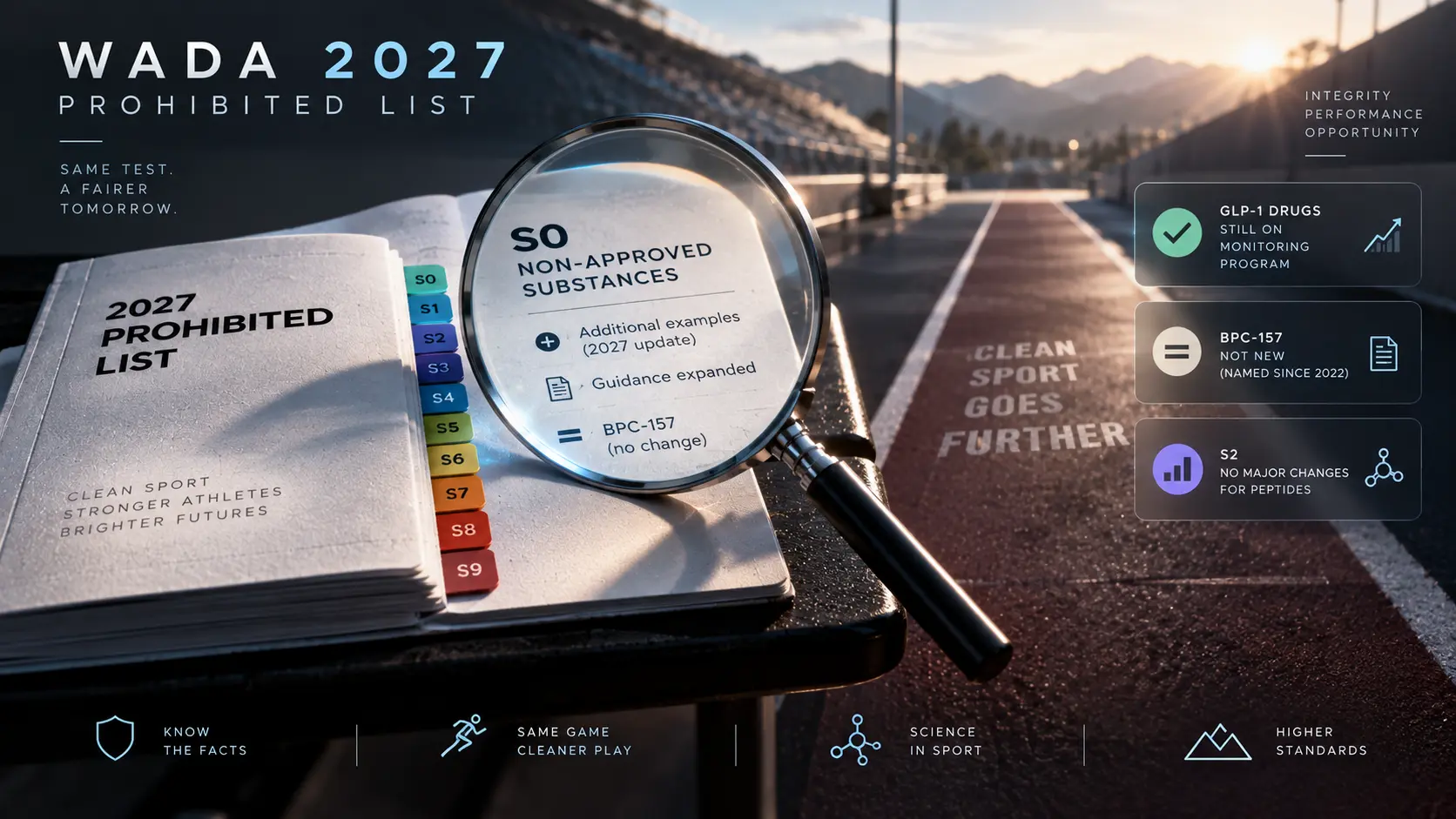
The WADA 2027 Prohibited List peptides update is smaller than the headlines suggest. WADA says section S0 (Non-Approved Substances) gains additional examples and guidance, but BPC-157 is not new there. It has been named in S0 since the 2022 List. GLP-1 receptor agonists such as semaglutide and tirzepatide stay off the List and remain on WADA's Monitoring Program. The 2027 List is final, was published on 21 September 2026, and takes effect on 1 January 2027.
Key Takeaways
- WADA's Executive Committee approved the 2027 Prohibited List on 10 September 2026, and WADA published it on 21 September 2026 [1].
- The 2027 List takes effect on 1 January 2027, the same day the 2027 World Anti-Doping Code comes into force [2][3].
- BPC-157 has been named as an S0 example since the 2022 List, and it was the first substance ever named in that section [4][5].
- WADA's announced 2027 change to S0 is extra examples and guidance, not a new prohibition [2].
- GLP-1 receptor agonists sit on the Monitoring Program, not in any section of the List; semaglutide has been monitored since 2024 and tirzepatide since 2026 [6].
- Every S0 substance is a Specified Substance, while every S2 substance is non-Specified, and that label shifts who must prove intent in a doping case [7][8].
- MOTS-c is not an S2 peptide hormone for WADA purposes; it is named in S4.4.1 as an AMPK activator [7].
Research Use Only. 99 Purity Peptides supplies compounds strictly for laboratory research. Nothing we sell is intended for human or veterinary use. This article explains sport anti-doping rules only. It is not medical, legal or dosing advice, and it makes no claim about whether any compound is lawful to buy or possess.
What Actually Changed in the WADA 2027 Prohibited List for Peptides?
The peptide change for 2027 is a clarification inside S0, not a new ban. WADA's announced summary, as relayed by the International Federation of Muaythai Associations (IFMA), says S0 received additional examples and guidance [2]. That same summary lists updates to S4, S5, S8 and S9, plus revised wording on Substances of Abuse [2].
Read the list of changed sections closely, and one class is missing. S2 (Peptide Hormones, Growth Factors, Related Substances and Mimetics) does not appear among the principal 2027 updates WADA announced [2]. That is the class holding most of the peptides athletes actually ask about.
Nothing in the summary reports a peptide as newly prohibited. None was reported as removed either.
Is BPC-157 new to the list in 2027?
No, and this is the correction that matters most. BPC-157 entered the List by name in 2022. WADA's own release that year said it was the first time any substance had been named as an example in S0 [4]. The U.S. Anti-Doping Agency (USADA) described the same 2022 addition in its athlete advisory [5].
The current text still carries the name. In the 2026 List, S0 names BPC-157 beside 2,4-dinitrophenol (DNP), two ryanodine receptor-1-calstabin complex stabilizers and two troponin activators [7]. A headline saying the 2027 List "just named" BPC-157 is therefore about five years late.
Who keeps getting the BPC-157 timeline wrong?
Errors run in both directions, and one appears in the peer-reviewed literature. A 2025 review in Pharmaceuticals states that WADA banned BPC-157 only temporarily in 2022 and no longer lists it [9]. The 2026 List text contradicts that plainly, because BPC-157 appears by name in S0 [7].
Several vendor and wellness pages make a different mistake. They place BPC-157 in both S0 and S2 at once. The S0 definition rules that out, since it covers only substances "not addressed by any of the subsequent sections of the List" [7]. A substance named or captured in S2 cannot also be an S0 substance.
How we graded the evidence
Every claim in this article was traced to the strongest source we could open. We graded sources by one test: how close is this to WADA's own text?
Grade | What the grade means | Sources in this article |
|---|---|---|
A | Primary legal or scientific text, opened and read | 2026 List text [7]; Józwiak review [9]; Tian study [10] |
B | A WADA statement, read on WADA's own pages or relayed by a Code signatory | WADA 2022 releases [4][11]; IFMA and FIB notices [2][1]; USADA advisories [5][12] |
C | Named-outlet reporting, or legal analysis of primary text | BBC Sport [6]; Bird & Bird [13]; LawInSport [8][3] |
D | Not verifiable against any source above | Names of any new 2027 S0 examples |
The weak spot is stated openly in the limits section below. Grade A text exists for 2026. For 2027, the best we could read was grade B.
Why Does It Matter That BPC-157 Is Named in S0 Instead of S2?
Classification does not decide whether BPC-157 is prohibited. Both S0 and S2 substances are prohibited at all times, in and out of competition [7]. What the section changes is how a case is charged and argued.
How does the class label change a doping case?
Each class opens with a line that settles this. The 2026 List marks every S0 substance as a Specified Substance and every S2 substance as non-Specified [7]. Under Article 10.2.1 of the World Anti-Doping Code, that label sets the starting sanction.
For a non-Specified Substance, the ban is four years unless the athlete proves the violation was not intentional [8]. With a Specified Substance, four years applies only when the anti-doping organization proves intent [8]. Where the four-year rule does not apply, the period is two years [8].
Provisional suspension follows the same split. Sport Integrity Australia states that a non-Specified finding requires a mandatory provisional suspension, with no discretion [14]. A Specified finding leaves that decision open.
BPC-157 and TB-500 show why this matters in practice. The two are often discussed together, yet they sit in different classes. TB-500 is named in S2.3 as a thymosin-β4 derivative, which makes it non-Specified [7]. BPC-157 sits in S0, which makes it Specified [7].
Case feature | BPC-157 (S0) | TB-500 (S2.3) |
|---|---|---|
Prohibited at all times | Yes [7] | Yes [7] |
Class label | Specified | Non-Specified |
Four-year ban under the 2021 Code | Only if the anti-doping body proves intent [8] | Applies unless the athlete proves no intent [8] |
Mandatory provisional suspension after a positive | No, it is discretionary [14] | Yes [14] |
Effect of the 2027 Code | Outside the new three-year tier, which covers non-Specified cases [13] | Adds a three-year tier when the athlete proves source and a non-sport context [13] |
Is the S0 label a loophole for BPC-157?
No, and WADA rules out that reading directly. The comment quoted in the List states that Specified Substances should not be considered less important or less dangerous than others [7]. They are simply more likely to have been used for a non-performance purpose [7]. BPC-157 also has no therapeutic use exemption route, because no authority anywhere has approved it [5].
What changes when the 2027 Code takes effect?
The rules shift again on 1 January 2027. Bird & Bird's analysis of the 2027 Code describes a new middle tier for non-Specified cases [13]. The tier covers an athlete who cannot prove the use was unintentional. That athlete must still prove how the substance got in, and that the context was unrelated to sport [13]. The ban is then three years [13]. Commentary in the Code calls this the "narrowest of corridors" [13].
Does a Specified label say anything about detection?
No, a Specified label says nothing about detectability. In 2023, the Shanghai Anti-Doping Laboratory validated a urine method for BPC-157 and five main metabolites, with detection limits of 0.01 to 0.11 ng/mL [10]. The published abstract describes in vitro incubation experiments and method validation, not a human administration study [10]. So it does not tell anyone how long BPC-157 stays detectable.
What Does the 2027 List Say About GLP-1 Receptor Agonists?
The 2027 List does not prohibit GLP-1 receptor agonists, and their status is not set in any List section. They remain on WADA's Monitoring Program, a separate document published alongside the List [1][6]. Monitored substances are tracked through testing, but they are not prohibited [1].
That settles a question readers often ask. No section of the List covers approved GLP-1 drugs. The S0 clarification and the GLP-1 decision are different instruments with different legal effects.
Instrument | Can a positive test be a violation? | Examples relevant to this article |
|---|---|---|
Prohibited List, S0 | Yes | BPC-157 and other unapproved substances not covered elsewhere [7] |
Prohibited List, S2 | Yes | CJC-1295, ipamorelin, AOD-9604, TB-500 [7] |
Prohibited List, S4.4 | Yes | MOTS-c, named as an AMPK activator [7] |
Monitoring Program | No | Semaglutide and tirzepatide [6] |
The monitoring history here is short. Semaglutide was first placed on the monitoring list in 2024, and tirzepatide joined in 2026 [6]. WADA has started one study and is preparing a second, both designed to mimic high-level exercise [6].
WADA's senior director for science and medicine, Olivier Rabin, told BBC Sport what those studies are for. The agency wants to know whether effects seen in patients with obesity also occur in non-obese, highly trained athletes [6]. Rabin also named side effects, including muscle loss, that could cancel out any benefit [6].
What does "pending further data" actually signal?
We could not find the exact phrase "pending further data" in any WADA text we were able to open. IFMA's relay of WADA's announcement says the agency wants more scientific data before deciding on future status, and that sport-specific research is under way [2]. That is the substance behind the phrase, whatever its exact wording.
Our own reading of it is simple. WADA is building the evidence it would need to act, and it has not promised to act. To move onto the List, a monitored substance must meet two of three criteria [6]. Those criteria are performance enhancement, health risk and violation of the spirit of sport [6]. Under the usual timetable, a change approved at the September 2027 Executive Committee meeting would apply from January 2028 [6]. WADA can also add a substance at any time in exceptional circumstances [15].
One detail matters more to this site's readers than the headline does. S0 turns on whether a substance has approval anywhere, not on what a label says. An incretin-class compound still in clinical development, with no approval from any health authority, fits the S0 wording on its face [7]. Monitored status for approved GLP-1 drugs does not extend to it.
What Stayed the Same From the 2026 List?
S2 does not appear among the principal 2027 updates WADA announced [2]. Our 2026 guide to WADA banned peptides covers these compounds one by one. Each keeps its 2026 placement unless WADA's 2027 redline shows an edit we could not see.
This is a consistency check, not a rebuild of that guide.
Compound | 2026 List location | Class label | Class among WADA's principal 2027 updates? |
|---|---|---|---|
CJC-1295 | S2.2.4, GHRH analogues | Non-Specified | No |
Sermorelin | S2.2.4, GHRH analogues | Non-Specified | No |
Ipamorelin | S2.2.4, GH secretagogues | Non-Specified | No |
AOD-9604 | S2.2.3, growth hormone fragments | Non-Specified | No |
IGF-1 | S2.3, growth factors | Non-Specified | No |
Mechano growth factors (MGFs) | S2.3, growth factors | Non-Specified | No |
TB-500 | S2.3, thymosin-β4 derivatives | Non-Specified | No |
MOTS-c | S4.4.1, AMPK activators | Non-Specified | Yes, S4 terminology and examples updated |
All locations and class labels above come from the 2026 List text [7]. The final column reflects WADA's announced 2027 summary [2]. For MOTS-c, the S4 update means the entry wording should be checked against WADA's redline before anyone quotes it.
Why is MOTS-c not in S2?
WADA treats MOTS-c as a metabolic modulator, not a peptide hormone. Because it is a mitochondrial-derived peptide, readers often file it with S2 anyway. It was added as a named S4.4 example for 2025, under AMP-activated protein kinase activators [12]. Classes S4.3 and S4.4 are non-Specified, just like S2 [7]. The S0 versus S2 difference discussed above therefore gives MOTS-c no softer starting point.
One S2 detail from last year is worth recalling. For 2026, WADA added further examples or clarifications to S1, S2, S4 and S6 [16]. The S2 wording in our 2026 guide is the wording still in force.
Is the 2027 List Final Yet?
Yes, the 2027 List is final and is not a draft. WADA's Executive Committee approved it on 10 September 2026, and WADA published it on 21 September 2026 [1]. Alongside it came the 2027 Summary of Major Modifications, a redline against the 2026 List, and the 2027 Monitoring Program [1].
The draft stage happened earlier in the year. WADA circulates a draft List to stakeholders, then its Health, Medical and Research Committee reviews the result [17]. The Executive Committee approves the final text in September [17]. Each cycle starts with a meeting in January and ends with publication by 1 October [16].
List year | Executive Committee approval | Publication | In force |
|---|---|---|---|
2022 | 14 September 2021 [4] | 30 September 2021 [11] | 1 January 2022 |
2026 | 11 September 2025 [16] | September 2025 [16] | 1 January 2026 |
2027 | 10 September 2026 [1] | 21 September 2026 [1] | 1 January 2027 |
WADA leaves a gap between publication and force on purpose. It describes the List as published three months before it takes effect, so athletes can adjust [15]. The 2027 List arrived 102 days before its start date. Until then, the 2026 List remains the one in force.
More official material is still coming. IFMA reports that an Athlete and Athlete Support Personnel Guide to the 2027 List is expected in December, through WADA's ADEL education platform [2].
What Does the Evidence Not Establish?
The limits here are specific, and they matter for anyone quoting this update.
We have not verified the names of any new 2027 S0 examples. For this review, the 2027 detail rests on WADA's announcement as relayed by Code signatories, not the 2027 List text itself [2][1]. Anyone quoting a specific new example should check WADA's redline first.
That S2 is unchanged also rests on a summary of principal updates, not a line-by-line redline read [2]. A minor wording edit inside S2 would not necessarily appear in that summary.
Whether GLP-1 receptor agonists enhance performance in trained athletes is still open, by WADA's own account. Its studies exist precisely because that question is unanswered [6].
A listing is not evidence that a compound works. For BPC-157, the human record is thin. The 2025 Pharmaceuticals review found a retrospective study of 12 patients with knee pain [9]. It also found a phase I trial in 42 healthy volunteers (NCT02637284) whose results submission was cancelled in 2016 [9]. Most published BPC-157 data come from rodent models [9].
Detection chemistry has its own ceiling. The Shanghai method shows BPC-157 and its metabolites can be measured in urine at very low concentrations [10]. It does not establish a human detection window, since the abstract reports no human administration arm [10].
Where Should You Go Next on This Site?
Start with the full compound picture. Our 2026 guide to WADA banned peptides covers every relevant compound in detail, and this update only tracks what moved for 2027.
For BPC-157 outside sport, read our piece on whether BPC-157 is legal. It covers the regulatory questions this article deliberately leaves alone.
Anti-doping rules and drug law are separate systems. For the wider legal context, see are peptides legal in the US and our overview of FDA-approved peptides.
References
- Federation of International Bandy. WADA Published 2027 Prohibited List. 22 September 2026. https://worldbandy.com/2026/09/22/wada-published-2027-prohibited-list/
- International Federation of Muaythai Associations. WADA Publishes 2027 Prohibited List: What the IFMA Community Needs to Know. 22 September 2026. https://muaythai.sport/wada-publishes-2027-prohibited-list-what-the-ifma-community-needs-to-know/
- LawInSport. The 2027 WADA Code: Key Changes in Sanctions, Procedural Fairness and Athlete Privacy. https://www.lawinsport.com/topics/item/the-2027-wada-code-key-changes-in-sanctions-procedural-fairness-and-athlete-privacy
- World Anti-Doping Agency. WADA publishes 2022 Prohibited List. 30 September 2021. https://www.wada-ama.org/en/news/wada-publishes-2022-prohibited-list
- U.S. Anti-Doping Agency. Athlete Advisory: Explanation of Key Changes on 2022 WADA Prohibited List. 13 October 2021. https://www.usada.org/athlete-advisory/key-changes-2022-prohibited-list/
- Grundy T, Middleton E. Weight-loss drugs avoid Wada banned list for 2027. BBC Sport. 10 September 2026 (syndicated copy). https://ca.sports.yahoo.com/news/weight-loss-drugs-avoid-wada-182939592.html
- World Anti-Doping Agency. The 2026 Prohibited List: World Anti-Doping Code International Standard, in force 1 January 2026. Official English text as published in Austria's Federal Law Gazette, BGBl. III Nr. 219/2025, 30 December 2025. https://rdb.manz.at/__api/documents/ris.c.BGBl__III_Nr__219_2025/attachments/ris.c.BGBl__III_Nr__219_2025.Anlagen_0002_F0BD5BBE_465B_4C18_BFE4_16E75843E435.pdf
- LawInSport. Must athletes prove how a banned substance entered their body to establish lack of intention? (quotes World Anti-Doping Code Article 10.2.1 and 10.2.2). https://www.lawinsport.com/topics/item/must-athletes-prove-how-a-banned-substance-entered-their-body-to-establish-lack-of-intention
- Józwiak M, Bauer M, Kamysz W, et al. Multifunctionality and Possible Medical Application of the BPC 157 Peptide: Literature and Patent Review. Pharmaceuticals (Basel). 2025;18(2):185. PMID: 40005999. doi:10.3390/ph18020185. https://pmc.ncbi.nlm.nih.gov/articles/PMC11859134/
- Tian T, Jing J, Li Y, et al. Stable Isotope Labeling-Based Nontargeted Strategy for Characterization of the In Vitro Metabolic Profile of a Novel Doping BPC-157 in Doping Control by UHPLC-HRMS. Molecules. 2023;28(21):7345. PMID: 37959764. doi:10.3390/molecules28217345. https://pmc.ncbi.nlm.nih.gov/articles/PMC10650108/
- World Anti-Doping Agency. WADA's 2022 Prohibited List now in force. 1 January 2022. https://www.wada-ama.org/en/news/wadas-2022-prohibited-list-now-force
- U.S. Anti-Doping Agency. Athlete Advisory: What's New on the 2025 WADA Prohibited List? 29 September 2024. https://www.usada.org/athlete-advisory/new-2025-wada-prohibited-list/
- Bird & Bird LLP. The 2027 World Anti-Doping Code: Navigating the new legal landscape. 12 December 2025. https://www.twobirds.com/en/insights/2025/the-2027-world-anti-doping-code-navigating-the-new-legal-landscape
- Sport Integrity Australia. Sample analysis and test results. https://www.sportintegrity.gov.au/what-we-do/anti-doping/athlete-testing/sample-analysis-and-test-results
- World Anti-Doping Agency. The Prohibited List (questions and answers). https://www.wada-ama.org/en/prohibited-list
- World Rugby (reproducing WADA's release). WADA publishes 2026 Prohibited List. September 2025. https://www.world.rugby/keep-rugby-clean/news/1017826/copy-wada-publishes-2026-prohibited-list
- Swimming World Magazine (reproducing WADA's release). WADA Publishes 2026 List of Prohibited Substances and Methods. September 2025. https://www.swimmingworldmagazine.com/news/wada-publishes-2026-list-of-prohibited-substances-and-methods/
Frequently Asked Questions
What changed in the WADA 2027 prohibited list for peptides?
Very little changed for peptides in 2027. WADA's announced summary says section S0, Non-Approved Substances, gained additional examples and guidance. S2, which holds peptide hormones and growth factors such as CJC-1295 and TB-500, is not among the principal updates WADA announced. No peptide was reported as newly prohibited or removed. The List was published on 21 September 2026 and applies from 1 January 2027.
When does the WADA 2027 list take effect?
The 2027 Prohibited List takes effect on 1 January 2027. WADA's Executive Committee approved it on 10 September 2026, and WADA published it on 21 September 2026. Until 1 January 2027, the 2026 List remains the one in force. The revised World Anti-Doping Code also takes effect on 1 January 2027, so sanction rules change on the same day.
Is BPC-157 named directly in the 2027 list?
BPC-157 has been named directly since the 2022 List, when it became the first substance ever listed by name as an S0 example. The 2026 List still names it. WADA's 2027 summary describes added S0 examples, and it mentions no removals. Anyone checking an exact entry should read the 2027 redline on WADA's site, which marks every wording change against 2026.
What section of the WADA list covers unapproved peptides?
That depends on whether a later section already covers the peptide. S0 catches any pharmacological substance with no approval from any government health authority, where no other section addresses it. Unapproved peptides that act as growth hormone releasers or growth factors, such as CJC-1295 or TB-500, are named in S2 instead. BPC-157 is the best-known peptide sitting in S0.
What does WADA section S0 mean?
S0 is WADA's Non-Approved Substances class. It covers pharmacological substances with no current approval from any governmental health authority for human therapeutic use. The class applies only when no other section of the List addresses the substance. Its definition gives examples such as drugs in development, discontinued drugs, designer drugs and veterinary-only substances. S0 substances are prohibited at all times and classed as Specified Substances.
Did GLP-1 receptor agonists get added to the prohibited list in 2027?
No, GLP-1 receptor agonists were not added for 2027. WADA confirmed that semaglutide, tirzepatide and related drugs stay off the List. They remain on the Monitoring Program, which tracks patterns of use without making use a violation. Semaglutide has been monitored since 2024, and tirzepatide was added in 2026. An unapproved compound in the same drug class would still fall under S0.
What does "pending further data" mean for GLP-1 drugs and WADA?
It means WADA has not decided either way. The agency says it needs more scientific data before ruling on future status. It has started one study and is preparing another in highly trained athletes. A substance must meet two of three criteria to be listed. Under the usual timetable, any change approved in September 2027 would apply from January 2028.
Is the 2027 WADA list final or still a draft?
The 2027 List is final, not a draft. Its draft stage ran earlier in 2026, when WADA circulated a draft List to stakeholders for comment. The Executive Committee approved the final text on 10 September 2026. WADA then published it on 21 September 2026, with a Summary of Major Modifications, a redline and the 2027 Monitoring Program. Substances can still be added later in exceptional circumstances.
Are CJC-1295 and ipamorelin still prohibited under the 2027 list?
Yes, both remain prohibited in 2027. Each is named in S2.2.4 of the 2026 List, CJC-1295 as a growth hormone-releasing hormone analogue and ipamorelin as a growth hormone secretagogue. S2 is not among the principal 2027 updates WADA announced. They are prohibited at all times and classed as non-Specified Substances, which carries the stricter sanction starting point under the World Anti-Doping Code.
What is the difference between WADA sections S0 and S2 for peptides?
Both prohibit substances at all times. S2 names peptide hormones, releasing factors and growth factors, and every S2 substance is non-Specified. S0 is a residual class for unapproved substances that no other section covers, and every S0 substance is Specified. One substance cannot sit in both classes, because S0 applies only when later sections do not address it.
Does a section change affect whether a compound is prohibited at all times?
Not between S0 and S2, because both classes are prohibited in and out of competition. A move between them would change the Specified label and therefore the sanction framework, not the prohibition itself. Moving into an in-competition-only class, such as stimulants, would change timing. WADA announced no such move for any peptide in 2027.
How often does WADA update its prohibited list?
WADA updates the List once a year on a fixed cycle. Work starts with an initial meeting in January, and a draft goes to stakeholders during the year. The Executive Committee approves the final List each September. Publication happens by 1 October, and the List takes effect on 1 January. WADA can also add a substance at any time in exceptional circumstances.
Where can I read the official WADA 2027 prohibited list?
Go to WADA's own website, in its Prohibited List section. That page carries the 2027 List, the Summary of Major Modifications, the redline against 2026 and the 2027 Monitoring Program. WADA maintains the official text in English and French, and the English version prevails in any conflict. National anti-doping organizations also publish summaries and answer athlete questions.
Does the 2027 list change anything for athletes already avoiding these peptides?
For peptides, the 2027 List changes very little. An athlete already avoiding BPC-157, TB-500 and the growth hormone secretagogues faces the same prohibitions in 2027. Sanction rules shift more than the List does. On the same day, the 2027 World Anti-Doping Code adds a three-year tier for some non-Specified cases. Specific questions belong with a national anti-doping organization.
How does the 2027 list compare to the 2026 list overall?
The 2027 List is an adjustment year rather than an overhaul. WADA's summary revises cannabinoid wording in S8 and adds vaginal glucocorticoid use as a permitted route in S9. It also updates S4 terminology, adds S5 and S0 examples, and clarifies metabolite wording for Substances of Abuse. GLP-1 drugs stay on the Monitoring Program, and no peptide was reported as newly banned.