Last reviewed: September 2026
Quick Answer
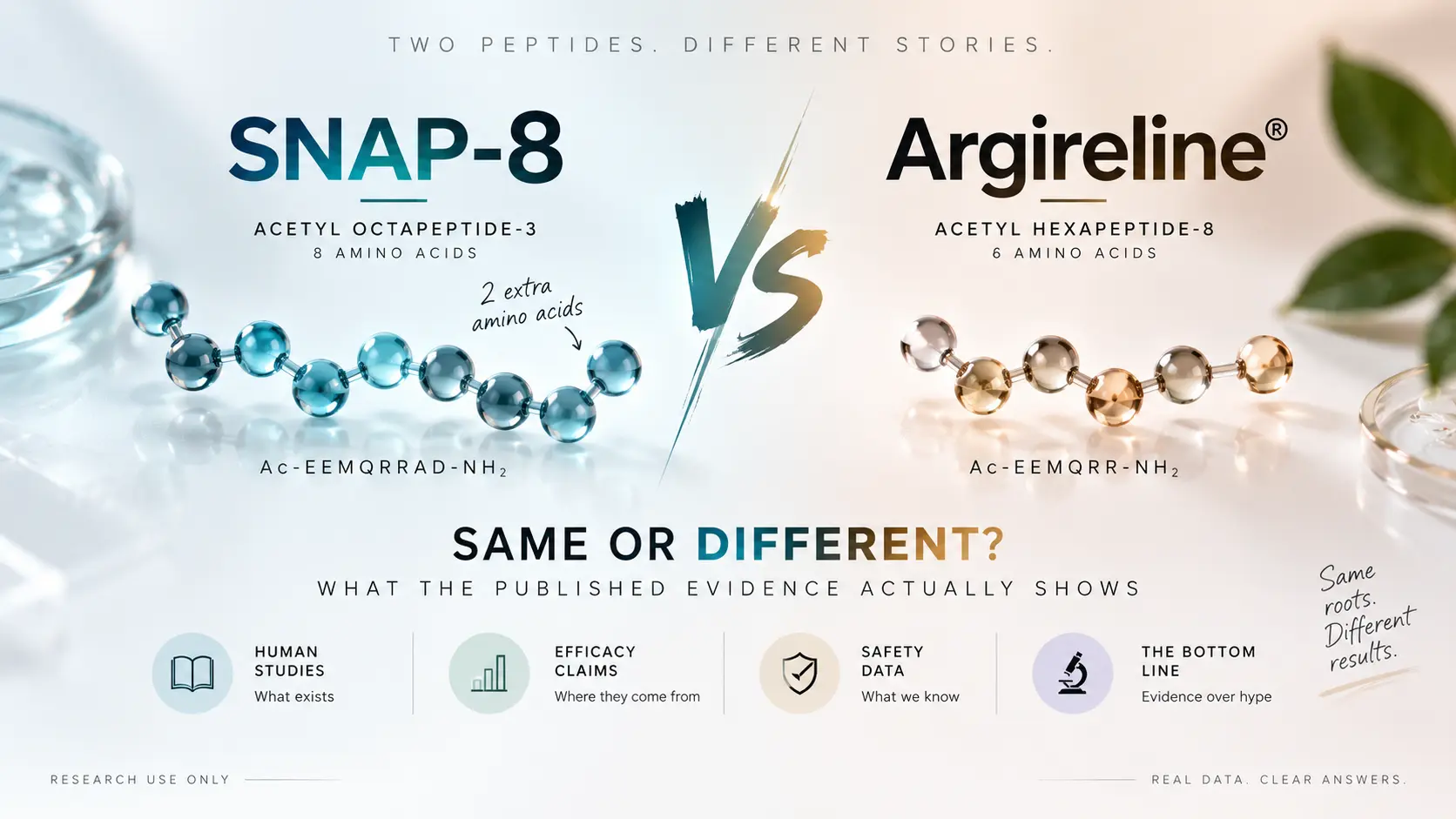
SNAP-8 vs Argireline is a comparison between two different compounds, not two names for one. SNAP-8 is acetyl octapeptide-3, an eight-residue peptide; Argireline is acetyl hexapeptide-8, a six-residue peptide, and the first six residues of SNAP-8 are the Argireline sequence. Argireline has two small human trials and one independent study that failed to separate it from its vehicle. SNAP-8 has never been tested on its own in a PubMed-indexed human study, and no head-to-head trial of the two has ever been published.
Key Takeaways
- SNAP-8 is acetyl octapeptide-3 (Ac-EEMQRRAD-NH2, ~1,075 Da). Argireline is acetyl hexapeptide-8 (Ac-EEMQRR-NH2, 889 Da). Any page calling SNAP-8 "acetyl hexapeptide-8" has merged two compounds.
- Both sequences copy a stretch of the N-terminal region of SNAP-25, a 206-residue protein: residues 12 to 17 for Argireline, 12 to 19 for SNAP-8.
- SNAP-8 appears in exactly two PubMed-indexed human studies, and in both it was one active among several inside a microneedle patch. In the 2024 patch trial it made up 0.03% of the formulation.
- The "63.13% wrinkle reduction" number is a maximum value from manufacturer literature, not a mean, and no peer-reviewed source for it could be located.
- The "30% more active than Argireline" claim also originates with the manufacturer. No published head-to-head trial of SNAP-8 against Argireline exists.
- FDA scientists measured where Argireline goes in skin: 0.22% of the applied dose reached human stratum corneum, 0.01% reached the epidermis, and none was detected in the dermis.
- The Cosmetic Ingredient Review panel concluded acetyl hexapeptide-8 is safe up to 0.005% and found data insufficient above that. The famous efficacy studies used 10%, two thousand times higher.
Research Use Only
99 Purity Peptides supplies research-grade compounds for laboratory use only. Nothing on this page is medical, cosmetic, dosing or application advice. Nothing sold is intended for human or veterinary consumption, and no product referenced here is approved by any regulator for any therapeutic or cosmetic use.
How We Graded the Evidence
Every efficacy claim on this page is sorted by five questions. Was it tested in humans, in animals, in cultured cells, or only in silico? Was there a control arm, and was it a vehicle control or a no-treatment control? Was the compound tested in isolation, or bundled with other actives? Were the authors independent of the party that owns the trademark? Were the endpoints instrument-measured or investigator-scored?
A claim is graded moderate only when it comes from a controlled human study of the isolated compound with instrument-measured endpoints and at least one independent replication. Weak covers controlled human data that fails one or two of those tests. Insufficient means the compound has never been isolated in a human study, or the only source is manufacturer literature. Nothing in this topic reaches strong.
Is SNAP-8 the Same as Argireline?
No. They are separate compounds with separate INCI names, separate CAS registry numbers and different molecular weights, and the confusion between them is the single most common error in this ingredient category.
SNAP-8 | Argireline | |
|---|---|---|
INCI name | Acetyl Octapeptide-3 | Acetyl Hexapeptide-8 |
Synonyms seen on labels | Acetyl glutamyl heptapeptide-1, acetyl glutamyl heptapeptide-3, acetyl octapeptide-1 | Acetyl hexapeptide-3, acetyl hexapeptide-8 amide |
Residues | 8 | 6 |
Sequence | Ac-Glu-Glu-Met-Gln-Arg-Arg-Ala-Asp-NH2 [7] | Ac-Glu-Glu-Met-Gln-Arg-Arg-NH2 [1] |
SNAP-25 region copied | Residues 12 to 19 [16] | Residues 12 to 17 [16] |
Molecular formula | C41H70N16O16S | C34H60N14O12S [15] |
Molecular weight | ~1,075 Da | 889 Da [15] |
CAS number | 868844-74-0 | 616204-22-9 [15] |
Commercialised by | Lipotec S.A., Barcelona (now Lubrizol) | Lipotec S.A., Barcelona (now Lubrizol) |
The naming mess has three separate roots, and they compound each other. Argireline was originally listed as acetyl hexapeptide-3 and later renamed acetyl hexapeptide-8, so both names are correct for the same molecule and both appear in the literature, including in papers published in the same year. SNAP-8 carries its own set of alternate names, one of which contains the word "heptapeptide" despite the compound having eight residues. And the shared "-8" in hexapeptide-8 and SNAP-8 invites a merge that is simply wrong: the 8 in SNAP-8 refers to the residue count, while the 8 in acetyl hexapeptide-8 is an INCI series number attached to a six-residue peptide.
The chemistry is straightforward once the names are fixed. Take Argireline and add alanine and aspartate at the C-terminus and you have SNAP-8. That is the entire structural difference: two residues, 186 daltons, and one additional carboxylate group. Our own SNAP-8 compound guide covers general background on the octapeptide; use the naming in this table, which is the one that matches the registry data.
How Are SNAP-8 and Argireline Supposed to Work?
The proposed mechanism is competitive interference with SNARE complex assembly, and it comes from cell-free and cultured-cell work, not from any demonstration in intact human skin.
SNAP-25 is one of three proteins that wind together to form the SNARE complex, the machinery that fuses a synaptic vesicle with the presynaptic membrane so neurotransmitter can be released. Botulinum toxin type A works by enzymatically cleaving SNAP-25. The peptide approach is different: a short fragment that resembles part of SNAP-25 is meant to compete for a place in the assembling complex, producing a complex that cannot drive fusion.
Blanes-Mira and colleagues reported in 2002 that Argireline interfered with formation or stability of the SNARE complex and inhibited neurotransmitter release in chromaffin cells, with a potency they described as similar to botulinum toxin type A but with much lower efficacy [1]. That work was biochemical and cell-based. The extension to SNAP-8 is a design argument: eight residues cover more of the SNAP-25 target region than six, so the longer fragment should compete better.
Two things are worth separating here. Competitive inhibition is reversible, unlike enzymatic cleavage, so any effect would depend on continuous presence of the peptide. And every step of this mechanism was established in preparations where the peptide already had access to the machinery. Getting there through intact skin is a different problem, and it is the one that decides whether any of this matters.
What Human Evidence Exists for Argireline?
Argireline has three human datasets worth taking seriously, and they point in different directions.
The 2002 founding study applied an oil-in-water emulsion containing 10% Argireline to one periorbital area of 10 healthy female volunteers, and analysed silicone imprints by confocal laser scanning microscopy over four weeks [3]. The published result is a reduction in wrinkle depth of up to 30% at 30 days. Two details rarely travel with that number. The vehicle alone reduced wrinkle depth by up to 10% in the same study, and the significance threshold was set at p<0.075 rather than the conventional 0.05 [3]. The indexed record lists a single university affiliation for that paper, though Argireline is a Lipotec trademark and the group's later work in this area is documented as Lipotec-linked.
The largest trial is Wang and colleagues, 2013: 60 Chinese subjects randomised to Argireline or placebo in a 3:1 ratio, applied to periorbital lines twice daily for four weeks [2]. Subjective global assessment using Daniell's classification and Seeman's standard gave a total anti-wrinkle efficacy of 48.9% in the active group against 0% in placebo. Objectively, silicone replicas analysed on a wrinkle-analysis instrument showed all roughness parameters decreased in the active group (p<0.01) and no clear decrease in placebo. The headline 48.9% figure is investigator-scored, not instrument-measured; the instrument endpoint was skin roughness, which is a related but different thing from wrinkle depth. The same group published a further report in the Journal of Cosmetic and Laser Therapy the same year, but that one is an animal study: Argireline applied to D-galactose-aged mice for six weeks, assessed by collagen histology, not a human trial [14].
Then there is the study almost nobody cites. Henseler, working independently in Düsseldorf with no declared competing interests, ran a double-blind split-face study in 19 women: an identical hyaluronic acid serum on both sides of the face, Argireline in one container only, four weeks, with wrinkle scores captured on a Visia complexion analysis system [3]. Wrinkle scores fell slightly on both sides. The difference between the Argireline side and the control side was not statistically significant for wrinkle score (p=0.829) or for the system's estimated skin age (p=0.804). The author's conclusion was that the effect of Argireline was not demonstrated and that it should not be considered an alternative to botulinum toxin.
That is the shape of the Argireline evidence base: two positive studies with manufacturer involvement or subjective primary endpoints, and one independent study with objective imaging that found nothing.
What Human Evidence Exists for SNAP-8?
None in isolation. SNAP-8 appears in two PubMed-indexed human studies, and in both it was one ingredient inside a multi-active product.
Avcil and colleagues, 2020, ran a 12-week single-centre study of hyaluronic acid microneedle patches in healthy volunteers with aged skin, applied at the outer eye corner and on the volar forearm [6]. The abstract reports neither a sample size nor an age range. The patches contained arginine/lysine polypeptide, acetyl octapeptide-3, palmitoyl tripeptide-5, adenosine and seaweed extracts. Reported outcomes include a 25.8% decrease in measured fine lines and wrinkles and a 15.4% improvement in hydration. There was no placebo or vehicle arm; the comparison is before against after.
Shin and colleagues, 2024, compared a dissolving microneedle patch against a plain hyaluronic acid placebo patch in 24 healthy subjects, one patch per eye, overnight, with assessments over 28 days [7]. The active patch was 90% hyaluronic acid, 5% ascorbic acid 2-glucoside, 4% sodium cyclic lysophosphatidic acid and 0.03% SNAP-8. The active patch outperformed the placebo patch on eye wrinkles, transepidermal water loss and lifting.
Read the composition again. The active patch differed from the placebo patch in three ingredients at once, and the peptide was the smallest of them by two orders of magnitude. A vitamin C derivative at 5% and a lysophosphatidic acid at 4% are not inert bystanders. Whatever that trial demonstrated, it cannot be attributed to the 0.03% of SNAP-8.
So the honest position is that SNAP-8 has no isolated human efficacy data at all. Not weak data. None.
SNAP-8 vs Argireline: How the Two Evidence Bases Compare
Argireline (acetyl hexapeptide-8) | SNAP-8 (acetyl octapeptide-3) | |
|---|---|---|
Indexed human studies of the isolated compound | 3 [1][2][3] | 0 |
Largest randomised controlled human trial | n=60, 3:1 randomisation, 4 weeks [2] | None |
Independent (non-manufacturer) human study | Yes, n=19, and it was negative on both endpoints [3] | None |
Instrument-measured primary endpoint | Roughness on silicone replicas [2]; Visia imaging [3] | Not applicable |
Data from mixed-ingredient products | Yes | Yes, both indexed studies [6][7] |
Regulatory-agency penetration data | Yes, FDA in vitro study [8] | None located |
Head-to-head against the other compound | None published | None published |
Our grade | Weak | Insufficient |
The asymmetry runs the opposite way to the marketing. SNAP-8 is routinely sold as the upgraded version, and it is the one with no isolated human data, while the compound it supposedly supersedes is the one with a published randomised trial and an independent replication attempt.
Where Does the "63.13%" Wrinkle Figure Come From?
From manufacturer technical literature, and no indexed publication reporting it could be found.
The number travels as a flat statement of fact: SNAP-8 reduces eye wrinkles by 63.13%. What the manufacturer-derived materials actually describe is a maximum, recorded in a small volunteer panel using a 10% solution applied twice daily for 28 days. A maximum is the best single result in the sample. It says nothing about what the average participant experienced and everything about the spread.
The two decimal places deserve a moment. Reporting a maximum to a hundredth of a percent from a small volunteer panel communicates a precision the study design cannot support. Instrument output often carries that many digits; the honest move is to round it away, not to print it.
The comparison figure has the same problem. Argireline's widely quoted "up to 30%" is also a maximum, from ten volunteers, in a study where the vehicle alone reached up to 10% [1][3]. Set the two maxima against each other and you are comparing two best-case values from two small unpublished-or-underpowered panels, one of which had a vehicle that did a third of the work.
What would it take to support the claim? A registered, adequately powered, vehicle-controlled trial of SNAP-8 alone, with an instrument-measured primary endpoint, reporting means and confidence intervals, published where methods can be inspected. That trial does not exist. Until it does, the correct way to write the number is with its source attached: a manufacturer-reported maximum, not a peer-reviewed finding.
Is SNAP-8 Really 30% More Active Than Argireline?
There is no published head-to-head trial of SNAP-8 against Argireline, which means the exact question this comparison asks has never been answered experimentally in humans.
The "approximately 30% more active" claim comes from manufacturer in vitro and in vivo testing. Suppose it is accurate as a biochemical statement. It would describe relative potency in an assay system, most likely chromaffin cells or a cell-free SNARE assembly assay, where the peptide is delivered directly to the target. The structural rationale is reasonable: eight residues cover SNAP-25 12-19 rather than 12-17 [16], and a larger interface can mean tighter competition.
Now apply it to skin, and the logic runs backwards. SNAP-8 is 1,075 Da against Argireline's 889 Da, and the added aspartate introduces another negatively charged group. Both changes work against passage through the stratum corneum, which preferentially excludes large, polar, water-soluble molecules. Argireline already has a log P around -6.3, a value the Cosmetic Ingredient Review panel cited when it judged percutaneous absorption unlikely [9]. SNAP-8 is bigger and more charged.
A potency advantage measured in a dish and a delivery disadvantage measured at the barrier are not the same currency, and nobody has published the arithmetic that converts one into the other. Our reading: the 30% figure, even taken at face value, is being applied to the wrong rate-limiting step.
Argireline vs SNAP-8 vs Matrixyl vs Copper Peptides: Which Has the Best-Designed Study?
Matrixyl, and it is not close on design quality, though the result still needs a caveat that rarely accompanies it.
Robinson and colleagues, 2005, ran a 12-week, double-blind, placebo-controlled, split-face, left-right randomised study in 93 women aged 35 to 55, comparing a moisturiser against the same moisturiser containing 3 ppm palmitoyl pentapeptide-4 (pal-KTTKS) [10]. Significant improvement versus control was reported for wrinkles and fine lines by both quantitative image analysis and expert grading. That is the strongest design anyone has brought to a cosmetic peptide.
The caveat: all six authors were from The Procter & Gamble Company, and the active was present at 3 parts per million, which is 0.0003%. The thing being tested was a moisturiser with a trace of peptide in it, against the same moisturiser.
GHK-Cu has the opposite profile: extensive preclinical literature and thin controlled human data. The one PubMed-indexed controlled trial of topical copper tripeptide in this space randomised patients after CO2 laser resurfacing; thirteen completed. Objective evaluation found no significant improvement in erythema resolution, wrinkles or overall skin quality, while patient-reported skin quality did favour the GHK-Cu arm (p=0.04) [11]. Our grading of the copper tripeptide literature is set out in the copper peptide research guide and in the comparative grading in our longevity peptide evidence review; this trial is why that grade is where it is.
Compound | Best controlled human study | Design quality | Sponsor independence | Our grade |
|---|---|---|---|---|
Palmitoyl pentapeptide-4 (Matrixyl) | n=93, 12 wk, split-face, vehicle-controlled [10] | Highest in class | All authors from sponsor | Weak to moderate |
Argireline | n=60, 4 wk, 3:1 randomised [2] | Subjective primary endpoint | No funding or conflict statement in the indexed record | Weak |
GHK-Cu | n=13 completed, post-laser [11] | Small, negative on objective endpoints | No funding or conflict statement in the indexed record | Weak |
SNAP-8 | None of the isolated compound | Not applicable | Not applicable | Insufficient |
Why Formulation and Concentration Decide Everything Here
Every human dataset in this article tested a specific peptide, at a specific concentration, in a specific vehicle, on intact facial skin, measured by surface imaging. None of it transfers to a different route, a different concentration or a different carrier.
The penetration data makes the point concrete. Scientists at FDA's Center for Food Safety and Applied Nutrition applied a 10% Argireline oil-in-water emulsion to hairless guinea pig and human cadaver skin in diffusion cells at 2 mg/cm², washed the surface after 24 hours, tape-stripped the stratum corneum, heat-separated epidermis from dermis and quantified the peptide by hydrophilic interaction chromatography with tandem mass spectrometry [8]. Most of the applied peptide washed off. Of what remained, 0.22% of the applied dose was in human stratum corneum and 0.01% in the epidermis. No peptide was detected in the dermis or in the receptor fluid beneath the skin.
The proposed mechanism requires reaching neuromuscular junctions, which sit below the dermis. The measurement says the compound does not reach the dermis. That is not a small gap in the story; it is the story.
Vehicle matters more than the active here. A 2015 study found a multiple water-in-oil-in-water emulsion delivered acetyl hexapeptide-8 better than other emulsion types in human skin mounted in a Franz diffusion chamber, as summarised in a 2025 review of the peptide's permeability [13]. Microneedle patches bypass the barrier mechanically, which is presumably why both SNAP-8 human studies used them. A 2025 review of acetyl hexapeptide-8 permeability reached the same conclusion from a different angle: the ability of the peptide to reach neuromuscular junctions remains uncertain, and formulation science is the limiting discipline [13].
The concentration picture is stranger still.
Source | Compound | Concentration applied | Context |
|---|---|---|---|
Blanes-Mira 2002 [1] | Argireline | 10% in O/W emulsion | Founding efficacy study, n=10 |
Kraeling 2015 (FDA) [8] | Argireline | 10% in O/W emulsion | Penetration measurement |
NIH blepharospasm pilot [4] | Argireline | 0.005% cream | Randomised, placebo-controlled, n=24 |
NIH follow-up NCT01750346 [5] | Argireline | 0.025% and 0.05% | Terminated after 8 of 24 planned patients |
Shin 2024 patch [7] | SNAP-8 | 0.03% of patch | One of three actives |
CIR industry survey [9] | Argireline | 0.005% maximum, leave-on | Highest reported real-world use |
The Cosmetic Ingredient Review Expert Panel concluded acetyl hexapeptide-8 amide is safe in cosmetics at concentrations up to 0.005%, and that available data are insufficient to determine safety above the reported conditions of use [9]. The studies generating the famous efficacy numbers used 10%, two thousand times that concentration. Anyone quoting the 2002 wrinkle figure while pointing at a product formulated in the range CIR actually surveyed is quoting a number generated under conditions the product does not reproduce.
Cosmetic Ingredient or Research Compound?
Neither peptide is an approved drug, and which category a finished product falls into is decided by the claim made for it, not by the molecule inside it.
The Federal Food, Drug, and Cosmetic Act defines cosmetics by intended use, as articles applied to the body for cleansing, beautifying, promoting attractiveness or altering the appearance [12]. It defines drugs, in part, as articles intended for use in diagnosis, cure, mitigation, treatment or prevention of disease, and as articles intended to affect the structure or any function of the body [12]. A product can be both if it has more than one intended use.
That distinction is doing real work here. "Reduces the appearance of fine lines" describes an effect on appearance and sits inside the cosmetic definition. "Inhibits neurotransmitter release" or "stimulates collagen synthesis" describes an effect on a bodily function, and a product marketed that way can be an unapproved new drug regardless of what its label calls it. The mechanism these two peptides are sold on is, stated plainly, a structure-function claim.
Cosmetics and their ingredients need no FDA premarket approval, with the exception of colour additives. The Modernization of Cosmetics Regulation Act of 2022 added facility registration, product listing, safety substantiation and adverse event reporting requirements, but it did not create a premarket approval pathway [17]. There is no third category between cosmetic and drug for marketing purposes.
Research-grade material sold for laboratory use only occupies none of these boxes. It is not a cosmetic product, because it is not intended for application to the body. It is not an approved drug. It is a reagent, and the documentation that matters for it is analytical, not cosmetic.
How Do You Verify a SNAP-8 or Argireline Lot?
Start with the name, because in this category the name is where most errors live.
A certificate of analysis for SNAP-8 should identify the compound as acetyl octapeptide-3, not acetyl hexapeptide-8, and the sequence line should read Ac-EEMQRRAD-NH2 with eight residues. If a COA carries a SNAP-8 product name alongside a hexapeptide INCI name or a six-residue sequence, the paperwork is describing two different compounds and at least one field is wrong. Watch for the synonym trap too: acetyl glutamyl heptapeptide-1 and acetyl glutamyl heptapeptide-3 are used for the octapeptide despite containing "hepta", so the residue count and sequence, not the trade name, are what to check.
Then work through four analytical fields.
Identity by mass spectrometry should return approximately 1,075 Da for the octapeptide and 889 Da for the hexapeptide. A 186 Da discrepancy between those two is the difference between the compounds, so mass alone distinguishes them. HPLC purity states what fraction of the peptide-related material is the target sequence; it does not account for non-peptide mass. Net peptide content does, and the gap between the two numbers is usually counterion and residual water. For trifluoroacetate-salt peptides that gap is substantial, so a vial labelled by gross mass contains meaningfully less peptide than the label weight suggests.
Two analytical details specific to this pair are worth knowing. Both sequences contain a single methionine, and methionine is among the residues most prone to oxidation, so identity and purity testing on the actual lot matters more here than a datasheet does.
Our guide to reading a certificate of analysis walks through each field in order, and current lot documents are published on the certificates page.
What the Evidence Does Not Establish
The gaps here are larger than the findings, and they should be stated without hedging.
There is no evidence that SNAP-8 does anything in humans on its own. Two indexed studies, both multi-ingredient, one without a control arm.
There is no evidence that SNAP-8 outperforms Argireline. No head-to-head trial has been published in any journal, at any concentration, in any vehicle.
There is no demonstration that either peptide reaches its proposed target in intact skin. FDA's measurement found none in the dermis [8].
There is no basis for the claim, circulating widely, that a National Institutes of Health study showed Argireline extends the effect of botulinum toxin. A real NIH trial exists and is worth reading: Lungu and colleagues at NINDS ran a double-blind, placebo-controlled, randomised study of 0.005% topical acetyl hexapeptide-8 in 24 blepharospasm patients receiving botulinum toxin, under FDA monitoring [4]. Time to return to baseline on the Jankovic Blepharospasm Rating Scale averaged 3.7 months in the active group against 3.0 in placebo. The authors wrote, in the paper, that the primary outcome was negative and the study was underpowered. Two of six authors were from BCN Peptides, which the paper notes is part of the same group as Lipotec. The planned follow-up at higher concentrations was registered as NCT01750346, enrolled 8 of a planned 24 patients, and is listed as terminated [5]. That sequence is the opposite of a positive finding, and it is what the confident one-line claim was built from.
Finally, there is no established safety or efficacy profile for either compound by any route other than topical cosmetic application. Published human data covers creams, serums and patches on intact facial skin. Nothing else.
Where to Go Next
Our SNAP-8 compound guide covers the octapeptide's background and the literature in more depth, and the certificate of analysis guide explains how to check identity, purity and net peptide content before a lot enters a study.
Research-grade SNAP-8 is supplied with lot-specific analytical documentation for laboratory use only. Argireline and Matrixyl are discussed here as comparators; we do not supply them.
References
- Blanes-Mira C, Clemente J, Jodas G, et al. A synthetic hexapeptide (Argireline) with antiwrinkle activity. International Journal of Cosmetic Science. 2002;24(5):303-310. doi:10.1046/j.1467-2494.2002.00153.x. PMID 18498523. https://pubmed.ncbi.nlm.nih.gov/18498523/
- Wang Y, Wang M, Xiao S, et al. The anti-wrinkle efficacy of argireline, a synthetic hexapeptide, in Chinese subjects: a randomized, placebo-controlled study. American Journal of Clinical Dermatology. 2013;14(2):147-153. doi:10.1007/s40257-013-0009-9. PMID 23417317. https://pubmed.ncbi.nlm.nih.gov/23417317/
- Henseler H. Investigating the effects of Argireline in a skin serum containing hyaluronic acids on skin surface wrinkles using the Visia Complexion Analysis camera system for objective skin analysis. GMS Interdisciplinary Plastic and Reconstructive Surgery DGPW. 2023;12:Doc09. doi:10.3205/iprs000179. PMID 38024099. https://www.egms.de/static/en/journals/iprs/2023-12/iprs000179.shtml
- Lungu C, Considine E, Zahir S, et al. Pilot study of topical acetyl hexapeptide-8 in the treatment for blepharospasm in patients receiving botulinum toxin therapy. European Journal of Neurology. 2013;20(3):515-518. doi:10.1111/ene.12009. PMID 23146065. https://pubmed.ncbi.nlm.nih.gov/23146065/
- National Institute of Neurological Disorders and Stroke. Placebo Controlled Double Blind Study of Acetyl Hexapeptide-8 in Treatment of Blepharospasm. ClinicalTrials.gov identifier NCT01750346. https://clinicaltrials.gov/study/NCT01750346
- Avcil M, Akman G, Klokkers J, Jeong D, Çelik A. Efficacy of bioactive peptides loaded on hyaluronic acid microneedle patches: a monocentric clinical study. Journal of Cosmetic Dermatology. 2020;19(2):328-337. doi:10.1111/jocd.13009. PMID 31134751. https://pubmed.ncbi.nlm.nih.gov/31134751/
- Shin JY, Han D, Yoon KY, Jeong DH, Park YI. Clinical safety and efficacy evaluation of a dissolving microneedle patch having dual anti-wrinkle effects with safe and long-term activities. Annals of Dermatology. 2024;36(4):215-224. doi:10.5021/ad.23.136. PMID 39082657. https://pmc.ncbi.nlm.nih.gov/articles/PMC11291098/
- Kraeling MEK, Zhou W, Wang P, Ogunsola OA. In vitro skin penetration of acetyl hexapeptide-8 from a cosmetic formulation. Cutaneous and Ocular Toxicology. 2015;34(1):46-52. doi:10.3109/15569527.2014.894521. https://www.tandfonline.com/doi/abs/10.3109/15569527.2014.894521
- Johnson W Jr, Bergfeld WF, Belsito DV, et al. Safety Assessment of Acetyl Hexapeptide-8 Amide as Used in Cosmetics. International Journal of Toxicology. 2025. doi:10.1177/10915818251340391. https://journals.sagepub.com/doi/10.1177/10915818251340391
- Robinson LR, Fitzgerald NC, Doughty DG, et al. Topical palmitoyl pentapeptide provides improvement in photoaged human facial skin. International Journal of Cosmetic Science. 2005;27(3):155-160. doi:10.1111/j.1467-2494.2005.00261.x. PMID 18492182. https://pubmed.ncbi.nlm.nih.gov/18492182/
- Miller TR, Wagner JD, Baack BR, Eisbach KJ. Effects of topical copper tripeptide complex on CO2 laser-resurfaced skin. Archives of Facial Plastic Surgery. 2006;8(4):252-259. doi:10.1001/archfaci.8.4.252. PMID 16847171. https://pubmed.ncbi.nlm.nih.gov/16847171/
- US Food and Drug Administration. Is It a Cosmetic, a Drug, or Both? (Or Is It Soap?). https://www.fda.gov/cosmetics/cosmetics-laws-regulations/it-cosmetic-drug-or-both-or-it-soap
- Zdrada-Nowak J, Surgiel-Gemza A, Szatkowska M. Acetyl Hexapeptide-8 in Cosmeceuticals: A Review of Skin Permeability and Efficacy. International Journal of Molecular Sciences. 2025;26(12):5722. doi:10.3390/ijms26125722. https://www.ncbi.nlm.nih.gov/pmc/articles/PMC12193160/
- Wang Y, Wang M, Xiao XS, Huo J, Zhang WD. The anti-wrinkle efficacy of Argireline. Journal of Cosmetic and Laser Therapy. 2013;15(4):237-241. doi:10.3109/14764172.2013.769273. PMID 23464592. https://pubmed.ncbi.nlm.nih.gov/23464592/
- PubChem. Acetyl hexapeptide-8, CID 11228338. National Center for Biotechnology Information. https://pubchem.ncbi.nlm.nih.gov/compound/11228338
- US Patent 9,079,048. Cosmetic or dermopharmaceutical composition comprising enkephalin-derived peptides for reducing and/or eliminating facial wrinkles (defines the SNAP-25 N-terminal regions residues 10-22, 12-19 and 12-17). https://image-ppubs.uspto.gov/dirsearch-public/print/downloadPdf/9079048
- US Food and Drug Administration. Cosmetics & U.S. Law (Modernization of Cosmetics Regulation Act of 2022). https://www.fda.gov/cosmetics/cosmetics-laws-regulations/cosmetics-us-law
Frequently Asked Questions
Is SNAP-8 the same as Argireline?
No. SNAP-8 is acetyl octapeptide-3, eight amino acids. Argireline is acetyl hexapeptide-8, six amino acids. The first six residues of SNAP-8 are the Argireline sequence, with alanine and aspartate added at the end, so they are related compounds rather than identical ones. They have different CAS numbers and molecular weights, and labelling SNAP-8 as acetyl hexapeptide-8 is an error.
What is SNAP-8's INCI name?
Acetyl Octapeptide-3. You may also see acetyl glutamyl heptapeptide-1, acetyl glutamyl heptapeptide-3 or acetyl octapeptide-1 used as synonyms, which is confusing because two of those contain "hepta" despite the compound having eight residues. Its CAS number is 868844-74-0 and its molecular weight is about 1,075 daltons. Check the residue count and sequence rather than trusting the name.
What is Argireline's INCI name?
Acetyl Hexapeptide-8. It was originally listed as acetyl hexapeptide-3 and both names remain in circulation for the same molecule, including in papers published in the same year. Its sequence is Ac-Glu-Glu-Met-Gln-Arg-Arg-NH2, its CAS number is 616204-22-9, and its molecular weight is 889 daltons. Argireline itself is a trademark, not an INCI name.
Is SNAP-8 stronger than Argireline?
Nobody has published a study that answers this. The "approximately 30% more active" figure comes from manufacturer testing, not from a peer-reviewed head-to-head trial, and no such trial exists in the indexed literature. Any potency advantage measured in a cell assay also has to survive delivery through skin, where SNAP-8's larger size and extra charge work against it.
Where does the "63.13% wrinkle reduction" figure come from?
Manufacturer technical literature for SNAP-8. It describes a maximum value from a small volunteer panel using a 10% solution over 28 days, and a maximum is the best single result in a sample rather than what a typical participant saw. No PubMed-indexed publication reporting that figure could be located. Quoting it as an average effect misrepresents it twice over: it is a best-case result, and it is not peer-reviewed.
Do these peptides work like Botox?
They are designed to target the same machinery by a different route. Botulinum toxin enzymatically cleaves SNAP-25 after being injected into muscle. These peptides are meant to compete with SNAP-25 for a place in the SNARE complex, reversibly, after being applied to skin. The mechanism was shown in cultured cells, not in intact human skin, and the two are not clinically equivalent.
Do they work on static wrinkles or only expression lines?
The proposed mechanism only addresses expression lines, since it targets neurotransmitter release and muscle contraction. Static wrinkles, which persist at rest and reflect collagen and elastin changes, are outside that mechanism entirely. Human studies of both compounds have focused on periorbital lines. No published data supports an effect on static wrinkles by this mechanism.
Has SNAP-8 ever been tested on its own in a human study?
No. SNAP-8 appears in two PubMed-indexed human studies and in both it was one active among several inside a microneedle patch. In the 2024 trial it made up 0.03% of a patch that also contained 5% ascorbic acid 2-glucoside and 4% sodium cyclic lysophosphatidic acid, so no result can be attributed to the peptide. There is no isolated human efficacy data for SNAP-8.
How good is the Argireline evidence?
Weak, and mixed. The best trial randomised 60 subjects 3:1 over four weeks, but its headline 48.9% figure was investigator-scored rather than instrument-measured. The 2002 founding study had 10 volunteers, a relaxed significance threshold and manufacturer-affiliated authors. An independent 2023 split-face study using objective imaging found no significant difference between the treated and untreated sides.
Which is better studied, SNAP-8 or Matrixyl?
Matrixyl, by a wide margin. Palmitoyl pentapeptide-4 has a 12-week, double-blind, placebo-controlled, split-face trial in 93 women. SNAP-8 has no controlled trial of the isolated compound at all. The Matrixyl study still carries caveats worth knowing: every author worked for the sponsoring company, and the active was tested at 3 parts per million inside a moisturiser.
Can SNAP-8 and Argireline be used together?
No published study has tested the combination, so there is no evidence on whether it does anything beyond either compound alone. The theoretical argument against expecting much is that both are proposed to compete for the same site on the same complex, so they would be competing with each other as well as with SNAP-25. Combination claims in this category are formulation marketing, not findings.
How long do these peptides take to show an effect in studies?
The published human studies ran 28 days to 12 weeks. The 2002 Argireline study ran 30 days, the 2013 randomised trial ran four weeks, the 2023 independent study ran four weeks, and the microneedle studies ran 28 days and 12 weeks. Because the proposed mechanism is reversible competitive inhibition, any effect would depend on continued presence of the peptide.
Are SNAP-8 or Argireline FDA-approved?
Neither is an approved drug. Cosmetic ingredients do not receive FDA premarket approval; only colour additives do. The Modernization of Cosmetics Regulation Act of 2022 added facility registration, product listing, safety substantiation and adverse event reporting, but created no approval pathway. Research-grade material sold for laboratory use is neither a cosmetic product nor an approved drug.
What concentration was used in the published studies?
It varies enormously, which is why the numbers do not transfer. The founding Argireline study and the FDA penetration study both used 10%. The NIH blepharospasm trial used 0.005%, its terminated follow-up used 0.025% and 0.05%, and the 2024 SNAP-8 patch contained 0.03%. The Cosmetic Ingredient Review panel reported a maximum real-world leave-on use of 0.005%.
How do you check that a vial actually contains what the label says?
Read the certificate of analysis rather than the product name. Confirm identity by mass, around 1,075 daltons for the octapeptide and 889 for the hexapeptide, since mass alone separates the two compounds. Check HPLC purity and net peptide content separately, because purity ignores counterion and residual water. Confirm the INCI name and residue count match the compound you ordered.