Vitamin B-12, chemically known as cobalamin, is the largest and most structurally complex of the vitamins. At its center is a cobalt ion held inside a corrin ring, a macrocycle related to the porphyrins found in heme and chlorophyll but with one fewer bridging carbon. A lower arm built on dimethylbenzimidazole attaches to the cobalt from below, and a variable upper ligand completes the coordination sphere. Depending on that upper group, the molecule is named cyanocobalamin, methylcobalamin, hydroxocobalamin, or adenosylcobalamin. The whole molecule weighs roughly 1.35 kDa, and its structure was solved by X-ray crystallography by Dorothy Hodgkin, work recognized with the 1964 Nobel Prize in Chemistry.
Unlike most small biomolecules, B-12 cannot be made by plants or animals. Only certain bacteria and archaea can synthesize it, through a pathway of roughly thirty enzymatic steps, and every other organism depends on uptake. That fact shapes much of the research around it. Transport proteins such as haptocorrin, intrinsic factor, and transcobalamin, along with their cell-surface receptors, are studied as a dedicated uptake system, and bacterial biosynthesis is studied as one of the most elaborate pathways in microbial metabolism.
In cells, cobalamin acts as a cofactor for two well-characterized enzymes. Methionine synthase uses a methylcobalamin intermediate to transfer a methyl group to homocysteine, linking B-12 chemistry to the folate cycle and to one-carbon metabolism. Methylmalonyl-CoA mutase uses adenosylcobalamin to rearrange methylmalonyl-CoA into succinyl-CoA inside mitochondria. Both reactions serve as model systems for radical enzymology and for studying how metal cofactors are delivered, processed, and protected inside the cell.
The chemistry of the cobalt center is a research subject in its own right. It cycles between Co(III), Co(II), and Co(I) oxidation states, and the Co(I) form is one of the strongest nucleophiles known in biochemistry. In adenosylcobalamin, the cobalt-carbon bond splits homolytically to generate a 5'-deoxyadenosyl radical, which is the starting point for a family of radical rearrangements. Enzymologists use these properties to study how proteins control highly reactive intermediates without letting them escape and damage the surrounding protein.
Laboratory applications are varied. Cell biologists use cobalamin in defined culture media and in studies of methylation pathways and mitochondrial metabolism. Biochemists use it in transport-protein binding assays and in experiments on cofactor trafficking. Analytical chemists value it as a stable, intensely colored reference compound with strong absorbance in the visible range, which suits UV-Vis spectroscopy, HPLC, and LC-MS method development. Photochemists study how light cleaves the cobalt-carbon bond in alkylcobalamins, a reaction that also makes handling in dim light a sensible habit.
B-12 is not a peptide, and that matters for how it is characterized. Peptide quality is usually judged by sequence and mass, while a cobalamin is judged by its coordination chemistry, its light absorbance profile, and its chromatographic purity. The same HPLC-based release testing used across this catalogue applies here, but the identity checks look at spectral features and retention behavior alongside mass.
Cobalamin exists in several forms that differ in the group attached to the cobalt. These forms behave differently in light, in solution, and in enzyme assays, so it is worth checking the lot documentation for the exact form before planning work that depends on it. Where an experiment is sensitive to the upper ligand, researchers typically confirm it analytically as part of their own workflow.
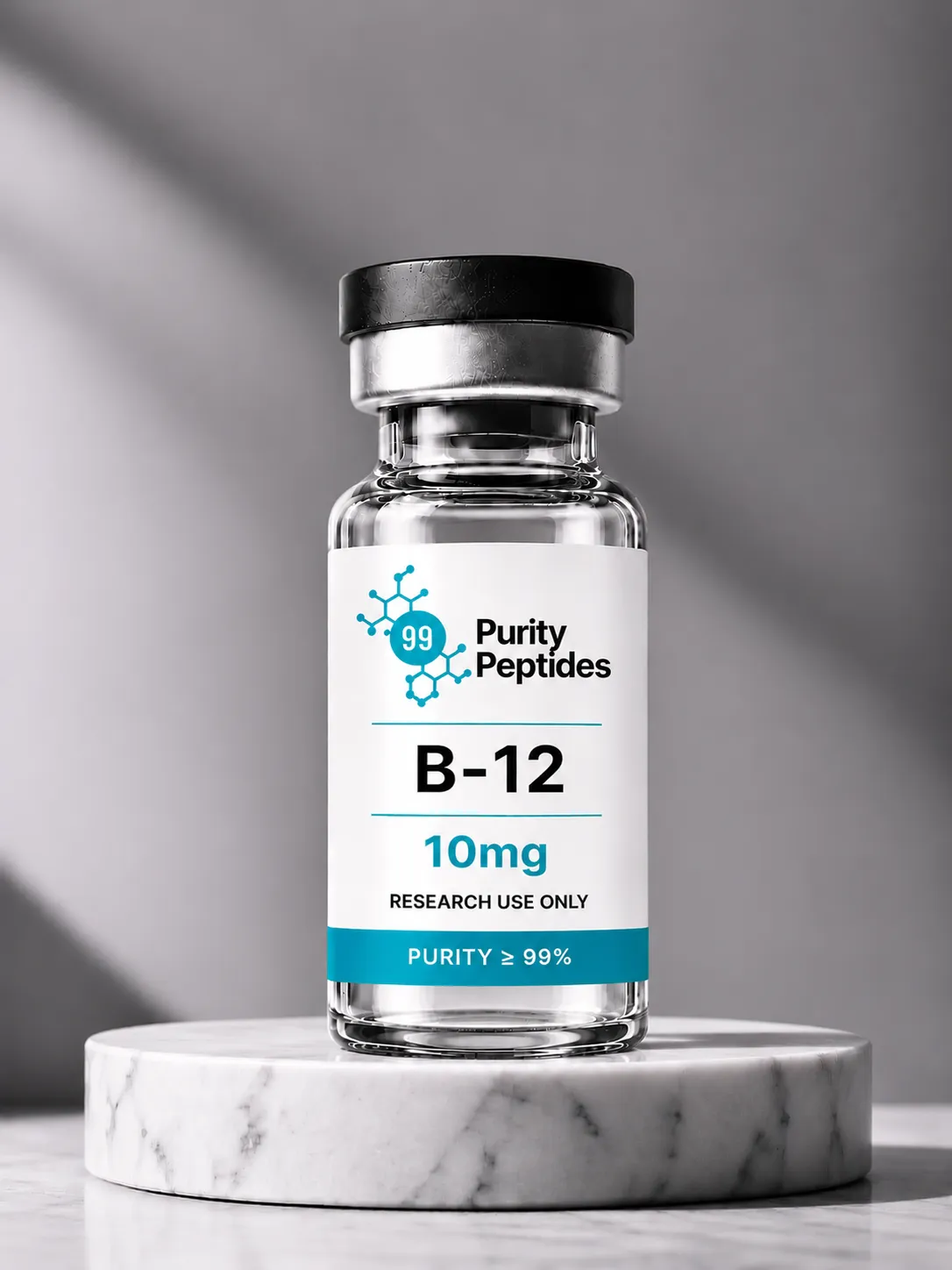
This product is offered as a single 10mg vial, with multi-vial kits available. The vial contains lyophilized powder, which limits degradation during storage and transport. Cobalamins are sensitive to light, so researchers typically protect both the vial and any prepared solutions from light, keep them cool and dry, and follow their own institution's handling procedures.
B-12 is a nutrient, and it is sold in many countries as a supplement or as a medicine. The material on this page is neither of those. It is research-grade, supplied for laboratory use only, and not intended for human or veterinary use. Purchasers are responsible for making sure their intended use complies with local regulations and institutional policies.