99Purity Peptides
Tienda
Categorías
COAsNosotrosBlogPreguntasContactoAfiliados
Comprar Ahora
Navegación
Top Formulations
View All in Category

Listo para elevar tu investigación.
Explora nuestro catálogo completo.

Explorar Catálogo
Category
Vial
Vial on Ice
Purity
Identity
99 Purity Peptides Logo

Purity You Can Trust.

Setting the gold standard in peptide synthesis with verified HPLC/MS testing for uncompromised results.

Stay ahead of the curve. Join 5,000+ top-tier labs getting exclusive formulations, early drop access, and breakthrough research news.

Explorar

  • Inicio
  • Nosotros
  • Tienda
  • Blog
  • Preguntas Frecuentes
  • COAs
  • Shipping Locations
  • Afiliados

Contacto

orders@99puritypeptides.com
support@99puritypeptides.com
+1 (843) 330-7365
@99puritypeptide

Contáctanos

Comunícate con nuestro equipo de soporte

Ver Catálogo

Ver todos los péptidos de investigación

99purity

Aviso Legal:El contenido de este sitio web no ha sido evaluado ni aprobado por la Administración de Alimentos y Medicamentos de EE. UU. (FDA). Los productos vendidos por 99 Purity Peptides se ofrecen únicamente con fines de investigación y laboratorio, y no están destinados a diagnosticar, tratar, curar o prevenir ninguna enfermedad. 99 Purity Peptides no es una farmacia de preparación magistral y no opera como una instalación de composición química según lo definido en la Sección 503A de la Ley Federal de Alimentos, Medicamentos y Cosméticos. Los productos no son para uso humano ni veterinario, y no están destinados a la ingestión, inyección ni ninguna forma de administración. Los niveles de pureza pueden variar según el producto y el lote; ciertos artículos pueden mostrar una pureza inferior al 99%.

Pay
Pay
PayPal
Zelle
VISA
AMEX
mastercard
+ more
99Purity Peptides © 2026·Política de Privacidad·Términos de Servicio·Política de Reembolso·Política de Uso en Investigación·Política de Envío·Aviso Médico·Política de Correcciones
Diseñado y Desarrollado por Belk Digital
Vista del producto 1
InicioTiendaPeptide BundlesMitochondrial Spray Pair
Peptide Bundles

Mitochondrial Spray Pair

$139.99

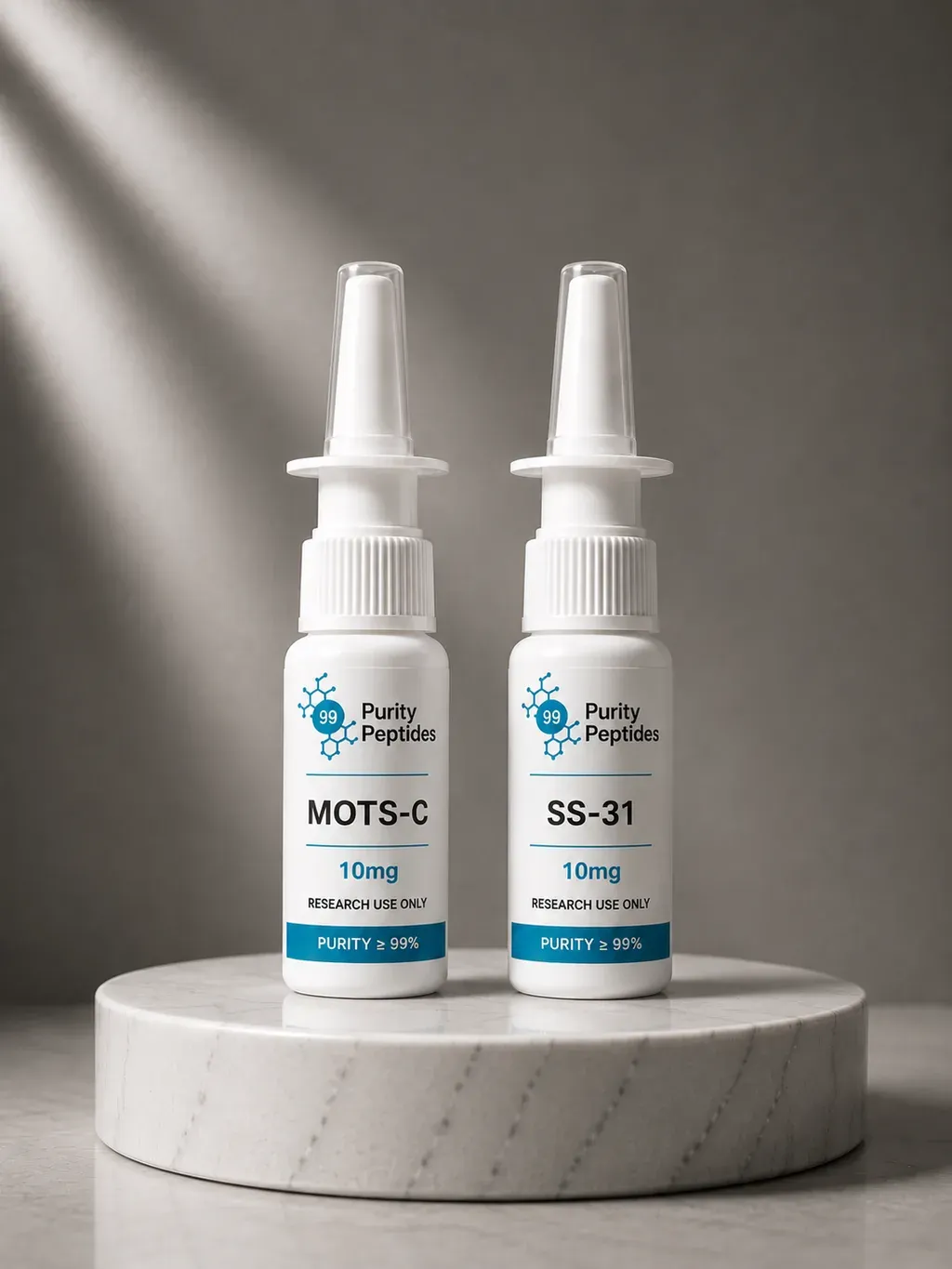
The Mitochondrial Nasal Spray Pair supplies MOTS-c and SS-31 in nasal format, each bottle containing 10 mg across approximately 45 actuations. The two compounds differ substantially in size — SS-31 is a tetrapeptide, MOTS-c a sixteen-residue peptide — which places them in different nasal absorption ranges. The format suits SS-31 considerably better on molecular weight grounds. For research use only.

Este Kit Incluye
In StockEnvío estándar gratis en pedidos de más de $300
1
Guaranteed Safe Checkout
Pay
Pay
PayPal
Zelle
VISA
AMEX
mastercard
+ more
Envío Rápido
99% Pureza
Probado por Terceros
Garantizado
99.9
Perfil del Compuesto

La
Ciencia.

≥99%

Certificado por HPLC

Pureza Verificada

Terceros

Análisis independiente

Probado en Laboratorio

Investigación

El más alto estándar

Calidad de Grado

COA

Trazabilidad completa

Documentado
Mitochondrial Spray Pair
Product Profile

Overview

The Mitochondrial Nasal Spray Pair brings together two compounds studied in mitochondrial research, supplied in nasal format. Each bottle contains 10 mg across approximately 45 actuations, giving roughly 222 micrograms nominally per actuation — the labelled mass describes the bottle rather than the individual spray.

Molecular weight separates these two products in a way it does not separate most nasal pairs. SS-31 is a four-residue peptide of approximately 640 daltons, comfortably within the range where nasal absorption of peptides is most efficient. MOTS-c is a sixteen-residue peptide of approximately 2,174 daltons, which falls in a range where reported nasal absorption is roughly an order of magnitude lower.

The nasal format therefore suits one compound in this pair considerably better than the other, and that difference cannot be formulated away.

The size gap is not arbitrary. SS-31’s compact alternating structure is what enables it to concentrate at the inner mitochondrial membrane — it is small because it was designed to be. MOTS-c is encoded within mitochondrial DNA, and its length is a property of the sequence the mitochondrial genome carries. The size difference that separates the two compounds pharmacologically is the same difference that separates them in nasal format.

Researchers should note that SS-31, also known as elamipretide, received FDA approval in September 2025.

For Research Use Only. Not intended for human consumption, therapeutic use, veterinary use, or diagnostic applications.

The Mitochondrial Nasal Spray Pair contains MOTS-c and SS-31 in nasal format, each bottle holding 10 mg across approximately 45 actuations. The two compounds fall in different nasal absorption ranges: SS-31, a tetrapeptide of roughly 640 daltons, sits in the most favourable range, while MOTS-c at roughly 2,174 daltons sits in a range where reported absorption is substantially lower.

Key Takeaways

  • The pair contains one MOTS-c nasal spray and one SS-31 nasal spray, each with 10 mg across approximately 45 actuations.
  • The labelled 10 mg describes the bottle total; nominal content per actuation is roughly 222 micrograms.
  • SS-31 is a four-residue peptide of approximately 640 daltons and falls in the most favourable nasal absorption range.
  • MOTS-c is a sixteen-residue peptide of approximately 2,174 daltons and falls in a range where reported nasal absorption is roughly an order of magnitude lower.
  • The size difference is intrinsic to what each compound is, not a formulation choice, and cannot be changed.
  • Both products are supplied strictly for laboratory research and are not intended for human consumption, therapeutic use, veterinary use, or diagnostic applications.

What’s Included in This Pair

ProductPeptide contentActuationsResiduesApproximate MW
MOTS-c nasal spray10 mg per bottle~4516~2,174 Da
SS-31 nasal spray10 mg per bottle~454~640 Da

Both are supplied as prepared solutions with batch documentation. Confirm actuation count and molecular weight against the documentation supplied with your lot.

What “10 mg / 45 Sprays” Describes

The labelled mass is the bottle total, not the content of a single actuation.

A 10 mg bottle delivering approximately 45 actuations contains roughly 222 micrograms per actuation nominally.

Nominal content is not delivered content — priming consumes actuations, residual volume remains in the device, and delivery varies between actuations. Delivered content is not absorbed content, which depends on absorption efficiency and, for this pair, differs substantially between the two compounds.

Each figure in that chain is smaller than the one before it, and the labelled bottle mass sits at the top.

These Two Compounds Are Not in the Same Absorption Band

Most nasal peptide pairings involve compounds of broadly similar size, and the format performs comparably for both. This pair does not work that way, and the difference is large enough to matter for study design.

Nasal absorption of peptides falls steeply with molecular size. Published work describes peptides below roughly 1,000 daltons absorbing far more efficiently than those in the 1,000 to 3,500 dalton range, where reported figures drop by roughly an order of magnitude, with further decline above that.

Where SS-31 sits

SS-31 is a four-residue peptide of approximately 640 daltons — one of the smallest compounds supplied in nasal format in this catalogue, and comfortably within the most favourable absorption range. On molecular weight grounds, SS-31 is a strong nasal candidate.

Where MOTS-c sits

MOTS-c is a sixteen-residue peptide of approximately 2,174 daltons, placing it in the intermediate range where reported nasal absorption is substantially lower than for smaller peptides.

MOTS-c is not among the more favourable nasal candidates on size grounds, and stating that is more useful than implying the format performs uniformly.

Why the size difference is not a formulation choiceSS-31’s small size is its targeting mechanism — a compact alternating aromatic-cationic sequence, short because it was designed to be. MOTS-c’s size follows from its origin: it is encoded within mitochondrial DNA, and its length is a property of that sequence. The size difference that separates these compounds pharmacologically is the same difference that separates them in nasal format.
Aviso de InvestigaciónTodos los productos de cada categoría son únicamente para uso en investigación y no aptos para uso humano o veterinario, diagnóstico o tratamiento.
Sigue Explorando

También Considerado.

Copper Peptide Spray Comparator

RESEARCH PEPTIDE

Both copper tripeptides sit in the favourable nasal absorption range. Their published research is almost entirely topical, and no intranasal study bridges the two.

Copper Peptide Spray Comparator
From
$114.99

Neuropeptide Spray Comparator

RESEARCH PEPTIDE

10 mg is the bottle total, not the per-spray content. Both peptides sit under 1,000 Da, where nasal absorption is most favourable. Research use only.

Neuropeptide Spray Comparator
From
$109.99

Melanocortin Analog Comparator

RESEARCH PEPTIDE

Three analogs of one hormone across a five-receptor family. Linear, cyclic and a metabolite of the cyclic — compared by structure and receptor selectivity. RUO.

Melanocortin Analog Comparator
From
$134.99

Thymosin Family Comparator

RESEARCH PEPTIDE

They share a name and almost nothing else. The thymosin grouping came from 1970s isoelectric focusing, not from relatedness. Two unrelated peptides compared. RUO.

Thymosin Family Comparator
From
$109.99
Customer Reviews
0.0
0 Reviews
5
0
4
0
3
0
2
0
1
0
0 Reviews

No Reviews Yet

Be the first to share your experience with this product and help other researchers!

Educación e Investigación

Más Información.

MOTS-c vs SS-31: dos péptidos mitocondriales, dos mecanismos distintos
Product Guides
Oct 17, 20265 min read

MOTS-c vs SS-31: dos péptidos mitocondriales, dos mecanismos distintos

MOTS-c vs SS-31 comparados en identidad, mecanismo, datos animales y ensayos en humanos, y por qué no existe una comparación directa.
MOTS-c vs. NAD+: un péptido y una coenzima, comparados con honestidad
Product Guides
Sep 14, 20265 min read

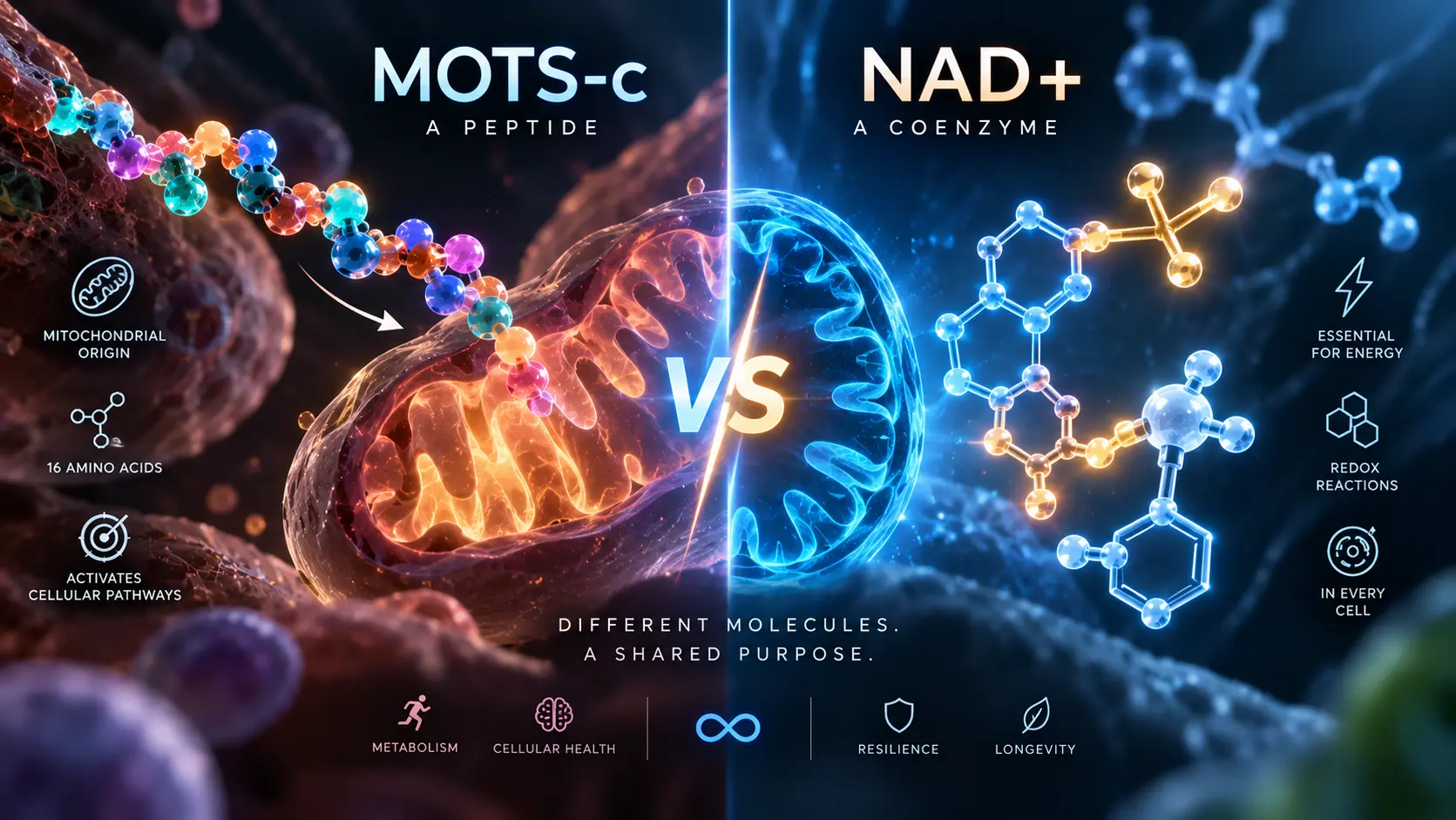
MOTS-c vs. NAD+: un péptido y una coenzima, comparados con honestidad

MOTS-c vs. NAD+ comparados con honestidad: uno es péptido, el otro coenzima. Qué muestra la evidencia, y por qué el ensayo de MOTS-c 2026 debe verificarse.

MOTS-c y Humanin: Péptidos Mitocondriales Explicados
Product Guides
Jul 23, 20265 min read

MOTS-c y Humanin: Péptidos Mitocondriales Explicados

Investigación de MOTS-c y Humanin: cómo estos péptidos derivados de mitocondrias vinculan el metabolismo, el envejecimiento, y la supervivencia celular. Vea lo que realmente muestra la ciencia.

READ

(preguntas frecuentes)

Preguntas Frecuentes

01

What is included in the Mitochondrial Nasal Spray Pair?

The pair includes one MOTS-c nasal spray and one SS-31 nasal spray, each containing 10 mg across approximately 45 actuations, supplied as prepared solutions with batch documentation. For research use only.
02

Does 10 mg mean per spray or per bottle?

Per bottle. A bottle labelled 10 mg contains 10 mg in total. Divided across approximately 45 actuations, that gives roughly 222 micrograms per actuation nominally. Actual delivered content is lower, since priming consumes actuations and residual volume remains in the device.
03

Do MOTS-c and SS-31 absorb the same way through the nose?

No. Nasal absorption of peptides falls steeply with molecular size. SS-31 at approximately 640 daltons sits in the most favourable range, while MOTS-c at approximately 2,174 daltons sits in a range where reported absorption is roughly an order of magnitude lower.
04

Is SS-31 small enough for nasal delivery?

On molecular weight grounds, yes. At approximately 640 daltons SS-31 is among the smaller compounds supplied in nasal format and falls comfortably within the range where nasal absorption of peptides is most efficient. No compound-specific intranasal study was identified, however.
05

Why does peptide size affect nasal absorption?

Larger molecules cross the nasal mucosa less readily than smaller ones, and the relationship is steep rather than gradual. Published work describes absorption dropping sharply above roughly 1,000 daltons, with further decline above roughly 3,500 daltons.
06

Can MOTS-c be made smaller for better nasal absorption?

No. MOTS-c is a sixteen-residue peptide encoded within mitochondrial DNA, and its length is a property of that sequence. Shortening it would produce a different molecule rather than a more absorbable version of the same one.
07

Why is SS-31 so much smaller than MOTS-c?

SS-31 is a synthetic four-residue peptide whose compact structure is its mitochondrial targeting mechanism — it is short by design. MOTS-c is a genome-encoded signalling peptide whose length follows from the mitochondrial DNA sequence that encodes it.
08

Is there published data on nasal absorption of these compounds?

No intranasal pharmacokinetic study was identified for either compound. The absorption bands referenced here are general to peptide molecular weight, drawn from work on other compounds. They predict a relationship rather than measuring these products.
09

Is SS-31 the same as elamipretide?

Yes. SS-31, elamipretide and MTP-131 refer to the same compound. Elamipretide received FDA accelerated approval in September 2025 for a rare genetic condition. Material supplied here is research-grade and is not that approved pharmaceutical product.
10

How does the nasal format differ from vials?

Nasal sprays are prepared solutions requiring no reconstitution, with concentration fixed at manufacture. Lyophilized vials are supplied dry, allow concentration to be selected, and are more stable in storage. For this pair, the nasal format also introduces the absorption difference between the two compounds.
11

Are the two sprays the same concentration?

Both contain 10 mg across approximately 45 actuations, so nominal per-actuation content is comparable. Confirm actual concentration on the documentation for each lot rather than assuming equivalence between the two products.
12

What should be verified on receipt?

Confirm identity, concentration, actuation count and lot number for both products. Identity confirmation matters particularly for SS-31, which circulates under at least three designations, and purity figures are not directly comparable between a four-residue and a sixteen-residue peptide.
13

Can these products be used on humans or animals?

No. Both are supplied for laboratory research only. They are not intended for human consumption, therapeutic use, veterinary use, or diagnostic applications, and no dosing, protocol, actuation count or administration guidance is provided for them.