Last reviewed: September 2026
Quick Answer
AI designed peptides are amino acid sequences proposed and refined by generative models rather than drawn up by medicinal chemists. As of September 2026, only one such candidate has been publicly confirmed to enter human trials, and several of the platform claims circulating online do not survive a check of the primary sources. What follows is that check: what the algorithms actually do, which programs have real experimental results behind them, and where the record still runs on announcements alone.
Key Takeaways
- Only one AI-designed peptide therapeutic has been publicly confirmed to enter human trials: ProteinQure's PQ203, a peptide-drug conjugate for triple-negative breast cancer, first dosed in Phase I in September 2025 [1][2].
- Claims of "at least 15" AI-designed peptides in trials misattribute an all-modality 2022 tally to peptides specifically; no primary source supports a peptide count above one [4][5].
- Duke University's PepPrCLIP platform designed peptides that bound β-catenin at K_D values of 200 and 150 nM and degraded it by more than 50% in DLD1 cells. That is cell culture work, with no animal or human testing reported [6].
- No "V-SPADE" algorithm exists in any Viva Biotech source; their actual platform is MARS/Pep2MARS, announced August 2026 with no disclosed benchmarks or wet-lab validation [8].
- The strongest experimental validation in the field this year comes from ApexGO: 100 AI-designed peptides synthesized, an 85% in-vitro hit rate, and efficacy in two mouse infection models [10].
- Pepti-Agent, a 2026 AI agent for peptide design, is computational only; its authors state explicitly that no candidate has been experimentally validated [9].
- No registry tracks AI-designed drugs, so every pipeline number depends on a private group's own classification criteria [4].
- A computationally designed sequence is a hypothesis until it is synthesized and tested, which is why mass spectrometry identity confirmation and HPLC purity testing matter at least as much for an AI-designed peptide as for any other.
Research Use Only. Nothing sold on 99puritypeptides.com is for human or veterinary consumption, and nothing in this article is medical, dosing, or health advice. This page covers drug-discovery methodology and the published record behind it, not any compound offered on this site.
How We Graded the Evidence
Every program below gets a grade. The scale is simple, and the bar for a high grade is deliberately hard to clear.
Grade | What it means |
|---|---|
A | Human-trial data reported (even early Phase I dosing) |
B | Animal data plus in-vitro results |
C | In-vitro and/or cell-culture results, no animal work |
D | Computational results only |
E | Company announcement only, no experimental data attached |
A grade describes the evidence behind a claim, not the quality of the algorithm. A brilliant model with no bench data gets a D. That is the point.
What Does It Actually Mean for AI to "Design" a Peptide?
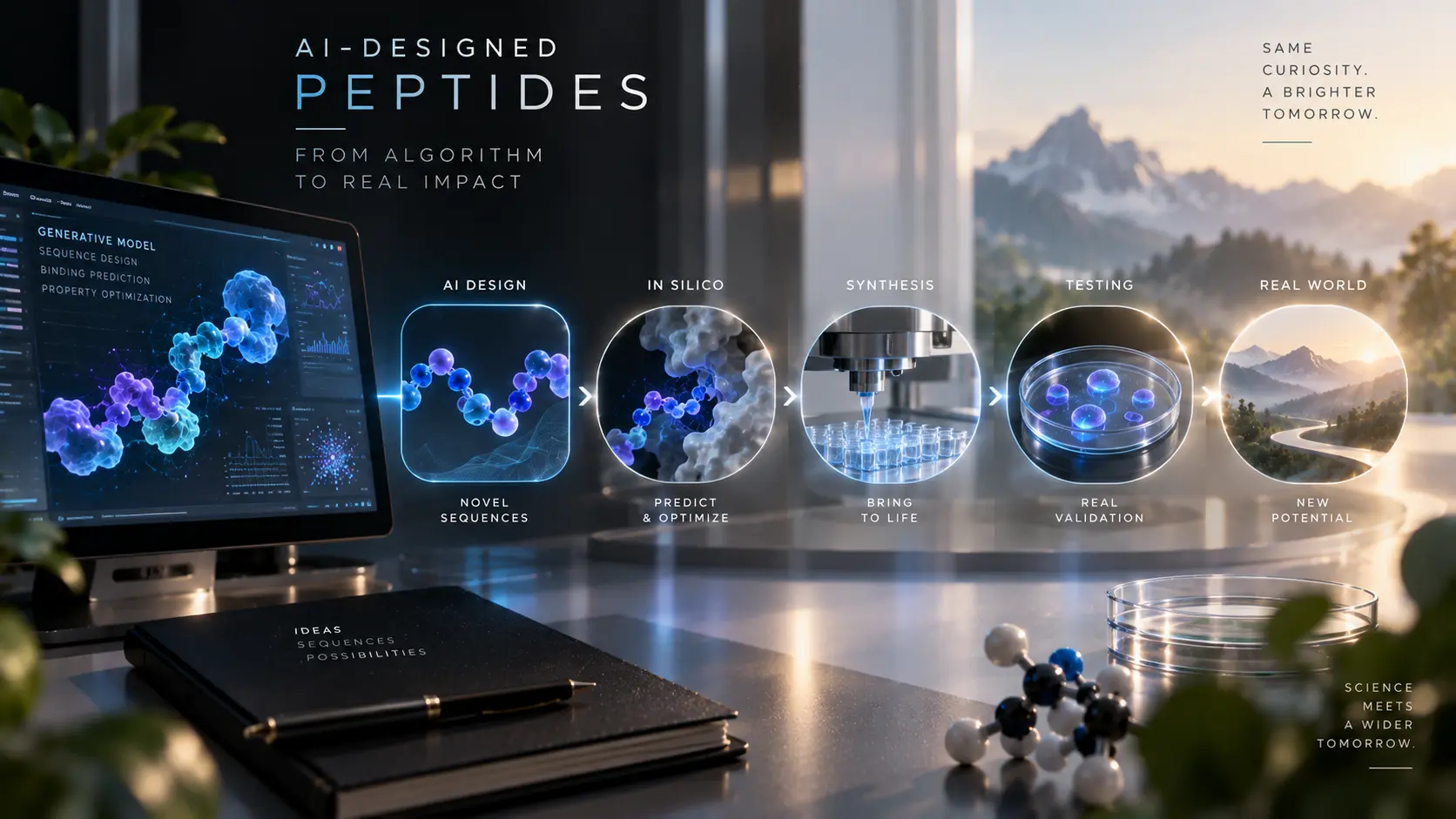
An AI-designed peptide is a sequence that a generative model proposed and computationally optimized for a target before any chemist synthesized it. The model searches an enormous space of possible amino acid combinations, scores each candidate in silico for binding affinity, selectivity, stability, and manufacturability, and iterates. That loop can compress a design phase that would take a medicinal chemistry team years into hours of computation.
This is different from using a computer to store or search existing peptide databases. A database search retrieves sequences someone already made. Generative design creates sequences that never existed, then filters them with predictive models. The Duke PepPrCLIP work illustrates the mechanics: a generative component proposes novel candidates through Gaussian perturbation of the ESM-2 protein language model's latent space, and a contrastive learning architecture adapted from OpenAI's CLIP then ranks which candidates should bind the target [6]. Pepti-Agent runs a similar closed loop with an LLM controller, generation and single-residue mutation tools, and ProtBERT-based classifiers scoring solubility, hemolysis, and non-fouling between iterations [9].
The boundary matters because the term gets stretched. Not every use of a computer in peptide work counts as AI design.
Activity | Counts as AI-designed? | Why |
|---|---|---|
A generative model proposes novel sequences, then optimizes them computationally for a target | Yes | The sequence originates from the model, not from a chemist's sketch or a library |
Virtual screening of an existing compound library with ML scoring | Partially | The selection is model-driven, but the sequences are pre-existing |
Searching a peptide database by keyword, mass, or motif | No | This is retrieval, not design |
Predicting ADME properties of a chemist-drawn sequence | No | The model evaluates; a person still designed |
An AI agent iteratively mutating sequences against predicted property scores | Yes | The refinement loop, not just the proposal, is algorithmic |
Insilico Medicine's 2025 demonstration shows the speed the design step can reach: its Biology42 engine generated more than 5,000 novel peptides against GLP-1R in a 72-hour cycle, without referencing any known GLP-1R binders, and 14 of 20 synthesized candidates showed biological activity in wet-lab testing [11]. Speed is real. Whether speed converts into drugs is a separate question, and the rest of this article treats it that way.
How Many AI-Designed Peptides Are Actually in Clinical Trials?
One. As of September 2026, the only AI-designed peptide therapeutic publicly confirmed to have entered human trials is ProteinQure's PQ203, a peptide-drug conjugate for triple-negative breast cancer that received its first Phase I dose in September 2025 [1]. Count it as one.
That number will surprise readers who have seen larger figures quoted. A peer-reviewed 2024 review put the honest state of the field in words rather than numbers: "many innovative peptide therapeutics are in various early stages of development, including preclinical studies with a few advancing to early-phase clinical trials, as of late 2024" [3]. "A few" is not a count, and it is not fifteen. ProteinQure's own CEO said in May 2025 that the company was advancing "what we believe to be the first AI-designed peptide therapeutic into the clinic" [2]. If a dozen others were already in trials, that statement would be strange.
The "at least 15" figure appears to be a misattribution. The only "15" found in any source is explicitly about AI-designed drugs across all modalities, and it is four years old: "at least 15 AI-designed molecules in clinical development by 2022," from a 2025 opinion piece whose author describes writing outside his expertise [5]. Current all-modality tallies are far bigger. A 2026 ASCO/JCO conference abstract counted 117 AI-enabled therapeutic assets across 63 companies in interventional human trials, and the industry tracker Medspark reported over 173 AI-designed drug programs in early 2026, up from roughly two dozen in late 2023 [4]. None of these are peptide-specific, and none rest on a shared definition.
That is the deeper problem. "AI-designed" is not a regulatory term, and ClinicalTrials.gov does not tag AI-driven discovery. A July 2026 pipeline analysis warned that "no single authoritative, government-maintained registry of 'AI-discovered drugs' exists," meaning every figure in this space depends on a private company's or research group's own classification criteria [4]. Two trackers can honestly report different totals because they count different things.
Public claim | Where it traces to | Verdict |
|---|---|---|
"At least 15 AI-designed peptides in clinical trials" | No primary source; nearest match is an all-modality 2022 tally in an opinion piece [5] | Not supported |
"~173 AI-designed programs in clinical development" | Medspark tracker via a July 2026 pipeline analysis, all modalities [4] | Verified as stated, but not peptide-specific |
"117 AI-enabled assets across 63 companies" | ASCO/JCO 2026 conference abstract, all modalities [4] | Verified as stated, but not peptide-specific |
"Zero AI-designed drugs in 2020" | Contradicted: Exscientia and Sumitomo's DSP-1181 entered Phase I in January 2020 [4] | False for AI drugs generally; unanswerable for peptides specifically |
"First AI-designed peptide therapeutic into the clinic" (PQ203) | ProteinQure company announcement, May 2025 [2] | Verified as the company's claim; only publicly confirmed peptide in trials |
One more distinction worth keeping straight throughout: a computational design result is not a clinical outcome. PQ203's Phase I announcement reports dosing, not efficacy. Nobody has published evidence that an AI-designed peptide works in people yet.
What Is Duke's Platform Doing Differently?
PepPrCLIP, from Pranam Chatterjee's lab at Duke, attacks the part of drug discovery that standard methods handle worst: disordered proteins. More than 80% of pathogenic proteins are considered "undruggable" by standard small-molecule inhibitors because they lack stable binding pockets [6]. These proteins resemble tangled, disordered chains rather than neat lock-and-key structures, which makes designing binders for them exceptionally difficult.
PepPrCLIP needs only the target's amino acid sequence, no 3D structure. Its generative half, PepPr, proposes novel peptide candidates from a protein language model, and its CLIP-based half ranks which ones should bind the target [7]. On held-out peptide-protein pairs from the Protein Data Bank, the discriminator reached 95.4% binary accuracy [6]. That is in-silico, grade D on its own. The interesting part is what happened after synthesis.
The team tested PepPrCLIP-designed peptides against β-catenin, a disordered signaling protein involved in several cancers [6]. In cell-free assays, the peptides bound immobilized β-catenin by ELISA and showed mid-nanomolar affinity by biolayer interferometry, with K_D values of 200 and 150 nM [6]. Fused to a ubiquitin-ligase domain to create "ubiquibodies," two designs drove more than 50% β-catenin degradation in DLD1 colon cancer cells, and the effect was blocked by a proteasome inhibitor, confirming the mechanism [6]. In the hardest test, peptides designed against SS18-SSX1, a highly disordered fusion oncoprotein behind synovial sarcoma, reduced the target protein by more than 40% in the HS-SY-II sarcoma cell line [6].
Separate experiments against the UltraID enzyme showed 19 of 20 generated peptides inhibiting it in HEK293T cells, with four exceeding 75% inhibition efficiency [6]. That hit rate is striking, and it is also exactly the kind of number that should make a reader ask for replication in a second lab.
The honest grade is C: in-vitro plus cell culture, no animal work. The paper contains no "in vivo" or "mice" mentions at all. Duke's press coverage described the peptides as "destroying" disease proteins, which is accurate only within cell culture [7]. Nobody has tested a PepPrCLIP design in an animal, let alone a person. The platform's real contribution is methodological: it designed binders for targets with no stable structure using sequence alone, and those designs worked in cells. That is genuinely hard, and genuinely not the same as a drug.
Is There Really a "V-SPADE" Algorithm?
No. There is no "V-SPADE" in any Viva Biotech announcement, publication, or third-party coverage we could find after repeated exact-phrase searches. The name appears to be a garble, possibly a confusion of V-Scepter, one of the company's three named AI-drug-discovery modules, with something else. Phrases like "simultaneous structure prediction and sequence generation" and "all-atom co-folding and co-design" do not appear in Viva Biotech's own materials at all [8].
What Viva Biotech actually announced, in its August 26, 2026 interim results release, is a "MARS multimodal integrated algorithm platform," with "Pep2MARS" positioned for designing peptides, cyclic peptides, and complex macrocycles [8]. MARS sits atop three modules: V-Scepter for physics-based parameterization, V-Orb for physics-driven modeling, and V-Mantle for generative AI including protein large language models [8]. The release reports that CADD/AIDD work had participated in 228 projects cumulatively with 92 clients as of June 30, 2026, and that AI-empowered projects accounted for about 14.0% of CRO revenue [8].
What the release does not contain is any validation: no benchmarks, no computational metrics, no in-vitro results, no clinical data for MARS or Pep2MARS [8]. The nearest thing to evidence is a vague line about a "deep collaboration with a global industry leader" advancing a "dry-wet closed-loop" model. No partner named, no experiment described [8]. The 228-project figure is a service-volume number, not proof that any algorithm works. No peer-reviewed paper or preprint on MARS or Pep2MARS could be located. Grade: E.
This section exists because the brief for this article asked for V-SPADE by name, and verification killed it. That is worth stating plainly rather than quietly dropping the section, since readers searching the term deserve the correction: if you read about "V-SPADE" elsewhere, know that Viva Biotech's own records describe something called MARS/Pep2MARS, and even that claim currently rests on a press release.
Is Any of This Independently Validated?
Yes, in pieces. The strongest results come from programs that synthesized their designs and tested them. The field's credibility problem is not a lack of algorithms; it is a shortage of synthesized, assayed candidates. Three 2025–2026 results show what the validation ladder actually looks like.
The strongest is ApexGO, published in Nature Machine Intelligence in May 2026. University of Pennsylvania researchers used a transformer variational autoencoder with Bayesian optimization to refine antimicrobial peptide templates, chemically synthesized 100 AI-designed compounds, and ran full in-vitro characterization [10]. The reported results: an 85% experimental hit rate and a 72% success rate at enhancing antimicrobial activity against Gram-negative pathogens, outperforming both HydrAMP and the PepDiffusion model on the same template-constrained task [10]. Then came the animal step. In two preclinical mouse models of Acinetobacter baumannii infection, the optimized molecules showed anti-infective activity superior to their templates and comparable to or exceeding a last-resort antibiotic [10]. Grade: B. This is in-vitro plus mouse work, not human data, and it optimizes antimicrobial activity rather than the classic binding-affinity story, but it is the rare AI peptide result with synthesized molecules, measured outcomes, and a direct benchmark against competing methods.
Insilico Medicine's GLP-1R demonstration sits a rung lower. Over 5,000 novel peptides were generated in a 72-hour cycle with no known GLP-1R binders as reference; 20 were selected for synthesis and wet-lab evaluation, 14 showed biological activity, and 3 reached single-digit nanomolar potency [11]. That is a respectable in-vitro result from a high-throughput pipeline. It is also a company announcement with no animal or human data. Grade: C.
Pepti-Agent, the 2026 arXiv preprint describing an LLM-driven agent for peptide design and optimization, is a useful contrast. The framework is genuinely interesting: generation, property prediction, and single-residue mutation exposed as inspectable tools, with refinement guided by live predictor output for solubility, hemolysis, and non-fouling [9]. But the authors are explicit: "no candidate has been experimentally validated," and the paper does not claim the agent outperforms simpler search procedures [9]. Grade: D. Honest, and exactly how computational work should be reported.
One claim that will not appear here: a widely repeated line that "more than half" of AI-generated peptide candidates in some validation effort maintained or improved binding affinity while gaining drug-like properties. We searched for its primary source across roughly 30 queries and could not find one combining that percentage, that comparison, and a described validation method. Near-matches checked and rejected included XtalPi's 75% SPR-threshold figure (a different statistic) and MOG-DFM's 6-of-24 binders (below half) [9 notes]. Until someone produces the source document, the statistic stays out.
Program | What was designed | What was actually measured | Grade |
|---|---|---|---|
ApexGO (Univ. of Pennsylvania) | 100 antimicrobial peptides via VAE + Bayesian optimization | 85% in-vitro hit rate; mouse infection models vs. last-resort antibiotic | B |
PepPrCLIP (Duke) | Binders for disordered targets (β-catenin, SS18-SSX1, UltraID) | ELISA/BLI binding (K_D 200, 150 nM); >50% degradation in cells | C |
Insilico GLP-1R campaign | 5,000+ peptides in 72 h | 14 of 20 synthesized active; 3 at single-digit nM, in vitro | C |
ProteinQure PQ203 | Peptide-drug conjugate vs. sortilin | Phase I first-in-human dosing, Sept 2025 | A |
Decoy D-MAV | AI-designed antiviral peptides (IMP³ACT platform) | None yet; hVIVO engagement to move toward Phase 1/2a | E |
Pepti-Agent | LLM agent optimizing solubility, hemolysis, non-fouling | Model-internal diagnostics only | D |
Viva MARS/Pep2MARS | Peptides, cyclic peptides, macrocycles | None disclosed | E |
Decoy Therapeutics' D-MAV program belongs on the ladder as a watch item. In June 2026 the company engaged hVIVO to advance its AI-designed antiviral peptide candidates toward Phase 1 first-in-human and Phase 2a studies, but the company describes itself as preclinical-stage and no human data exists yet [13]. PepBenchmark, released for ICLR 2026 with 35 standardized datasets, is infrastructure rather than a candidate, valuable for the field but not evidence that any design works [12].
What Does AI Design Not Replace?
Everything downstream of the design step. A computationally designed sequence is a hypothesis with unusually good math behind it. Synthesis can fail. The molecule can aggregate, degrade, or refuse to fold as predicted. It can bind the target and do nothing useful, or bind the wrong thing. Toxicology, pharmacokinetics, and clinical trials answer those questions, and no design algorithm shortens the regulatory review that demands them.
This is where analytical verification earns its keep. An AI-designed sequence is, by definition, a molecule with no prior track record: no reference standard history, no batch-to-batch literature, no prior COAs to compare against. That makes identity confirmation by mass spectrometry and purity measurement by HPLC at least as important as for any established peptide, and arguably more so. A single wrong residue in a 30-mer is invisible to a casual glance at a sequence string and obvious to a mass spectrometer. The guide to reading a certificate of analysis walks through exactly which fields confirm identity versus purity, and how peptide labs ensure purity explains why both tests are necessary rather than alternatives.
The practical rule: demand the same documentation for a computationally designed sequence that you would for any research peptide: batch-specific identity and purity data, a named testing method, a testing date. Novelty of origin is not a substitute for analytical proof of content.
What the Evidence Does Not Establish
Honest limits, stated plainly:
- No AI-designed peptide has been approved as a drug. The furthest any candidate has publicly reached is Phase I dosing.
- PQ203's trial announcement reports that dosing began, not that the candidate works. Phase I first-in-human studies test safety and pharmacokinetics, not efficacy.
- "AI-designed" does not mean safer, more potent, or more likely to succeed than a traditionally designed candidate. No head-to-head clinical comparison exists.
- The "at least 15 in trials" figure is unsupported; the verifiable peptide count is one. All-modality tallies in the hundreds are real numbers about a different question.
- "V-SPADE" is not a real product name. Viva Biotech's MARS/Pep2MARS has no disclosed benchmarks or wet-lab validation.
- The "more than half maintained or improved affinity" statistic could not be traced to a primary source and should not be quoted as fact.
- Corporate announcements (PQ203, Decoy, Insilico, Viva) are claims about programs, not peer-reviewed results. Treat them as leads, not conclusions.
- In-silico and animal results are not clinical outcomes. A 95.4% discriminator accuracy and a mouse infection model are genuine achievements that tell you nothing about human pharmacology.
- There is no authoritative registry of AI-designed drugs, so any pipeline count is only as good as the private classification behind it.
What a Lab Should Demand Before Trusting Any Sequence
The design origin of a peptide, human chemist or generative model, stops mattering the moment the powder is in the vial. From that point, only analytical evidence counts. For any research peptide, and especially for a computationally novel sequence with no track record, a lab should verify the following before building an experiment on it.
Check | What it confirms | Why it matters more for AI-designed sequences |
|---|---|---|
Mass spectrometry identity | The observed molecular weight matches the labeled sequence | A model can propose any sequence; only the spectrum proves synthesis produced it |
HPLC purity with chromatogram | The share of the sample that is the target peptide | Novel sequences have no impurity profile history to compare against |
Batch-specific lot number | The COA describes your vial, not a generic run | Design hype travels faster than documentation; match them yourself |
Named testing method and date | How and when the tests were run | A computational pedigree does not exempt a batch from physical testing |
Independent laboratory | The lab has no stake in the result | Self-reported data on a self-designed molecule is a single point of failure |
For the full walkthrough, see the guide to reading a certificate of analysis, the batch-specific certificate library, how peptide labs ensure purity, and the research peptide purity standards guide for U.S. laboratories. Whatever a sequence's origin, this is what a lab should demand before trusting it.
References
- ProteinQure Inc. ProteinQure Announces First Patient Dosed in Phase I Clinical Trial of PQ203 in Advanced Metastatic Cancer. Company announcement. September 17, 2025. https://www.proteinqure.com/proteinqure-announces-first-patient-dosed-in-phase-i-clinical-trial-of-pq203-in-advanced-metastatic-cancer/
- ProteinQure Inc. ProteinQure Raises Series A Financing to Advance First AI-Designed Peptide Therapeutic into Clinical Trials. Company announcement. May 28, 2025. https://www.proteinqure.com/proteinqure-raises-series-a-financing-to-advance-first-ai-designed-peptide-therapeutic-into-clinical-trials/
- Nissan N, Allen MC, Sabatino D, et al. Future Perspective: Harnessing the Power of Artificial Intelligence in the Generation of New Peptide Drugs. Biomolecules. 2024;14(10):1303. PMID: 39456236. https://pmc.ncbi.nlm.nih.gov/articles/PMC11505729/
- IntuitionLabs. AI-Discovered Drugs in Clinical Trials 2026: Full Pipeline. Industry analysis. July 31, 2026. https://intuitionlabs.ai/pdfs/ai-discovered-drugs-clinical-trials-2026.pdf
- CustomerThink. AI's Symbiotic Impact on Drug Development and Patient Experience in Global Pharma and Biotech. Opinion. 2025. https://customerthink.com/ais-symbiotic-impact-on-drug-development-and-patient-experience-in-global-pharma-and-biotech/
- Bhat S, Palepu K, Hong L, et al. De novo design of peptide binders to conformationally diverse targets with contrastive language modeling. Science Advances. 2025;11(4). DOI: 10.1126/sciadv.adr8638. PMID: 39841846. https://www.science.org/doi/10.1126/sciadv.adr8638
- Duke Pratt School of Engineering. Harnessing Generative AI to Treat Undruggable Diseases. Press release. January 2025. https://pratt.duke.edu/news/harnessing-generative-ai-to-treat-undruggable-diseases/
- Viva Biotech Holdings Group. Viva Biotech Announces Its 2026 Interim Results: AI Sparks New Paradigm in Drug R&D, CDMO Commercial Manufacturing Accelerates Revenue Growth. Company announcement via PRNewswire. August 26, 2026. https://www.prnewswire.com/news-releases/viva-biotech-announces-its-2026-interim-results-ai-sparks-new-paradigm-in-drug-r-d-cdmo-commercial-manufacturing-accelerates-revenue-growth-302860711.html
- Chen H, Chandrasekhar A, Farimani AB, et al. Pepti-Agent: An AI Agent for Peptide Design and Optimization. arXiv preprint. June 13, 2026. DOI: 10.48550/arXiv.2606.15422. https://arxiv.org/abs/2606.15422
- Torres MDT, Zeng Y, Wan F, et al. A generative artificial intelligence approach for peptide antibiotic optimization. Nature Machine Intelligence. 2026;8(5):841-856. DOI: 10.1038/s42256-026-01237-5. https://www.nature.com/articles/s42256-026-01237-5
- Insilico Medicine. Insilico Showcases Advanced Generative Biologics Engine in Breakthrough 72-Hour Peptide Design Targeting GLP1R for Cardiometabolic Disease. Company announcement via PR Newswire. October 29, 2025. https://www.prnewswire.co.uk/news-releases/insilico-showcases-advanced-generative-biologics-engine-in-breakthrough-72-hour-peptide-design-targeting-glp1r-for-cardiometabolic-disease-302597932.html
- Zhang J, Wang R, Zhou K, et al. PepBenchmark: A Standardized Benchmark for Peptide Machine Learning. ICLR 2026. arXiv preprint. 2026. DOI: 10.48550/arXiv.2604.10531. https://arxiv.org/abs/2604.10531
- Decoy Therapeutics, Inc. Decoy Therapeutics Partners with hVIVO to Advance Lead D-MAV Candidate into the Clinic. Company announcement via PR Newswire. June 1, 2026. https://www.prnewswire.com/news-releases/decoy-therapeutics-partners-with-hvivo-to-advance-lead-d-mav-candidate-into-the-clinic-302786694.html
Frequently Asked Questions
What are AI-designed peptides?
AI-designed peptides are amino acid sequences proposed and computationally optimized by machine learning models rather than drawn up by medicinal chemists. The models search vast sequence spaces, score candidates in silico for properties like binding affinity and stability, and iterate before any synthesis. They are research-stage design outputs, not a category of approved drugs, and each one still requires full laboratory and clinical validation.
How does AI actually design a peptide sequence?
A generative model proposes novel amino acid sequences, often by sampling the latent space of a protein language model trained on natural proteins. Property-prediction models then score each candidate for binding affinity, selectivity, solubility, and stability. An optimization loop, sometimes run by an LLM-based agent, mutates the sequences and re-scores them across iterations. Only the top-ranked candidates are ever synthesized and tested in the lab.
Are any AI-designed peptides in clinical trials right now?
As of September 2026, one has been publicly confirmed: ProteinQure's PQ203, a peptide-drug conjugate for triple-negative breast cancer, which received its first Phase I dose in September 2025. A peer-reviewed 2024 review described only "a few" such candidates reaching early-phase trials. Claims of fifteen or more trace to all-modality AI-drug tallies misattributed to peptides specifically, and no registry tracks AI-designed candidates.
How many AI-optimized peptide candidates are in development?
No verifiable total exists. One candidate (PQ203) is confirmed in Phase I, and several programs (Decoy Therapeutics' D-MAV antivirals, Insilico Medicine's GLP-1R peptides) are in preclinical stages moving toward the clinic. Published pipeline counts in the hundreds cover all drug modalities and rest on private trackers' own classification rules, since no authority tags AI-driven discovery. Treat any peptide-specific total above one as speculation until a company discloses it.
What is Duke University's peptide design platform?
It is called PepPrCLIP, built in Pranam Chatterjee's lab and published in Science Advances in January 2025. A generative component proposes novel peptides from a protein language model, and a CLIP-based discriminator ranks which ones should bind a target using only its amino acid sequence. Tested designs bound β-catenin at nanomolar affinity and degraded it in cultured cells. Validation is computational and cell-based; no animal or human testing has been reported.
What is the V-SPADE algorithm?
No such algorithm exists in any Viva Biotech source. The name appears to be a garble of the company's actual offerings. Viva Biotech's August 2026 interim results describe a "MARS multimodal integrated algorithm platform" with "Pep2MARS" for designing peptides, cyclic peptides, and macrocycles, built on three modules named V-Scepter, V-Orb, and V-Mantle. The company has disclosed no benchmarks, methods, or wet-lab validation for it, and no peer-reviewed publication exists.
Do AI-designed peptides still need to be tested in a lab?
Yes, without exception. A computationally designed sequence is a hypothesis until it is synthesized, characterized, and tested. Laboratory work confirms the molecule was made correctly, binds its target, behaves in cells, and is safe in animals before any human trial. AI shortens the design step; it replaces none of the wet-lab verification, toxicology, or clinical testing that determines whether a candidate can become a drug.
How is an AI-designed peptide different from a naturally derived one?
The difference is in origin, not in kind. An AI-designed peptide is a novel sequence proposed by a model; a naturally derived one comes from a biological source or a human-designed library. Once synthesized, both are molecules subject to the same physical laws and the same analytical verification. The AI-designed sequence arguably deserves more scrutiny, since it has no prior literature or track record behind it.
Does AI design guarantee a peptide will work as a drug?
No. Design models optimize predicted properties, and predictions are wrong often enough that every program still synthesizes candidates and tests them empirically. Even a validated binder can fail on stability, pharmacokinetics, toxicity, or manufacturability. No AI-designed peptide has completed clinical testing, so there is no track record on which to base any guarantee. Treat design as a faster starting gun, not a finish line.
What does "undruggable" mean in this context?
"Undruggable" describes disease-related proteins that standard small-molecule drugs struggle to target, usually because they lack stable binding pockets. More than 80% of pathogenic proteins fall in this category, many being disordered or "floppy" chains. Peptides are attractive here because they can contact larger, flatter protein surfaces. The term is a statement about current methods, not a permanent property. Platforms like Duke's PepPrCLIP exist specifically to challenge it.
How is binding affinity verified for an AI-designed peptide?
Through the same assays used for any peptide: cell-free binding measurements such as ELISA, surface plasmon resonance (SPR), or biolayer interferometry (BLI), which report a dissociation constant (K_D). Duke's PepPrCLIP peptides, for example, showed K_D values of 200 and 150 nM against β-catenin by BLI. Computational scores are predictions only; these physical measurements are the verification, and they say nothing about behavior in a living system.
Is AI peptide design the same as using a peptide database search tool?
No. A database search retrieves sequences that already exist, ranked by stored properties. Generative AI design proposes sequences that never existed, then scores and refines them computationally. The database approach is limited to what is already known; the generative approach can explore novel regions of sequence space. Only the second creates new candidate molecules, and only it carries the risk of a model confidently proposing something unmakable.
What is a generative model, in this context?
A generative model is a machine learning system trained on large collections of natural protein and peptide sequences that learns their statistical patterns, then produces new sequences following those patterns. In peptide design, models like ESM-2 or task-specific PeptideGPT variants generate candidates that are chemically plausible but novel. Generation is only the first half; the designs then pass through predictive scoring and iterative mutation before any laboratory synthesis.
Why does purity verification matter as much for an AI-designed peptide?
Because a computationally designed sequence has no prior track record. An established peptide has years of reference data, prior batches, and impurity profiles; a novel AI-generated sequence has none of that. Mass spectrometry confirms the synthesis produced the intended sequence, and HPLC quantifies its share. Without both on a batch-specific certificate of analysis, no result built on the material has a foundation.
Where can I read the primary research on AI peptide design?
Start with Bhat et al., Science Advances (2025, DOI 10.1126/sciadv.adr8638), for Duke's PepPrCLIP, and Torres et al., Nature Machine Intelligence (2026, DOI 10.1038/s42256-026-01237-5), for ApexGO. The Pepti-Agent preprint is on arXiv (2606.15422); Nissan et al., Biomolecules (2024, PMID 39456236), covers the clinical picture. Company announcements from ProteinQure, Decoy, Insilico, and Viva cover pipeline claims. Read them as leads, not peer review.