Pinealon is a tripeptide made of three amino acids in a fixed order: glutamic acid, aspartic acid, and arginine (Glu-Asp-Arg, often written EDR). The reported molecular formula is C15H26N6O8, with a molecular weight of about 418.4 g/mol. That makes it one of the smallest peptides used in laboratory research. Two acidic side chains and one strongly basic side chain give it a distinctly polar, charged character, and it dissolves readily in water.
The peptide belongs to a family of short regulatory peptides developed by Vladimir Khavinson and his colleagues at the St. Petersburg Institute of Bioregulation and Gerontology. The central idea of that research program is that very short sequences, two to four amino acids long, can act as specific signals in cells, and that they may interact with nucleic acids and chromatin in ways that larger peptides do not. Pinealon was developed in the context of work on brain-derived peptide complexes, and Epithalon, a tetrapeptide also sold on this site, comes from the same tradition.
Published reports describe Pinealon in a few settings. In cultured neurons and related cell models, investigators have examined how the peptide affects reactive oxygen species, cell viability under oxidative stress, and signaling through pathways such as ERK 1/2. Other groups have looked at gene expression in animal and cell models, and at how Glu-Asp-Arg interacts with DNA in biophysical experiments. It is fair to say that most of this literature comes from a small number of laboratories and that independent replication is still limited. That is a reason for caution in interpreting any single result, and it is also a reason researchers continue to study the peptide.
A tripeptide is small enough that questions about how it enters cells are legitimate research questions in themselves. Di- and tripeptides are known substrates of the proton-coupled peptide transporters PEPT1 and PEPT2, and laboratories studying peptide uptake often use charged tripeptides to compare transport behavior in different cell types. Researchers also study how such a small peptide might reach the nucleus and what it could bind there, using fluorescent labeling, spectroscopy, and computational modeling.
Experimental design matters a great deal with a peptide this small. Tripeptides are cleaved rapidly by peptidases that are present in serum and on cell surfaces, so the concentration a cell actually sees can differ from the concentration that was added. Careful laboratories measure the intact peptide over time in their own assay medium, compare serum-free and serum-containing conditions, and include controls such as scrambled or reversed sequences. That discipline is part of what makes short-peptide data interpretable.
The analytical side is just as relevant. Highly polar peptides are awkward to retain on standard reversed-phase columns, so Pinealon is a practical test compound for HPLC method development, for hydrophilic interaction chromatography (HILIC), and for LC-MS work on small charged peptides. It is also useful as a short-peptide standard in stability studies, where researchers look at deamidation, cyclization, and aggregation under different storage conditions.
Within the short-peptide family, Pinealon is often compared with Epithalon and other bioregulator-type peptides. Comparative studies look at differences in amino acid composition, charge, cellular responses, and analytical behavior, which helps place each sequence within the broader question of how short peptides could act as cellular signals.
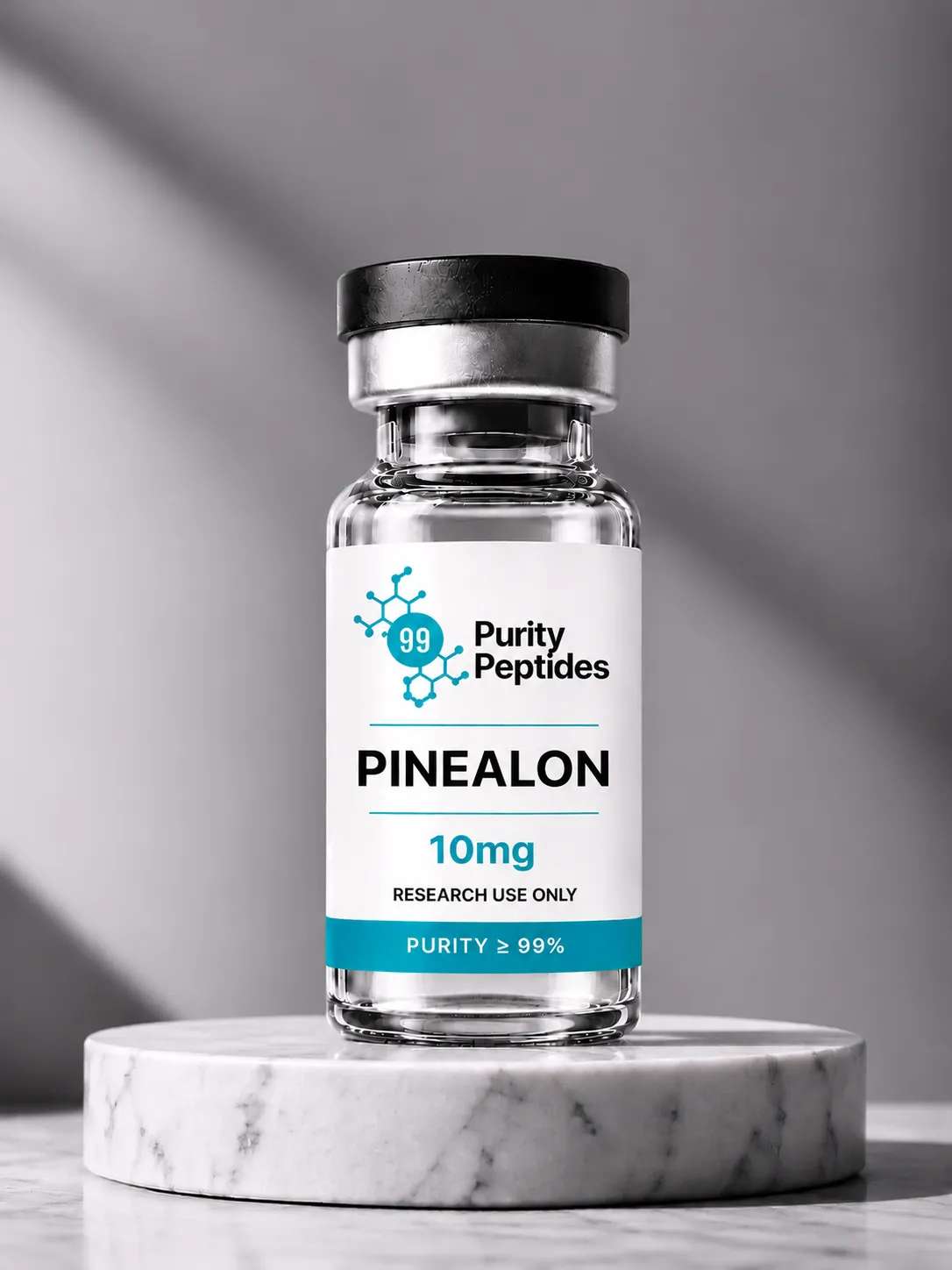
This product is supplied as a single 10mg vial, with multi-vial kits available. The peptide is lyophilized to protect it during storage and transport. Researchers generally keep it dry, cool, and protected from light, and follow their own institution's procedures for handling after reconstitution.
Pinealon is sold for Research Use Only. Nothing on this page describes a use in people, and the peptide is not intended for human or veterinary administration. Purchasers are responsible for making sure their intended use complies with local regulations and institutional policies.