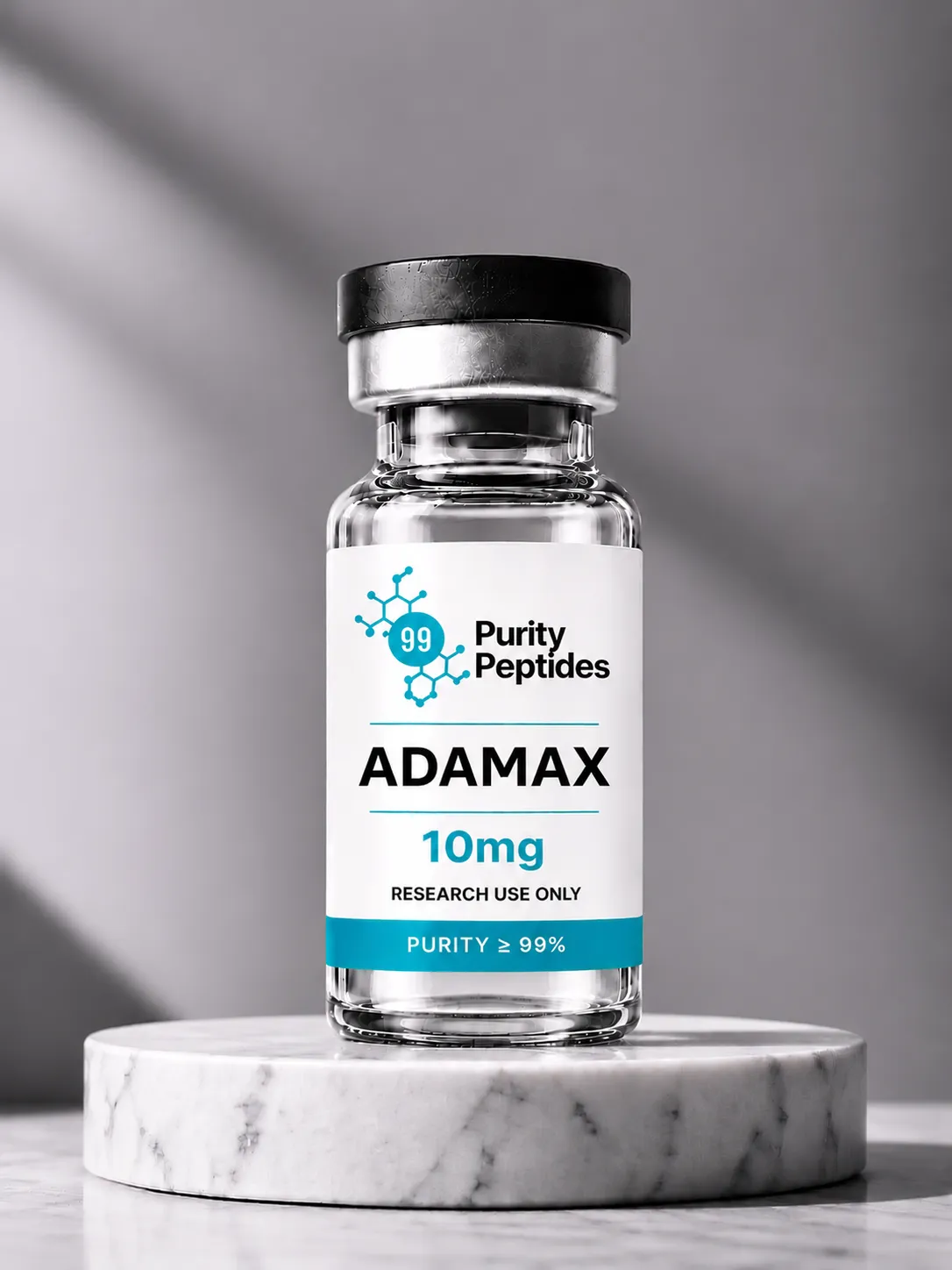
Adamax is a synthetic peptide analog built from Semax. Semax itself is a heptapeptide with the sequence Met-Glu-His-Phe-Pro-Gly-Pro, which combines the ACTH(4-7) fragment of adrenocorticotropic hormone with a Pro-Gly-Pro tripeptide at the C-terminus to slow enzymatic breakdown. It was developed in Russia in the 1980s and has been studied in laboratory models for its effects on neurotrophin expression, including brain-derived neurotrophic factor (BDNF), and for its relationship to melanocortin signaling. Adamax takes that framework and adds terminal modifications intended to change how the molecule behaves.
Public chemical references describe Adamax as Semax with the N-terminal and C-terminal modifications found in another research peptide, Peptide 021, including a rigid adamantane-type cage group. A commonly cited formula is C50H69N11O11S, corresponding to a molecular weight of roughly 1032 g/mol. Because the structure is documented mainly through secondary sources, researchers who need a specific structural detail should confirm it against the lot documentation and their own analysis.
Adamantane is the reason the compound draws attention. It is a compact, diamond-like hydrocarbon cage with high lipophilicity, and it has a long history in medicinal chemistry. Adding it to a molecule tends to raise lipophilicity and can shield nearby bonds from enzymes, which is why it appears in several established drugs. In a peptide, the same logic applies in principle: a bulky hydrophobic group at an end of the chain can change solubility, membrane interactions, chromatographic retention, and the rate at which proteases cleave the peptide.
It is important to be direct about the evidence. Peer-reviewed literature on Adamax itself is limited, and much of the commentary found online is promotional rather than scientific. The mechanistic context that does exist comes from research on Semax and from general work on adamantane-modified peptides. This page does not repeat claims about performance, because they have not been established in independent studies, and it describes the compound's structure and the experiments for which it is suited.
A practical point for anyone planning work with it is handling. A hydrophobic terminus can lower solubility in plain water compared with Semax, and modified peptides sometimes stick to plastic or aggregate at higher concentrations. Researchers therefore choose solvents and containers carefully, check recovery after dilution, and confirm concentration analytically instead of relying on the weighed amount alone.
Those experiments are mostly about the chemistry of modification. Groups compare Semax and Adamax in protease degradation assays and in serum or plasma stability studies. They measure lipophilicity through chromatographic retention or partition experiments, and they use cell monolayer or artificial membrane models to look at how terminal modifications affect permeability. Receptor-binding and signaling comparisons are also possible, although the results should be read as data about the molecule in a particular assay.
As a reference compound, Adamax is also useful for analytical development. A modified peptide with a hydrophobic terminus behaves differently from the parent on reversed-phase columns, which makes it a good test case for method development, impurity profiling, and LC-MS characterization of modified peptides.
Adamax is often studied beside Semax and Selank, both of which are available on this site, to compare structural variants within the broader family of Russian-developed regulatory peptides.
This product is supplied as a single 10mg vial, with multi-vial kits available. The peptide is lyophilized to protect it during storage and transport. Researchers generally keep it dry, cool, and protected from light, and follow their own institution's procedures for handling after reconstitution.
Adamax is sold for Research Use Only and is not intended for human or veterinary use. Some regulators have begun to scrutinize newer synthetic peptide analogs, so purchasers are responsible for confirming that they may lawfully obtain and hold this material where they work.