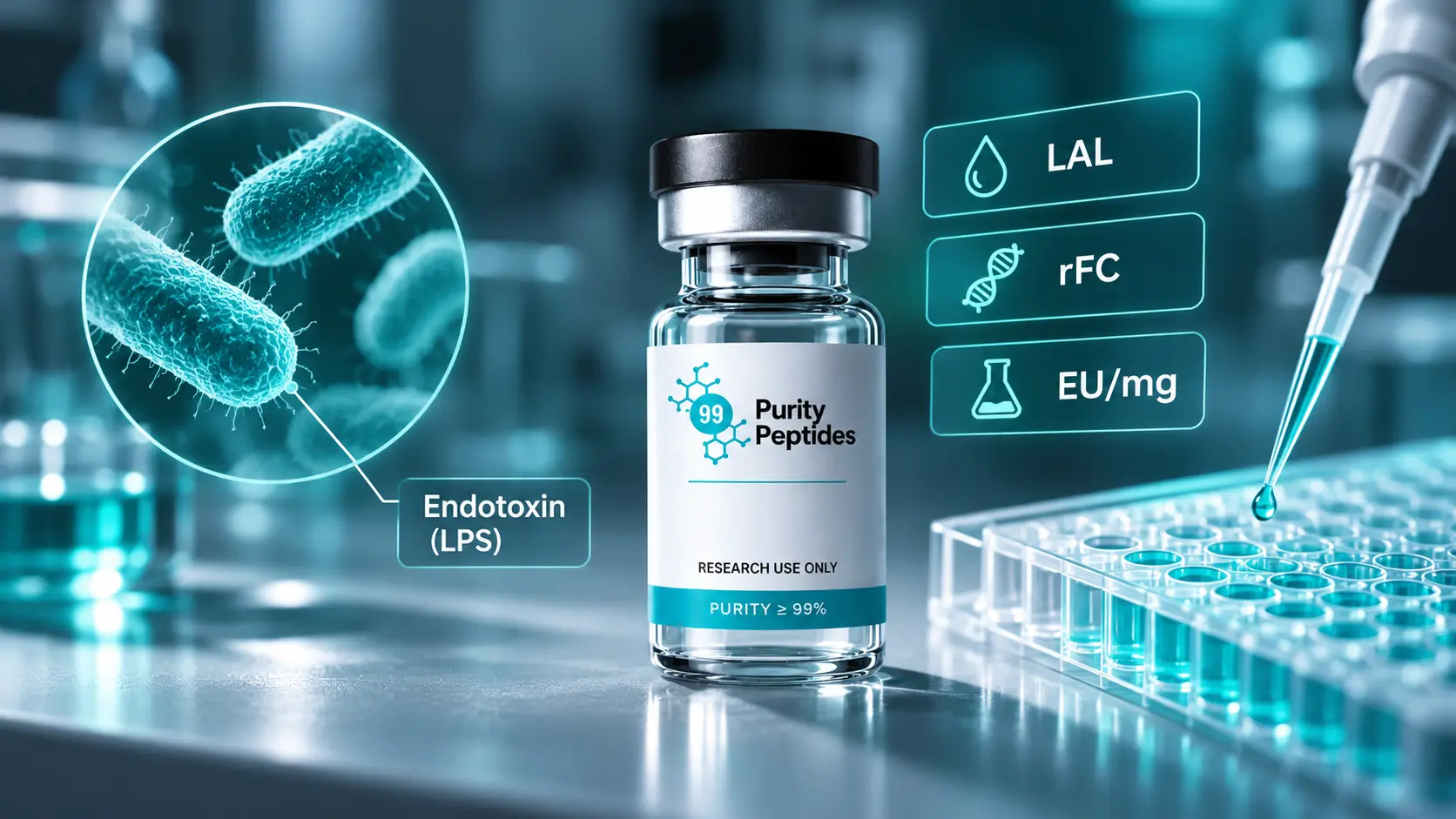
Endotoxin is one of the quality claims peptide suppliers make most often and explain least. A result such as "less than 0.5 EU/mg" can be meaningful or nearly useless, depending on the units, the method and the concentration at which it was tested. This guide explains what endotoxin is, how it is measured, what the units mean, and why it matters for in vitro research even when a peptide is highly pure.
Research use only. All products referenced on this page are intended solely for in vitro laboratory research. They are not for human or veterinary use.
Key Takeaways
- Endotoxin is lipopolysaccharide from the outer membrane of Gram-negative bacteria. HPLC purity testing does not detect it.
- The established tests are based on Limulus amebocyte lysate (LAL). Recombinant Factor C and recombinant cascade reagents became official US Pharmacopeia alternatives in May 2025 [1,2].
- Long-term proficiency data found recombinant Factor C assays comparable to LAL, with good endotoxin recovery [3].
- Results are reported in endotoxin units (EU), but per mL, per mg and per vial are different denominators and cannot be compared directly.
- For in vitro work, the question is how much endotoxin ends up in your well at your working concentration, not whether a number sounds low.
- A COA endotoxin line is only useful if it states the method, the units and the detection limit.
What Is Endotoxin?
Endotoxin is lipopolysaccharide (LPS), a structural component of the outer membrane of Gram-negative bacteria. It is released when bacteria divide or die, and it survives conditions that kill the bacteria themselves. That is why a sterile product can still contain endotoxin.
For research peptides, endotoxin can enter from water, reagents, equipment or handling during synthesis, purification and filling. Lyophilization concentrates whatever is present along with the peptide.
Why Purity Testing Does Not Catch It
HPLC purity measures peptide-related material that absorbs ultraviolet light and separates on the column. Endotoxin is present at trace mass and does not appear as a peak in a standard purity method. A peptide can therefore be 99% pure by HPLC and still carry enough endotoxin to affect a cell assay. Purity and endotoxin are separate questions, which is why our guide to how peptide labs ensure purity treats them as separate release tests.
Why Endotoxin Matters in In Vitro Research
Many cell types respond strongly to LPS, particularly immune cells such as monocytes and macrophages. In those systems, endotoxin can trigger cytokine release or inflammatory signaling on its own. If the endotoxin arrives with a peptide, the response can be wrongly credited to the peptide.
Detection assays are sensitive enough to find this. A comparison of recombinant Factor C and LAL assays found that the recombinant assay detected most LPS structures in picogram quantities. Of the assays compared, only the recombinant Factor C result correlated significantly with IL-6 release from a human monocytic cell line [4]. That correlation illustrates the practical concern: very small amounts of LPS are biologically active in cell systems.
Studies most sensitive to endotoxin include:
- Inflammation and cytokine assays, where LPS is itself a classic stimulus.
- Immune cell cultures, including macrophage, monocyte and dendritic cell work.
- Studies of anti-inflammatory or immunomodulatory peptides, where an endotoxin signal can mask or mimic the effect being studied.
- Barrier, wound and tissue-repair models that include inflammatory readouts.
For research on peptides such as KPV or LL-37, whose research interest centers on inflammatory and immune pathways, endotoxin control is part of basic experimental design.
How Endotoxin Is Measured
LAL Methods
The traditional bacterial endotoxins test uses lysate from horseshoe crab blood cells. Endotoxin activates Factor C, which starts an enzyme cascade. Laboratories read the result in one of three ways.
- Gel-clot: a pass or fail test showing whether endotoxin is above a set threshold.
- Turbidimetric: measures the cloudiness that develops as the reaction proceeds.
- Chromogenic: measures a color released from a synthetic substrate, which allows precise quantitation.
LAL remains the most widely used approach and is described in US Pharmacopeia chapter 85. One known limitation is that LAL can also respond to some non-endotoxin substances through an alternative pathway, known as Factor G [3].
Recombinant Factor C and Recombinant Cascade Reagents
Recombinant reagents reproduce the detection step without animal-derived lysate. Recombinant Factor C (rFC) uses only the first enzyme of the cascade and reads by fluorescence. Recombinant cascade reagent (rCR) rebuilds the cascade and reads chromogenically [5].
US Pharmacopeia chapter 86, Bacterial Endotoxins Test Using Recombinant Reagents, was published for early adoption in November 2024 and became official on May 1, 2025 [1,2]. It is an additional pathway, not a replacement, so laboratories using LAL can continue to do so [2]. Users remain responsible for verifying the method for their own material [6].
How the Methods Compare
The evidence on comparability is now substantial. A six-year proficiency program comparing one kinetic chromogenic LAL assay with two rFC assays found both recombinant assays comparable to LAL. All results met compendial acceptance criteria, and the rFC assays showed even better endotoxin recovery [3]. A separate comparison in pharmaceutical water found an rFC assay less prone to interference than the incumbent LAL method in some samples [7].
Feature | LAL (USP 85) | Recombinant reagents (USP 86) |
|---|---|---|
Source | Horseshoe crab amebocyte lysate | Recombinant Factor C or recombinant cascade |
Readout | Gel-clot, turbidimetric or chromogenic | Fluorescent (rFC) or chromogenic (rCR) |
Response to non-endotoxin glucans | Possible via Factor G pathway | Factor G pathway absent |
Compendial status in the US | Long-established | Official since May 2025 |
Validation | Established methods | Product-specific verification required |
Understanding Endotoxin Units
Results are reported in endotoxin units (EU), which express activity relative to a reference standard endotoxin. The number only makes sense alongside its denominator.
- EU/mL: endotoxin per millilitre of a solution. It depends on how much the peptide was diluted for testing.
- EU/mg: endotoxin per milligram of material. It is the most useful figure for comparing lots, because it does not depend on reconstitution volume.
- EU/vial: total endotoxin in a vial. It is common for lyophilized samples tested whole.
A lab testing service for vials, for example, reports lyophilized samples in EU per vial and liquid solutions in EU per mL [8]. Converting between them requires knowing the peptide amount and the dilution used. A result of 0.05 EU/mL measured on a solution diluted to 0.1 mg/mL is equivalent to 0.5 EU/mg, which is ten times the figure printed.
Why "Less Than" Results Matter
Endotoxin assays have a detection range. A well-reported result below that range is written as "less than" the limit, for example less than 0.05 EU/mL, not as zero. A COA that reports exactly zero, or that gives no detection limit, is harder to interpret. One example COA from an independent lab lists the assay type, cartridge lot, detection range, spike recovery and a less-than result, which is the level of detail worth looking for [9].
Calculating Endotoxin in Your Own Experiment
For in vitro work, what matters is the endotoxin concentration that actually reaches your cells. You can estimate it from an EU/mg result.
Peptide endotoxin level | Working peptide concentration | Endotoxin in the well |
|---|---|---|
0.1 EU/mg | 10 µg/mL | 0.001 EU/mL |
1 EU/mg | 10 µg/mL | 0.01 EU/mL |
1 EU/mg | 100 µg/mL | 0.1 EU/mL |
10 EU/mg | 100 µg/mL | 1 EU/mL |
The calculation is the EU/mg value multiplied by the working concentration in mg/mL. The same peptide lot can be harmless at a low working concentration and a real confounder at a high one. Sensitivity to endotoxin differs widely between cell types, so the acceptable level is a decision for each assay rather than a universal number. Including an LPS-only control at a matching endotoxin level is one practical way to check whether a response is endotoxin-driven.
How to Read the Endotoxin Line on a COA
Our guide to reading a certificate of analysis covers the full document. For endotoxin, check these points.
- Method: LAL gel-clot, kinetic turbidimetric, kinetic chromogenic, rFC or rCR.
- Units: EU/mg, EU/mL or EU/vial, plus the dilution or sample concentration when EU/mL is used.
- Detection limit: a less-than result should state the limit it is below.
- Spike recovery or test suitability: confirms the peptide did not inhibit or enhance the assay.
- Lot match: the lot number should match your vial.
- Testing laboratory: whether the test was performed in house or by an independent lab.
A missing endotoxin line is not proof of contamination, but it means you have no information either way. You can review 99 Purity Peptides lot documentation on our certificates page.
Handling Practices That Limit Endotoxin
Endotoxin is heat-stable and sticks to surfaces, so handling can add it after a vial is opened. Use sterile, endotoxin-free consumables and water for reconstitution, work aseptically, and avoid reusing pipette tips or containers. Storage does not remove endotoxin, but good storage prevents bacterial growth in reconstituted solutions. Our peptide storage guidelines and bacteriostatic water reconstitution guide cover those basics.
The Bottom Line
Endotoxin is invisible to purity testing and active at trace levels in many cell systems. LAL and recombinant methods both measure it reliably, and recombinant reagents now have full US Pharmacopeia standing. The figure that matters is endotoxin per milligram, converted into the concentration that reaches your cells. Read the method, units and detection limit before trusting any endotoxin claim, and treat a missing result as an open question.
References
- European Pharmaceutical Review. Final Chapter <86> text published for early adoption. https://www.europeanpharmaceuticalreview.com/?p=235443
- Kulkarni M. Recombinant Endotoxin Testing Compendial Since 2025, LAL Stays. Pharma Now. August 29, 2026. https://www.pharmanow.live/microbiology-ccs/recombinant-endotoxin-testing-compendial-lal
- Piehler M, Roeder R, Blessing S, Reich J. Comparison of LAL and rFC Assays: Participation in a Proficiency Test Program between 2014 and 2019. Microorganisms. 2020;8(3):418. PMID: 32188126. DOI: 10.3390/microorganisms8030418.
- Abate W, Sattar AA, Liu J, Conway ME, Jackson SK. Evaluation of recombinant factor C assay for the detection of divergent lipopolysaccharide structural species and comparison with Limulus amebocyte lysate-based assays and a human monocyte activity assay. J Med Microbiol. 2017;66(7):888-897. PMID: 28693666. DOI: 10.1099/jmm.0.000510.
- Pharma Now. Recombinant Endotoxin Testing: What the Evidence Actually Shows. August 12, 2026. https://www.pharmanow.live/knowledge-hub/research/recombinant-endotoxin-testing-rfc-vs-rcr
- American Pharmaceutical Review. USP 86: Bacterial Endotoxins Testing Using Recombinant Reagents. https://www.americanpharmaceuticalreview.com/Videos/617002-USP-86-Bacterial-Endotoxins-Testing-Using-Recombinant-Reagents/
- Marius M, Vacher F, Bonnevay T. Comparison of bacterial endotoxin testing methods in purified pharmaceutical water matrices. Biologicals. 2020;67:49-55. PMID: 32753293. DOI: 10.1016/j.biologicals.2020.07.001.
- LabRulez. Endotoxin analysis (LAL) for liquid solutions and lyophilised samples. https://lcms.labrulez.com/products/2522
- BioRegen. Limulus Amebocyte Lysate (LAL) Report of Analysis, example report NC-ENDO-03302026-353. https://iebpxtbrcsbgadwyrqqi.supabase.co/storage/v1/object/public/product-coas/tirzepatide-10mg/Endotoxin_2353_NC_Tirzepatide_10mg.pdf
Frequently Asked Questions
What is endotoxin in a peptide?
Endotoxin is lipopolysaccharide from the outer membrane of Gram-negative bacteria. It can enter a peptide during synthesis, purification or filling and survives conditions that kill bacteria. It is a separate quality attribute from purity and is measured with its own assay.
Does high HPLC purity mean a peptide is endotoxin-free?
No. HPLC purity measures peptide-related material and does not detect endotoxin, which is present at trace mass. A peptide can be 99 percent pure and still carry enough endotoxin to affect a sensitive cell assay, so endotoxin must be tested separately.
What is the difference between LAL and recombinant Factor C testing?
LAL uses lysate from horseshoe crab blood cells and can also respond to some glucans through the Factor G pathway. Recombinant Factor C uses a lab-made version of the first enzyme in the cascade and reads by fluorescence. A six-year proficiency study found recombinant assays comparable to LAL, and US Pharmacopeia chapter 86 made recombinant reagents an official alternative in May 2025.
What does EU/mg mean?
EU/mg means endotoxin units per milligram of material. It is the most useful figure for comparing lots because it does not depend on how much liquid was used for testing. EU/mL and EU/vial results need the sample concentration or vial content to be converted into EU/mg.
What endotoxin level is acceptable for in vitro research?
There is no single universal limit for in vitro work, because cell types differ widely in sensitivity. Multiply the EU/mg result by your working concentration to estimate the endotoxin reaching your cells, then judge it against your assay. Including an LPS-only control at a matching level helps show whether a response is endotoxin-driven.
Why do COAs report endotoxin as less than a number?
Every assay has a detection range. When endotoxin falls below the lowest point of that range, a properly reported result states that it is less than the limit rather than zero. The limit itself tells you how sensitive the test was.
Can endotoxin be added after a vial is opened?
Yes. Endotoxin can come from non-sterile water, consumables or handling. Using endotoxin-free water and consumables and working aseptically keeps a clean lot clean after reconstitution.