Last reviewed: September 2026

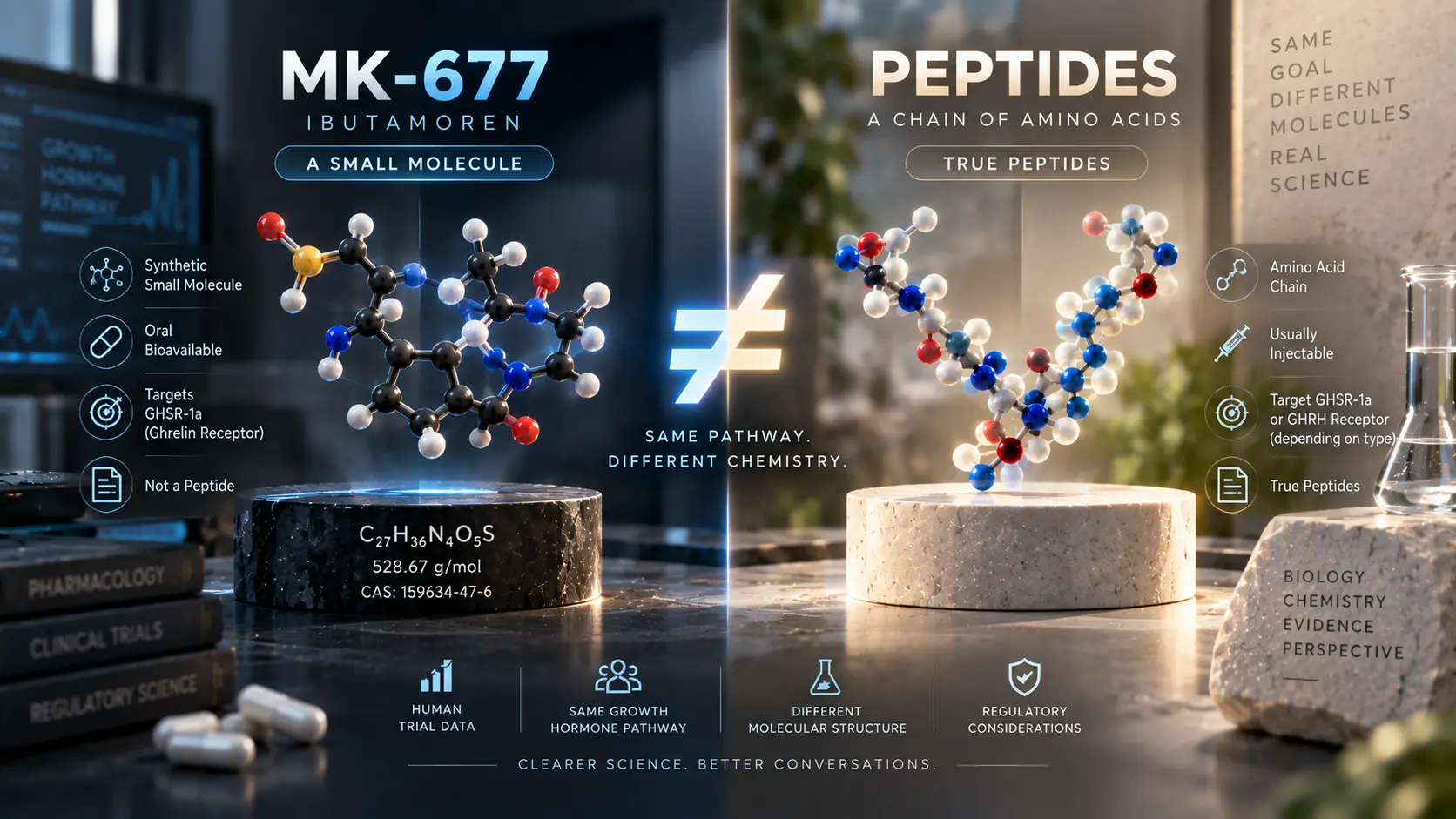
Quick Answer: No. MK-677 (ibutamoren) is not a peptide. It is a synthetic spiropiperidine small molecule that acts as a non-peptide agonist of the ghrelin receptor (GHSR-1a). It gets grouped with peptide secretagogues because it triggers the same growth hormone pathway, not because it shares their chemistry. Human trials dosed it orally, raised growth hormone and IGF-1, and also recorded higher fasting glucose.
Key Takeaways
- MK-677 (ibutamoren) is a synthetic small molecule, not a peptide. Its core is a spiro[2H-indole-3,4'-piperidine] ring system.
- Its formula is C27H36N4O5S, its molar mass is 528.67 g/mol, and its CAS number is 159634-47-6 [7].
- It acts on the ghrelin receptor (GHSR-1a), the same receptor targeted by the peptide secretagogues ipamorelin, GHRP-2, GHRP-6, and hexarelin [8][1].
- The peptides CJC-1295, sermorelin, and tesamorelin act through a different receptor, the GHRH receptor.
- Three randomized human trials (1996, 2008, 2008) form the core evidence. They showed higher GH and IGF-1, plus higher fasting glucose [2][3][4].
- MK-677 has no FDA approval for any indication. Its status is Investigational New Drug [7].
- WADA names ibutamoren (MK-677) in section S2.2.4 of the 2026 Prohibited List. It is banned at all times [5].
Research Use Only. This article is an educational reference for laboratory researchers. Nothing here is medical advice, and nothing here is guidance on using MK-677. MK-677 is not approved for human or veterinary use. 99 Purity Peptides does not sell MK-677.
Is MK-677 a Peptide?
MK-677 (ibutamoren) is not a peptide. This is the single most important fact in this article, and every other section builds on it.
A peptide is a chain of amino acids joined by peptide bonds. MK-677 contains no amino acid chain. Its structure is built around a spiro[2H-indole-3,4'-piperidine] ring system, which places it in the spiropiperidine class of synthetic small molecules [7][8]. The published IUPAC name spells out that ring core directly. Its molecular formula is C27H36N4O5S, its molar mass is 528.67 grams per mole, and its CAS number is 159634-47-6 [7].
Chemical suppliers describe it the same way. Cayman Chemical lists ibutamoren as an "orally-active, non-peptidic agonist of GHSR," the growth hormone secretagogue receptor [8]. PubMed's indexing tags it under "Spiro Compounds," a chemistry category, not a peptide category [4]. The compound is also filed in the literature under the names MK-0677, L-163,191, and LUM-201, with ibutamoren as its International Nonproprietary Name [7].
The correct scientific label is "growth hormone secretagogue" or "ghrelin receptor agonist." Both describe what the molecule does, not what it is made of. Calling MK-677 a peptide is a category error, similar to calling a key a lock because both are involved in opening a door.
Why Is MK-677 Grouped With Peptide Secretagogues?
It is grouped with them because it acts on the same receptor, not because it shares their chemistry. This distinction explains nearly all of the confusion.
The growth hormone axis has two main receptor systems that researchers target. The first is the ghrelin receptor, also called GHSR-1a. MK-677 activates this receptor. So do the genuine peptides ipamorelin, GHRP-2, GHRP-6, and hexarelin. The second is the GHRH receptor. The peptides CJC-1295, sermorelin, and tesamorelin act there instead.
The original pharmacology paper made this split explicit. Patchett and colleagues reported in 1995 that MK-677 (then called L-163,191) was "mechanistically indistinguishable" from the peptide GHRP-6, while its action differed from GHRH [1]. Shared pharmacology, different chemistry. That finding has held up for thirty years.
Regulators sort by effect for the same reason. WADA's section S2.2.4 covers "growth hormone releasing factors" and prints GHRH analogues, secretagogue mimetics including ibutamoren (MK-677), and GH-releasing peptides side by side [5]. The list cares about what a substance does in the body. Chemistry is secondary.
Vendors follow the same logic, with less care. A shopper searching for growth hormone secretagogues sees one category. The store menu reflects buying habits, not molecular structure. The table below keeps the two ideas separate.
Compound | Chemical class | A peptide? | GH-axis receptor target | Named in WADA S2.2.4? |
|---|---|---|---|---|
MK-677 (ibutamoren) | Spiropiperidine small molecule | No | GHSR-1a (ghrelin receptor) | Yes, as ibutamoren |
Ipamorelin | Synthetic peptide | Yes | GHSR-1a (ghrelin receptor) | Yes, named |
GHRP-2 | Synthetic peptide | Yes | GHSR-1a (ghrelin receptor) | Yes, as pralmorelin |
GHRP-6 | Synthetic peptide | Yes | GHSR-1a (ghrelin receptor) | Yes, named |
Hexarelin | Synthetic peptide | Yes | GHSR-1a (ghrelin receptor) | Yes, as examorelin |
CJC-1295 | Synthetic peptide | Yes | GHRH receptor | Yes, named |
Sermorelin | Synthetic peptide | Yes | GHRH receptor | Yes, named |
Tesamorelin | Synthetic peptide | Yes | GHRH receptor | Yes, named |
The pattern is clear. Receptor target determines the grouping. Chemistry determines whether the word "peptide" applies. Only the rows marked "Yes" in the third column earn that word.
Why Can MK-677 Be Taken Orally When Most Peptides Cannot?
It survives the gut because it is not a peptide, and digestive enzymes are designed to cut peptides apart. That is the whole explanation.
Most peptide drugs have poor oral bioavailability for two reasons. Enzymes in the stomach and intestine break peptide bonds before the drug can be absorbed. The surviving fragments then struggle to cross the intestinal wall. Reviews of oral peptide delivery name pre-systemic enzymatic degradation and poor mucosal penetration as the main barriers [10][9].
The enzymes involved are not subtle. Pepsin starts the work in the stomach. Trypsin, chymotrypsin, and brush-border peptidases continue it in the small intestine. Together they digest the vast majority of ingested protein into fragments and amino acids. A peptide drug faces the same machinery [9].
MK-677 sidesteps this machinery by having no peptide chain to cut. Its rigid spiro ring scaffold presents no peptide bonds to those enzymes. Chemical stability, not formulation trickery, is the reason it reaches the bloodstream after oral dosing.
The human trials confirm the point in practice. Chapman and colleagues gave it by mouth once daily to 32 older adults and measured higher 24-hour growth hormone [2]. Nass and colleagues dosed it orally for two full years and recorded sustained IGF-1 elevation [3]. The Alzheimer's trial used daily oral dosing for twelve months with the same hormonal response [4]. Three trials, one route, consistent systemic effects.
One caveat is needed. "Most" does not mean "all." A small number of peptide drugs have reached oral formulations through special absorption technology. They are the exception that proves the difficulty, not evidence that the barrier is trivial [9]. MK-677 never needed such technology. It was designed from the start as an orally active nonpeptide secretagogue [1].
What Does the Human Trial Record Actually Show?
Three randomized human trials form the core of the record, and their results are mixed. Each one is summarized below with its design stated plainly. Dose figures appear here only to describe what the studies did.
The first trial came in 1996. Chapman and colleagues randomized 32 healthy adults aged 64 to 81 to placebo or MK-677 at three dose levels, given orally once daily across two periods of 14 and 28 days [2]. Mean 24-hour growth hormone rose in a dose-dependent way, reaching a 97 percent increase at the highest dose. IGF-1 entered the normal range for young adults within two to four weeks. Fasting glucose also rose, from 5.4 to 6.8 millimoles per liter at four weeks. Cortisol did not change.
The second trial is the longest ever run. Nass and colleagues randomized 65 healthy adults aged 60 to 81 to once-daily oral MK-677 or placebo for two years, in a double-blind modified-crossover design [3]. Fat-free mass changed by plus 1.1 kilograms with MK-677 versus minus 0.5 kilograms with placebo. Strength and physical function did not improve. Fasting glucose rose by an average of 0.3 millimoles per liter, and insulin sensitivity decreased. The authors noted the trial lacked statistical power for functional endpoints.
The third trial tested a disease hypothesis and failed. Sevigny and colleagues randomized 563 patients with mild-to-moderate Alzheimer disease to MK-677 or placebo daily for twelve months across multiple centers [4]. Of those, 416 completed treatment and assessments. IGF-1 rose 60.1 percent at six weeks and 72.9 percent at twelve months, proving the drug engaged its target. Clinical scores did not differ between groups on any of the four standard measures. The authors concluded it was ineffective at slowing Alzheimer progression.
Trial | Population | Duration | Design | Key outcomes |
|---|---|---|---|---|
Chapman 1996 [2] | 32 healthy adults, 64-81 | 14 and 28 days | Randomized, double-blind, placebo-controlled | 24-h GH up 97% at top dose; IGF-1 into young-adult range; fasting glucose 5.4 to 6.8 mmol/L |
Nass 2008 [3] | 65 healthy adults, 60-81 | 2 years | Randomized, double-blind, placebo-controlled, modified crossover | Fat-free mass +1.1 vs -0.5 kg; no strength or function gain; fasting glucose +0.3 mmol/L; insulin sensitivity down |
Sevigny 2008 [4] | 563 mild-to-moderate Alzheimer patients | 12 months | Randomized, double-blind, multicenter | IGF-1 up 60-73%; no difference on CIBIC-plus, ADAS-Cog, ADCS-ADL, or CDR-sob |
How we graded the evidence. Strong means support from randomized, placebo-controlled human trials. Weak means indirect or underpowered data. Negative means a randomized trial tested the claim and found nothing. Missing means no human trial addressed it. The table below applies those grades.
Claim about MK-677 | Evidence type | Grade | Basis |
|---|---|---|---|
Raises GH and IGF-1 in older adults | Randomized human trials | Strong | Chapman 1996 and Nass 2008 both showed it [2][3] |
Improves strength or physical function | Randomized human trial | Negative to weak | Nass 2008 found no gain and was underpowered for function [3] |
Slows Alzheimer disease progression | Randomized human trial | Negative | Sevigny 2008 found no clinical difference [4] |
Has no effect on blood sugar | Randomized human trials | Contradicted | Chapman and Nass both recorded higher fasting glucose [2][3] |
Is safe for long-term use | No dedicated long-term safety trial | Missing | Longest trial lasted two years in 65 people [3] |
Two patterns stand out. The hormonal effects are consistent across all three trials. The functional and clinical effects are absent or unproven. A compound can move a biomarker without changing an outcome, and this record is a clean example.
Is MK-677 FDA-Approved?
No. MK-677 has no FDA approval for any indication. Its regulatory status is Investigational New Drug, which means it remains an experimental compound [7].
No new drug application for MK-677 has ever been approved. No brand-name product has reached pharmacies. The compound was studied by its developers through the 1990s and 2000s, including the Alzheimer trial run by Merck Research Laboratories, but development never produced a marketed medicine [4][7].
This status matters for two reasons. First, "not FDA-approved" is not the same as "illegal to possess." Approval governs marketing as a medicine. Research chemicals occupy a separate regulatory space, which our guide to peptide legality covers in detail. Second, the lack of approval means no approved labeling exists. There is no official statement of indication, no official safety profile, and no quality standard enforced by a regulator.
Some growth hormone pathway drugs did reach approval, which makes MK-677's position stand out. Our FDA-approved peptides guide lists the compounds that cleared that bar. MK-677 is not among them. For laboratory work, the honest description is "unapproved investigational compound," and that description should travel with the compound wherever it is discussed.
Is MK-677 Banned in Sport?
Yes. WADA names ibutamoren (MK-677) in section S2.2.4 of the 2026 Prohibited List, under "growth hormone secretagogues (GHS) and their mimetics" [5]. The section is prohibited at all times, in and out of competition. Every substance in S2 is a non-Specified Substance [5].
Note the irony. The anti-doping list files this non-peptide in the same section as the peptide secretagogues it mimics. WADA sorts by effect. A compound that stimulates growth hormone release lands in S2.2.4 whether it is a peptide, a mimetic, or anything else [5]. Our compound-by-compound WADA guide walks through all 27 entries on the 2026 list.
Enforcement is real, not theoretical. In 2019, USADA sanctioned a U.S. taekwondo athlete after an out-of-competition sample collected that February tested positive for ibutamoren. The source was a contaminated supplement, which did not excuse the violation [6]. In 2025, a weightlifter accepted a three-year sanction after testing positive for both ipamorelin and ibutamoren. Anti-doping laboratories run targeted tests for these compounds.
Could an athlete get a therapeutic use exemption? In practice, no. A TUE requires a medically justified need for a prohibited substance with no permitted alternative. MK-677 has no approved medical use anywhere, so that pathway has no realistic application here. For S2 substances generally, the only TUE route runs through an approved medicine meeting every criterion. MK-677 cannot start that process.
What Do Vendor Pages Get Wrong About MK-677?
Vendor pages repeat three claims that the evidence does not support. Each one is examined below against the human data.
Vendor claim | What the evidence says | Verdict |
|---|---|---|
A natural way to boost growth hormone | MK-677 is a synthetic small molecule built in a laboratory. Nothing about its origin is natural. | Misleading |
Safer than injectable peptides because it is oral | Route of administration and safety are separate questions. No head-to-head safety trials exist, and human trials recorded glucose effects. | Misleading |
No effect on blood sugar | Chapman 1996 and Nass 2008 both recorded higher fasting glucose; Nass also found lower insulin sensitivity. | Contradicted by human data |
The "natural" claim is pure marketing language. A spiropiperidine synthesized through medicinal chemistry is not natural by any definition a chemist would accept. The word is doing sales work, not descriptive work. Growth hormone biology is natural. The molecule triggering it is not.
The "safer because oral" claim confuses convenience with safety. Swallowing a compound is easier than injecting one. Ease is not a toxicity profile. No trial has compared the safety of MK-677 against any injectable peptide secretagogue. Meanwhile, the trials that do exist recorded metabolic changes: higher fasting glucose in both Chapman and Nass, plus reduced insulin sensitivity in Nass [2][3]. An honest safety discussion starts from those findings, not from the route of administration.
The blood sugar claim is the most directly falsifiable. Chapman measured fasting glucose rising from 5.4 to 6.8 millimoles per liter over four weeks [2]. Nass measured a 0.3 millimole per liter average rise with decreased insulin sensitivity over two years [3]. These are randomized, placebo-controlled results. A vendor page claiming "no effect on blood sugar" is not interpreting data differently. It is contradicting it.
A broader habit sits behind all three claims. Vendor pages treat classification as marketing. MK-677 lands in the "peptides" category because that is where the customers are. It gets described as natural because that is what customers want to hear. The chemistry and the trial record tell a drier story, and the drier story is the accurate one.
What Has the Research Not Established About MK-677?
The research has not established that MK-677 improves strength, physical function, or long-term safety. Stating the gaps matters as much as stating the findings.
Strength and function were tested once, in the two-year Nass trial, and the result was no improvement [3]. The trial was also underpowered for those endpoints, which means the question is unresolved rather than closed. One underpowered negative is not proof of no effect. It is certainly not proof of an effect.
Long-term safety is the largest gap. Sixty-five people followed for two years is a thin foundation for a compound discussed as widely as this one [3]. Rare harms, harms that take years to appear, and interactions with other substances would not reliably show up in a trial of that size. The record contains no dedicated long-term safety study.
Disease effects beyond Alzheimer disease are untested in randomized trials. The Alzheimer trial is instructive precisely because it failed despite strong target engagement [4]. Raising IGF-1 by over 70 percent did not slow clinical decline. Biomarker movement is not clinical benefit, and this trial is the clearest demonstration of that gap in the MK-677 literature.
Animal and cell studies exist, and some show interesting signals. They do not transfer directly to humans. The history of drug development is full of compounds that worked in animals and failed in people. Until randomized human data exist for a given outcome, the correct statement is "not established," stated plainly and without hedging toward either side.
Where Can Researchers Compare Genuine Peptide Secretagogues?
Researchers comparing growth hormone secretagogues should start with genuine peptides whose chemistry matches their labels. The receptor biology in this article only becomes testable in the lab with well-characterized materials.
Ipamorelin is a synthetic peptide and a selective GHSR-1a agonist, the same receptor MK-677 activates through different chemistry. It is the closest true-peptide comparator for receptor-level questions.
GHRP-2 and GHRP-6 are the classic peptide secretagogues. Patchett's original work benchmarked MK-677 directly against GHRP-6 pharmacology [1]. Both peptides remain standard reference points for GHSR-1a signaling research.
The CJC-1295 and Ipamorelin blend covers the other receptor system. CJC-1295 targets the GHRH receptor while ipamorelin targets GHSR-1a, which makes the combination useful for studying the two pathways side by side.
Whatever a lab orders, the documentation standard should be the same. Every batch should carry a batch-specific certificate of analysis with HPLC purity data and mass spectrometry identity confirmation from an independent laboratory. Our guide to reading a certificate of analysis explains what each section proves, and our certificate library publishes the actual batch documents. In a field where sellers mislabel a small molecule as a peptide, paperwork is not a formality. It is the experiment's foundation.
References
- Patchett AA, Nargund RP, Tata JR, et al. Design and biological activities of L-163,191 (MK-0677): a potent, orally active growth hormone secretagogue. Proc Natl Acad Sci U S A. 1995;92(15):7001-7005. doi:10.1073/pnas.92.15.7001. PMCID: PMC41459. https://pmc.ncbi.nlm.nih.gov/articles/PMC41459/
- Chapman IM, Bach MA, Van Cauter E, et al. Stimulation of the growth hormone (GH)-insulin-like growth factor I axis by daily oral administration of a GH secretogogue (MK-677) in healthy elderly subjects. J Clin Endocrinol Metab. 1996;81(12):4249-4257. doi:10.1210/jcem.81.12.8954023. PMID: 8954023. https://pubmed.ncbi.nlm.nih.gov/8954023/
- Nass R, Pezzoli SS, Oliveri MC, et al. Effects of an oral ghrelin mimetic on body composition and clinical outcomes in healthy older adults: a randomized trial. Ann Intern Med. 2008;149(9):601-611. doi:10.7326/0003-4819-149-9-200811040-00003. PMID: 18981485. PMCID: PMC2757071. https://pubmed.ncbi.nlm.nih.gov/18981485/
- Sevigny JJ, Ryan JM, van Dyck CH, et al.; MK-677 Protocol 30 Study Group. Growth hormone secretagogue MK-677: no clinical effect on AD progression in a randomized trial. Neurology. 2008;71(21):1702-1708. doi:10.1212/01.wnl.0000335163.88054.e7. PMID: 19015485. https://pubmed.ncbi.nlm.nih.gov/19015485/
- World Anti-Doping Agency. The Prohibited List 2026 (in force 1 January 2026). S2.2.4 names ibutamoren (MK-677) among growth hormone secretagogues and their mimetics; all S2 substances are non-Specified and prohibited at all times. https://www.wada-ama.org/en/prohibited-list
- U.S. Anti-Doping Agency. Jacqueline Galloway accepts sanction for anti-doping rule violation (ibutamoren positive from out-of-competition sample, 12 February 2019). https://www.usada.org/sanction/jacqueline-galloway-accepts-doping-sanction/
- Ibutamoren. Wikipedia. Chemical identifiers (formula C27H36N4O5S, molar mass 528.67 g/mol, CAS 159634-47-6, PubChem CID 9939050, IUPAC name), non-peptide ghrelin receptor agonist description, and Investigational New Drug legal status. https://en.wikipedia.org/wiki/Ibutamoren
- Cayman Chemical. Ibutamoren (mesylate) product description: "orally-active, non-peptidic agonist of GHSR" and GH secretagogue; formal name includes the spiro[indole-piperidine] core (via authorized distributor). https://www.biomol.com/products/chemicals/biochemicals/ibutamoren-mesylate-cay18003-5
- Challenges and Opportunities in Delivering Oral Peptides and Proteins. Expert Opin Drug Deliv. 2023. PMID: 37450427. PMCID: PMC10990675. https://pmc.ncbi.nlm.nih.gov/articles/PMC10990675/
- Oral delivery of peptide drugs: barriers and developments. BioDrugs. 2005;19(3):165-177. PMID: 15984901. https://pubmed.ncbi.nlm.nih.gov/15984901/
Frequently Asked Questions
Is MK-677 a peptide?
No. MK-677 is not a peptide. It is a synthetic spiropiperidine small molecule, also called ibutamoren, with the formula C27H36N4O5S. A peptide is a chain of amino acids joined by peptide bonds. MK-677 has no amino acid chain. It is classed as a growth hormone secretagogue and a non-peptide agonist of the ghrelin receptor (GHSR-1a). The peptide label is a classification error.
Is ibutamoren the same thing as MK-677?
Yes. Ibutamoren is the International Nonproprietary Name (INN) for MK-677. The compound is also listed in the literature as MK-0677 and L-163,191, and it appeared under the developmental name LUM-201. A tentative brand name, Oratrope, never reached the market. All of these names refer to the same synthetic small molecule, and none of them makes it a peptide.
What is the chemical structure of MK-677?
MK-677 is built around a spiro[2H-indole-3,4'-piperidine] ring system, which gives the spiropiperidine class its name. Its molecular formula is C27H36N4O5S and its molar mass is 528.67 grams per mole. Its CAS number is 159634-47-6 and its PubChem entry is CID 9939050. The rigid ring scaffold is the reason it survives digestion, unlike peptide chains.
Why can MK-677 be taken orally when most peptides cannot?
Digestive enzymes such as pepsin and trypsin cut peptide bonds, which is why most peptide drugs have poor oral bioavailability. MK-677 has no peptide chain to cut. Its ring-based small-molecule structure resists that enzymatic attack. Every major human trial administered it by mouth and measured systemic growth hormone and IGF-1 responses, which confirms oral activity in practice.
How does MK-677 raise growth hormone levels?
MK-677 is an agonist of the ghrelin receptor, also called GHSR-1a. Ghrelin is the stomach-derived hormone that signals hunger and stimulates growth hormone release. By binding this receptor, MK-677 mimics part of ghrelin's signaling and prompts the pituitary to release more growth hormone. IGF-1 then rises as a downstream response. This is pharmacology, not chemistry: it copies the signal without copying the molecule.
Is MK-677 FDA-approved?
No. MK-677 has no FDA approval for any indication. Its regulatory status is Investigational New Drug, which means it remains an experimental compound. No new drug application for it has been approved, and no brand-name product has reached pharmacies. This status is separate from debates about research chemicals. For laboratory work, treat it as an unapproved investigational compound and nothing more.
Is MK-677 banned in sport?
Yes. WADA prints ibutamoren (MK-677) by name in section S2.2.4 of the 2026 Prohibited List, under growth hormone secretagogues and their mimetics. The section is prohibited at all times, in and out of competition, and its substances are non-Specified. Athletes have been sanctioned after testing positive for it. With no approved medical use, there is no realistic therapeutic-use exemption pathway.
Is MK-677 a SARM?
No. MK-677 is not a selective androgen receptor modulator. SARMs, such as ostarine (MK-2866, enobosarm), act on the androgen receptor. MK-677 acts on the ghrelin receptor (GHSR-1a) instead. The similar "MK" numbering is a coincidence of pharmaceutical code names, not a sign of related chemistry. Neither compound is a peptide, and they belong to different drug classes entirely.
What is the longest human trial of MK-677?
The longest is a two-year randomized, double-blind, placebo-controlled trial in 65 healthy adults aged 60 to 81, published in the Annals of Internal Medicine in 2008. Fat-free mass changed by plus 1.1 kilograms with MK-677 versus minus 0.5 kilograms with placebo. Strength and physical function did not improve. Fasting glucose rose and insulin sensitivity fell. The authors noted the trial was underpowered for functional outcomes.
Does MK-677 affect blood sugar?
Yes, according to human trial data. In a 1996 trial of 32 older adults, fasting glucose rose from 5.4 to 6.8 millimoles per liter over four weeks. In the two-year 2008 trial, fasting glucose rose by an average of 0.3 millimoles per liter and insulin sensitivity decreased. Any vendor page claiming it has no effect on blood sugar is contradicted by these randomized, placebo-controlled results.
Is MK-677 a steroid?
No. MK-677 is not a steroid. Steroids share a characteristic four-ring carbon skeleton and act through steroid hormone receptors. MK-677 has a spiropiperidine scaffold and acts on the ghrelin receptor. It is also not a selective androgen receptor modulator. Calling it a steroid misstates both its structure and its mechanism, and the error usually comes from sellers grouping unrelated compounds together.
How is MK-677 different from HGH?
HGH is recombinant human growth hormone itself, a 191-amino-acid protein that replaces the hormone directly. MK-677 is a small molecule that stimulates the body's own growth hormone release through the ghrelin receptor. One supplies the hormone; the other prompts its secretion. WADA lists them in different subsections: HGH under S2.2.3 and ibutamoren under S2.2.4.
What should MK-677 be compared against in research?
Compare it against genuine growth hormone secretagogues, not against random peptides. The meaningful comparisons are receptor-level: ipamorelin, GHRP-2, GHRP-6, and hexarelin share its GHSR-1a target, while CJC-1295, sermorelin, and tesamorelin act through the GHRH receptor instead. Those comparators are true peptides, which makes them useful for separating chemistry effects from receptor effects in the lab.
Is it legal to buy MK-677 in the United States?
MK-677 has no FDA approval, so it cannot be marketed as a drug, dietary supplement, or treatment for any condition. Vendors sell it labeled for laboratory research use only, and that label is not a loophole for personal use. Rules differ by context: anti-doping rules ban it for tested athletes regardless of how it was bought. Anyone considering a purchase should check current federal and state rules first.
Why do vendors list MK-677 under peptides?
Vendors list it under peptides because shoppers search for growth hormone secretagogues as a group, and peptide is the category name they recognize. The listing reflects buying habits, not chemistry. Some sellers may also be repeating the error from other sellers. A vendor's category page is not a scientific source. For classification, trust structural data and primary literature instead of a store menu.