GHRP-2 Research Peptide: Mechanism, Comparisons, and What the Evidence Shows
Growth hormone-releasing peptides get lumped together constantly — GHRP-2, GHRP-6, Hexarelin, Ipamorelin, all filed under the same vague “GH secretagogue” umbrella on plenty of supplier pages. That’s not wrong exactly, but it skips the part that actually matters for anyone doing serious comparison work: these compounds share a receptor class, not an identical pharmacological profile. Potency, selectivity, and reported side-effect patterns in the literature all differ between them.
Featured Product
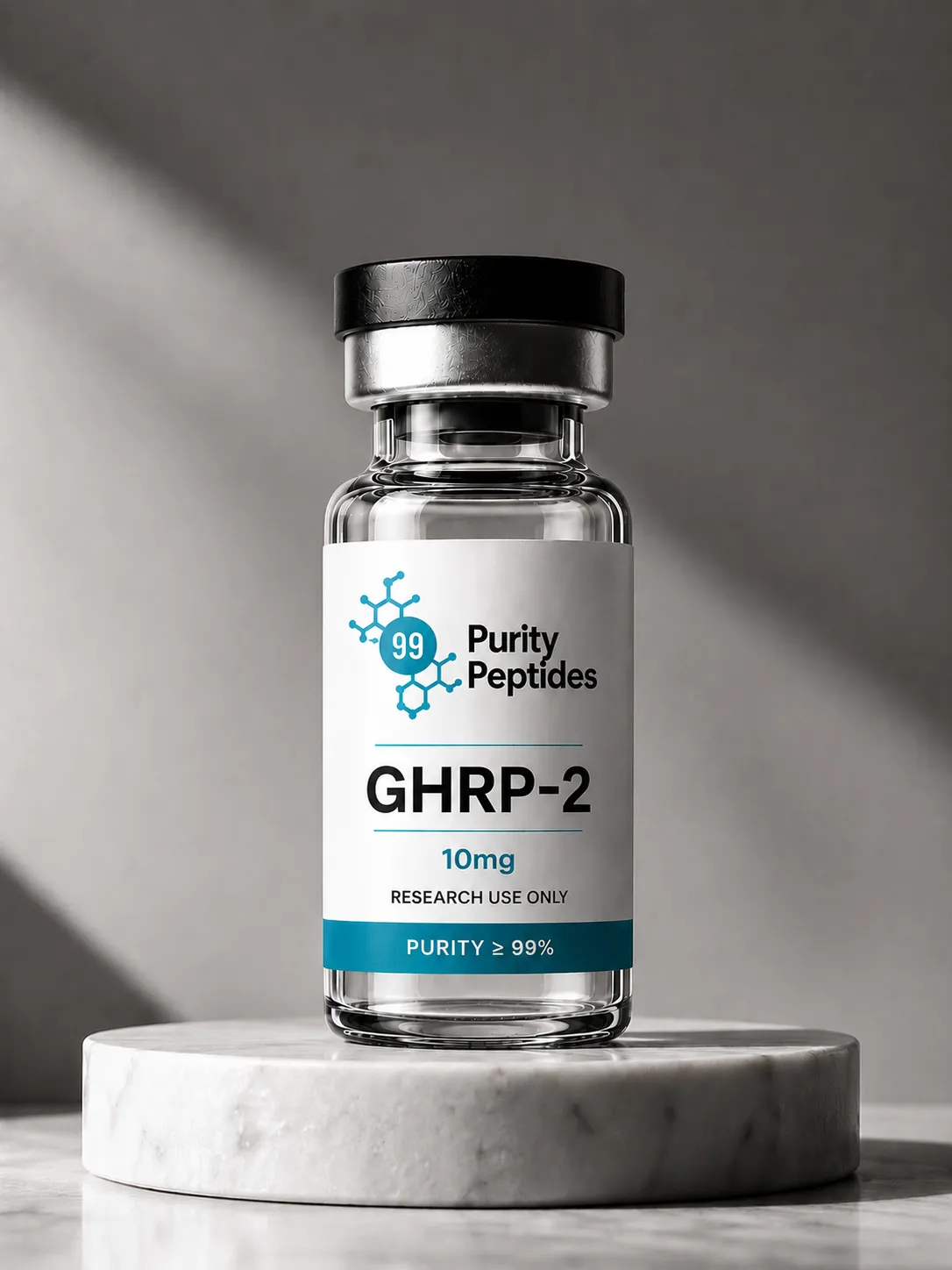
GHRP-2 specifically is a synthetic hexapeptide that activates the ghrelin receptor, and it’s one of the older, more extensively referenced compounds in this class — it shows up in the literature under several names, which is itself a common source of confusion. This article covers what GHRP-2 actually is, how its receptor mechanism compares to related compounds, and what a buyer should look for in supplier documentation. GHRP-2 is not FDA-approved for human or animal use, and nothing here should be read as dosing or administration guidance.
What Is GHRP-2? Names, Codes, and Classification
GHRP-2 is a synthetic hexapeptide — a chain of six amino acids — classified as a growth hormone-releasing peptide (GHRP) and, more specifically, as a ghrelin receptor (GHS-R1a) agonist. It’s one of several compounds developed in this class alongside GHRP-6 and Hexarelin, all designed to stimulate GH release through the ghrelin-receptor pathway rather than the GHRH-receptor pathway used by compounds like CJC-1295 or Sermorelin.
GHRP-2 carries several names across different literature and supplier contexts:
- GHRP-2 — the common research-peptide industry name
- Pralmorelin — the International Nonproprietary Name (INN)
- KP-102 — an early research code used in some pharmacology literature
- GPA-748 — another research code that appears in older references
If you’re cross-referencing older pharmacology papers, it’s worth checking which of these names or codes a given source uses, since some literature searches under “GHRP-2” alone will miss papers indexed under Pralmorelin or the numeric codes.
Mechanism of Action: The Ghrelin Receptor Pathway
GHRP-2 binds the ghrelin receptor (GHS-R1a), the same receptor that endogenous ghrelin activates. This is a functionally distinct pathway from the GHRH receptor used by GHRH analogs — the two receptor systems converge on GH release from the pituitary, but through separate signaling cascades.
This distinction is why GHRP-2 and GHRH analogs are so often discussed together rather than as competitors: because they work through different receptors, they’re studied as potentially additive or synergistic when combined in laboratory models, rather than as two options for achieving the identical effect through the identical mechanism.
GHRP-2 vs. GHRP-6: The Complete Comparison
This is the single most common comparison in the category, and it deserves a direct, scannable answer rather than vague reassurance that “they’re similar.”
Attribute | GHRP-2 | GHRP-6 |
|---|---|---|
Receptor target | Ghrelin receptor (GHS-R1a) | Ghrelin receptor (GHS-R1a) |
Structure | Synthetic hexapeptide | Synthetic hexapeptide |
Alternate names | Pralmorelin, KP-102, GPA-748 | — |
Reported relative potency | Frequently reported as more potent for GH release in comparative literature | Reference compound in much of the earlier GHRP literature |
Reported appetite-stimulating effect | Reported in literature, generally described as less pronounced than GHRP-6’s | More strongly associated with appetite stimulation in reported literature |
Common research use | Standalone or dual-receptor stacking | Standalone or dual-receptor stacking; historically the more studied reference compound |
The practical takeaway from the literature: both work through the same receptor, but they aren’t pharmacologically identical, and reported differences in potency and appetite-related effects are exactly the kind of detail that should be sourced to specific studies rather than repeated as received wisdom. Where you can cite a specific paper for a specific comparative claim, do — where you can’t, describe it as commonly reported in the literature rather than an established fact.
GHRP-2 vs. Hexarelin vs. Ipamorelin
Compound | Receptor Pathway | Structural Class | Primary Research Distinction |
|---|---|---|---|
GHRP-2 | Ghrelin receptor (GHS-R1a) | Synthetic hexapeptide | Also known as Pralmorelin; moderate reported appetite effect relative to GHRP-6 |
Hexarelin | Ghrelin receptor (GHS-R1a) | Synthetic hexapeptide | Frequently reported in literature as one of the most potent GH secretagogues in this class |
Ipamorelin | Ghrelin receptor (GHS-R1a) | Synthetic pentapeptide | Widely reported as the most receptor-selective of the group, with comparatively less reported impact on cortisol and prolactin |
All three activate the same receptor family, which is exactly why the differentiating factor in research literature isn’t “which receptor” but rather selectivity, relative potency, and secondary hormonal effects (cortisol, prolactin) reported alongside GH release. Ipamorelin’s comparatively higher reported selectivity is one of the more consistently cited distinctions across this compound class.
GHRP-2 in Dual-Receptor Research Designs
Because GHRP-2 activates the ghrelin receptor rather than the GHRH receptor, it’s frequently studied in combination with GHRH-pathway compounds such as CJC-1295 No DAC. The rationale in dual-receptor research designs is that activating both pathways together may produce a larger combined GH pulse than either pathway alone — a research question distinct from evaluating GHRP-2 as a standalone compound.
This is worth treating as its own supporting topic rather than folding entirely into either individual product page, since readers comparing GHRP-2 to GHRP-6 are often at a different research stage than readers specifically evaluating a GHRP-2/CJC-1295 combination design.
What the Research Literature Actually Shows
GHRP-2 is among the more extensively referenced compounds in the ghrelin-receptor-agonist class, partly because of its longer history in pharmacology research compared to newer, more receptor-selective compounds like Ipamorelin. That said, most of the comparative claims that circulate on supplier and forum content — relative potency rankings, specific appetite-effect magnitudes — trace back to a mix of older pharmacology literature and community-reported experience rather than a single, comprehensive head-to-head clinical trial comparing all these compounds directly.
A responsible page states that distinction plainly: general mechanism (ghrelin-receptor agonism, GH release via pituitary stimulation) is well-supported; specific comparative rankings between GHRP-2, GHRP-6, and Hexarelin should be treated as commonly reported patterns in the literature and community discussion, not as definitively settled findings, unless a specific citable study is named.
Purity, COA Verification, and Supplier Trust
The same trust concerns that apply across this entire compound category apply to GHRP-2. A meaningful certificate of analysis should show:
- HPLC purity result, specific to the tested batch
- LC-MS identity confirmation, verifying the molecule matches its labeled sequence
- Batch or lot number matching the specific vial received
- Named third-party testing laboratory, not an internal-only test
- Test date, since peptide stability can shift over time even under proper storage
Given how often “GHRP-2” and its various research codes get referenced inconsistently across supplier pages, a batch-matched COA from a named lab is the most reliable way to confirm what’s actually in a given vial — more reliable than the product name or purity percentage on a label alone.
Handling and Storage Principles
At a general level, lyophilized research peptides like GHRP-2 are typically stored frozen and protected from light and repeated temperature cycling prior to use, and supplier-specific storage guidance should always take precedence over generic advice. This article intentionally does not provide reconstitution ratios, volumes, or dosing protocols — those specifics depend on the intended research application and should be determined by qualified researchers following their own institutional protocols and the compound’s certificate of analysis, not a blog post.
Regulatory Status and Research-Use-Only Classification
GHRP-2 is not approved by the FDA for human or animal use. As with other research peptides in this broader category, its regulatory and compounding status can be subject to change over time, and any specific claims about current compounding-list status should be verified directly against the FDA’s public docket before publishing, since positions on bulk substance nomination lists have shifted for related compounds in this space in recent reporting cycles.
Common Myths About GHRP-2
Myth: GHRP-2 and GHRP-6 are functionally identical. They share a receptor target and structural class, but reported potency and secondary effects (like appetite stimulation) differ between them in the literature.
Myth: “GHRP-2” and “Pralmorelin” are different compounds. Pralmorelin is simply the International Nonproprietary Name for the same compound sold under the GHRP-2 research-peptide name.
Myth: More potent GH release in comparative reports automatically makes one compound “better” for research. Which compound is appropriate depends on the specific research question — selectivity, half-life, and secondary hormonal effects all matter alongside raw potency.
Myth: Comparative potency rankings between GHRP-2, GHRP-6, and Hexarelin are settled, universally agreed-upon facts. Much of what circulates is drawn from a mix of older literature and community-reported experience rather than a single comprehensive clinical comparison. That’s worth stating directly rather than repeating as settled fact.
Myth: GHRP-2 is FDA-approved because it’s sold by professional-looking suppliers. Supplier presentation doesn’t change regulatory status. GHRP-2 remains a research-use-only compound with no FDA approval for human or animal use.
Conclusion
GHRP-2 is a synthetic hexapeptide and ghrelin-receptor agonist, also known as Pralmorelin, KP-102, or GPA-748 depending on the source. It works through the same general receptor pathway as GHRP-6 and Hexarelin but isn’t pharmacologically identical to either — reported differences in potency and secondary effects like appetite stimulation are meaningful distinctions worth checking against specific literature rather than assuming from the shared receptor class alone. It’s frequently studied alongside GHRH-pathway compounds like CJC-1295 No DAC in dual-receptor research designs. As with any research peptide, the most reliable way to evaluate a supplier is a real, batch-matched, third-party certificate of analysis — not the product name or marketing copy.
Researchers comparing GHRP-2 to GHRP-6, Hexarelin, or Ipamorelin should review the current certificate of analysis, confirm third-party HPLC and LC-MS verification, and match the compound’s receptor-selectivity profile to their specific research design before purchasing. [Browse the GHRP-2 research peptide listing] and review the published COA before ordering.
Frequently Asked Questions
What is GHRP-2?
GHRP-2 is a synthetic hexapeptide that acts as a ghrelin receptor (GHS-R1a) agonist, studied for its growth hormone-releasing activity. It’s also known as Pralmorelin, KP-102, or GPA-748.
Is GHRP-2 the same thing as Pralmorelin?
Yes. Pralmorelin is the International Nonproprietary Name for the same compound sold under the GHRP-2 research-peptide name.
What is the difference between GHRP-2 and GHRP-6?
Both are synthetic hexapeptide ghrelin-receptor agonists, but they differ in reported relative potency and secondary effects — GHRP-6 is more strongly associated with appetite stimulation in reported literature, while GHRP-2 is generally described as having a less pronounced appetite effect.
How does GHRP-2 stimulate growth hormone release?
It binds the ghrelin receptor (GHS-R1a) on pituitary cells, triggering GH release through a signaling pathway distinct from the GHRH-receptor pathway used by compounds like CJC-1295.
Is GHRP-2 more potent than GHRP-6?
Some comparative literature and community-reported experience describe GHRP-2 as more potent for GH release, but this isn’t drawn from a single definitive head-to-head clinical trial and should be treated as a commonly reported pattern rather than a settled fact.
How does GHRP-2 compare to Hexarelin?
Both are ghrelin-receptor agonists in the same synthetic hexapeptide class, but Hexarelin is frequently reported in literature as one of the more potent compounds in this group.
How does GHRP-2 compare to Ipamorelin?
Ipamorelin is a synthetic pentapeptide (not hexapeptide) that is widely reported as more receptor-selective, with less reported impact on cortisol and prolactin compared to GHRP-2.
Why is GHRP-2 studied alongside GHRH analogs like CJC-1295?
Because GHRP-2 activates the ghrelin receptor while GHRH analogs activate a separate receptor, dual-receptor research designs study whether combining both pathways produces an additive GH-release effect.
Is GHRP-2 FDA approved?
No. GHRP-2 is not FDA-approved for human or animal use and is classified strictly as a research-use-only compound.
What do KP-102 and GPA-748 refer to?
These are earlier research codes referring to the same compound now more commonly sold under the name GHRP-2.
How do I know if a GHRP-2 supplier is legitimate?
Look for a batch-matched certificate of analysis from a named third-party lab showing both HPLC purity and LC-MS identity confirmation, rather than relying on the product name or a purity percentage alone.
Is there strong, definitive research comparing GHRP-2 to other GH secretagogues?
Much of the comparative data circulating in supplier and forum content draws on older pharmacology literature and community-reported experience rather than a single comprehensive clinical comparison. That gap is worth acknowledging directly.
Does GHRP-2 affect appetite?
Some appetite-stimulating effect is reported in the literature for ghrelin-receptor agonists generally, with GHRP-2 generally described as having a less pronounced effect than GHRP-6.
What structural class does GHRP-2 belong to?
It’s a synthetic hexapeptide — a six-amino-acid chain — within the broader growth hormone-releasing peptide (GHRP) class of ghrelin-receptor agonists.
Why do supplier pages use different names for the same GHRP-2 compound?
GHRP-2 has a longer research history than some newer compounds in this class, so it accumulated multiple names and codes (Pralmorelin, KP-102, GPA-748) across different literature sources before the “GHRP-2” name became the common industry standard.