What Is BPC-157? A Quick Research Primer
BPC-157 (Body Protection Compound-157) is a synthetic pentadecapeptide — a chain of 15 amino acids — derived from a protective protein originally identified in human gastric juice. It was first isolated and characterized in fractionation studies led by Predrag Sikiric and colleagues at the University of Zagreb School of Medicine, whose research group has produced the large majority of the published BPC-157 literature to date.
Featured Products

In preclinical models, BPC-157 is most closely associated with two mechanisms:
- Localized angiogenesis — promoting new blood vessel formation at an injury site via the VEGFR2/Akt/eNOS signaling pathway
- Fibroblast migration and nitric-oxide modulation — supporting the cellular processes involved in tissue and gut-lining repair
A 2025 systematic review of BPC-157 in orthopaedic sports medicine, led by researchers at Case Western Reserve University and published in HSS Journal, identified roughly three dozen studies spanning fracture, tendon, ligament, muscle, and bone-healing models. The overwhelming majority were preclinical (animal or in vitro); the review located only a small human case series involving intra-articular injections for chronic knee pain, with no completed randomized controlled trial in humans.
What Is TB-500? A Quick Research Primer
TB-500 is the trade name commonly used for a synthetic fragment of Thymosin Beta-4 (Tβ4), a naturally occurring 43-amino-acid protein. Structurally, TB-500 refers to a short active sequence of that larger molecule, most often cited as the actin-binding region responsible for its biological activity.
Where BPC-157's research base centers on localized, injury-site effects, TB-500's preclinical literature centers on systemic mechanisms:
- Actin sequestration — binding G-actin to regulate cytoskeletal dynamics and cell motility
- Cell migration — supporting the movement of repair-related cells (including satellite cells) toward damaged tissue
- Anti-inflammatory signaling — modulating pro-inflammatory cytokines such as TNF-α and IL-1β in some animal models
The parent molecule, thymosin beta-4, has a comparatively more developed human evidence base than BPC-157, including Phase 2 trials in wound-healing contexts such as pressure ulcers and an ophthalmic trial for dry-eye-related corneal staining. It's important to note, however, that these human trials studied full-length thymosin beta-4 — not the shorter TB-500 fragment sold in the research peptide market, which has a much thinner independent human dataset.
The Mechanistic Rationale for Combining Them
The reasoning researchers and clinicians cite for pairing BPC-157 and TB-500 is mechanistic, not empirical — meaning it's a hypothesis built from each peptide's individual pathway data, not a conclusion drawn from a combined study.
Feature | BPC-157 | TB-500 |
|---|---|---|
Primary mechanism | Localized angiogenesis (VEGF/Akt/eNOS) | Systemic actin-mediated cell migration |
Scope of action | Injury-site specific | Body-wide / systemic |
Molecule type | 15-amino-acid gastric-derived peptide | Fragment of thymosin beta-4 (43-AA protein) |
Human evidence | Limited; small case series only | Stronger for the parent molecule (Tβ4), thinner for the TB-500 fragment specifically |
Primary research group | Sikiric et al., University of Zagreb | Multiple groups; originally isolated by Allen Goldstein |
The complementary-pathways argument goes like this: if BPC-157 helps establish local vascular and cellular conditions for repair, and TB-500 helps mobilize and move repair-related cells to the site, then combining them could theoretically address both the local and systemic sides of tissue healing. This is a coherent hypothesis worth testing — but a coherent hypothesis is not the same thing as a validated finding.
So, Can BPC-157 and TB-500 Be Studied Together? What the Evidence Actually Shows
Based on a review of the current systematic reviews, PubMed-indexed studies, and 2026 science journalism coverage, no peer-reviewed study has directly administered BPC-157 and TB-500 together and measured a combined outcome. Every co-administration claim currently circulating traces back to individual-peptide data, animal studies of each compound run separately, or user-reported anecdote — not a dedicated combination trial.
Direct Answer (Featured Snippet Target) No. As of 2026, there is no published peer-reviewed study that has directly tested BPC-157 and TB-500 administered together. Each peptide has been studied independently in preclinical models; the combination — sometimes called the “Wolverine Stack” — is a community framing built on individual-peptide mechanisms, not a tested protocol. |
What Coverage of the Existing Literature Has Found
A 2025 systematic review catalogued roughly three dozen BPC-157 studies in orthopaedic and sports-medicine contexts, the large majority preclinical and produced by a small number of research groups. Reporting on the BPC-157 literature in February 2026 highlighted a related limitation worth flagging for anyone evaluating the evidence: a large share of the existing animal studies originate from a single laboratory, which is a common critique in narrow, emerging research fields and a reason to weigh replication and independent verification carefully rather than treat the existing volume of studies as equivalent to broad scientific consensus.
TB-500's standalone literature is comparatively smaller in peer-reviewed volume, though the parent molecule (thymosin beta-4) has more developed human trial data in specific applications like wound healing. Neither peptide's individual research base currently includes a study designed around simultaneous administration with the other.
Why the “Wolverine Stack” Framing Gets Ahead of the Evidence
The term “Wolverine Stack” originated in fitness and injury-recovery forums, not in a research setting, drawing on the comic-book character's rapid-healing ability as shorthand for the combined peptides' theorized effect. That branding has driven significant search and community interest — but it also illustrates a common pattern in emerging research-compound spaces: a catchy name for a plausible hypothesis circulates faster than the actual data needed to confirm or refute it.
- Community dosing protocols for the combination are not derived from a published study — they're aggregated anecdote.
- Claimed “synergy” between the two peptides has not been measured in a controlled combined trial.
- Individual-peptide safety data does not automatically transfer to a combined-administration context, which is precisely why researchers who study drug or peptide combinations run dedicated co-administration and interaction studies before drawing conclusions.
What Would a Genuine BPC-157 + TB-500 Combination Study Look Like?
For readers designing or evaluating research protocols, a properly controlled combination study would typically need to isolate the combined effect from each peptide's independent effect. At minimum, that means:
- A single-peptide BPC-157 arm, a single-peptide TB-500 arm, a combined arm, and a control/vehicle arm
- Standardized, validated outcome measures relevant to the tissue model being studied (e.g., biomechanical tendon strength, histological healing scores)
- Adequate sample sizes and, ideally, replication across more than one independent laboratory
- Reported safety and tolerability data specific to co-administration, not extrapolated from single-peptide studies
This structure — separate arms plus a combined arm — is standard practice in pharmacology for identifying whether two compounds are additive, synergistic, or simply independent in effect. Its absence in the BPC-157/TB-500 literature is exactly what “no combination data exists” means in practice.
How to Evaluate Combination Claims Critically
Whether you're a researcher, a journalist, or simply trying to make sense of conflicting online claims, a few questions help separate evidence-based content from hype:
- Does the source cite a specific combined-administration study, or does it cite two separate single-peptide studies and imply a combined effect?
- Is the claim attributed to a named, searchable study (author, journal, year), or to unspecified “research”?
- Does the source distinguish between the parent molecule (thymosin beta-4) and the shorter TB-500 fragment when citing human trial data?
- Does the source acknowledge what is NOT yet known, or does it present a hypothesis as a settled conclusion?
Common Mistake The most frequent error in online coverage of this topic is citing BPC-157 and TB-500 studies side by side and letting the juxtaposition imply a combined finding, without ever pointing to a study that tested them together. Reading the two individual bodies of research is not the same as reading combination research. |
Where This Leaves the Research Community
The mechanistic rationale for studying BPC-157 and TB-500 together is scientifically reasonable — the two peptides work through genuinely different pathways, which is exactly the kind of pairing pharmacology researchers do go on to test in combination studies. What's missing is the study itself. Until a controlled, published co-administration trial exists, any claim about combined efficacy, synergy, or safety is an extrapolation from single-peptide data, not a documented finding.
For 99 Purity Peptides, that distinction is the point of this article: research-use peptides deserve research-grade claims. We'll continue tracking new systematic reviews and combination studies as they publish and will update this page accordingly.
Key Takeaways
- No peer-reviewed study has directly tested BPC-157 and TB-500 administered together as of 2026.
- BPC-157's research base centers on localized angiogenesis (VEGF/Akt/eNOS); TB-500's centers on systemic actin-mediated cell migration.
- A 2025 systematic review found roughly three dozen BPC-157 studies, mostly preclinical, with only a small human case series.
- Coverage of the BPC-157 literature in 2026 flagged that many studies concentrate in a small number of labs — a reason to weigh independent replication.
- The “Wolverine Stack” is a community/forum term, not a peer-reviewed protocol.
- A genuine combination study would require separate single-peptide arms plus a combined arm to isolate any additive or synergistic effect.
- Evaluate combination claims by checking whether a source cites an actual co-administration study or is implying one from two separate bodies of research.
Frequently Asked Questions
Can BPC-157 and TB-500 be studied together?
They can theoretically be included in the same study design, but as of 2026 no peer-reviewed study has published results from administering them together. Each peptide's evidence base currently comes from separate, independent research.
Is the “Wolverine Stack” backed by scientific research?
No. “Wolverine Stack” is a community-coined name for the BPC-157/TB-500 combination. The mechanistic rationale for pairing them is scientifically plausible, but no controlled study has tested the combination directly.
What mechanisms do BPC-157 and TB-500 share?
Both are studied in the context of tissue repair and are frequently discussed together in soft-tissue and injury-recovery research, but their primary mechanisms differ: BPC-157 is linked to localized angiogenesis, while TB-500 is linked to systemic, actin-mediated cell migration.
What mechanisms make BPC-157 and TB-500 different?
BPC-157's effects in preclinical models are concentrated at the injury site, largely through VEGF-related angiogenesis. TB-500's effects are more systemic, driven by its role in actin regulation and cell motility throughout the body.
How many peer-reviewed studies test BPC-157 and TB-500 together?
Zero, based on current systematic reviews and literature coverage as of 2026. Individual-peptide studies exist for each compound, but no dedicated co-administration study has been published.
What did the 2025 systematic review on BPC-157 find?
A 2025 systematic review published in HSS Journal identified roughly three dozen BPC-157 studies in orthopaedic and sports-medicine contexts — predominantly preclinical animal research, with a small human case series and no completed randomized controlled trial.
Is there human data on the BPC-157/TB-500 combination?
No combination-specific human data exists. Some human data exists for each peptide independently (more developed for thymosin beta-4, the parent molecule of TB-500, than for BPC-157), but not for the two administered together.
What animal models have tested BPC-157 and TB-500?
Each peptide has been studied separately across various rodent models relevant to tendon, ligament, muscle, bone, and gut-lining repair. No animal model study has been published testing the two peptides in combination.
Why is there limited research on the BPC-157/TB-500 combination?
Combination studies are more resource-intensive to design (requiring separate and combined treatment arms) and typically follow, rather than precede, a mature body of single-compound research. Given that even the individual-peptide literature — particularly for TB-500 — is still developing, a dedicated combination trial has not yet been published.
Is BPC-157/TB-500 combination research increasing?
Interest in the topic is increasing based on search and community discussion volume, but that interest has not yet translated into a published peer-reviewed combination study as of 2026.
What does “Research Use Only” mean for BPC-157 and TB-500?
Research Use Only (RUO) means a compound is sold and labeled strictly for laboratory and research applications, not for human or veterinary consumption. Regulatory status for compounded peptides has been actively evolving in 2026; researchers should verify current status directly with primary regulatory sources rather than relying on older summaries.
How should researchers evaluate BPC-157/TB-500 stacking claims?
Check whether a claim cites an actual co-administration study or is inferring a combined effect from two separate single-peptide studies. Favor sources that name specific studies, authors, and publication years over sources citing unspecified “research.”
Does 99 Purity Peptides sell BPC-157 and TB-500?
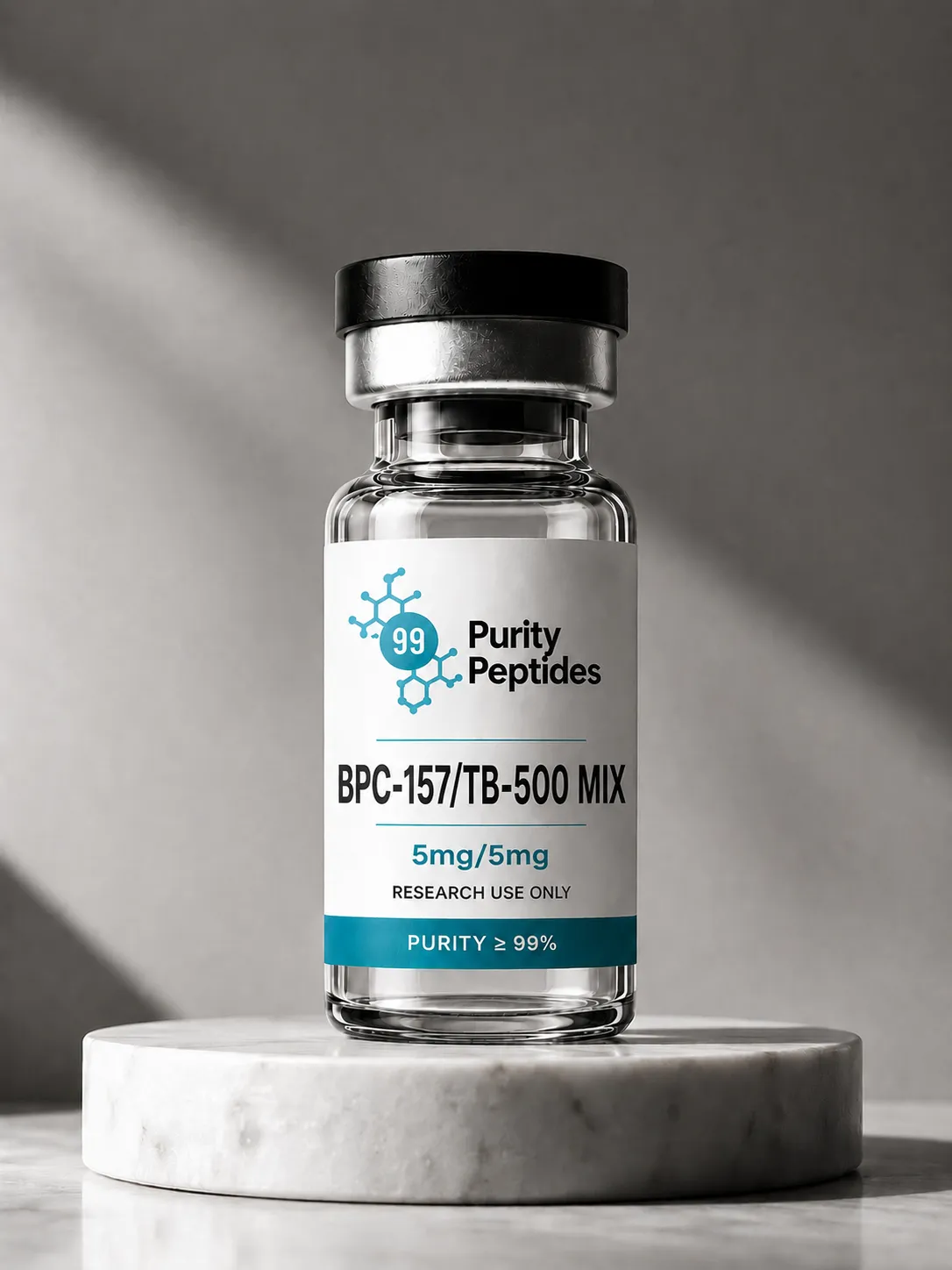
Yes, 99 Purity Peptides offers both compounds as Research Use Only products with third-party purity verification. See our BPC-157 and TB-500 product pages for current specifications and documentation.
What's next for BPC-157/TB-500 combination research?
Given the mechanistic rationale researchers have already articulated, a controlled combination study is a plausible next step for the field. This page will be updated if and when such a study is published.