ARA-290 Peptide (Cibinetide): Mechanism, Clinical Evidence & Research Status
If you've spent any time in erythropoietin research or the tissue-protective peptide literature, ARA-290 is a name that keeps surfacing — usually alongside its investigational designation, Cibinetide. It's an unusual peptide in the research-supplier world for one reason: it isn't a speculative blend with no clinical history. It's a single, well-characterized 11-amino-acid compound that went through real Phase II human trials, published in peer-reviewed journals, before its developer closed its doors.
Featured Product
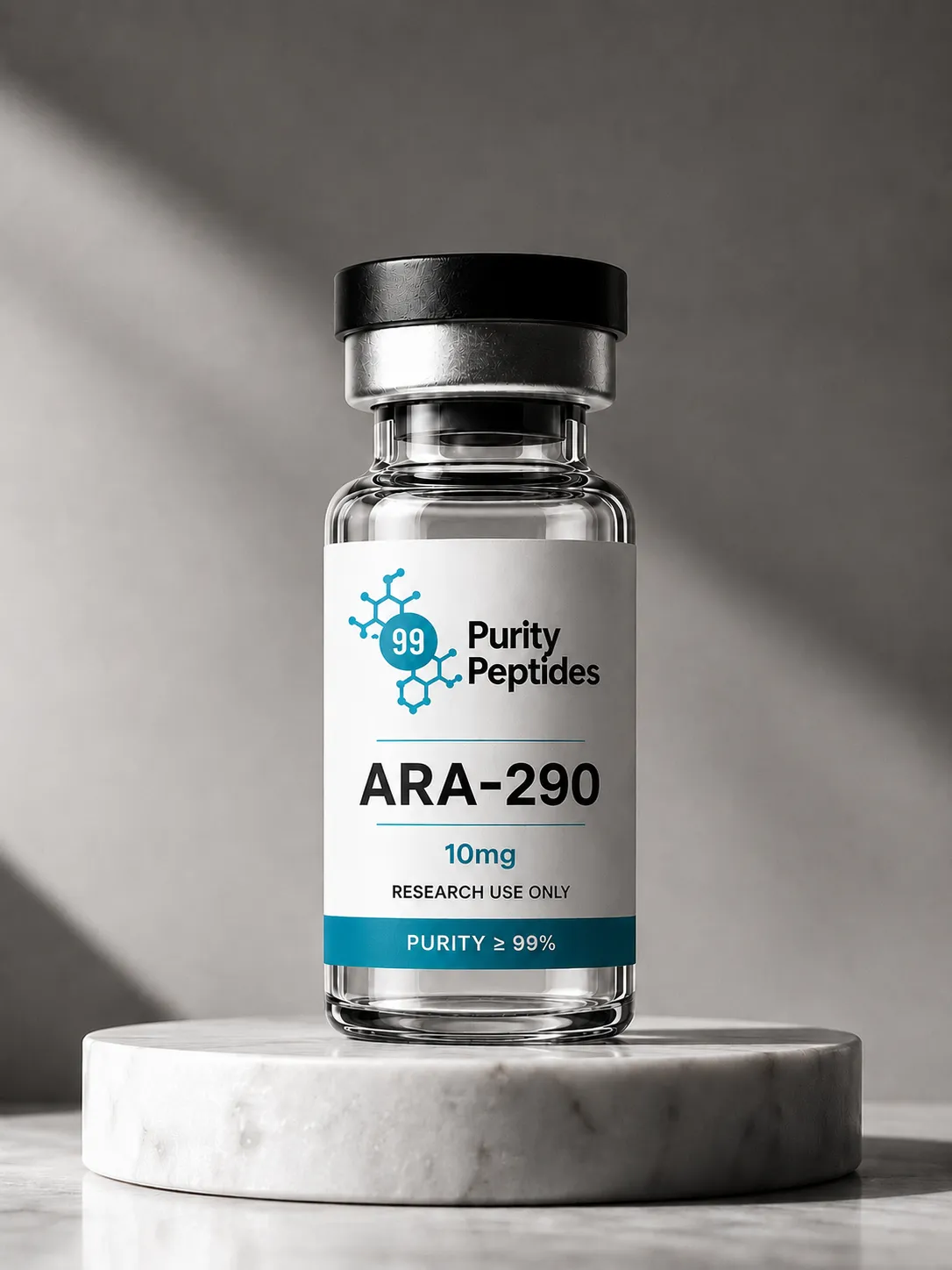
That history is exactly what most supplier pages get wrong. They either copy the same three sentences about erythropoietin every competitor uses, or they skip the regulatory story entirely — including the fact that the company behind ARA-290, Araim Pharmaceuticals, ceased operations in April 2026 without ever filing for FDA approval. This guide covers what the published research actually shows, how the compound is believed to work, what happened to its development program, and what to look for if you're evaluating a supplier's purity documentation.
Research Use Only: ARA-290 is not approved by the FDA for any human or veterinary indication. Everything below is intended for laboratory research and educational purposes, not for human or animal administration.
What Is ARA-290 (Cibinetide)?
What is ARA-290? ARA-290 is a synthetic peptide made of 11 amino acids, engineered from a specific surface region — the helix-B domain — of the erythropoietin (EPO) molecule. Its investigational drug name is Cibinetide. Researchers created it to isolate EPO's tissue-protective, anti-inflammatory signaling from EPO's other major effect: stimulating red blood cell production. |
Erythropoietin is best known as the hormone that tells bone marrow to make red blood cells. But over two decades of research, scientists including Anthony Cerami and Michael Brines — who co-founded Araim Pharmaceuticals in 2006 — identified a second, largely separate function of EPO: a tissue-protective, anti-inflammatory signal that operates through a different receptor pathway. ARA-290 was engineered specifically to trigger that second pathway while leaving red-blood-cell production essentially untouched, which is the entire premise behind calling it "non-erythropoietic."
This distinction matters for research design. A compound that carries EPO's anti-inflammatory signaling without its hematopoietic (blood-cell-boosting) effects is far easier to study for nerve repair and inflammation control, since researchers don't have to account for changes in red blood cell counts as a confounding variable.
How ARA-290 Works: The Innate Repair Receptor Pathway
How does ARA-290 work? ARA-290 binds to a receptor complex called the innate repair receptor (IRR) — believed to be formed from the EPO receptor (EPOR) paired with the beta-common receptor (CD131, also written βcR). This pathway is proposed to modulate cytokine activity, support regulatory T-cell (Treg) balance, and encourage nerve-fiber repair, without engaging the classical EPOR homodimer that drives red blood cell production. |
The classical EPO receptor most people are familiar with works as a homodimer — two identical EPOR subunits pairing up — and that pairing is what drives erythropoiesis in bone marrow. The innate repair receptor is proposed to be a different receptor assembly, combining one EPOR subunit with CD131. Published preclinical work associates activation of this pathway with several downstream effects that show up repeatedly across the ARA-290 literature:
- Modulation of pro-inflammatory cytokine signaling
- Support for regulatory T-cell (Treg) induction and Th1/Th2 balance
- Suppression of microglial activation in neural tissue models
- Support for Schwann cell proliferation, relevant to peripheral nerve repair
- Corneal and dermal small-nerve-fiber regeneration, the outcome measure used in the human sarcoidosis trials
It's worth being precise about the evidence tier here: the receptor mechanism itself is largely supported by preclinical and mechanistic studies rather than by direct receptor-binding confirmation in the human trials. The human data (below) measured clinical and structural outcomes — pain scores, nerve fiber density — not receptor occupancy directly. Any page claiming otherwise is overstating what's been shown.
ARA-290 vs Erythropoietin: Key Differences
Attribute | Erythropoietin (EPO) | ARA-290 (Cibinetide) |
|---|---|---|
Structure | 165-amino-acid glycoprotein hormone | 11-amino-acid synthetic peptide fragment |
Primary receptor target | Classical EPOR homodimer | Proposed innate repair receptor (EPOR + CD131) |
Effect on red blood cells | Stimulates erythropoiesis (used clinically for anemia) | Designed to avoid significant erythropoietic effect |
Regulatory status | FDA-approved for specific anemia indications | Investigational only; never approved; orphan drug designation for one indication |
Clinical trial history | Decades of approved clinical use | Phase II trials only; no Phase III completed |
Current development | Actively marketed by multiple manufacturers | Development stalled after Araim Pharmaceuticals closed (April 2026) |
Clinical Trial Evidence: What the Published Research Actually Shows
This is the section most competitor pages skip entirely, and it's the biggest evidence-based differentiator available on this topic: ARA-290 has a real, peer-reviewed Phase II human trial history. Below is a summary of the published studies most frequently cited in the literature.
Study / Journal | Condition Studied | Design | Key Reported Finding |
|---|---|---|---|
Heij et al., Molecular Medicine (2012) | Sarcoidosis-associated small-fiber neuropathy | Randomized, double-blind pilot study | Improved Small Fiber Neuropathy Screening List (SFNSL) scores vs. placebo; no safety concerns identified |
Dahan et al., Molecular Medicine (2013) | Sarcoidosis-associated small-fiber neuropathy | Randomized, double-blind study | Symptom improvement and increased corneal nerve fiber density vs. placebo |
Brines et al., Molecular Medicine (2014) | Type 2 diabetes with neuropathic symptoms | Randomized, double-blind study; daily subcutaneous dosing for 28 days | Improvements in HbA1c, lipid profile, neuropathic symptoms, and corneal nerve fiber density |
Culver/Brines et al., Investigative Ophthalmology & Visual Science (2017) | Sarcoidosis-associated painful small-fiber neuropathy | Phase 2b, double-blind, randomized, placebo-controlled, two-center (64 patients) | Significant increase in corneal nerve fiber area at the 4 mg dose (~23% vs. baseline); placebo-corrected reduction in pain intensity; no significant safety issues reported |
Limitations of the Existing Evidence
An honest research summary has to include the limitations, and there are several worth stating plainly:
- Small sample sizes — the sarcoidosis trials ranged from under 40 to 64 participants.
- Single-center or two-center design conducted primarily in the Netherlands, which limits generalizability.
- The diabetic neuropathy trial was similarly small and was underpowered for some of its metabolic secondary endpoints.
- No Phase III, multicenter replication trial was ever completed before Araim Pharmaceuticals ceased operations.
- As of 2026, no active clinical trials for ARA-290 or Cibinetide are registered on ClinicalTrials.gov.
In plain terms: the Phase II data provide a genuine proof-of-concept signal — particularly the structural corneal nerve fiber findings, which are harder to fake with a placebo response than pain scores alone — but they fall well short of the evidence bar required for regulatory approval.
What Happened to ARA-290? Araim Pharmaceuticals and Current Development Status
What happened to Araim Pharmaceuticals and is ARA-290 still in development? Araim Pharmaceuticals, founded in 2006 by Anthony Cerami, Michael Brines, and Ferdinand Breedveld, developed ARA-290 through Phase II human trials and secured FDA orphan drug designation for sarcoidosis-associated small-fiber neuropathy. The company ceased operations in April 2026. No Phase III trial was ever completed, no New Drug Application (NDA) was filed, and as of 2026 there is no active clinical development program or registered trial for the compound. |
Orphan drug designation is worth explaining because it's frequently misunderstood: it's a status the FDA grants to encourage development of treatments for rare diseases (through incentives like tax credits and market exclusivity periods), not an approval or an endorsement of safety and efficacy. ARA-290 received this designation for the sarcoidosis-associated small-fiber neuropathy indication, but that designation lapsed in relevance once development stalled — it was never converted into an approved product.
The practical takeaway for researchers: any page or supplier claiming ARA-290 is "in late-stage trials" or "pending FDA approval" is out of date. Development has been dormant since Araim's closure, and the compound's status today is squarely investigational and Research Use Only.
Purity, HPLC Verification, and Certificates of Analysis: What to Look For
Because ARA-290 has no standardized retail market or FDA-regulated manufacturing pathway, purity verification is entirely dependent on the individual supplier's testing practices. This is also where most supplier pages fall short — purity is claimed but rarely demonstrated. A credible research peptide listing should give you a way to verify what you're actually looking at.
What a Certificate of Analysis (COA) Should Show
- The specific batch or lot number, matched to the vial you receive
- HPLC (High-Performance Liquid Chromatography) purity percentage, ideally with the chromatogram itself, not just a stated number
- Mass spectrometry (LC-MS) confirmation of the correct molecular weight and sequence identity
- The testing laboratory's name — a third-party lab independent of the manufacturer carries more weight than an in-house test
- Date of testing and, where applicable, endotoxin or sterility data for research applications that require it
A generic "99% pure" claim with no chromatogram, no batch number, and no named testing lab is a red flag, not a purity guarantee. If a supplier can't show you the underlying data behind a purity claim, treat the number as unverified.
Handling and Storage: General Principles for Research Peptides
Lyophilized (freeze-dried) peptides like ARA-290 are generally more stable than reconstituted solutions and are typically shipped and stored frozen, protected from light and moisture, until they're needed for a specific experiment. Reconstituted peptide solutions have a much shorter usable window and are considerably more sensitive to temperature and freeze-thaw cycling than the lyophilized form.
Because handling protocols — reconstitution ratios, buffer selection, storage duration once reconstituted — depend on the specific research application, equipment, and institutional protocol in use, we don't publish step-by-step reconstitution instructions here. Any credible supplier should provide a product-specific technical data sheet, and researchers working under an institutional review process should follow their lab's established SOPs rather than a generic online guide.
Common Myths About ARA-290
Myth: ARA-290 and Cibinetide are two different compounds.
Reality: They're the same molecule. "Cibinetide" is the investigational drug name Araim Pharmaceuticals used in its regulatory filings and published trials; "ARA-290" is the research/compound code most commonly used in supplier and community contexts.
Myth: ARA-290 is FDA-approved because it has clinical trial data.
Reality: Having completed Phase II trials is not approval. ARA-290 has never been submitted for, or granted, FDA approval for any indication.
Myth: ARA-290 boosts red blood cells like EPO does.
Reality: It was specifically engineered to minimize that effect by targeting the innate repair receptor rather than the classical erythropoietin receptor.
Myth: Because Araim closed, ARA-290 is discontinued or illegal.
Reality: The compound itself isn't illegal to sell as a research chemical under Research Use Only terms; what changed is that its clinical development program stopped, and no company currently holds an active IND for it.
Myth: A high stated purity percentage alone proves a supplier is trustworthy.
Reality: A purity number without a matching chromatogram, batch number, and named third-party lab is unverifiable and shouldn't be taken at face value.
Why Researchers Study Non-Erythropoietic EPO Derivatives
ARA-290 sits inside a broader research category: compounds engineered to isolate one signaling function of a naturally occurring hormone from its other effects. For erythropoietin specifically, the appeal is straightforward — EPO's tissue-protective signaling has been observed across a range of preclinical injury models (cardiac, renal, cerebral ischemia-reperfusion), but using EPO itself in these contexts risks unwanted changes in blood viscosity and red cell mass. A non-erythropoietic derivative lets researchers isolate the protective signal as a variable worth studying on its own, separate from hematological effects that would otherwise complicate a study's interpretation.
This is also why ARA-290 is frequently discussed alongside other tissue-protective and anti-inflammatory research peptides, even though the compounds themselves are structurally unrelated — the shared thread is a research interest in modulating inflammation and supporting nerve or tissue repair through defined receptor pathways rather than broad, systemic hormonal effects.
Conclusion
ARA-290 (Cibinetide) is one of the more evidence-backed compounds in the research-peptide space — a genuinely EPO-derived, non-erythropoietic peptide with a real Phase II clinical trial record in sarcoidosis-associated neuropathy and diabetic neuropathy. It's also, just as clearly, an investigational compound whose development stalled when Araim Pharmaceuticals closed in April 2026, with no FDA approval, no active trials, and no confirmed path back into clinical development. For laboratory researchers, that combination — real mechanistic and clinical literature, paired with an unambiguous Research Use Only status — is exactly what should shape both the questions you bring to a supplier and the purity documentation you should expect back.
Evaluating ARA-290 for a laboratory research application? Review our Certificate of Analysis and HPLC/LC-MS purity data for our current batch before you order, or reach out to our team with study-specific questions about handling and documentation. For laboratory research use only. Not for human or animal use.
Frequently Asked Questions
Is ARA-290 the same thing as Cibinetide?
Yes. Cibinetide is the investigational drug name Araim Pharmaceuticals used in regulatory filings and published clinical trials; ARA-290 is the compound code used more broadly, including by research suppliers.
What is ARA-290 used for in research?
In published human trials, ARA-290 was studied for sarcoidosis-associated small-fiber neuropathy and type 2 diabetic neuropathy. In preclinical literature more broadly, it has been studied for tissue-protective and anti-inflammatory effects across several injury models.
How does ARA-290 differ from erythropoietin?
ARA-290 is an 11-amino-acid fragment engineered from EPO's helix-B domain. It's designed to activate the innate repair receptor pathway associated with tissue protection and anti-inflammatory signaling, while minimizing the red-blood-cell-stimulating effect that defines EPO's classical function.
Is ARA-290 FDA-approved?
No. ARA-290 has never been approved by the FDA for any human or veterinary indication. It received FDA orphan drug designation for one indication, which is a development incentive, not an approval.
What happened to Araim Pharmaceuticals?
Araim Pharmaceuticals, the company that developed ARA-290 through Phase II trials, ceased operations in April 2026. No Phase III trial was completed and no NDA was filed.
Will ARA-290 ever reach Phase III trials or approval?
There is no publicly known active development program for ARA-290 as of 2026, and no trials are currently registered on ClinicalTrials.gov. Whether another company acquires the rights and resumes development is not something that can be predicted from currently available information.
What were the results of the ARA-290 sarcoidosis neuropathy trials?
Multiple Phase II studies reported improvements in neuropathic symptom scores and increased corneal nerve fiber density versus placebo, including a two-center Phase 2b trial showing a roughly 23% increase in corneal nerve fiber area at the 4 mg dose. Sample sizes were small (under 40 to 64 participants) and no Phase III replication was completed.
What were the results of the ARA-290 diabetic neuropathy trial?
A published Molecular Medicine study reported improvements in HbA1c, lipid profile, and neuropathic symptoms alongside increased corneal nerve fiber density in patients with type 2 diabetes following 28 days of dosing, though the trial was small and underpowered for some secondary metabolic endpoints.
How many amino acids are in ARA-290?
ARA-290 is an 11-amino-acid peptide.
What is the innate repair receptor?
The innate repair receptor (IRR) is a proposed receptor assembly combining the erythropoietin receptor (EPOR) with the beta-common receptor (CD131). It's distinct from the classical EPOR homodimer that drives red blood cell production, and is the pathway ARA-290 is believed to act through.
Is ARA-290 safe for research use?
The published Phase II trials reported no significant safety issues in the study populations under clinical supervision. That said, ARA-290 is not approved for human or animal use, and safety data outside a controlled clinical trial setting has not been established. It should be used strictly as a Research Use Only compound in appropriate laboratory settings.
What does 99% HPLC-verified purity mean for a peptide?
It means high-performance liquid chromatography testing found the compound to be approximately 99% pure relative to detectable impurities and byproducts. A credible purity claim should be accompanied by the actual chromatogram, a matching batch number, and ideally confirmation from an independent third-party lab.
What is a certificate of analysis (COA) and why does it matter?
A COA is a document showing the actual test results for a specific product batch, typically including purity percentage, identity confirmation (via mass spectrometry), and testing lab information. It matters because it's the only way to verify a supplier's purity claims rather than taking them on faith.
How is ARA-290 different from BPC-157 for nerve-related research?
The two are structurally and mechanistically distinct. ARA-290 is derived from erythropoietin and is studied through the innate repair receptor pathway; BPC-157 is a synthetic peptide derived from a gastric protective protein and is studied through different proposed mechanisms. Researchers interested in nerve-related outcomes should evaluate each compound's own literature separately rather than treating them as interchangeable.
Can ARA-290 be used in in-vitro studies?
Preclinical literature includes in-vitro and animal model research on ARA-290's mechanism and tissue-protective effects. As with any research compound, appropriate use depends on your institution's protocols and the specific study design.