
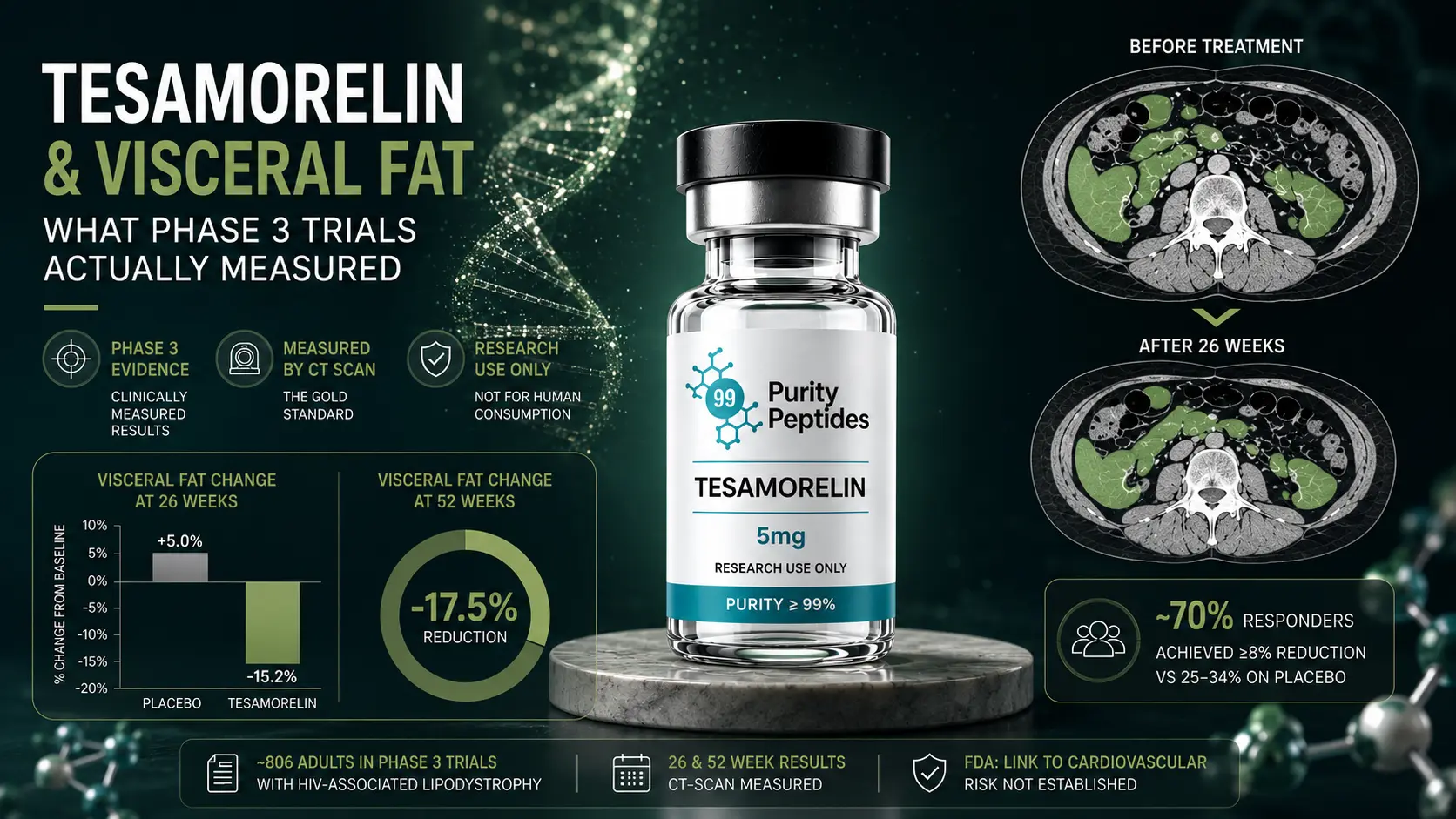
Search for how much visceral fat tesamorelin reduces and several different numbers turn up — some close to 15%, others as high as 69%. Only one of those figures comes from a trial publication. This guide goes back to the primary Phase 3 trial data, explains exactly what was measured, and resolves why the numbers in circulation disagree.
Research use only. Every figure below is checked against the primary trial publications listed in the sources section, not against secondary summaries.
Quick Answer
In Phase 3 trials, tesamorelin reduced visceral adipose tissue by approximately 15% at 26 weeks and 17.5% at 52 weeks in patients who continued treatment, measured by CT scan in adults with HIV-associated abdominal fat accumulation. A separate figure — the share of patients meeting the trials' ≥8% "responder" threshold, near 70% — is frequently misreported as the reduction itself.
Key takeaways:
- 15.2% at 26 weeks: the pivotal 2007 NEJM trial reported this reduction in visceral adipose tissue, versus a 5.0% increase under placebo.
- ~70% "responder" rate: roughly 68–70% of tesamorelin-treated patients met the trials' definition of at least an 8% VAT decrease — a patient count, not the average reduction.
- 25–34% of placebo patients also responded: essential context for interpreting the responder statistic.
- Subcutaneous fat did not change significantly — treatment effect of −0.6%, p = 0.08.
- Every pivotal trial enrolled adults with HIV-associated lipodystrophy on antiretroviral therapy. No Phase 3 data exists for healthy adults.
- The FDA has stated that the link between visceral fat reduction and improved cardiovascular risk has not been established in this population.
What the Phase 3 Trials Reported
Tesamorelin's efficacy in visceral fat reduction rests on two multicenter, double-blind, placebo-controlled Phase 3 trials that together enrolled roughly 806 adults with HIV-associated abdominal fat accumulation, plus a smaller trial examining liver fat.
| Study | Population | Duration | Reported change in VAT |
|---|---|---|---|
| LIPO-010 (Falutz et al.) | 412 adults with HIV and excess abdominal fat, 86% male | 26 weeks | −15.2% tesamorelin vs +5.0% placebo |
| Pooled LIPO-010 + CTR-1011 | ~806 adults, same criteria | 26 weeks | −24 ± 41 cm² vs +2 ± 35 cm² placebo; treatment effect −15.4% |
| Pooled, extension phase | Patients continuing tesamorelin | 52 weeks | −35 ± 50 cm² (−17.5 ± 23.3%) |
| Pooled, subcutaneous fat | Same | 26 weeks | −2 ± 32 cm² vs +2 ± 29 cm²; treatment effect −0.6%, p = 0.08 |
Two things stand out in that table. The visceral fat effect is consistent across both the individual trial and the pooled analysis, landing near 15% at six months. And the effect was selective: subcutaneous fat did not change to a statistically meaningful degree, which distinguishes tesamorelin from interventions that reduce fat mass generally.
The standard deviation on the 52-week figure — ±23.3% — deserves attention. It is larger than the mean. Individual responses varied enormously, and a single average conceals that spread.
Trial registrations: NCT00123253, NCT00435136, NCT00608023.
The Primary Endpoint and How VAT Was Measured
Visceral adipose tissue is fat stored within the abdominal cavity, surrounding the internal organs. It is distinct from subcutaneous adipose tissue, which sits between skin and muscle. The distinction matters because the two compartments behave differently in metabolic research, and because they respond differently to tesamorelin.
The Phase 3 primary efficacy endpoint was the number of square centimeters of visceral adipose tissue as assessed by computed tomography. A CT scan produces a cross-sectional abdominal image, and the visceral compartment is measured directly in cm² on that slice.
Measurement method matters more than it might appear. CT provides a direct anatomical measurement of a defined cross-section. Waist circumference, bioimpedance, and DEXA estimate body composition by different means and are not interchangeable with CT-measured VAT. When comparing tesamorelin results against other compounds, confirm that the same measurement method was used, or the comparison does not hold.
The endpoint was expressed as percent change from baseline. That framing is why every figure in this article carries a timepoint — a percentage change without a timepoint is not a complete statement of the finding.
Timeline: What Changed at 26 Weeks and 52 Weeks
At 26 weeks, the 2007 NEJM trial reported a 15.2% decrease in visceral adipose tissue with tesamorelin against a 5.0% increase with placebo. The pooled analysis of both Phase 3 trials reported the same period as a −15.4% treatment effect, expressed as the difference between arms.
Those two numbers describe the same period through slightly different lenses. The NEJM figure is the within-group change in the tesamorelin arm. The pooled figure is the treatment effect — the tesamorelin change relative to placebo. They are close because placebo change was small, but they are not identical measurements.
At 52 weeks, patients who continued tesamorelin showed a visceral fat reduction of 35 ± 50 cm², corresponding to −17.5 ± 23.3%. Waist circumference decreased by 3.4 ± 6.0 cm over the same period.
The trials used a re-randomization design. At week 26, patients originally assigned to tesamorelin were reassigned either to continue tesamorelin or to switch to placebo, while original placebo patients moved to tesamorelin. That structure is what makes the 52-week data interpretable as a continuation effect rather than simply a longer exposure.
A later characterization of the literature, published in Clinical Infectious Diseases in 2012, described tesamorelin as decreasing visceral adipose tissue by 15%–20% over 6 to 12 months. That range is a fair summary of the two timepoints above.
Why Reported Figures Differ Between Sources
Search for a tesamorelin visceral fat percentage and several different numbers turn up. Most of the variation traces to four identifiable causes, and one common error.
- Different timepoints. Roughly 15% describes 26 weeks. Roughly 17.5% describes 52 weeks in patients who continued treatment. A source quoting one without the other is not wrong, only incomplete.
- Within-group change versus treatment effect. The NEJM trial reported a 15.2% within-group decrease. The pooled analysis reported a −15.4% treatment effect against placebo. These are different calculations that happen to produce similar figures here.
- Single trial versus pooled analysis. LIPO-010 alone enrolled 412 patients. The pooled analysis covered roughly 806 across two trials. Pooled figures are generally more stable but are not the same dataset.
- Responder subgroups versus the full population. Some analyses report outcomes only among patients meeting the ≥8% responder threshold. Those figures describe a selected subgroup, not everyone who received the compound.
Responder Rate Is Not Reduction Magnitude
In the Phase 3 trials, a "VAT responder" was defined as a patient achieving at least an 8% decrease in visceral adipose tissue by CT scan, with greater than 80% medication compliance, no major protocol violation, and at least one post-baseline measurement.
A post hoc analysis of the Phase 3 data, published in the Journal of Clinical and Translational Science, reported that 68% of one patient stratum (88 of 130) and 70% of another (144 of 207) met that responder definition at week 26.
That figure — near 70% — describes how many patients responded. It does not describe how much visceral fat was lost. The average reduction across the treated population remained close to 15%.
The two numbers answer different questions, and conflating them inflates the apparent effect roughly fourfold. A reader encountering a figure near 69% or 70% attached to the phrase "visceral fat reduction" is almost certainly seeing a responder rate that has been misread.
The Placebo Responder Rate
The responder statistic carries a second piece of context that is frequently omitted.
According to regulatory review documentation, 25.0% of placebo patients in LIPO-010 and 34.1% in CTR-1011 also achieved a visceral fat decrease of 8% or greater at week 26 — despite neither trial specifying a diet or exercise regimen.
Health Canada raised this point directly when questioning how much added benefit tesamorelin provides. Citing a 70% responder rate without noting that a quarter to a third of placebo patients cleared the same threshold overstates the finding.
Absolute Versus Relative Reduction
Trial results can be expressed as an absolute change or a relative one, and the two look very different.
The pooled Phase 3 analysis reported both. The absolute change at 26 weeks was −24 cm² of visceral adipose tissue. The relative change was −15.4%. Both describe the same result. The absolute figure tells you how much tissue changed; the relative figure tells you how much of the starting amount that represented.
Relative percentages depend on baseline. A patient starting with more visceral fat and one starting with less can show identical percentage reductions while losing very different absolute amounts of tissue — which is one reason a predictor analysis of the Phase 3 data selected absolute change rather than percent change as its outcome measure.
When comparing sources, check which one is being reported. A source giving only a percentage has told you less than it appears.
A Note on a Figure We Previously Published
An earlier version of our tesamorelin content stated that Phase 3 trials showed a 69% visceral fat reduction over 26 weeks. That figure was incorrect and has been removed.
Reviewing it against the primary literature, no trial publication or regulatory document reports a visceral fat reduction of that magnitude. The published figures are approximately 15% at 26 weeks and 17.5% at 52 weeks.
The most likely source of the error is the responder rate described above. Roughly 68–70% of tesamorelin-treated patients met the ≥8% responder threshold, and that proportion appears to have been read as a reduction magnitude rather than a patient count. We have corrected the figure and cited the primary trials directly so the numbers can be checked.
What Happens After Discontinuation
Visceral fat partially reaccumulated in patients who stopped tesamorelin. The Phase 3 extension design provides direct evidence on this point, because half of the patients originally assigned to tesamorelin were switched to placebo at week 26.
An analysis of liver enzyme outcomes in these trials noted partial reaccumulation of visceral adipose tissue over the subsequent 26-week period among patients switched to placebo. Notably, some metabolic improvements observed in responders persisted through week 52 even in that group, despite the partial return of visceral fat.
Patients who continued tesamorelin through week 52 maintained their reduction, with the pooled analysis reporting that the effect was sustained across the full year.
The re-randomization design also reduced the responder group substantially. The number of patients meeting responder criteria fell from 232 at week 26 to 110 at week 52 — a consequence of half the tesamorelin arm crossing to placebo, not of the compound losing effect in those who continued.
What the Phase 3 Trials Do Not Establish
Three limits are worth stating plainly, because they are frequently omitted from summaries of this data.
- The clinical significance of the visceral fat reduction is not settled. Regulatory review documentation records the FDA's conclusion that tesamorelin is clearly effective at modifying a biomarker, but that the clinical benefit at this degree of visceral fat reduction is uncertain. The FDA further indicated that the link between visceral fat reduction and improved cardiovascular risk has not been established in patients with HIV-associated lipodystrophy.
- The findings apply to one population. Every pivotal trial enrolled adults with HIV-associated abdominal fat accumulation who were receiving antiretroviral therapy. There is no Phase 3 dataset for healthy adults, for people without HIV, or for cosmetic body composition goals. Extending these percentages to other populations is not supported by the trial evidence.
- Individual variation was large. The ±23.3% standard deviation on the 52-week figure means individual results ranged widely around the mean. Roughly 30% of treated patients did not reach even the 8% responder threshold.
Regulatory Status
Tesamorelin is approved by the U.S. Food and Drug Administration for reducing excess abdominal fat in people with HIV-associated lipodystrophy, marketed under the EGRIFTA brand. It is the only therapy holding FDA approval for that specific indication.
That approval is narrow. It covers one population and one indication. Use outside HIV-associated lipodystrophy falls outside the approved labeling, and the registration-quality trial evidence summarized on this page was generated entirely within that population.
Research-grade tesamorelin sold for laboratory use is a separate category. Research materials are not the approved pharmaceutical product, carry no approval for human or veterinary use, and are supplied for in vitro laboratory research only.
Research Handling and Sourcing
Working with published trial data requires the same care as working with the compound itself.
- Go to the primary publication. Secondary summaries introduce errors, and the responder-rate confusion documented on this page is a demonstration of how a single misreading propagates. The trials cited here are indexed on PubMed and registered on ClinicalTrials.gov; every figure in this article can be checked against them.
- Match the measurement method. CT-measured visceral adipose tissue in cm² is not interchangeable with waist circumference, DEXA, or bioimpedance estimates. Comparisons across measurement methods are not valid comparisons.
- Check the population before extrapolating. Trial results describe the population enrolled. HIV-associated lipodystrophy data does not transfer to other groups without evidence that it does.
For laboratory materials, the same verification logic applies to analytical documentation. A certificate of analysis should state the sequence, confirm identity by mass spectrometry, and report HPLC purity with a lot number matching the vial. Our certificates of analysis are published per lot, and our guide to purity, COA and HPLC verification for tesamorelin-containing materials covers what those documents should show.
For related mechanism context, our guide to tesamorelin's GHRH mechanism and growth hormone pathway covers the pharmacology rather than the trial outcomes, and our tesamorelin and sermorelin comparison sets the two GHRH analogues side by side. Concentration arithmetic for laboratory preparation is handled by our reconstitution calculator.
Verify What You Source
Every vial ships with a lot-specific certificate of analysis stating sequence, identity confirmation and HPLC purity.
View Certificates of Analysis →Sources
- Falutz J, Allas S, Blot K, et al. Metabolic effects of a growth hormone-releasing factor in patients with HIV. N Engl J Med. 2007;357(23):2359-70. PMID 18057338
- Falutz J, Mamputu JC, Potvin D, et al. Effects of tesamorelin (TH9507), a growth hormone-releasing factor analog, in HIV-infected patients with excess abdominal fat: a pooled analysis of two multicenter, double-blind placebo-controlled phase 3 trials with safety extension data. J Clin Endocrinol Metab. 2010;95(9):4291-304. PMID 20554713
- Stanley TL, Falutz J, Marsolais C, et al. Reduction in visceral adiposity is associated with an improved metabolic profile in HIV-infected patients receiving tesamorelin. Clin Infect Dis. 2012. PMID 22495074
- Effect of tesamorelin in people with HIV with and without dorsocervical fat: post hoc analysis of phase III double-blind placebo-controlled trial. J Clin Transl Sci. PMC9947601
- Visceral fat reduction with tesamorelin is associated with improved liver enzymes in HIV. PMID 28832410
- Clinical Review Report: Tesamorelin (Egrifta). CADTH Common Drug Review. NCBI Bookshelf. NBK539136
- Efficacy and Safety of Tesamorelin in People with HIV on Integrase Inhibitors. PMC11365754
Every numerical claim on this page was checked against the primary trial publications listed above rather than against secondary summaries. Where sources report different figures, the difference is explained in the article rather than resolved by selecting a preferred number. Where a previously published figure was found to be wrong, it has been corrected in the open.
Tesamorelin Research Material
Supplied with lot-specific analytical documentation for laboratory research use.
View Product Details →Frequently Asked Questions
Q1. What percentage of visceral fat does tesamorelin reduce?
Phase 3 trials reported approximately a 15% reduction in visceral adipose tissue at 26 weeks and 17.5% at 52 weeks in patients continuing treatment, measured by CT scan. The 2007 NEJM trial specifically reported 15.2% against a 5.0% increase in the placebo group. All figures come from adults with HIV-associated abdominal fat accumulation.
Q2. Why do some sources say tesamorelin reduces visceral fat by 69%?
No trial publication supports a 69% visceral fat reduction. That figure appears to originate from the trials' responder rate: roughly 68–70% of tesamorelin-treated patients achieved at least an 8% visceral fat decrease. A responder rate describes how many patients responded, not the magnitude of reduction, and the two are frequently confused.
Q3. What is a tesamorelin VAT responder?
A VAT responder in the tesamorelin Phase 3 trials was a patient achieving at least an 8% decrease in visceral adipose tissue by CT scan, with greater than 80% medication compliance, no major protocol violation, and at least one post-baseline measurement. Roughly 68–70% of treated patients met this definition at week 26.
Q4. How was visceral fat measured in the tesamorelin trials?
Visceral adipose tissue was measured in square centimeters using computed tomography, producing a direct cross-sectional abdominal measurement. This was the primary efficacy endpoint. CT-measured visceral fat is not interchangeable with waist circumference, DEXA, or bioimpedance estimates, so comparisons across measurement methods are not valid.
Q5. Who was enrolled in the tesamorelin Phase 3 trials?
The pivotal trials enrolled approximately 806 adults with HIV-associated abdominal fat accumulation who were receiving antiretroviral therapy. The 2007 NEJM trial enrolled 412 patients, 86% of whom were men, receiving 2 mg subcutaneous tesamorelin or placebo daily for 26 weeks. No Phase 3 data exists for healthy adults.
Q6. What happened at 52 weeks?
Patients who continued tesamorelin through 52 weeks showed a visceral adipose tissue reduction of 35 ± 50 cm², corresponding to −17.5 ± 23.3%, with waist circumference decreasing 3.4 ± 6.0 cm. The large standard deviation indicates substantial individual variation around that average.
Q7. Does tesamorelin reduce subcutaneous fat?
No. The pooled Phase 3 analysis reported no statistically significant change in subcutaneous adipose tissue: −2 ± 32 cm² with tesamorelin versus +2 ± 29 cm² with placebo, a treatment effect of −0.6% with a p-value of 0.08. The observed effect was selective to visceral fat.
Q8. Does visceral fat return after stopping tesamorelin?
Partially. In the Phase 3 extension phase, patients switched from tesamorelin to placebo at week 26 showed partial reaccumulation of visceral adipose tissue over the following 26 weeks. Some metabolic improvements in responders persisted through week 52 despite that partial return.
Q9. Is tesamorelin FDA approved?
Yes, for one specific indication. Tesamorelin is FDA-approved for reducing excess abdominal fat in people with HIV-associated lipodystrophy, marketed as EGRIFTA. It is the only therapy approved for that indication. Research-grade tesamorelin sold for laboratory use is a separate category with no approval for human use.
Q10. Do tesamorelin trial results apply to people without HIV?
The Phase 3 evidence does not support that extension. Every pivotal trial enrolled adults with HIV-associated abdominal fat accumulation on antiretroviral therapy. No registration-quality trial has tested tesamorelin for general abdominal fat in healthy adults, so the reported percentages describe that specific population only.
Q11. What did the FDA say about the clinical benefit of visceral fat reduction?
Regulatory review documentation records the FDA's conclusion that tesamorelin is clearly effective at modifying a biomarker, but that the clinical benefit at this degree of visceral fat reduction is uncertain. The FDA also indicated that the link between visceral fat reduction and improved cardiovascular risk has not been established in this population.
Q12. Why did a quarter of placebo patients also show visceral fat reduction?
Regulatory review documentation records that 25.0% of placebo patients in one Phase 3 trial and 34.1% in the other achieved a visceral fat decrease of 8% or greater at week 26, despite neither trial specifying diet or exercise. Health Canada cited this when questioning the extent of added benefit.
Q13. What is the difference between absolute and relative visceral fat reduction?
Absolute change reports how many square centimeters of visceral fat changed — for example, −24 cm² at 26 weeks. Relative change reports that as a percentage of the starting amount — −15.4% in the same analysis. Two patients can share an identical percentage reduction while losing very different absolute amounts of tissue, since relative figures depend on baseline.
Q14. Is research-grade tesamorelin the same as the FDA-approved product?
No. Research-grade tesamorelin sold for laboratory use is a separate category from the FDA-approved EGRIFTA product. Research materials carry no approval for human or veterinary use and are supplied strictly for in vitro laboratory research. The clinical trial data on this page describes the approved pharmaceutical studied under medical supervision, not research-use compounds.
Research Use Only
Products sold by 99 Purity Peptides are supplied for research and laboratory purposes only. They are not intended to diagnose, treat, cure, or prevent any disease, are not for human or veterinary use, and are not intended for ingestion, injection, or any form of administration. The clinical trial data summarized on this page describes an FDA-approved pharmaceutical product studied in a specific patient population under medical supervision. It does not describe research-grade materials and does not constitute evidence of any effect from research-use compounds. Nothing on this page is medical advice.