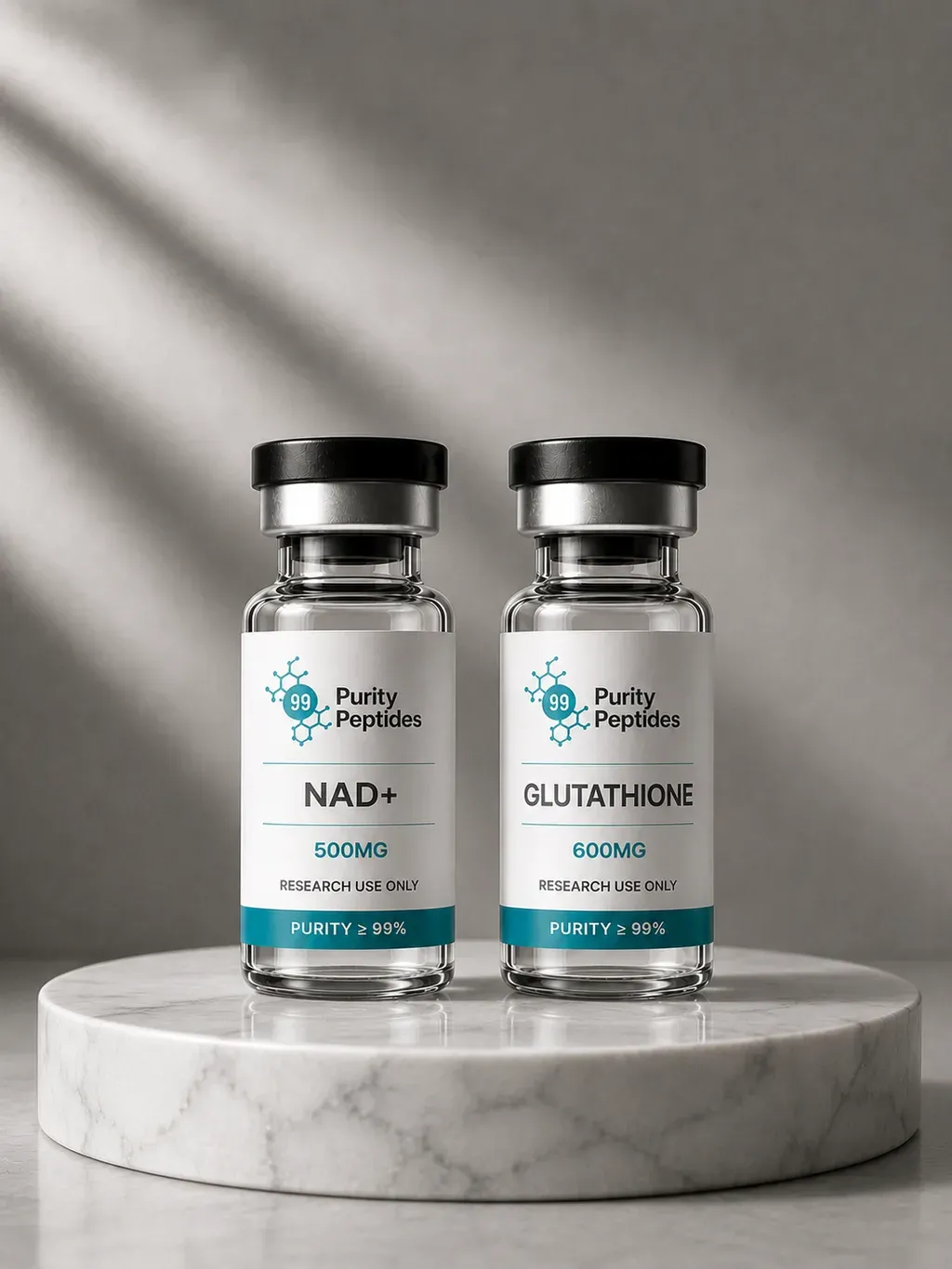
The Redox Research Pair supplies NAD+ at 500 mg and glutathione at 600 mg. Both are described as redox compounds, but they occupy different roles: glutathione is a thiol redox buffer and a direct antioxidant, while NAD+ is a redox cofactor carrying electrons in catabolic metabolism. The two connect indirectly, through NADP+ and NADPH. Supplied lyophilized. For research use only.
HPLC certified
Independent analysis
Highest standard
Full traceability
The Redox Research Pair brings together the two compounds most often grouped under cellular redox research, and the pairing is more useful once their roles are separated.
Glutathione is a tripeptide and the cell’s principal low-molecular-weight thiol. The ratio between its reduced form, GSH, and its oxidised dimer, GSSG, is a standard readout of cellular oxidative state, and glutathione performs antioxidant work directly through the free thiol on its cysteine residue.
NAD+ is a dinucleotide coenzyme rather than a peptide, and it is not an antioxidant. It carries electrons in catabolic metabolism, cycling between NAD+ and NADH, and the NAD+/NADH ratio reflects metabolic flux rather than oxidative stress. The two ratios therefore measure different variables.
The compounds do connect, indirectly. Glutathione reductase regenerates GSH from GSSG using NADPH — not NADH — and NADP+ is produced from NAD+ by NAD kinase. The route runs through three enzymatic steps and a separate pyridine nucleotide pool.
Glutathione is also an unusual peptide: its glutamate is joined through a gamma peptide bond rather than a standard backbone linkage, which is why no ribosome assembles it. Both compounds are supplied lyophilized with batch documentation.
For Research Use Only. Not intended for human consumption, therapeutic use, veterinary use, or diagnostic applications.
The Redox Research Pair is a two-vial set containing NAD+ at 500 mg and glutathione at 600 mg. Glutathione is a thiol redox buffer and a direct antioxidant; NAD+ is a redox cofactor that carries electrons in metabolism and is not an antioxidant. The two connect indirectly, through NADP+ and NADPH rather than directly.
| Compound | Mass | Molecular class | Redox role | Why it is included |
|---|---|---|---|---|
| NAD+ | 500 mg | Dinucleotide coenzyme | Electron carrier in catabolic metabolism | Represents the metabolic redox couple, NAD+/NADH |
| Glutathione | 600 mg | Tripeptide, gamma-linked | Thiol redox buffer and direct antioxidant | Represents the oxidative-state redox couple, GSH/GSSG |
Both are supplied as lyophilized material with batch documentation. On a molar basis the two masses are broadly comparable — roughly 750 µmol of NAD+ against roughly 1,950 µmol of glutathione — though salt form affects both figures.
Both compounds are routinely described as redox compounds. The word applies to each in a different sense, and the difference determines what an experiment using them can conclude.
Glutathione is the principal low-molecular-weight thiol in most cells. Its cysteine residue carries a free thiol group, which is the reactive site. Two glutathione molecules can oxidise to form the disulfide dimer GSSG, and glutathione reductase converts GSSG back to reduced glutathione.
The ratio between reduced and oxidised glutathione is itself a widely used measure of cellular oxidative state. Glutathione performs antioxidant work directly, acting as a substrate for glutathione peroxidases and participating in conjugation reactions through glutathione S-transferases.
NAD+ does not scavenge reactive species and does not reduce oxidised protein thiols. It is an electron carrier: catabolic dehydrogenases reduce NAD+ to NADH, and NADH delivers electrons into the electron transport chain.
NAD+ is separately consumed — not cycled — as a substrate by enzyme families including sirtuins and PARPs, which cleave it rather than reducing it. Neither role is antioxidant activity.
Vendor descriptions frequently present NAD+ as an antioxidant. That characterisation is incorrect, and a study built on it will attribute an observation to the wrong mechanism.
The GSH/GSSG ratio is a measure of oxidative state. The NAD+/NADH ratio is a measure of metabolic flux and energy state.
A researcher measuring one is not measuring the other, and the two can move independently. Grouping both under “redox” as though they were interchangeable readouts of a single variable produces experiments that do not measure what they report.
Be the first to share your experience with this product and help other researchers!
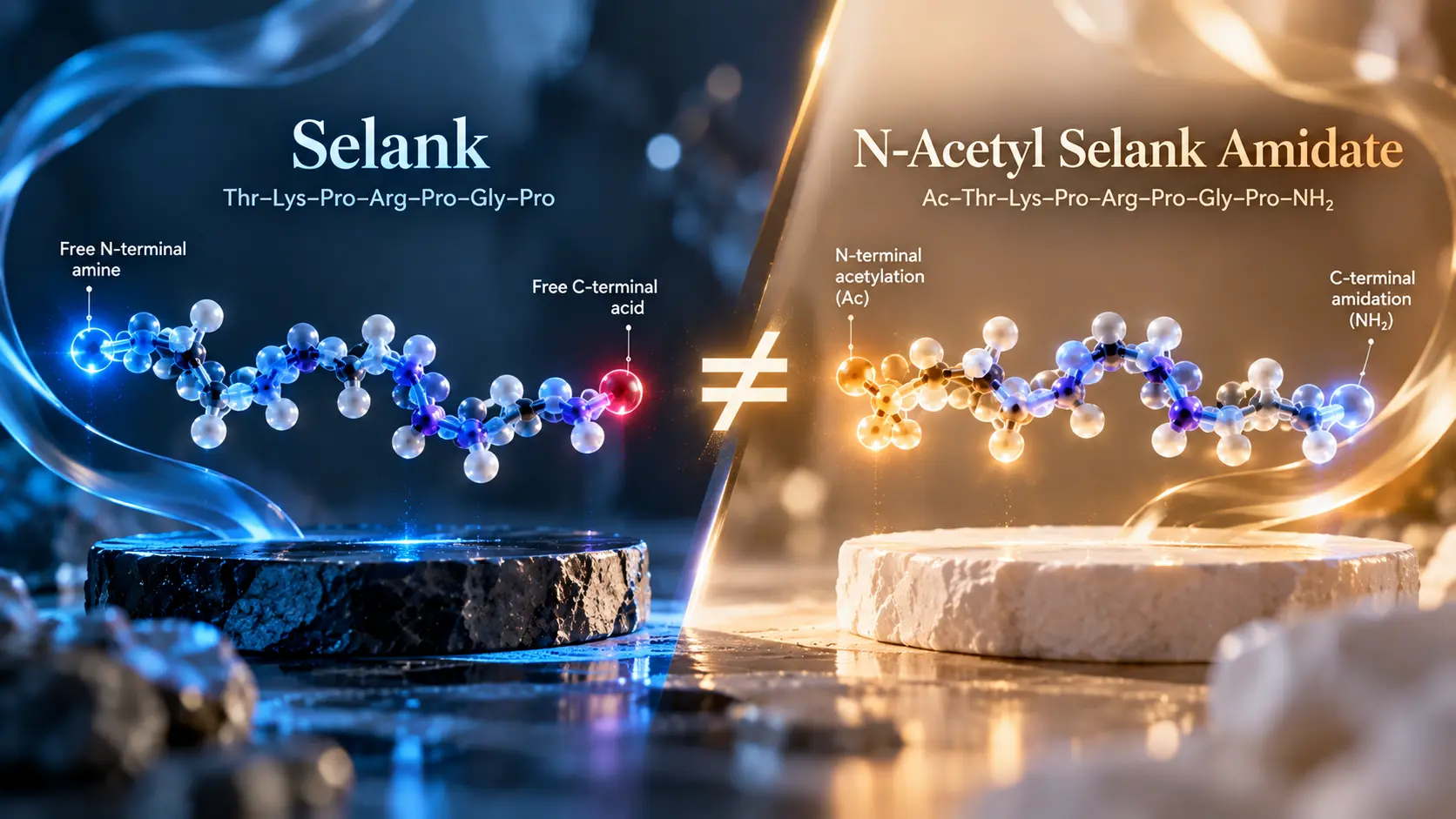
N-acetyl selank amidate is not Selank's full chemical name. Compare sequences, masses and database records, and learn how to tell the two apart on a COA.

Is CJC-1295 legal? It is not FDA-approved, left FDA Category 2 in 2024, was voted down for 503A compounding, and is banned by WADA. Verified status.
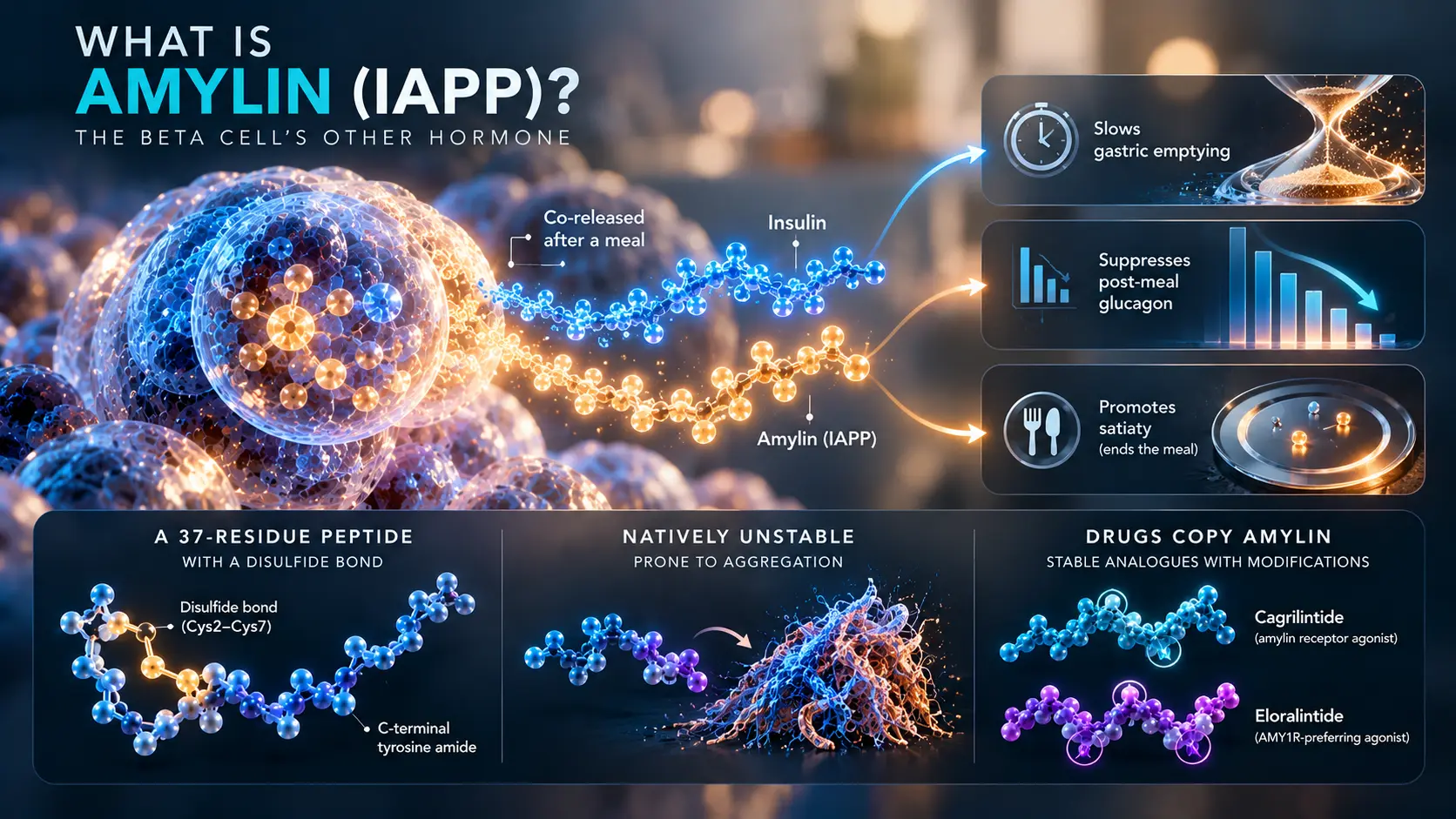
What is amylin? A 37-residue hormone the beta cell releases alongside insulin. Its real job, why it clumps, and how cagrilintide and eloralintide copy it.
(faqs)