GHRP-6 Research Peptide: Mechanism, Comparisons, and the Appetite-Stimulation Question
GHRP-6 has a longer research history than almost any other compound in the ghrelin-receptor-agonist family, which is exactly why it gets treated as the default reference point whenever GHRP-2, Hexarelin, or Ipamorelin come up for comparison. That reference-compound status is useful, but it also means a lot of supplier content leans on “GHRP-6 is the original” without actually explaining what sets it apart pharmacologically — particularly the appetite-stimulating effect that shows up in its literature far more prominently than in newer, more receptor-selective compounds.
Featured Product
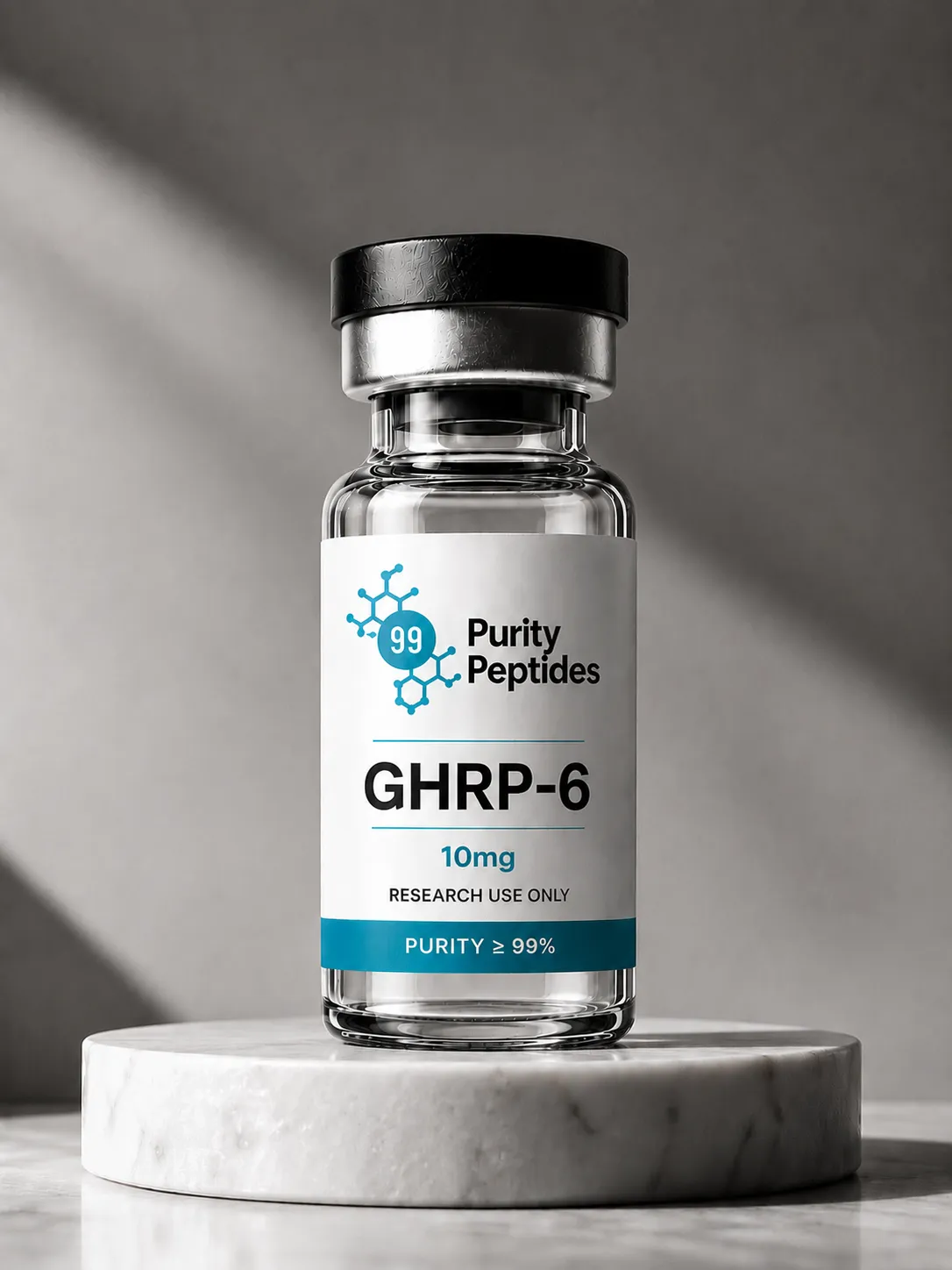
This article covers what GHRP-6 actually is, how it compares structurally and functionally to related ghrelin-receptor agonists, and what the evidence base does and doesn’t support — including the appetite-stimulation question, which is one of the more genuinely well-supported claims in this compound category rather than a vague marketing point. GHRP-6 is not FDA-approved for human or animal use, and nothing here should be read as dosing or administration guidance.
What Is GHRP-6? Origin and Classification
GHRP-6 is a synthetic hexapeptide — a six-amino-acid chain — and one of the first compounds developed in the growth hormone-releasing peptide (GHRP) class. It acts as an agonist at the ghrelin receptor (GHS-R1a), the same receptor endogenous ghrelin activates, and its discovery predates most of the other compounds now commonly compared to it, including GHRP-2 and Ipamorelin.
Because of that earlier development timeline, GHRP-6 shows up as the baseline reference compound in a large share of the foundational pharmacology literature on ghrelin-receptor agonists — which is part of why later compounds are so often described relative to it (“more selective than GHRP-6,” “less appetite effect than GHRP-6”) rather than the other way around.
Mechanism of Action: The Ghrelin Receptor Pathway
GHRP-6 binds GHS-R1a, triggering a signaling cascade in pituitary cells that results in growth hormone release — mechanistically the same receptor pathway used by GHRP-2 and Hexarelin, and distinct from the GHRH-receptor pathway used by compounds like CJC-1295 or Sermorelin.
Because ghrelin itself is also the body’s primary hunger-signaling hormone, and GHRP-6 mimics ghrelin’s activity at this receptor, it isn’t surprising that GHRP-6 carries appetite effects alongside its GH-releasing activity — that’s a direct consequence of activating the same receptor ghrelin normally does, not an unrelated side effect layered on top.
GHRP-6 vs. GHRP-2: The Complete Comparison
This is one of the two most common comparisons in this compound category (the GHRP-6 vs. Hexarelin comparison below is the other), and it deserves a direct answer.
Attribute | GHRP-6 | GHRP-2 |
|---|---|---|
Receptor target | Ghrelin receptor (GHS-R1a) | Ghrelin receptor (GHS-R1a) |
Structure | Synthetic hexapeptide | Synthetic hexapeptide |
Alternate names | — | Pralmorelin, KP-102, GPA-748 |
Research history | One of the earliest GHRP compounds; historical reference standard | Developed after GHRP-6; frequently compared against it |
Reported appetite-stimulating effect | More strongly associated with appetite stimulation in reported literature | Generally described as less pronounced than GHRP-6’s |
Reported relative GH-release potency | Reference compound in much of the earlier literature | Frequently reported as more potent for GH release in comparative literature |
The practical distinction: if a research design specifically needs to study or control for appetite-related ghrelin-receptor effects, GHRP-6’s more pronounced reported appetite activity is directly relevant. If appetite effects are a confound rather than a variable of interest, that’s exactly the kind of design consideration that should shape which compound is selected — not just “which one is newer” or “which one is more potent.”
GHRP-6 vs. Hexarelin vs. Ipamorelin
Compound | Receptor Pathway | Structural Class | Primary Research Distinction |
|---|---|---|---|
GHRP-6 | Ghrelin receptor (GHS-R1a) | Synthetic hexapeptide | Historical reference compound; strongest reported appetite-stimulating effect in this group |
Hexarelin | Ghrelin receptor (GHS-R1a) | Synthetic hexapeptide | Frequently reported in literature as one of the most potent GH secretagogues in this class; also referenced in some preclinical cardioprotective research models |
Ipamorelin | Ghrelin receptor (GHS-R1a) | Synthetic pentapeptide | Widely reported as the most receptor-selective of the group, with comparatively less reported impact on cortisol, prolactin, and appetite |
Ipamorelin’s development was explicitly aimed at improving on the selectivity limitations of earlier compounds like GHRP-6, which is a useful way to understand the compound family’s history: GHRP-6 established the receptor mechanism and baseline effect, and later compounds were designed to refine selectivity and reduce secondary effects like appetite stimulation and impact on cortisol and prolactin.
GHRP-6 and the Appetite-Stimulation Question
This is worth its own section because it’s one of the more consistently and directly supported claims in this compound category, rather than a vague, hard-to-verify comparative statement. Ghrelin’s role as the body’s primary orexigenic (appetite-stimulating) hormone is well established in endocrinology literature, and because GHRP-6 activates the same receptor ghrelin does, its appetite-stimulating activity in research models follows directly from that shared mechanism rather than requiring a separate, compound-specific evidence trail.
That said, the magnitude and consistency of that effect across different research contexts, dosing patterns, and study populations is a separate, more specific question than the general mechanism — and specific quantitative claims about appetite effect size should be sourced to a named, citable study rather than stated as a fixed, universal figure.
GHRP-6 in Dual-Receptor Research Designs
Like GHRP-2, GHRP-6 activates the ghrelin receptor rather than the GHRH receptor, so it’s frequently studied alongside GHRH-pathway compounds such as CJC-1295 No DAC in dual-receptor research designs exploring whether combined pathway activation produces an additive GH-release effect. In designs specifically studying appetite alongside GH release, GHRP-6’s more pronounced reported appetite activity can be either a relevant variable of interest or a confound to control for, depending on the specific research question.
What the Research Literature Actually Shows
GHRP-6 has one of the longer and more established literature bases in this compound category, given its early development relative to GHRP-2, Hexarelin, and Ipamorelin. The core mechanism — ghrelin-receptor agonism, GH release via pituitary stimulation, and appetite stimulation as a direct consequence of that same receptor activity — is well grounded in endocrinology and pharmacology literature.
Where the evidence gets thinner is in some of the more specific secondary claims that circulate in supplier and forum content, particularly around “cytoprotective” or “cardioprotective” effects sometimes attributed to ghrelin-mimetic peptides. Where such research exists, it frequently comes from preclinical or animal-model studies rather than established clinical findings in humans, and a responsible page should say so explicitly rather than let “cytoprotective peptide” sit in a keyword list without qualification. If your team can cite a specific, verifiable preclinical study, do so with the model system named directly; if not, this article shouldn’t manufacture that claim, and neither should your published content.
Purity, COA Verification, and Supplier Trust
The same trust concerns that apply across this compound category apply to GHRP-6. A meaningful certificate of analysis should show:
- HPLC purity result, specific to the tested batch
- LC-MS identity confirmation, verifying the molecule matches its labeled sequence
- Batch or lot number matching the specific vial received
- Named third-party testing laboratory, not an internal-only test
- Test date, since peptide stability can shift over time even under proper storage
Given how often GHRP-6 is bundled into generic “GH secretagogue” category listings without being tested and documented as its own specific compound, a batch-matched COA from a named lab remains the most reliable way to confirm what’s actually in a given vial.
Handling and Storage Principles
At a general level, lyophilized research peptides like GHRP-6 are typically stored frozen and protected from light and repeated temperature cycling prior to use, and supplier-specific storage guidance should always take precedence over generic advice. This article intentionally does not provide reconstitution ratios, volumes, or dosing protocols — those specifics depend on the intended research application and should be determined by qualified researchers following their own institutional protocols and the compound’s certificate of analysis, not a blog post.
Regulatory Status and Research-Use-Only Classification
GHRP-6 is not approved by the FDA for human or animal use. As with other compounds in this broader research-peptide category, its regulatory and compounding status can be subject to change over time, and any specific claims about current compounding-list status should be verified directly against the FDA’s public docket before publishing.
Common Myths About GHRP-6
Myth: GHRP-6 and GHRP-2 are functionally identical. They share a receptor target and structural class, but GHRP-6 is generally reported to have a stronger appetite-stimulating effect and different relative GH-release potency than GHRP-2.
Myth: Being “the original” GHRP compound makes GHRP-6 obsolete compared to newer options. Research history isn’t the same as research relevance — GHRP-6’s specific pharmacological profile, including its pronounced appetite activity, is exactly why it remains relevant for certain research designs and irrelevant for others.
Myth: GHRP-6’s appetite-stimulating effect is an unrelated side effect. It follows directly from the same ghrelin-receptor mechanism responsible for its GH-releasing activity — the two effects share a root cause, not a coincidence.
Myth: “Cytoprotective” and “cardioprotective” claims about GHRP-6 are established clinical facts. Where such research exists, it’s frequently from preclinical or animal-model studies, not established human clinical findings. That distinction should be stated plainly.
Myth: GHRP-6 is FDA-approved because it’s sold by professional-looking suppliers. Supplier presentation doesn’t change regulatory status. GHRP-6 remains a research-use-only compound with no FDA approval for human or animal use.
Conclusion
GHRP-6 is one of the original synthetic hexapeptide ghrelin-receptor agonists, and its long research history is exactly why so many newer compounds in this category — GHRP-2, Hexarelin, Ipamorelin — are described relative to it. Its most distinctive, well-supported characteristic is a pronounced appetite-stimulating effect that follows directly from its shared mechanism with endogenous ghrelin, which makes it relevant to some research designs and a confound in others. Secondary claims about cytoprotective or cardioprotective effects deserve more caution, since much of that evidence comes from preclinical models rather than established clinical findings. As with any research peptide, the most reliable way to evaluate a supplier is a real, batch-matched, third-party certificate of analysis.
Researchers comparing GHRP-6 to GHRP-2, Hexarelin, or Ipamorelin should review the current certificate of analysis, confirm third-party HPLC and LC-MS verification, and weigh the compound’s reported appetite-stimulation profile against their specific research design before purchasing. [Browse the GHRP-6 research peptide listing] and review the published COA before ordering.
Frequently Asked Questions
What is GHRP-6?
GHRP-6 is a synthetic hexapeptide that acts as a ghrelin receptor (GHS-R1a) agonist, studied for its growth hormone-releasing activity. It’s one of the earliest and most extensively referenced compounds in this class.
What is the difference between GHRP-6 and GHRP-2?
Both are synthetic hexapeptide ghrelin-receptor agonists, but GHRP-6 is generally reported to have a stronger appetite-stimulating effect, while GHRP-2 is frequently reported as more potent for GH release specifically.
Why does GHRP-6 stimulate appetite?
Because it activates the ghrelin receptor, the same receptor endogenous ghrelin uses to signal hunger. The appetite effect follows directly from that shared mechanism.
How does GHRP-6 compare to Hexarelin?
Both are ghrelin-receptor agonists in the same hexapeptide structural class, but Hexarelin is frequently reported in literature as one of the more potent GH secretagogues and has also been referenced in some preclinical cardioprotective research models.
How does GHRP-6 compare to Ipamorelin?
Ipamorelin is a synthetic pentapeptide developed to improve on GHRP-6’s selectivity limitations, and is widely reported as having less impact on appetite, cortisol, and prolactin.
Is GHRP-6 the original GHRP compound?
It’s one of the earliest compounds developed in the GHRP class and is frequently used as the reference point against which newer compounds like GHRP-2 and Ipamorelin are compared.
Why is GHRP-6 studied alongside GHRH analogs like CJC-1295?
Because GHRP-6 activates the ghrelin receptor while GHRH analogs activate a separate receptor, dual-receptor research designs study whether combining both pathways produces an additive GH-release effect.
Is GHRP-6’s cytoprotective research well established?
Some cytoprotective and cardioprotective research on ghrelin-mimetic peptides comes from preclinical or animal-model studies rather than established clinical findings in humans. This distinction should be stated clearly rather than implied as settled science.
Is GHRP-6 FDA approved?
No. GHRP-6 is not FDA-approved for human or animal use and is classified strictly as a research-use-only compound.
How do I know if a GHRP-6 supplier is legitimate?
Look for a batch-matched certificate of analysis from a named third-party lab showing both HPLC purity and LC-MS identity confirmation, rather than relying on the product name or a purity percentage alone.
Does GHRP-6 have a stronger appetite effect than Ipamorelin?
Yes, based on comparative literature — Ipamorelin was specifically developed to be more receptor-selective, with a comparatively lower reported appetite-stimulating effect than GHRP-6.
What structural class does GHRP-6 belong to?
It’s a synthetic hexapeptide — a six-amino-acid chain — within the broader growth hormone-releasing peptide (GHRP) class of ghrelin-receptor agonists.
Is GHRP-6 more potent than GHRP-2 for GH release?
Comparative literature more frequently reports GHRP-2 as the more potent compound for GH release specifically, while GHRP-6’s more distinctive property is its appetite-stimulating effect.
Can GHRP-6 be studied alongside GHRP-2 in the same research design?
Some comparative or combination research designs may examine both compounds, but that’s a study-specific decision based on the particular research question, not a general recommendation.
What should a GHRP-6 certificate of analysis include?
HPLC purity results, LC-MS identity confirmation, a batch number matching the received vial, the name of the third-party testing lab, and the test date.