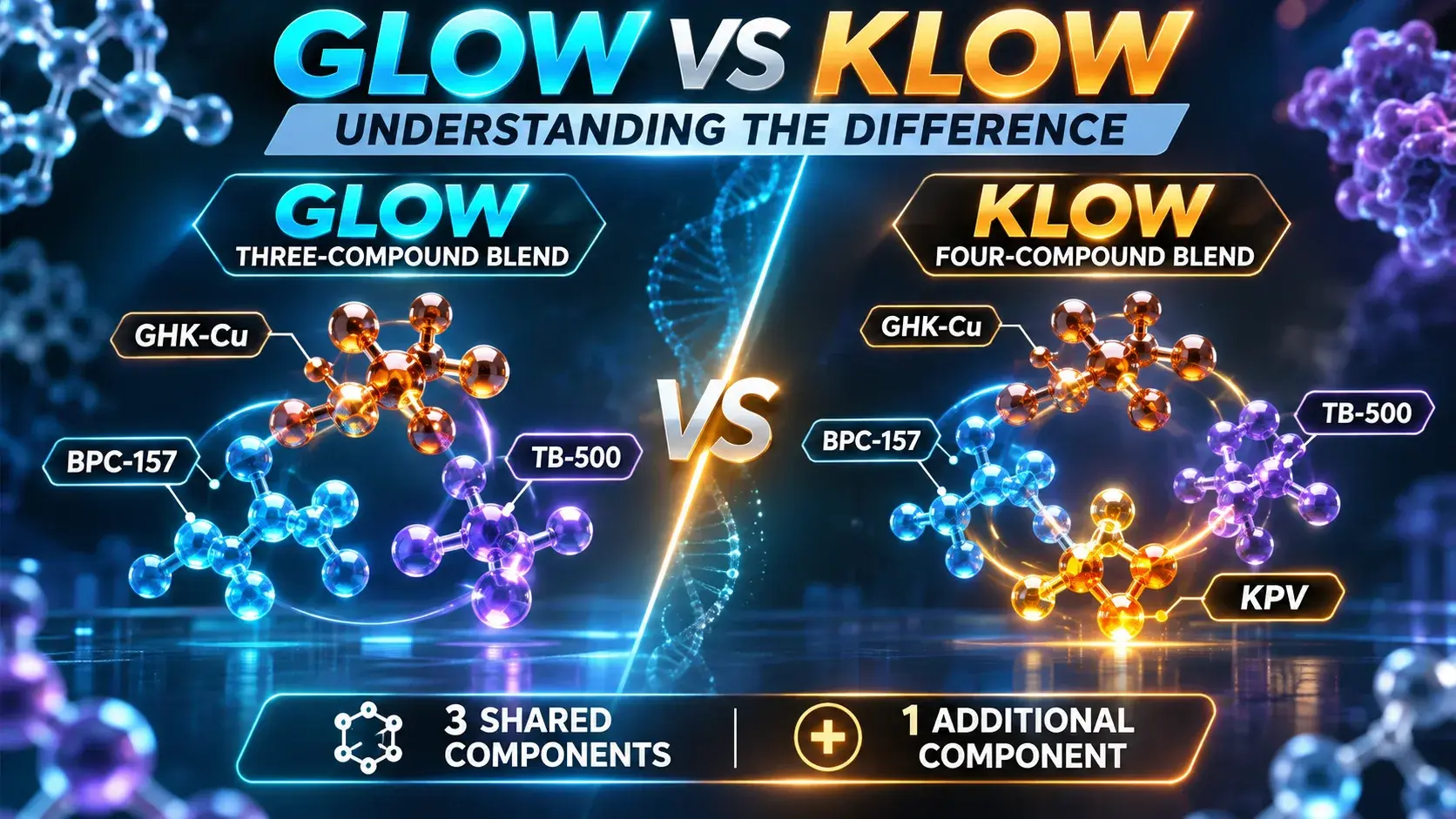
Quick Answer KLOW is GLOW plus 10 mg of KPV. GLOW holds GHK-Cu 50 mg, BPC-157 10 mg, and TB-500 10 mg for 70 mg total. KLOW holds the same three amounts plus KPV 10 mg for 80 mg total. The extra 10 mg is KPV alone. It does not raise the amount of any shared peptide. Total blend weight does not tell you the concentration of each component, the purity of each component, or the quality of the vial. You need the component list, the ratio, and the analytical record for each component.
Research Use Only disclaimer This article is for laboratory research information only. GLOW and KLOW are research materials. They are not approved medicines. They are not for human or veterinary use. No part of this article gives a dose, an injection instruction, or a treatment recommendation. Concentration math in this article is arithmetic only. It is not dose guidance.
Key Takeaways
- GLOW is a three peptide blend at 70 mg total. KLOW is a four peptide blend at 80 mg total. The difference is KPV at 10 mg.
- GHK-Cu is 50 mg in both vials. BPC-157 is 10 mg in both vials. TB-500 is 10 mg in both vials. KPV is present only in KLOW.
- GHK-Cu is 71.4 percent of GLOW by mass and 62.5 percent of KLOW by mass. The absolute amount stays at 50 mg in both.
- A higher total does not mean a higher concentration for each component. At the same hypothetical final volume, the shared components have the same concentration in both blends.
- Blend purity is not the same as individual peptide purity. A single purity figure can hide which component was tested and how it was calculated.
- No published study has tested GLOW or KLOW as a blend. The evidence is component level only, mostly from cell culture and animal models.
- A pre-blended vial fixes the ratio. Separate component vials let a researcher set each amount on its own and run single-component arms.
- The 99 Purity Peptides COA portal lists KLOW at 99.68 percent, batch KLOW-WM2610-003, analyzed 16 November 2026, and GLOW at 99.87 percent, batch GLOW-WM2607-001, analyzed 11 August 2026. Those figures are for those batches only.
- The product pages for the KLOW component control set and the GLOW and KLOW comparative pair returned 404 on 28 November 2026. This article does not link to them.
What GLOW 70 mg and KLOW 80 mg actually contain
KLOW holds one more peptide than GLOW. That is the whole compositional difference on the stated labels. The shared peptides do not change in amount when KPV is added. The vial total changes because a fourth component is added, not because the first three grow.
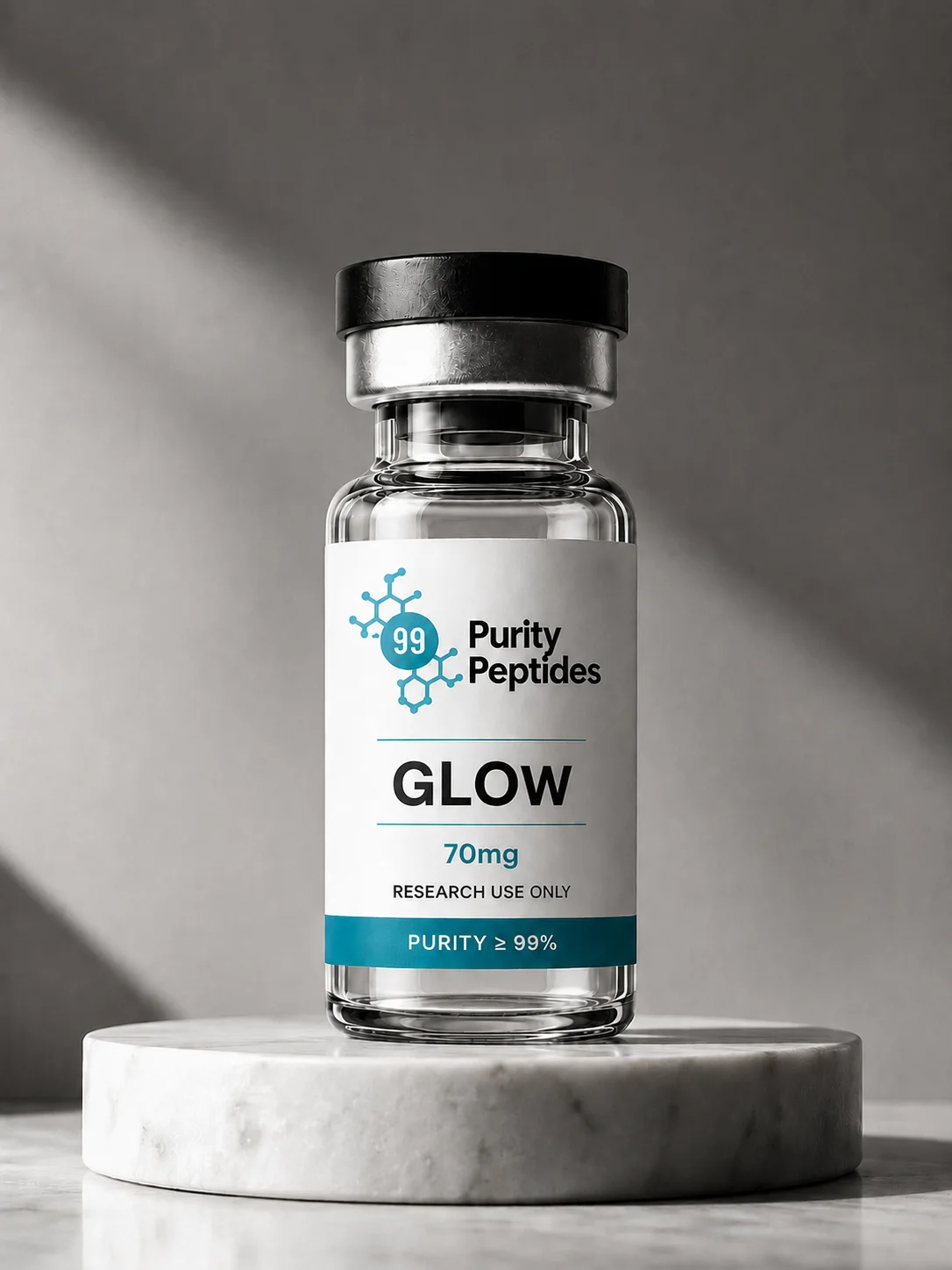
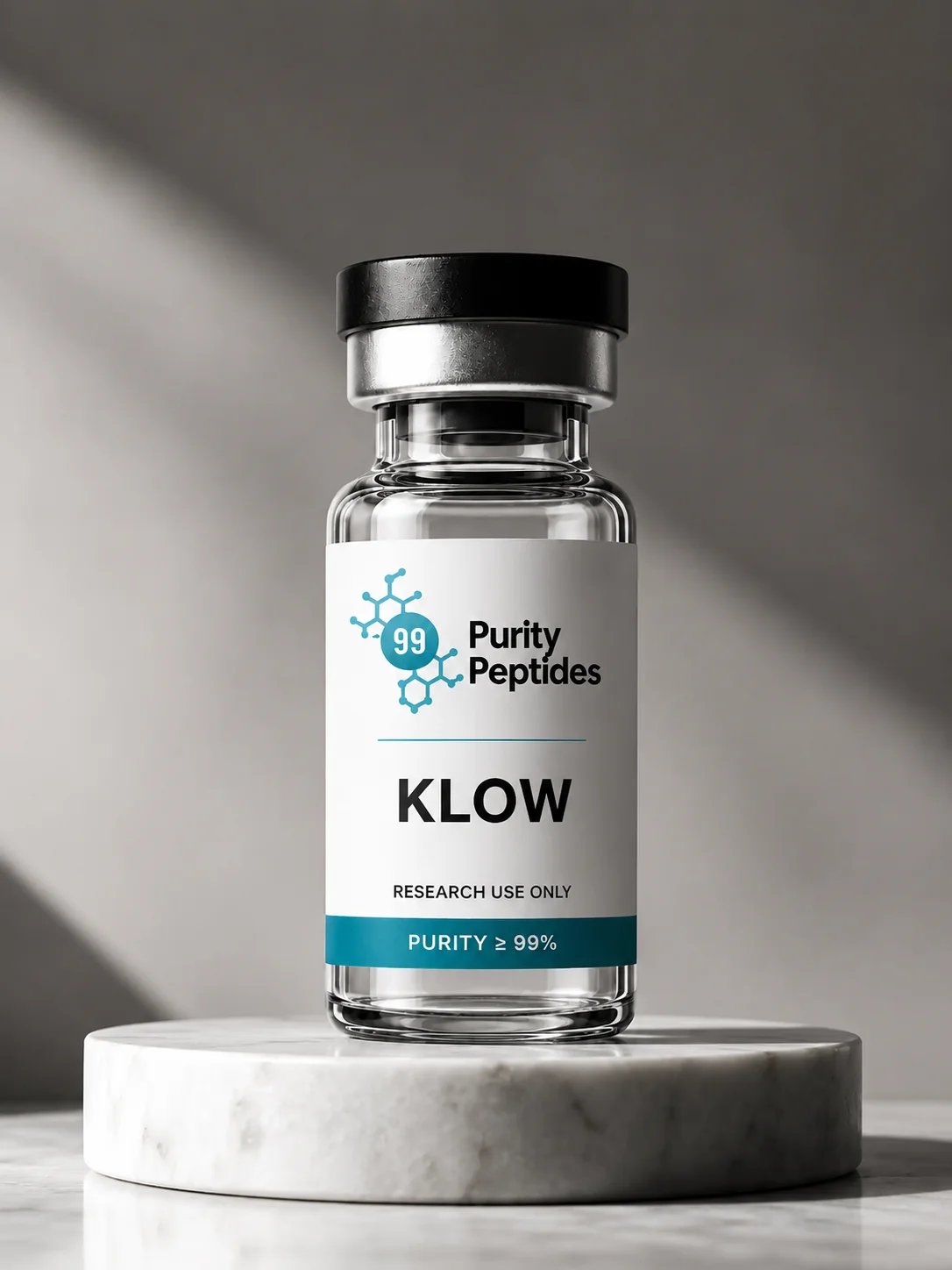
GLOW is listed on the 99 Purity Peptides product page as GLOW 50mg/10mg/10mg 3ML [1]. KLOW is listed as KLOW 50mg/10mg/10mg/10mg 3ML [2]. The product pages claim 99 percent or higher HPLC purity and third-party testing on both pages. The body text on both pages is general. It does not name the components in prose. The component assignment used in this article follows the standard vendor convention used by all three competitors in the research for this article, and it matches the site COA portal entries for the single components. The writer must treat the title numbers as the primary official source for the split, and the lot COA as the check for the batch in hand.
Comparison field | GLOW 70 mg | KLOW 80 mg |
|---|---|---|
Total stated blend weight | 70 mg | 80 mg |
Listed components | GHK-Cu, BPC-157, TB-500 | GHK-Cu, BPC-157, TB-500, KPV |
Individual component quantities | GHK-Cu 50 mg, BPC-157 10 mg, TB-500 10 mg | GHK-Cu 50 mg, BPC-157 10 mg, TB-500 10 mg, KPV 10 mg |
Component ratios by mass | 5 to 1 to 1 | 5 to 1 to 1 to 1 |
KPV inclusion | Not present | Present at 10 mg |
Component level documentation | Not publicly disclosed as a separate blend COA field | Not publicly disclosed as a separate blend COA field |
Blend level analytical documentation | COA portal lists 99.87 percent, batch GLOW-WM2607-001, analyzed 11 August 2026 | COA portal lists 99.68 percent, batch KLOW-WM2610-003, analyzed 16 November 2026 |
Total peptide content | 70 mg labeled | 80 mg labeled |
Testing laboratory | Not publicly disclosed on the product page | Not publicly disclosed on the product page |
Important limitations | Body text does not name components in prose | Body text does not name components in prose |
The table uses the product titles for the split. It does not invent a per-component purity figure. It does not invent a per-component measured content figure. Those fields are not publicly disclosed on the product pages checked on 28 November 2026. A reader who needs them should ask for the lot COA and read it before comparing blends.
Why a blend name is not a specification
GLOW and KLOW are product names. They are not chemical names. No naming authority registers either name as a single substance. Two sellers can use the same name for different mixtures. One seller can change a ratio and keep the name. That is why the label matters more than the name on the front.
Veridae states the point in plain words. Nothing in either name fixes the contents, so two sellers could put different mixtures under the same name [5]. AKH Bio Labs makes the same point with its own lots. Each blend has its own certificate, with its own batch number, test date, and results string [6]. Side-Line puts it in research terms. A blend name is an index rather than a specification, and two vials sharing a name are not automatically comparable research inputs [7].
The 99 Purity Peptides prices on 28 November 2026 were $91.80 for GLOW and $108.00 for KLOW [1][2]. Price does not rank quality. A higher price can reflect a larger total, a different batch, or a different cost base. It does not prove a higher purity or a better analytical record. Compare the component list and the COA first. Use price only after those checks.
What the official pages do and do not state
The official pages state the title split, the price, the in-stock status, and the claims of 99 percent or higher HPLC purity and third-party testing. The COA portal adds batch level figures. It lists 63 batches verified, with HPLC and mass spectrometry from independent third-party US laboratories [3]. For KLOW, it lists 99.68 percent, batch KLOW-WM2610-003, analyzed 16 November 2026. For GLOW, it lists 99.87 percent, batch GLOW-WM2607-001, analyzed 11 August 2026. Those are the 99 Purity figures to use. Do not use a competitor lot as if it were a 99 Purity lot.
The official pages do not state the laboratory name for each blend lot on the product page. They do not state per-component purity for the blend. They do not state per-component measured content for the blend. They do not state counterion content, excipient content, or residual moisture. They do not state a manufacturer reason for including KPV. This article shows those fields as not publicly disclosed. That is more honest than filling them with a guess.
What BPC-157 TB-500 KPV and GHK-Cu are in these blends
Each component has its own identity. Each one has its own research record. No finding for one component proves a result for the blend. The blend has not been studied as a blend.
Component | What it is | Formula and mass |
|---|---|---|
GHK-Cu | Copper complex of the tripeptide glycyl-histidyl-lysine, also called prezatide copper | C14H23CuN6O4+, 402.92 g/mol, PubChem CID 71587328 [8] |
BPC-157 | Synthetic 15 amino acid peptide, Gly-Glu-Pro-Pro-Pro-Gly-Lys-Pro-Ala-Asp-Asp-Ala-Gly-Leu-Val | C62H98N16O22, 1419.5 g/mol, PubChem CID 9941957 [9] |
TB-500 | Name used for thymosin beta-4 related material, see the identity note below | Fragment Ac-LKKTETQ, C38H68N10O14, 889.0 g/mol, PubChem CID 62707662 [11], or full thymosin beta-4, C212H350N56O78S, 4963 g/mol, PubChem CID 16132341 [12] |
KPV | Tripeptide Lys-Pro-Val, residues 11 to 13 of alpha-MSH, also listed as MSH (11-13) | C16H30N4O4, 342.43 g/mol, PubChem CID 125672 [10] |
The GHK ligand alone, without copper, is C14H24N6O4, 340.38 g/mol, PubChem CID 73587 [13]. The copper complex mass depends on the salt form. PubChem also lists a 1 to 1 complex at 400.90 g/mol, CID 139035031, and a bis form with two GHK ligands per copper at 742.3 g/mol, CID 9831891. This article uses 402.92 g/mol for the 1 to 1 prezatide copper form in its molar math. A different salt form would change the molar result. The COA should state the form used.
GHK-Cu and the copper complex
GHK-Cu is a small copper binding tripeptide. It was first isolated from human plasma in 1973 by Loren Pickart, as reported in the competitor research and in the wider literature. Laboratory work on it clusters around extracellular matrix signaling, collagen related gene expression, and metalloproteinase activity in cultured fibroblast models [7].
The blue tint of GLOW and KLOW powder comes from the copper complex. Veridae explains the color with a textbook example. A copper (II) complex absorbs orange and red light, and the eye sees the complementary blue color [5]. A 2021 study in Inorganic Chemistry measured the absorption band of the GHK copper complex at 606 nm. That is close to orange light, which is why the complex reads as blue. The tint tells you a copper complex is present. It does not tell you how much is present, how pure it is, or whether the other components are present at all. Color is an observation. The report is the measurement.
GHK-Cu is 50 mg in both vials on the stated labels. It is the largest component by mass in both blends. It dominates the vial by mass, and it dominates even more by molecule count, as shown in the ratio section below. That does not make it the most important component for every research question. It makes it the largest share of the powder.
BPC-157 and TB-500 and the identity problem with TB-500
BPC-157 is a 15 amino acid peptide derived from a partial sequence of a protein found in human gastric juice. Its research record is mostly rodent work on tendon, ligament, muscle, and gastrointestinal injury. Human data are limited. The evidence does not establish a human benefit.
TB-500 needs a clear identity note. The name is used for two different materials. One is the synthetic fragment Ac-LKKTETQ, seven amino acids, residues 17 to 23 of thymosin beta-4, with a mass of about 889 Da [11]. The other is full-length thymosin beta-4, 43 amino acids, with a mass of about 4963 Da [12]. Most published efficacy data attributed to TB-500 were generated with the full-length protein, not the fragment. A reader who uses the wrong mass in a molar calculation will get a wrong molar ratio by a factor of about 5.6.
Veridae cites the full protein in its table, with a mass of about 5053 Da for the UniProt entry, and notes that the exact peptide in a vial is defined by its reference standard [5]. AKH Bio Labs calls TB-500 a fragment based analogue of thymosin beta-4, and notes that phase 2 wound trials in that literature used the full-length peptide rather than the fragment [6]. The 99 Purity COA portal lists TB-500 as a single component at 99.18 percent, batch TB5-MW2610-001, analyzed 15 November 2026, but it does not state in the portal text whether that lot is the fragment or the full protein [3]. This article therefore gives both masses, uses the fragment mass for its molar example, and labels that choice plainly. Do not present a molar share for TB-500 as settled until the lot COA states the identity.
KPV and why it changes the research question
KPV is Lys-Pro-Val. It is the C-terminal tripeptide of alpha-melanocyte-stimulating hormone, alpha-MSH. Its research literature sits in a different area from the other three components. It covers NF-kB inflammatory signaling, pro-inflammatory cytokine readouts such as TNF-alpha and IL-6, epithelial tight junction and barrier integrity work in mucosal cell models, and PepT1 mediated cellular uptake [7].
In KLOW, KPV occupies the inflammation side of the component set. The other three components are studied for fibroblast migration and vascular recruitment, actin mediated cell motility, and collagen synthesis and matrix remodeling. KPV is the component studied for inflammatory signaling. GLOW has no equivalent fourth component. Its three peptides cover migration, motility, and matrix remodeling, but not the alpha-MSH derived inflammation pathway [6].
Why is KPV in KLOW but not GLOW? The compositional answer is simple. KLOW adds KPV at 10 mg. GLOW does not list it. The manufacturer reason is not publicly disclosed on the product pages checked on 28 November 2026. This article does not invent a reason. It gives the scientific context for KPV separately, and it keeps that context apart from the manufacturer decision. A reader should not read a literature summary as a statement of why a company chose a formulation.
No study has tested KPV together with GHK-Cu, BPC-157, and TB-500 as a four component blend. The same limit applies to GLOW. No study has tested those three together as a blend. The available literature is component level. It describes individual peptides, mostly in cell culture and animal models. It does not establish a combined effect, a synergy, or a human outcome.
How component ratios work and why total weight misleads
An 80 mg blend does not hold more of each peptide than a 70 mg blend. On the stated labels, it holds the same amount of each shared peptide, plus 10 mg of KPV. Total weight rises because a component is added. It does not rise because the shared components grow.
Total blend weight is a sum. It is the mass of all components added together. Individual component mass is the mass of one named peptide in that sum. A total can hide a split. Two vials can share a total and hold different components. Two vials can differ in total and hold the same amount of a given component. That is the case here.
Total blend mass and individual component mass
Start with a clearly labeled hypothetical example. Imagine two blends. Blend A holds 40 mg of peptide X and 30 mg of peptide Y, for 70 mg total. Blend B holds 40 mg of peptide X, 30 mg of peptide Y, and 10 mg of peptide Z, for 80 mg total. Blend B has a higher total. It does not have more X or more Y. It has the same X and the same Y, plus Z. A reader who compares only the totals would miss that fact.
GLOW and KLOW follow the same pattern on the stated labels. GLOW holds GHK-Cu 50 mg, BPC-157 10 mg, and TB-500 10 mg. KLOW holds GHK-Cu 50 mg, BPC-157 10 mg, TB-500 10 mg, and KPV 10 mg. The three shared amounts are identical. The 10 mg difference is KPV alone.
Mass ratios and percentage composition
A mass ratio compares one component mass with another. A percentage composition divides one component mass by the total blend mass and multiplies by 100. Both need the labeled masses. Both are arithmetic on the label, not analytical measurements.
For GLOW, the mass ratio is 5 to 1 to 1. GHK-Cu is 50 mg, BPC-157 is 10 mg, and TB-500 is 10 mg. For KLOW, the mass ratio is 5 to 1 to 1 to 1. GHK-Cu is 50 mg, and BPC-157, TB-500, and KPV are 10 mg each.
Component | GLOW mass | GLOW share by mass | KLOW mass | KLOW share by mass |
|---|---|---|---|---|
GHK-Cu | 50 mg | 71.4 percent | 50 mg | 62.5 percent |
BPC-157 | 10 mg | 14.3 percent | 10 mg | 12.5 percent |
TB-500 | 10 mg | 14.3 percent | 10 mg | 12.5 percent |
KPV | Not present | 0 percent | 10 mg | 12.5 percent |
Total | 70 mg | 100 percent | 80 mg | 100 percent |
The math is simple. For GLOW, 50 divided by 70 equals 0.714, or 71.4 percent. For KLOW, 50 divided by 80 equals 0.625, or 62.5 percent. For each 10 mg component in GLOW, 10 divided by 70 equals 0.143, or 14.3 percent. For each 10 mg component in KLOW, 10 divided by 80 equals 0.125, or 12.5 percent.
GHK-Cu falls as a share from 71.4 percent to 62.5 percent when KPV is added. Its absolute mass stays at 50 mg. A share change is not a dose change. A reader who sees the share fall might think GHK-Cu was reduced. It was not reduced on the stated labels. The total grew around it.
Mass share versus molar share
Equal milligrams are not equal moles. A mole counts molecules. A milligram counts mass. A small molecule gives more moles per milligram than a large molecule. That matters here because the four components differ sharply in size.
Use the verified masses from PubChem. GHK-Cu as prezatide copper is 402.92 g/mol [8]. BPC-157 is 1419.5 g/mol [9]. KPV is 342.43 g/mol [10]. TB-500 as the Ac-LKKTETQ fragment is 889.0 g/mol [11]. The molar amount is mass in mg divided by molar mass in g/mol, which gives millimoles.
For GLOW, GHK-Cu gives 50 divided by 402.92, or 0.124 millimoles. BPC-157 gives 10 divided by 1419.5, or 0.007 millimoles. TB-500 as fragment gives 10 divided by 889.0, or 0.011 millimoles. The total is 0.142 millimoles. GHK-Cu is 87.1 percent of the molecules, BPC-157 is 4.9 percent, and TB-500 is 7.9 percent.
For KLOW, add KPV at 10 divided by 342.43, or 0.029 millimoles. The total is 0.172 millimoles. GHK-Cu is 72.3 percent of the molecules, BPC-157 is 4.1 percent, TB-500 is 6.6 percent, and KPV is 17.0 percent.
Component | GLOW moles | GLOW share by moles | KLOW moles | KLOW share by moles |
|---|---|---|---|---|
GHK-Cu | 0.124 mmol | 87.1 percent | 0.124 mmol | 72.3 percent |
BPC-157 | 0.007 mmol | 4.9 percent | 0.007 mmol | 4.1 percent |
TB-500 as fragment | 0.011 mmol | 7.9 percent | 0.011 mmol | 6.6 percent |
KPV | Not present | 0 percent | 0.029 mmol | 17.0 percent |
Total | 0.142 mmol | 100 percent | 0.172 mmol | 100 percent |
These molar shares use the fragment identity for TB-500 and the 1 to 1 copper complex for GHK-Cu. If TB-500 were the full protein at 4963 g/mol, its molar amount would fall to 0.002 millimoles, and GHK-Cu would rise to about 93 percent of the molecules in GLOW. If GHK-Cu were a different salt form, its molar amount would shift as well. Molar math is useful only when the identity and the salt form are stated. The COA should state them.
How blend concentration is calculated
Concentration is mass divided by volume. Total blend concentration is total blend mass divided by final solution volume. Individual component concentration is that component mass divided by the same final solution volume. Both need a volume. A label total alone cannot give a concentration.
Use clearly labeled hypothetical volumes. The volumes below are not a reconstitution instruction. They are arithmetic examples to show how the math works. The product titles include 3ML, which describes the vial size, not a stated reconstitution volume. Do not read 3 mL as a recommended volume.
At a hypothetical final volume of 2 mL, GLOW gives a total concentration of 70 divided by 2, or 35.0 mg per mL. KLOW gives 80 divided by 2, or 40.0 mg per mL. The per-component results show the key point.
Component | GLOW at 2 mL | KLOW at 2 mL |
|---|---|---|
GHK-Cu | 25.0 mg per mL | 25.0 mg per mL |
BPC-157 | 5.0 mg per mL | 5.0 mg per mL |
TB-500 | 5.0 mg per mL | 5.0 mg per mL |
KPV | Not present | 5.0 mg per mL |
Total blend | 35.0 mg per mL | 40.0 mg per mL |
Total concentration rises from 35.0 to 40.0 mg per mL. The shared component concentrations do not rise. GHK-Cu stays at 25.0 mg per mL in both. BPC-157 and TB-500 stay at 5.0 mg per mL in both. Only KPV appears as a new 5.0 mg per mL line in KLOW.
At a hypothetical final volume of 3 mL, the same pattern holds at lower numbers. GLOW gives a total of 70 divided by 3, or 23.33 mg per mL. KLOW gives 80 divided by 3, or 26.67 mg per mL. GHK-Cu is 16.67 mg per mL in both. Each 10 mg component is 3.33 mg per mL in both. KPV adds a 3.33 mg per mL line in KLOW only.
More volume lowers every concentration by the same factor. Less volume raises every concentration by the same factor. The ratio between components never changes when volume changes. A calculator that takes a single total mass and a single volume can give a total concentration. It cannot give per-component concentrations unless it also takes each component mass as a separate input.
The 99 Purity Peptides calculator is live at /peptide-calculator [4]. In the page text checked on 28 November 2026, it takes one vial mass in mg, one diluent volume in mL, and one target dose in mcg, and it outputs U-100 syringe units. No blend mode was found in that page text. It does not ask for a second, third, or fourth component. It cannot split a blend into per-component amounts. It cannot verify a product composition, purity, or quality. A calculator only processes the values entered by the user. The brief path /klow-peptide-reconstitution-concentration-reference was not confirmed live in search on 28 November 2026, so this article does not link to it. The math in this section is the reference a reader needs, with every assumption stated.
How blend purity differs from individual peptide purity
Purity and content are different numbers. Purity is a share. Content is an amount. A vial can have a high purity figure and still hold less peptide than the label states. A vial can hold the labeled amount and still have a low purity figure. You need both numbers, per component, to compare blends.
What HPLC purity means for one peptide
HPLC, or high-performance liquid chromatography, pushes a dissolved sample through a packed column so the mixture separates into its components. A detector records each compound as a peak at the time it leaves, its retention time. For a single compound, HPLC purity is the main peak area divided by the total area of every peak, multiplied by 100. The Japanese Pharmacopoeia calls this the peak area percentage method, as cited by Veridae [5].
A single-compound vial should give one large peak plus a few small impurity peaks. The purity figure tells you what share of the detector area belongs to the named peak. It does not by itself tell you how many milligrams are in the vial. That needs a separate assay against a reference standard.
What a blend purity figure can and cannot mean
A blend has no single main peak. It has three large peaks for GLOW and four large peaks for KLOW, plus impurity peaks. A blend purity figure usually means the combined area of the named component peaks divided by the total area of all peaks, multiplied by 100. A report should say how its figure was calculated. If it gives one number and no method note, ask the laboratory whether it is the combined figure or the figure for one component.
Here is a worked example with invented round numbers, following the Veridae method [5]. A three-component blend gives these peak areas. Component peaks are 610,000, 205,000, and 175,000. Two small impurity peaks are 6,000 and 4,000. The total area is 610,000 plus 205,000 plus 175,000 plus 6,000 plus 4,000, which equals 1,000,000. The component peaks add to 990,000. Purity is 990,000 divided by 1,000,000, multiplied by 100, which equals 99.00 percent. The numbers are invented to show the arithmetic. They are not a result for any real lot.
Peak area is not weight. Different compounds absorb ultraviolet light differently, so equal milligrams can give very different peak sizes. The Japanese Pharmacopoeia states that accurate proportions require correcting each area by its relative response factor, as cited by Veridae [5]. On a GLOW chromatogram, the peak sizes will rarely line up with the 50, 10, and 10 mg on the label, and that alone is not a sign of a problem.
The way to measure how much of each component is in the vial is an assay against a reference standard for each component. For a blend, that means one reference standard and one calibration for each component. The result you want is content per component, milligrams of each named peptide next to its labeled amount. A total alone shows the vial holds about the right weight of peptide overall. It cannot show that the split matches the label.
HPLC and LC-MS in a mixture
HPLC separates. LC-MS identifies. HPLC gives retention time and peak area. LC-MS gives a measured mass for each peak. A retention time match says a peak leaves the column when the reference does. It does not prove nothing else leaves at that moment too. Mass spectrometry after HPLC gives each component peak its own measured mass, and it is the stronger confirmation [5].
The hard part in a blend is keeping the peaks apart. If two components leave the column at nearly the same time, their peaks overlap and neither can be measured cleanly. ICH Q2(R2), the international guideline on validating analytical procedures, states that for critical separations, specificity can be shown by the resolution of the two components that elute closest to each other, as cited by Veridae [5]. A method that works for each peptide on its own still has to be shown to separate them when they are run together.
KLOW is harder than GLOW in this respect. It has four components, including two low mass tripeptides, GHK-Cu and KPV. It has six pairwise relationships to resolve, against three for GLOW. Side-Line makes the same point in design terms. A single aggregate purity figure for a mixture is close to meaningless, because the technique is measuring relative absorbance across a sample that is supposed to contain four distinct species [7]. Credible documentation resolves each constituent separately, with identity confirmed by molecular weight through MS analysis, purity determined per component by HPLC, quantity stated in milligrams so molar ratios can be reconstructed, and lot level traceability that ties the record to the vial in hand.
Nominal weight versus actual analytical content
Nominal fill weight is the labeled amount. Measured content is the amount found by assay. Net peptide content is the amount of actual peptide after counterions, excipients, and residual moisture are taken out. Analytical purity is a share of detector area. These are four different measurements. Do not describe one as proof of the others.
A purity figure can be high while measured content is low, because residual salt and moisture occupy part of the lyophilized cake. Purity describes the proportion of the peptide fraction that is the intended sequence. It says nothing on its own about how much of that sequence is present, as Side-Line notes [7]. A blend COA that gives only a total measured content, such as the Veridae lots at 73.70 mg for a 70 mg label and 85.02 mg for an 80 mg label, shows the vial holds about the labeled weight overall, at 105.3 percent and 106.3 percent respectively [5]. It does not show that each component matches its label. Those Veridae lots are Veridae lots. They are not 99 Purity lots.
For 99 Purity, the COA portal lists single-component lots as well as blend lots [3]. GHK-Cu is listed at 99.51 percent, batch CU50-WM2610-01, analyzed 19 October 2026. BPC-157 is listed at 99.14 percent, batch BC5-MW2610-001, analyzed 15 November 2026. TB-500 is listed at 99.18 percent, batch TB5-MW2610-001, analyzed 15 November 2026. KPV is listed at 99.27 percent, batch KPV5-MW2610-001, analyzed 14 November 2026. Those are separate single-component lots, with different batch numbers and dates. They do not add up to a blend purity figure. An individual component COA does not automatically establish the composition or analytical quality of the finished blend. A blend level report may not disclose every individual component quantity or impurity profile. Read both, and do not sum them as if they were one test.
How pre-blended vials differ from separate component control sets
A pre-blended vial and a set of separate component vials are different research tools. They are not the same product in different packaging. One fixes the ratio. The other leaves the ratio open. That choice changes what a study can prove.
What a pre-blended vial fixes at manufacture
A pre-blended vial holds several peptides freeze-dried together in one powder. The supplier decides the ratio and the total mass. When the vial is reconstituted, all components dissolve into one solution at that fixed ratio. Every draw from that solution holds all components in the same proportion. You cannot draw one component without drawing the others.
GLOW and KLOW are pre-blended vials on the stated labels. GLOW fixes GHK-Cu, BPC-157, and TB-500 at 50, 10, and 10 mg. KLOW fixes those three plus KPV at 50, 10, 10, and 10 mg. A researcher who uses a pre-blended vial accepts that fixed ratio for the whole study. That can simplify handling. It can also limit interpretation, as shown below.
What separate component vials restore
Separate component vials hold one peptide each. Each vial has its own label, its own lot, and its own COA. A researcher can set each component amount on its own. A researcher can run one component alone, two together, or all four together, at matched concentrations. A researcher can change one amount while holding the others constant. That is not possible inside a pre-blended vial.
Separate vials also restore independent traceability. Each component can be tracked to its own batch, its own test date, and its own analytical record. If one lot is questioned, the other lots are not automatically questioned with it. If one component needs a different concentration in a new arm, it can be set without remaking the whole blend.
Comparison field | Pre-blended vial | Separate component control set |
|---|---|---|
Product format | One vial, several peptides freeze-dried together | Several vials, one peptide in each |
Component identification | One label lists all components | Each label lists one component |
Component level documentation | One blend COA, may lack per-component content | One COA per component, per lot |
Composition transparency | Ratio is fixed and stated on the label | Ratio is set by the researcher at the bench |
Independent component tracking | One lot for the whole mixture | One lot per component |
Flexibility in research design | Low, ratio cannot be changed in the vial | High, each amount can be set on its own |
Analytical testing requirements | One mixture run, with co-elution risk | One run per component, simpler separation |
Potential sources of variability | One cake, one storage history | Several cakes, several storage histories |
Experimental interpretation | Attribution is hard without extra arms | Attribution is possible with single-component arms |
Documentation complexity | Lower at purchase, higher at interpretation | Higher at purchase, lower at interpretation |
The table does not rank the formats. It shows a trade. A pre-blended vial is simpler to buy and to handle. Separate vials are simpler to interpret. Choose the format that matches the research question, not the format that looks simpler on a product page.
What a control set is and is not
A component control set is a set of individual component vials that correspond to a blend. It is not automatically a validated experimental control. The word control in a product name does not prove a study design. A product set becomes a control only when it is used as a control arm in a study, at a stated concentration, with a stated vehicle, and with documentation to match.
The brief for this article listed a KLOW component control set at /product/klow-component-control-set and a GLOW and KLOW comparative pair at /product/glow-klow-comparative-pair. Both URLs returned 404 on 28 November 2026, on a text fetch and on a direct HTTP check. This article does not link to either page, and it does not describe their contents. A reader should not assume a set exists because a brief lists it. The set may exist under a different slug, or it may not be published yet. The live-only rule in the brief requires that a link be omitted when the destination is not live. That rule is followed here.
If a control set is published later, a researcher should check five things before using it. First, which individual components are supplied, and do they match the documented KLOW formulation. Second, whether their individual quantities are disclosed. Third, whether individual product documentation is available for each vial. Fourth, how the set is described by the manufacturer, and whether that description claims a control function it cannot prove. Fifth, whether the quantities in the set match the quantities in the blend, or whether they differ. Do not assume separate vials hold the same component quantities as the blend unless the documentation confirms it.
How to design a comparison without overstating what a blend proves
A blend result is a mixture result. It can show that a mixture produced a change under stated conditions. It cannot, on its own, show which component produced that change. That limit is not a flaw in the blend. It is a fact about mixtures. A good design works around it.
The research question comes first
Start with the question, not the product. Is the question about KPV alone, about the three shared peptides, about the full four-component mixture, or about the difference between the mixture and its parts? Each question needs different arms. A blend arm alone answers only the mixture question. A single-component arm alone answers only that component question. A comparison needs both.
Side-Line states the arm structure plainly. Resolving attribution requires a vehicle control, each constituent alone at the concentration it occupies in the blend, and the full mixture [7]. Only when the single-component arms are run at matched concentrations does the mixture arm become interpretable, because only then can additivity be calculated and compared against what was observed.
Comparison groups and matched concentrations
A complete comparison for KLOW would include a vehicle arm, four single-component arms, and the full blend arm. A complete comparison for GLOW would include a vehicle arm, three single-component arms, and the full blend arm. That is three control arms plus vehicle for GLOW, and four plus vehicle for KLOW. The four-component case is harder than the three-component case in a way that compounds rather than adds, as Side-Line notes [7]. It needs more arms, more plate capacity, and a larger space of possible pairwise and higher-order interactions to rule in or out.
Matched concentration matters. A single-component arm must use the same concentration that component occupies in the blend. If GHK-Cu is 25.0 mg per mL in the blend at a hypothetical 2 mL final volume, the GHK-Cu alone arm must use 25.0 mg per mL, not a different amount chosen for convenience. If the arms use different concentrations, the comparison cannot separate a component effect from a concentration effect.
What a blend result can and cannot establish
A blend that matches the sum of its parts is evidence of additivity. A blend that exceeds the sum is evidence of interaction, but only when the single-component arms were run at matched concentrations. A blend run without those arms is evidence of nothing in particular about its parts, as Side-Line puts it [7]. It is evidence that the mixture did something under those conditions, and nothing more.
The only direct test of a pair from these blends that the research for this article found is a 2026 rat study. Biçer and colleagues randomized 32 male Sprague-Dawley rats after standardized Achilles tendon transection and repair into four groups of eight, control, BPC-157, TB-500, and the two peptides combined, with intraperitoneal treatment for four weeks [14]. Both peptide groups showed higher maximum load to failure than controls, but statistical significance was reached only in the TB-500 group. The combination group showed no additional benefit over either peptide given alone. The authors described the work as exploratory and preliminary. It is a single four-week rodent experiment with eight animals per arm. It does not establish a ranking that transfers to humans, to other tissues, or to GLOW or KLOW as blends. It does show why a combination arm without single-component arms would have proved nothing about synergy. The combination looked plausible on a mechanism diagram. The test did not support an added benefit.
Batch consistency and testing records support reproducibility. A study that uses one lot for the blend arm and a different lot for a single-component arm has introduced a batch variable. A study that does not record lot numbers, test dates, and analytical methods cannot be checked by another laboratory. Documentation is not paperwork for its own sake. It is the part of the study that lets another team repeat it.
How KLOW and GLOW compare with a Wolverine style combination
Wolverine is a community nickname, not a standardized product. It means BPC-157 plus TB-500 together, commonly 10 mg plus 10 mg for a 20 mg total. The name comes from the comic character known for rapid healing. It is not a clinical designation. It is not a single molecule. It has no single molecular weight, no CAS number, and no standardized composition.
What Wolverine means in the research community
The Wolverine stack is the two-peptide core that GLOW and KLOW share. BPC-157 and TB-500 are the two peptides in the pair. They work through different mechanisms in the literature. BPC-157 is described for angiogenesis and connective tissue repair. TB-500 is described for actin binding and cell migration. The case for combining them rests on those non-overlapping mechanisms, not on a study that tested them together, except for the single rat study above.
Sellers can differ in the ratio they use for Wolverine. Common listings use 10 mg plus 10 mg, or 5 mg plus 5 mg. No ratio is clinically validated, and no peer-reviewed combination dose-finding study exists for the pair as a blend. A reader should check the label for the specific vial, not assume a standard ratio from the name.
Where Wolverine sits beside GLOW and KLOW
GLOW is Wolverine plus GHK-Cu. KLOW is GLOW plus KPV. The nesting is exact on the stated labels.
Blend | Total | GHK-Cu | BPC-157 | TB-500 | KPV | Components |
|---|---|---|---|---|---|---|
Wolverine style | 20 mg | Not present | 10 mg | 10 mg | Not present | 2 |
GLOW | 70 mg | 50 mg | 10 mg | 10 mg | Not present | 3 |
KLOW | 80 mg | 50 mg | 10 mg | 10 mg | 10 mg | 4 |
The shared amounts stay the same across the three. BPC-157 is 10 mg in each. TB-500 is 10 mg in each. GHK-Cu is 50 mg where it is included. KPV is 10 mg where it is included. Adding a component adds a research domain and a design burden. It does not automatically add a benefit. The three blends are not interchangeable. A study that needs GHK-Cu cannot use Wolverine alone. A study that needs KPV cannot use GLOW alone. A study that needs only BPC-157 and TB-500 does not need the extra components in GLOW or KLOW.
None of the three competitors in the research for this article covered Wolverine in depth. Veridae lists BPC-157 plus TB-500 as its own two-component blend, but it does not use the Wolverine name [5]. AKH Bio Labs and Side-Line do not address it. That is a gap this article fills, with the limits stated above. Do not make recovery, healing, or performance claims for any of the three. Do not present the rat BPC-157 plus TB-500 result as a result for GLOW or KLOW.
What to check on a blend COA before you compare
A certificate of analysis, or COA, is the lab report for one lot. Start by matching the lot code on the vial to the COA. Then read the purity figure, the measured content against the label, and how identity was confirmed for each component. A report that lists one compound for a three-compound vial may belong to a different product, as Veridae warns [5].
The lot match and the method note
Check the lot code first. Check the test date next. Check the laboratory name. A COA for a different lot does not prove anything about the vial in hand. A COA with no date cannot be placed in time. A COA with no laboratory name cannot be checked with that laboratory.
Check how purity was calculated. A blend report should say whether its figure is the combined area of all named component peaks, or a figure for one component. A report that gives one number and no method note leaves the reader to guess. Ask the laboratory for the method note before you compare that figure with another lot.
Per-component content and identity
Ask for measured content for each component, next to its labeled amount. A total alone shows the vial holds about the labeled weight overall. It cannot show that the split matches the label. Because different peptides absorb ultraviolet light differently, peak sizes cannot be read as weights, so each component needs its own assay against its own reference standard [5].
Ask how identity was confirmed for each component. A retention time match is accepted evidence, but it is not the strongest. The Japanese Pharmacopoeia calls liquid chromatography identification highly specific only when a detector that reads chemical structure is added, as cited by Veridae [5]. Mass spectrometry after HPLC gives each peak a measured mass and is the stronger confirmation. The 99 Purity COA portal states that every batch is verified through independent third-party US laboratories using HPLC and mass spectrometry [3]. That is the standard to look for on the lot COA itself.
What is still missing after a clean COA
A clean COA does not prove a blend was studied. It does not prove synergy. It does not prove a human benefit. It does not establish net peptide content unless it states it. It does not establish that the blend will behave the same way in solution over time. It establishes identity, purity, and content for that lot, under that method, on that date. That is valuable, and it is also limited.
Use this checklist before you compare two blends.
- Lot code on the vial matches the lot code on the COA.
- Test date and laboratory name are stated.
- Every component on the label is named on the COA.
- Measured content is given for each component, next to its labeled amount.
- Purity is given with a method note, stating whether it is combined or per-component.
- Identity is confirmed per component, with mass spectrometry where available.
- Batch traceability ties the record to the vial in hand.
If any item is missing, ask the supplier for it before you treat the two blends as comparable. If the supplier cannot provide it, say so in your own notes. Do not fill the gap with a competitor lot number.
What the evidence does not establish
This section matters as much as the comparison. It states the limits plainly, so a reader does not over-read the tables above.
No published study has tested GLOW as a blend. No published study has tested KLOW as a blend. No published study has tested Wolverine as a blend in humans. The only direct test of a pair from these blends is the single 2026 rat Achilles study of BPC-157 plus TB-500, with 32 rats and eight per arm, which found no added benefit for the combination [14]. That study does not prove that combinations never help. It proves that one combination, in one model, at one set of amounts, did not add benefit over either peptide alone.
Component level literature does not establish a blend outcome. GHK-Cu, BPC-157, TB-500, and KPV have each been studied on their own, mostly in cell culture and animal models. A finding for one component does not transfer to the other components, and it does not transfer to the mixture. A mechanism diagram is not a result. A plausible synergy is not a measured synergy.
A purity figure does not establish a dose, a safety profile, or a human outcome. A concentration calculation does not establish a safe amount for a person or an animal. A calculator result does not establish that a vial holds what its label states. A product name does not establish a composition. A price does not establish quality.
The HHS interim compounding policy published on 30 October 2026 does not cover RUO sellers, and it does not cover blends. It applies only to state-licensed pharmacies, federal facilities, or licensed physicians compounding listed peptides on patient-specific prescriptions, single-API only. Retatrutide is not listed, and neither GLOW nor KLOW is a compounded drug under that policy. Do not use that policy as evidence for a blend.
Conclusion
KLOW is GLOW plus 10 mg of KPV. The shared peptides stay at GHK-Cu 50 mg, BPC-157 10 mg, and TB-500 10 mg. The total rises from 70 mg to 80 mg because a fourth component is added, not because the first three grow. Total weight alone does not establish concentration, purity, or quality.
Compare blends by component list first, by ratio and per-component concentration second, and by per-component COA third. Use a pre-blended vial when the fixed ratio matches the research question. Use separate component vials when attribution matters, when a ratio needs to change, or when single-component arms are needed. Do not rank GLOW above KLOW, or KLOW above GLOW, on total weight alone. Rank them only on what the documentation proves for the lot in hand.
You can review product specifications for KLOW 80 mg and GLOW 70 mg, inspect batch documentation on our certificates of analysis page, run single-vial concentration math with the peptide calculator, or read our KLOW reconstitution concentration reference and endotoxin testing beyond HPLC purity guide.
Frequently Asked Questions
What is the difference between GLOW and KLOW peptide?
KLOW is GLOW plus 10 mg of KPV. GLOW holds GHK-Cu 50 mg, BPC-157 10 mg, and TB-500 10 mg for 70 mg total. KLOW holds the same three amounts plus KPV 10 mg for 80 mg total. The shared peptides do not change in amount. The total rises because a fourth component is added.
What is the composition of GLOW 70 mg?
On the stated 99 Purity Peptides title, GLOW is 50 mg plus 10 mg plus 10 mg for 70 mg total, with the component assignment GHK-Cu 50 mg, BPC-157 10 mg, and TB-500 10 mg. The product body text does not name the components in prose, so the split should be checked against the lot COA. No per-component purity or measured content figure is publicly disclosed on the product page.
What is the composition of KLOW 80 mg?
On the stated 99 Purity Peptides title, KLOW is 50 mg plus 10 mg plus 10 mg plus 10 mg for 80 mg total, with the component assignment GHK-Cu 50 mg, BPC-157 10 mg, TB-500 10 mg, and KPV 10 mg. The COA portal lists KLOW at 99.68 percent, batch KLOW-WM2610-003, analyzed 16 November 2026. That figure is for that batch only.
Why is KPV in KLOW but not GLOW?
KLOW adds KPV at 10 mg, and GLOW does not list it. That is the compositional difference. The manufacturer reason for including KPV is not publicly disclosed on the product pages checked on 28 November 2026. In the literature, KPV is studied for inflammatory signaling, while the other three components are studied for matrix remodeling, angiogenesis, and cell migration. That literature context is not a statement of the manufacturer reason.
Does KLOW contain more peptide than GLOW?
KLOW contains more total peptide by label, 80 mg against 70 mg, but it does not contain more of each peptide. GHK-Cu, BPC-157, and TB-500 are the same labeled amounts in both vials. The extra 10 mg is KPV alone. A higher total does not mean a higher amount of a shared component.
How do you calculate multi-peptide blend concentration?
Divide each component mass by the final solution volume. Total concentration is total blend mass divided by volume. Individual concentration is that component mass divided by the same volume. At a hypothetical 2 mL final volume, GLOW gives 35.0 mg per mL total, with GHK-Cu at 25.0 mg per mL and BPC-157 and TB-500 at 5.0 mg per mL each. KLOW gives 40.0 mg per mL total, with the same shared component concentrations and KPV at 5.0 mg per mL. The volumes are hypothetical examples for math only, not a reconstitution instruction.
What is the difference between total blend weight and individual component weight?
Total blend weight is the sum of all component masses in the vial. Individual component weight is the mass of one named peptide in that sum. A total can hide a split. Two vials can share a total and hold different components, and two vials can differ in total and hold the same amount of a given component. GLOW and KLOW are the second case for the shared peptides.
How does blend purity differ from individual peptide purity?
Individual peptide purity is the main peak area divided by total area for one compound. Blend purity is usually the combined area of all named component peaks divided by total area. A single blend figure does not by itself show how many milligrams of each component are present, and it does not show which component was tested. Peak area is not weight, and a retention time match is weaker than mass spectrometry for identity.
What is the difference between pre-blended peptide vials and separate component control vials?
A pre-blended vial fixes the ratio at manufacture, so every draw holds all components in that ratio. Separate component vials hold one peptide each, so a researcher can set each amount on its own and run single-component arms at matched concentrations. A product set is not automatically a validated experimental control. It becomes a control only when it is used as a control arm in a study.
What is the difference between KLOW, GLOW, and a Wolverine-style combination?
Wolverine is a community nickname for BPC-157 plus TB-500, commonly 10 mg plus 10 mg for a 20 mg total. GLOW is Wolverine plus GHK-Cu at 50 mg, for 70 mg total. KLOW is GLOW plus KPV at 10 mg, for 80 mg total. The shared amounts stay the same across the three on the stated labels. No standardized Wolverine composition exists, and no study has tested the pair as a blend in humans.
What information should a multi-peptide blend COA contain?
It should match the lot code on the vial, state the test date and laboratory name, name every component, give measured content for each component next to its labeled amount, state how purity was calculated, and state how identity was confirmed for each component. A total alone, a single purity figure with no method note, or a retention time match presented as mass spectrometry are all reasons to ask the laboratory for more detail.
Can a peptide calculator establish actual blend purity?
No. A calculator only processes the values entered by the user. The 99 Purity Peptides calculator takes one vial mass, one diluent volume, and one target amount, and it outputs U-100 syringe units. No blend mode was found in the page text checked on 28 November 2026. It cannot split a blend into per-component amounts, and it cannot verify composition, purity, or quality.