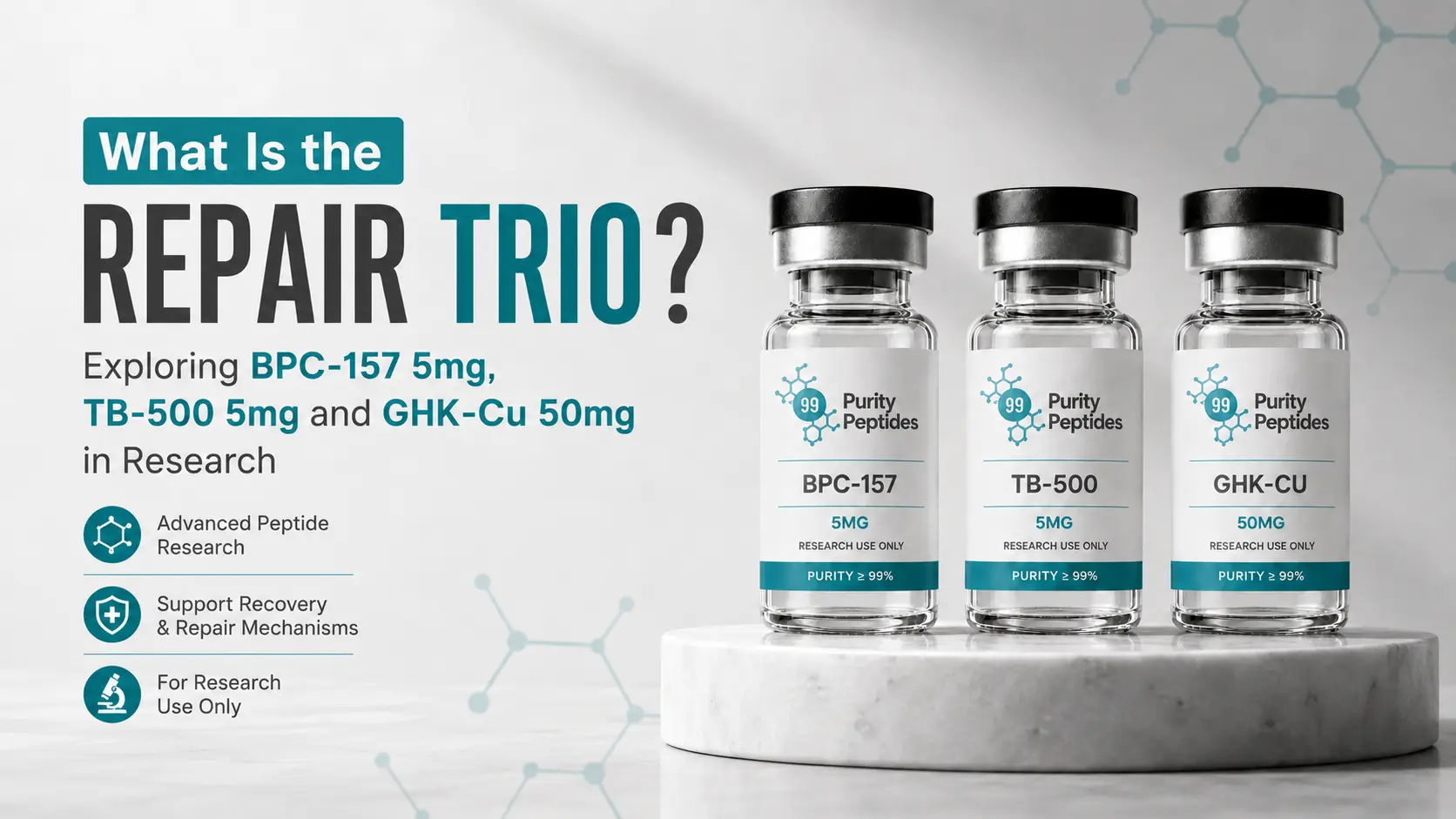
A researcher scanning 99 Purity Peptides’ catalog will find three familiar names bundled under one unfamiliar one: the Repair Trio. BPC-157, TB-500, and GHK-Cu each have their own body of published research, their own mechanisms, and their own following — so why package them together, and why in a 5mg / 5mg / 50mg split instead of the ratio most of the market uses for a similar combination? This guide answers both questions directly. It walks through what each peptide contributes to a tissue-repair research model, how the Repair Trio’s composition compares to the market’s more commonly searched “GLOW” blend, and what a researcher should check on a Certificate of Analysis before treating any ratio as fixed. It also covers reconstitution math, storage considerations, and where BPC-157 and TB-500 currently stand in the 2026 U.S. regulatory landscape.
This article is written for laboratory and research use only. BPC-157, TB-500, and GHK-Cu are supplied as research-use-only (RUO) compounds, not for human consumption, diagnostic use, or in vitro/in vivo application in humans or animals outside a qualified research setting.
What Is the Repair Trio Peptide Stack?
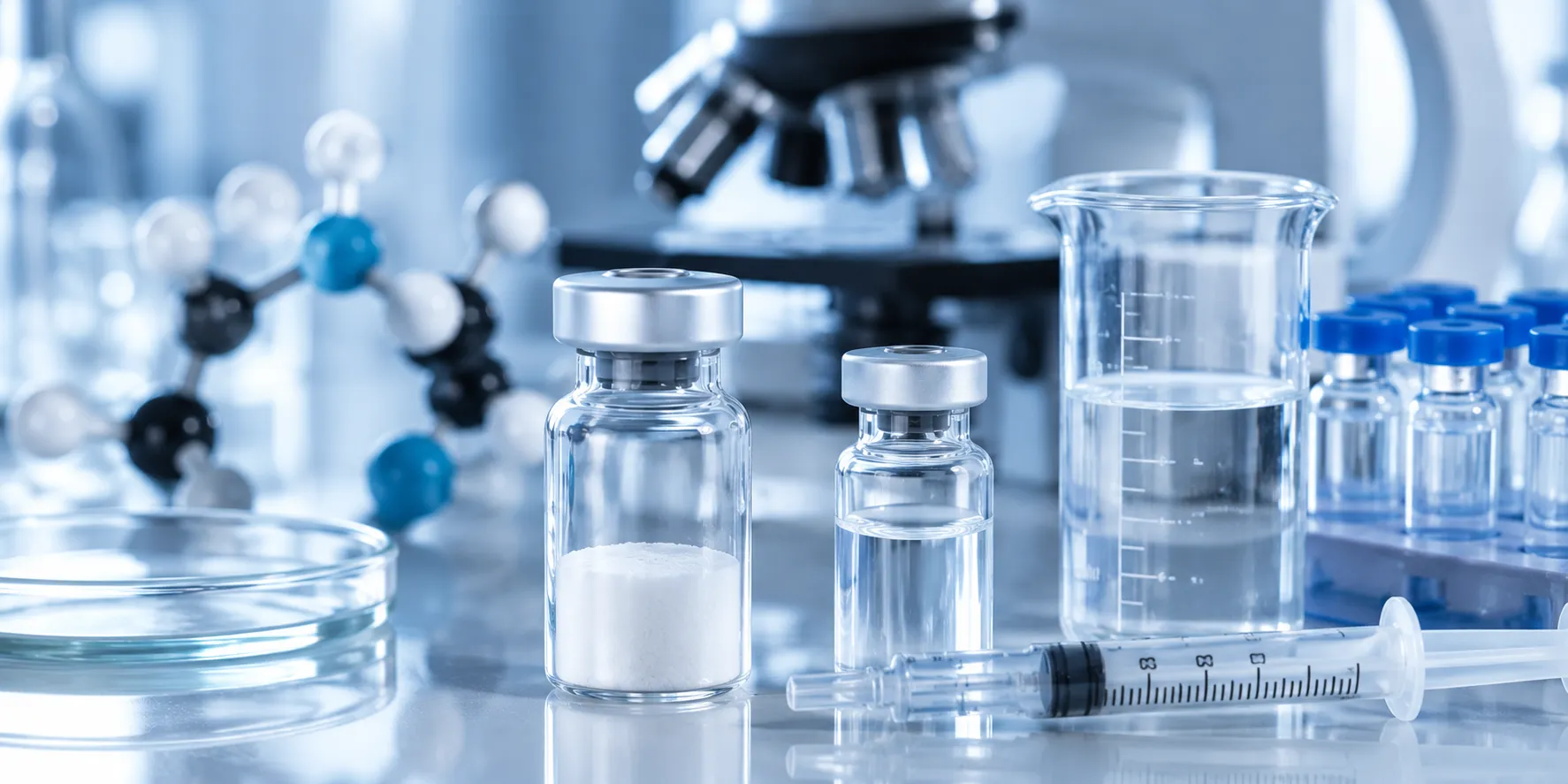
The Repair Trio is 99 Purity Peptides’ three-vial research kit combining BPC-157 (5mg), TB-500 (5mg), and GHK-Cu (50mg). Unlike a premixed blend, each peptide ships lyophilized in its own vial, which lets a researcher reconstitute, store, and study each compound independently while still working from a single, pre-paired kit.
Component | Amount per Vial | Classification |
BPC-157 | 5mg | Synthetic pentadecapeptide (15 amino acids) |
TB-500 | 5mg | Synthetic Thymosin Beta-4 (Tβ4) fragment |
GHK-Cu | 50mg | Copper(II) complex of the tripeptide Gly-His-Lys |
The name “Repair Trio” is 99PP’s own house name for this combination — it is worth knowing upfront, because most of the broader research-peptide market refers to a BPC-157/TB-500/GHK-Cu combination generically as “GLOW.” Section 4 below unpacks that naming overlap in detail, since it is one of the more common points of confusion researchers run into.
Why Three Peptides Instead of One? Mapping the Stack to the Tissue-Repair Timeline
Published tissue-repair research generally describes healing as a series of overlapping phases: hemostasis, inflammation, proliferation, and remodeling. No single peptide’s research literature covers all four phases equally well, which is the practical logic behind combining three peptides with different studied mechanisms rather than relying on one. The mapping below is a research-organization framework, not a clinical claim — the phases overlap substantially in any real biological system, and each peptide’s literature touches more than one phase to varying degrees.
Inflammation and Early Signaling: BPC-157
BPC-157 research has focused heavily on angiogenesis — the formation of new blood vessels — including studies on VEGFR2 upregulation and nitric oxide signaling pathway involvement. Because new vasculature is one of the earliest requirements for supplying an injury site with the cells and factors needed for repair, BPC-157’s research profile sits mechanistically closest to the inflammation-to-early-proliferation window.
Proliferation and Cell Migration: TB-500
TB-500 is studied primarily for actin-sequestering activity, a mechanism linked to fibroblast and endothelial cell migration in research models. Cell migration is a defining feature of the proliferation phase, when the wound bed research literature describes as needing new cells to move into the injury area — which is the phase TB-500’s published mechanism maps to most directly.
Remodeling and Matrix Synthesis: GHK-Cu
GHK-Cu’s literature centers on collagen type I synthesis, elastin production, and modulation of matrix metalloproteinases (MMPs) — the enzymes that both build and break down extracellular matrix during tissue remodeling. That places GHK-Cu’s research relevance latest in the timeline, during the phase where a research model’s new tissue is organized and strengthened.
Peptide | Primary Research Phase | Key Mechanism Studied |
BPC-157 | Inflammation → early proliferation | Angiogenesis, VEGFR2 upregulation, nitric oxide signaling |
TB-500 | Proliferation | Actin sequestration, fibroblast/endothelial cell migration |
GHK-Cu | Remodeling | Collagen/elastin synthesis, MMP modulation, antioxidant activity |
Key Takeaway The Repair Trio pairs three peptides whose published mechanisms roughly track the inflammation, proliferation, and remodeling phases of tissue repair — the rationale for three vials instead of one is phase coverage, not redundancy. |
The Science Behind Each Component
BPC-157: The Gastric Pentadecapeptide
BPC-157 is a synthetic 15-amino-acid peptide derived from a fragment of a protective compound found in human gastric juice. Its research literature spans angiogenesis signaling, nitric oxide pathway involvement, and growth factor receptor modulation, most commonly in tendon, ligament, and gastrointestinal tissue-repair models.
TB-500: The Thymosin Beta-4 Fragment
TB-500 is a synthetic version of a fragment derived from thymosin beta-4 (Tβ4), a naturally occurring 43-amino-acid protein. It is important to note that “TB-500” as sold commercially is typically this shorter synthetic fragment — not the full 43-residue native protein — and vendor sourcing can vary on exactly which fragment sequence is supplied. Researchers should confirm the specific sequence against the lot’s Certificate of Analysis rather than assuming uniformity across suppliers.
GHK-Cu: The Copper Tripeptide
GHK-Cu is the copper(II) complex of the naturally occurring tripeptide glycyl-L-histidyl-L-lysine (Gly-His-Lys), first isolated from human plasma in 1973. Unlike BPC-157 and TB-500, GHK-Cu is endogenous — the body produces it, and circulating levels are reported to decline with age, which is part of the rationale behind studying exogenous GHK-Cu. Its research base covers collagen and elastin stimulation, glycosaminoglycan synthesis, gene expression modulation, and antioxidant activity.
Property | BPC-157 | TB-500 | GHK-Cu |
Classification | Synthetic pentadecapeptide | Synthetic Tβ4 fragment | Copper(II) tripeptide complex |
Approx. molecular weight | ~1,419 Da | Varies by fragment length | ~403.93 Da (complex) |
Origin | Gastric-juice-derived sequence | Derived from native Tβ4 | Naturally occurring in human plasma |
Primary mechanism studied | Angiogenesis / VEGFR2 | Actin sequestration / cell migration | Collagen synthesis / MMP modulation |
CAS registry numbers on file for GHK-Cu: 89030-95-5 for the copper(II) complex and 49557-75-7 for the metal-free GHK tripeptide — useful reference points when cross-checking a Certificate of Analysis.
Repair Trio vs. GLOW Peptide Blend: Resolving the Name Confusion
Most of the research-peptide market refers to a BPC-157 + TB-500 + GHK-Cu combination generically as “GLOW.” 99 Purity Peptides sells its own, separately formulated GLOW product, so the Repair Trio exists as a distinct kit built around the same three compounds under a different house name and a different ratio. That distinction matters for a researcher comparing listings across suppliers, because “GLOW” and “Repair Trio” are not always describing the same composition.
On composition specifically: 99PP’s Repair Trio ships BPC-157 5mg / TB-500 5mg / GHK-Cu 50mg — a 1:1:10 ratio by mass. Many other “GLOW” listings in the wider market instead use a roughly 5:1:1 ratio scaled the other direction, built around GHK-Cu 50mg with TB-500 10mg and BPC-157 10mg. Neither ratio is inherently more correct; they reflect different formulation choices. What matters for research purposes is confirming the actual per-vial mass against the current lot’s Certificate of Analysis rather than assuming a fixed industry-standard ratio exists.
Composition Detail | 99PP Repair Trio | Typical Market “GLOW” Listing |
BPC-157 | 5mg | ~10mg |
TB-500 | 5mg | ~10mg |
GHK-Cu | 50mg | ~50mg |
Vial format | Three separate vials | Varies — often premixed |
Verification Note This ratio comparison reflects current keyword and market research, not a confirmed lab result. Treat the exact per-vial mass on any listing — including this one — as provisional until checked against that specific lot’s COA. |
Separate Vials vs. Premixed Blends: Why Formulation Format Matters
The Repair Trio ships as three separate lyophilized vials rather than a single premixed multi-peptide solution. That format choice has practical research implications. Separate vials let a researcher reconstitute, store, and dose each peptide independently, which supports isolating variables across a study design — running BPC-157 alone against a TB-500 + GHK-Cu combination, for example. It also avoids one peptide’s excipients or reconstitution conditions affecting the stability of another, since GHK-Cu’s copper-complex chemistry and BPC-157/TB-500’s peptide-bond chemistry do not necessarily share the same degradation profile.
A premixed blend trades that flexibility for simpler handling — one reconstitution step instead of three, and one vial to label and store instead of three. Which format fits a given study depends on whether the research design calls for combined dosing only, or benefits from the ability to isolate each peptide’s contribution.
How to Reconstitute the Repair Trio Peptide Blend
Because the Repair Trio ships as three separate vials with three different peptide masses (5mg, 5mg, and 50mg), each vial is reconstituted on its own — there is no single bacteriostatic water volume that applies to all three. The concentration math itself follows the same formula used across peptide research generally:
Concentration (mg/mL) = total peptide mass in the vial (mg) ÷ volume of bacteriostatic water added (mL)
From there, the volume to draw for a given research protocol’s target mass is: volume to draw (mL) = target mass (mg) ÷ concentration (mg/mL). The figures below are illustrative math only — the applicable bacteriostatic water volume for a specific Repair Trio lot always comes from that vial’s label and accompanying Certificate of Analysis, not from a generic formula.
1. Confirm the peptide mass printed on each vial’s label against its Certificate of Analysis before reconstituting anything.
2. Select a bacteriostatic water volume appropriate to the target concentration for the study — the same total mass reconstituted in a smaller volume yields a higher mg/mL concentration, and vice versa.
3. Inject the bacteriostatic water slowly down the inside wall of the vial rather than directly onto the lyophilized powder, to avoid disrupting the peptide structure.
4. Gently swirl the vial to dissolve the powder completely — do not shake, which can degrade peptide integrity.
5. Visually confirm full dissolution; a cloudy or particulate solution should not be used.
6. Label each of the three reconstituted vials with the reconstitution date and resulting concentration, since BPC-157, TB-500, and GHK-Cu will each carry different concentrations once reconstituted.
7. Store each reconstituted vial according to that peptide’s specific label and COA guidance — see the storage section below.
Because GHK-Cu’s 50mg fill is ten times the mass of the 5mg BPC-157 and TB-500 vials, a research protocol that draws equal volumes from all three vials will not deliver equal mass amounts of each peptide. Confirming each vial’s independent concentration before drawing is the step most likely to be skipped and most likely to matter.
Storage and Stability Best Practices
Lyophilized (freeze-dried) peptide vials are generally stored refrigerated or frozen, away from light, until reconstitution — the exact temperature range and shelf life should always be confirmed against the specific vial’s label and COA rather than assumed. Once reconstituted, peptides are typically refrigerated and used within a materially shorter window than their lyophilized shelf life, since dissolution exposes the peptide to hydrolysis, oxidation, deamidation, and aggregation — the same degradation pathways covered in more depth in 99PP’s dedicated storage and handling guide.
GHK-Cu’s stability profile is not identical to BPC-157’s or TB-500’s. As a copper(II) coordination complex, GHK-Cu’s relevant degradation chemistry involves the copper-peptide bond and redox activity, whereas BPC-157 and TB-500 are conventional peptide chains subject to proteolytic and hydrolytic breakdown. That difference is a practical reason to treat each Repair Trio vial’s storage guidance independently rather than applying one blanket protocol to all three.
Understanding Purity and the Certificate of Analysis for a Multi-Peptide Kit
A Certificate of Analysis (COA) documents a specific manufacturing lot’s identity and purity, typically verified by HPLC (High-Performance Liquid Chromatography) and, in more rigorous cases, LC-MS. Because the Repair Trio bundles three separately manufactured compounds rather than one blended formulation, a thorough purity review means checking three separate COAs — one per vial — rather than a single document.
This is also where the ratio question from Section 4 gets resolved in practice: a lot COA that states the actual peptide mass per vial is the concrete way to confirm whether a given Repair Trio shipment matches its label claim of 5mg / 5mg / 50mg, rather than relying on the product description alone.
Repair Trio Compared to 99 Purity Peptides’ Other Recovery Kits
The Repair Trio sits inside a broader family of multi-peptide recovery kits, each built around a different combination of research mechanisms.
Kit | Components | Distinguishing Research Angle |
Repair Trio | BPC-157 5mg + TB-500 5mg + GHK-Cu 50mg | Tissue-repair phase coverage: angiogenesis → cell migration → matrix remodeling |
Advanced Repair & Immune | BPC-157 10mg + TB-500 10mg + KPV 10mg + LL-37 5mg | Adds an innate-immune signaling axis (KPV / LL-37) alongside tissue repair |
Gut & Mucosal Panel | BPC-157 5mg + KPV 10mg + Thymosin Alpha-1 10mg | Mucosal-interface focus: epithelial repair, local inflammation, immune modulation |
Current Regulatory Status of BPC-157 and TB-500 in the U.S. (2026)
BPC-157 and TB-500’s regulatory status shifted twice in 2026. On April 15, 2026, the FDA removed both peptides from its Category 2 list (substances flagged for significant safety risk pending further review). On July 23–24, 2026, the FDA’s Pharmacy Compounding Advisory Committee (PCAC) met to evaluate seven nominated peptides for the Section 503A Bulks List — the list of substances licensed compounding pharmacies may legally use. The committee voted narrowly, 8–6 with one abstention, to recommend BPC-157, KPV, and TB-500 for inclusion; MOTS-c passed 7–5 with two abstentions, and Semax and Epitalon cleared by similarly tight margins. Emideltide was the only rejection.
That vote is a recommendation, not a decision. The U.S. Department of Health and Human Services must still formally accept the committee’s recommendation, and the FDA must complete notice-and-comment rulemaking before any substance is actually added to the 503A Bulks List. As of this publication, none of the peptides reviewed at the July 2026 meeting appear on the 503A Bulks List, and none is an FDA-approved drug — compounding pharmacies remain legally unable to prepare them for patients. GHK-Cu was not part of this review batch; as a naturally occurring endogenous compound, it sits outside the compounding-substance review process altogether.
Practically, that leaves the research-use-only (RUO) channel as the applicable legal framework for BPC-157, TB-500, and GHK-Cu today, distinct from the prescription and compounding-pharmacy channel that remains closed pending final rulemaking.
Choosing a Three-Peptide Stack for Tissue-Repair Research
For a lab designing a tissue-repair study that spans angiogenesis, cell migration, and matrix remodeling, a three-vial format like the Repair Trio offers a practical starting point — each peptide can be studied alone, in pairs, or as the full combination, without being locked into one fixed premixed ratio. As with any research peptide purchase, the two things worth confirming before a study begins are the same two flagged throughout this guide: the actual per-vial mass against a current lot COA, and third-party purity verification at or above the supplier’s stated threshold.
Key Takeaways
- The Repair Trio bundles BPC-157 5mg, TB-500 5mg, and GHK-Cu 50mg in three separate vials, not a premixed blend.
- Each peptide’s published research maps loosely to a different tissue-repair phase: BPC-157 to inflammation/angiogenesis, TB-500 to proliferation/cell migration, and GHK-Cu to remodeling/collagen synthesis.
- “Repair Trio” is 99PP’s house name; most of the market calls this three-peptide combination “GLOW” — and ratios differ across listings, so always verify against a lot COA.
- Because the kit ships as three vials with three different masses (5mg, 5mg, 50mg), each vial is reconstituted independently using its own concentration math.
- GHK-Cu’s copper-complex chemistry degrades differently than BPC-157/TB-500’s peptide-bond chemistry, so a single storage protocol should not be assumed across all three vials.
- As of mid-2026, BPC-157 and TB-500 cleared FDA Category 2 and received a narrow, nonbinding PCAC recommendation for the 503A Bulks List — neither is FDA-approved or currently compoundable pending final rulemaking.
Frequently Asked Questions
What is the Repair Trio peptide stack?
The Repair Trio is 99 Purity Peptides’ three-vial research kit combining BPC-157 5mg, TB-500 5mg, and GHK-Cu 50mg, sold as separate lyophilized vials rather than a premixed blend.
What peptides are in the Repair Trio?
BPC-157 (5mg), TB-500 (5mg), and GHK-Cu (50mg).
What is the BPC-157, TB-500, and GHK-Cu ratio in the Repair Trio?
The Repair Trio ships at a 1:1:10 ratio by mass (5mg:5mg:50mg). This differs from the roughly 5:1:1 ratio (GHK-Cu 50mg : TB-500 10mg : BPC-157 10mg) many other market “GLOW” listings use — always confirm against the current lot’s COA.
How do I reconstitute the Repair Trio peptide blend?
Each of the three vials is reconstituted independently, since they hold different peptide masses. Concentration (mg/mL) equals total peptide mass divided by the volume of bacteriostatic water added; see Section 6 for the full step-by-step process.
How should the Repair Trio be stored before and after reconstitution?
Lyophilized vials are generally stored refrigerated or frozen and away from light; once reconstituted, refrigerate and check the specific lot’s label for its stability window, since GHK-Cu’s copper-complex chemistry degrades differently than BPC-157/TB-500’s peptide-bond chemistry.
Is the Repair Trio the same as the GLOW peptide blend?
They combine the same three compounds, but “GLOW” is the market’s generic name for this pairing while “Repair Trio” is 99PP’s house name and formulation — the ratios and vial format can differ between the two.
What is BPC-157 studied for in research?
BPC-157 is a synthetic 15-amino-acid peptide studied primarily for angiogenesis-related mechanisms, including VEGFR2 upregulation and nitric oxide signaling, in tissue-repair research models.
What is TB-500 studied for in research?
TB-500 is a synthetic fragment derived from thymosin beta-4, studied for actin-sequestering activity linked to fibroblast and endothelial cell migration.
What is GHK-Cu studied for in research?
GHK-Cu is a copper(II) tripeptide complex studied for collagen and elastin synthesis, glycosaminoglycan production, MMP modulation, and antioxidant activity.
How does BPC-157 differ from TB-500?
BPC-157 is a gastric-juice-derived pentadecapeptide studied mainly for angiogenesis signaling, while TB-500 is a thymosin beta-4 fragment studied for actin-sequestering, cell-migration activity — different sequences and different primary mechanisms.
Why is GHK-Cu included alongside BPC-157 and TB-500?
GHK-Cu’s research focus on collagen synthesis and matrix remodeling addresses the later tissue-repair phase that BPC-157’s angiogenesis and TB-500’s cell-migration research do not primarily target.
What is the difference between a separate-vial and a premixed peptide blend?
Separate vials allow independent reconstitution, storage, and dosing of each peptide, which supports isolating variables in a study; a premixed blend simplifies handling but fixes the ratio and reconstitution step to a single vial.
What is the current regulatory status of BPC-157 and TB-500?
As of mid-2026, both cleared FDA Category 2 (April 15, 2026) and received a narrow, nonbinding PCAC recommendation for the 503A Bulks List (July 23–24, 2026). Neither is FDA-approved, and neither is currently on the 503A list pending formal HHS action and rulemaking.
Is the Repair Trio third-party tested?
Verify current testing and Certificate of Analysis availability directly on the product page and certificates library before publishing any specific purity claim.
How is the Repair Trio different from 99PP’s Advanced Repair & Immune kit?
Advanced Repair & Immune adds KPV and LL-37 to build in an innate-immune signaling axis alongside tissue repair, while the Repair Trio focuses on the angiogenesis → cell migration → matrix remodeling sequence alone.