Oxytocin Research Peptide — SEO Blog Deliverable
Featured Product
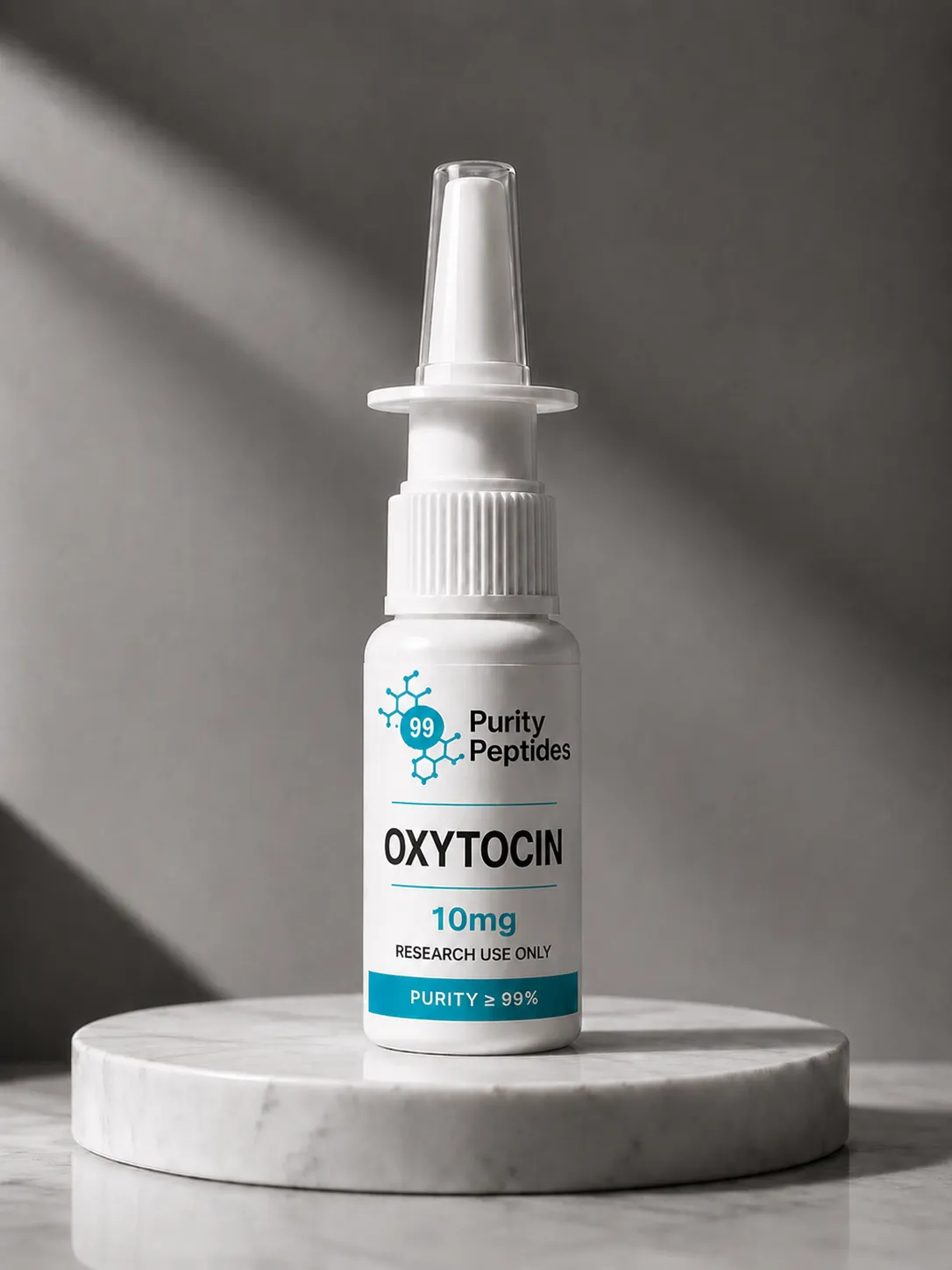
Oxytocin Research Peptide: Purity, COA, and Technical Specifications for Laboratory Use
A lab manager opening a fresh vial of oxytocin shouldn't have to guess what's inside it. Yet that's exactly the position many buyers are in when a supplier ships a peptide with no certificate of analysis, no chromatogram, and no clear storage guidance. For a hormone as structurally delicate as oxytocin — a nine-amino-acid peptide held together by a single disulfide bridge — that gap in documentation isn't a minor inconvenience. It can mean degraded material, inconsistent assay results, and wasted reagent budget.
This guide walks through what oxytocin research peptide actually is, how its purity is verified, what belongs on a proper Certificate of Analysis, and how to evaluate a supplier before you commit a purchase order. It's written for procurement staff, lab managers, and researchers who need working knowledge rather than marketing copy.
Everything here describes oxytocin strictly as a research reagent. It is not intended for human or veterinary use, dosing guidance, or clinical application.
1. What Is Oxytocin Research Peptide?
Oxytocin is a naturally occurring nonapeptide hormone, meaning it is built from nine amino acid residues. In the body, it is synthesized in the hypothalamus and released by the posterior pituitary gland, where it plays roles in uterine contraction, lactation, and social-behavior signaling pathways that have made it a long-standing subject of neuroscience and endocrinology research.
"Oxytocin research peptide" refers to a synthetic, laboratory-produced version of this same amino acid sequence, manufactured for in-vitro study, assay development, and analytical reference purposes rather than for administration to humans or animals. Because it is produced synthetically and sold under a research-use-only (RUO) designation, its value to a lab depends almost entirely on two things: the purity of the synthesis and the quality of the documentation that proves it.
2. Chemical and Structural Profile
Oxytocin's structure is well characterized in public chemical databases such as PubChem and DrugBank. The table below summarizes the core identifiers a researcher should expect to see confirmed on a supplier's product page or COA.
Property | Value |
|---|---|
Compound name | Oxytocin |
CAS number | 50-56-6 (verify against the specific lot's COA before citing) |
Amino acid sequence | Cys-Tyr-Ile-Gln-Asn-Cys-Pro-Leu-Gly-NH2 (cyclic, disulfide bridge between the two cysteine residues) |
Molecular formula | C43H66N12O12S2 |
Molecular weight | ≈ 1007.19 g/mol |
Appearance | White to off-white lyophilized powder |
Typical purity (research grade) | ≥98% by HPLC, lot-dependent |
Common solvents | Sterile water, dilute acetic acid, or DMSO, depending on assay requirements |
Recommended storage | -20°C to -80°C, desiccated, protected from light, prior to reconstitution |
Every one of these values should be lot-specific and traceable back to a COA rather than taken from a generic product description. Peptide synthesis introduces natural lot-to-lot variability, so the numbers on this page are a starting reference point, not a substitute for the documentation that ships with your specific order.
3. How Research-Grade Oxytocin Is Manufactured
Most commercial oxytocin peptide is produced through solid-phase peptide synthesis (SPPS), a method where amino acids are added one at a time to a resin-bound chain, then cleaved and folded to form the correct disulfide bond. After synthesis, the crude peptide is purified — typically by preparative HPLC — to strip out truncated sequences, deletion products, and other synthesis by-products.
This purification step is where quality separates from cost-cutting. A supplier that skips a rigorous purification pass can still sell a peptide labeled "oxytocin," but the actual purity may fall well short of what a research application requires. That's why independent verification, not just a label claim, matters so much in this category.
4. Verifying Purity: HPLC, LC-MS, and NMR Explained
Three analytical methods dominate peptide quality control, and each answers a different question.
High-Performance Liquid Chromatography (HPLC)
HPLC separates the components of a sample based on how they interact with a chromatography column, producing a chromatogram — a plot of detector response over time. For oxytocin, HPLC is the primary method used to state a purity percentage: the target peptide should appear as one dominant, sharp peak, with any impurity peaks representing only a small fraction of the total peak area.
Mass Spectrometry (MS / LC-MS)
Where HPLC tells you how pure a sample is, mass spectrometry tells you whether the molecule is actually oxytocin. LC-MS or MS/MS measures the mass-to-charge ratio of the peptide and its fragments, confirming that the observed mass matches oxytocin's expected molecular weight of roughly 1007 g/mol. This is the identity check that HPLC alone cannot provide.
Nuclear Magnetic Resonance (NMR)
NMR is used less routinely on a per-lot basis but is valuable for structural confirmation, particularly for verifying that the disulfide bridge has formed correctly rather than the peptide remaining in a linear, unfolded state. A supplier that can provide NMR data alongside HPLC and MS is signaling a more rigorous quality program than one relying on HPLC alone.
5. How to Read an Oxytocin Certificate of Analysis (COA)
A COA is only useful if you know what to look for. At minimum, a legitimate oxytocin COA should include:
- Lot or batch number, matched to the vial you received
- Purity percentage by HPLC, with the chromatogram available on request
- Identity confirmation by MS, with the observed mass stated
- Appearance and solubility notes
- Storage conditions and expiration or retest date
- Manufacturing or testing date, and the name of the testing lab if outsourced
If a COA is generic — undated, missing a lot number, or reused across multiple product listings — treat it as a red flag rather than proof of quality. A traceable, lot-specific COA is the single clearest signal that a supplier is running a real quality-control process rather than printing paperwork after the fact.
6. Storage, Stability, and Reconstitution
Lyophilized oxytocin is comparatively stable when kept sealed, desiccated, and frozen, but it is still a peptide with a disulfide bond that can degrade under poor handling. General best practice, consistent with standard peptide-handling guidance, includes the following.
- Store unopened, lyophilized vials at -20°C for shorter-term use or -80°C for longer-term archival storage
- Keep vials desiccated and protected from light and humidity
- Avoid repeated freeze-thaw cycles once reconstituted; aliquot the reconstituted solution instead
- Bring vials to room temperature before opening to reduce condensation inside the vial
- Reconstitute in the solvent specified for your assay (commonly sterile water or dilute acetic acid) and document the concentration prepared
Stability data is lot- and formulation-specific, so treat any general storage guidance — including the points above — as a starting framework, and defer to the storage instructions on your COA or SDS when they differ.
7. Applications in Laboratory Research
Oxytocin's established biological roles in the body make it a reference compound across several research areas. In published literature, it is studied in the context of uterine and reproductive physiology, lactation and milk-ejection reflexes, cardiovascular signaling pathways, and social and behavioral neuroscience, where it is examined as part of broader oxytocin-vasopressin signaling systems. Beyond hypothesis-driven biology, purified oxytocin is also used as an analytical reference standard — a well-characterized molecule against which a lab can calibrate an HPLC or LC-MS method before applying that method to other peptides.
This article does not make claims about outcomes, dosing, or effects in humans or animals. Any specific experimental finding belongs in the primary literature your lab is already citing — not in a supplier's marketing copy.
8. Oxytocin vs. Vasopressin: Analytical Differences
Oxytocin is frequently discussed alongside arginine vasopressin (AVP), a structurally related nonapeptide that differs from oxytocin at only two amino acid positions. For labs running assays on either or both compounds, the analytical distinction matters.
Feature | Oxytocin | Vasopressin (AVP) |
|---|---|---|
Residue count | 9 amino acids | 9 amino acids |
Key structural difference | Ile at position 3, Leu at position 8 | Phe at position 3, Arg at position 8 |
Approx. molecular weight | ≈1007.19 g/mol | ≈1084.23 g/mol |
Primary physiological association | Uterine contraction, lactation, social bonding pathways | Water retention, vasoconstriction, blood pressure regulation |
Analytical note | Distinguishable from AVP by mass and retention time on standard reversed-phase HPLC | Co-elution risk with oxytocin is low but should be verified per method |
Because the two molecules are close in mass and structure, any lab running comparative assays should validate that its HPLC or LC-MS method fully resolves oxytocin from vasopressin before relying on the results.
9. Choosing a Reliable Oxytocin Supplier
Not every listing that says "oxytocin research peptide" backs that claim with real quality control. Before ordering, it's worth running through a short documentation checklist.
- Does the supplier provide a lot-specific COA, not a generic one reused across batches?
- Is HPLC purity data available, ideally with the chromatogram itself, not just a stated percentage?
- Is there MS or LC-MS confirmation of identity alongside the purity number?
- Is a Safety Data Sheet (SDS) provided for handling and hazard classification?
- Does the supplier clearly label the product as research-use-only, with no suggestion of human or veterinary use?
- Are storage, handling, and shipping conditions stated explicitly, rather than left to assumption?
- Can the supplier speak to lot-to-lot consistency if you plan to order repeatedly for a longitudinal study?
A supplier that answers all seven questions without hesitation is a supplier worth building a working relationship with. One that can't produce a lot-specific COA on request is a supplier worth walking away from, regardless of price.
10. Shipping and Compliance Notes for U.S. Research Buyers
Research peptides shipped within and into the United States are typically handled as laboratory chemicals rather than pharmaceuticals, which means packaging, labeling, and documentation matter for smooth delivery to institutional buyers. Universities, CROs, and biotech R&D departments generally expect a supplier to provide, alongside the shipment, an SDS, a COA, and any hazard labeling appropriate to the compound's classification. If your institution has a procurement or environmental health and safety (EHS) office, it's worth confirming their intake requirements before placing a first order, since documentation standards can vary by institution even when the underlying compound is the same.
11. Expert Insights
After years of evaluating peptide suppliers for research applications, a consistent pattern shows up: the suppliers worth repeat business are the ones who treat documentation as part of the product, not an afterthought. A HPLC purity number without a chromatogram is a claim, not evidence. A COA without a lot number is marketing collateral, not quality control. Labs that build supplier evaluation into their standard operating procedures — rather than reordering from whoever was cheapest last time — consistently report fewer failed assays traceable back to reagent quality.
A second pattern worth naming directly: purity percentages alone don't tell the whole story. Two lots can both carry a "98% pure" label while differing meaningfully in impurity profile — one dominated by a single closely related by-product, the other showing several minor peaks. For assay-sensitive work, ask for the actual chromatogram rather than accepting the summary number at face value.
12. Research Overview and Evidence Limitations
Oxytocin has a substantial published literature behind it, spanning decades of endocrinology, reproductive physiology, and behavioral neuroscience research. That said, this article intentionally avoids citing specific studies, trial results, or statistics, because doing so without direct access to and verification of the primary sources would risk misrepresenting findings — something a research-focused audience depends on getting right. If your work requires citation-backed claims about oxytocin's biological effects, consult primary literature through a database such as PubMed rather than relying on secondary summaries, including this one.
What can be stated with confidence, because it concerns the compound's chemistry rather than its biological effects, is the material covered in Sections 2 through 6 above: molecular identity, standard analytical verification methods, and general storage practice.
13. Benefits of Verified Research-Grade Material
The case for paying attention to purity documentation isn't abstract — it shows up directly in experimental reliability.
- Reproducibility: consistent, verified purity reduces lot-to-lot variability that can otherwise confound assay results
- Traceability: a lot-specific COA lets you retroactively audit which batch was used in which experiment
- Time savings: fewer failed runs caused by degraded or misidentified material
- Regulatory and institutional readiness: proper SDS and COA documentation simplifies EHS and procurement review
- Method development confidence: a well-characterized reference standard supports more reliable HPLC/LC-MS method validation
14. Common Myths About Research Oxytocin
Myth: "98% purity" always means the same thing
It doesn't. Purity by HPLC peak area, purity by mass, and purity relative to a specific reference standard can all produce different numbers for the same sample. Always check which method the percentage refers to.
Myth: Any white lyophilized powder in a labeled vial is verified oxytocin
Appearance confirms nothing about identity or purity. Only MS-based identity confirmation, paired with HPLC purity data, verifies what's actually in the vial.
Myth: Research-grade and pharmaceutical-grade are interchangeable
Research-use-only peptides are manufactured and tested for laboratory and analytical use, not to pharmaceutical Good Manufacturing Practice (GMP) standards. They are not equivalent to, and should not be treated as, a pharmaceutical product.
Myth: A cheaper listing with the same purity claim is functionally identical
Price differences often reflect differences in purification rigor, testing frequency, and documentation quality — not just markup. A lower price with no COA available on request is a cost signal, not a value signal.
16. Conclusion
Oxytocin research peptide is a well-defined molecule with decades of characterization behind it, which makes the sourcing decision less about the compound itself and more about who is manufacturing and documenting it. A lot-specific COA, HPLC and MS verification, clear storage guidance, and honest research-use-only labeling are the concrete signals that separate a dependable supplier from a listing that just happens to use the right chemical name. Building a short supplier checklist into your procurement process — the same one outlined in Section 9 — pays for itself the first time it catches a weak COA before a purchase order goes out.
Reviewing an oxytocin listing for your lab? Check the product page for lot-specific COA and HPLC data before you order, and reach out to the supplier directly with any documentation questions — a supplier confident in its quality control will welcome them.
Frequently Asked Questions
What is oxytocin research peptide used for?
It is used as a research reagent in laboratory settings — for in-vitro studies, behavioral and endocrinology research, and as an analytical reference standard for method development. It is not intended for human or veterinary administration.
Where can I buy oxytocin research peptide in the USA?
Look for a supplier that ships within U.S. research-chemical compliance norms and provides a lot-specific COA, HPLC purity data, and an SDS with every order, rather than choosing based on price alone.
How pure is research-grade oxytocin?
Reputable suppliers typically report ≥98% purity by HPLC, though the exact figure is lot-dependent and should always be confirmed against that specific lot's COA rather than a general product description.
How do I read an oxytocin COA?
Check for a lot number matching your vial, an HPLC purity percentage with chromatogram available, MS-based identity confirmation, storage conditions, and a testing or manufacture date.
What is the CAS number for oxytocin?
The commonly referenced CAS registry number for oxytocin is 50-56-6. Always cross-check the CAS number stated on your specific product's COA, since packaging errors do happen.
How should oxytocin be stored in the lab?
As a lyophilized powder, it should be kept sealed, desiccated, protected from light, and frozen — typically -20°C for shorter-term storage or -80°C for longer-term archival storage — until reconstitution.
What solvents dissolve oxytocin?
Sterile water and dilute acetic acid are commonly used; DMSO may be used depending on the assay. Solvent choice should follow your specific protocol and the supplier's reconstitution guidance.
How is oxytocin purity verified by HPLC?
HPLC separates the sample into its components and measures the relative peak area of the target peptide against total peak area, producing a chromatogram that a lab can inspect for a single dominant, sharp peak.
Does oxytocin require special shipping?
As a research chemical, it is generally shipped with appropriate cold-chain handling if required, along with an SDS and hazard labeling appropriate to its classification. Requirements can vary by supplier and receiving institution.
What is the molecular weight of oxytocin?
Approximately 1007.19 g/mol, corresponding to the molecular formula C43H66N12O12S2.
How stable is oxytocin at -20°C versus -80°C?
Both temperatures are commonly used for lyophilized peptide storage, with -80°C generally preferred for longer archival periods. Exact stability data is lot- and formulation-specific and should be confirmed with your supplier.
Can oxytocin be used as an analytical standard?
Yes. Well-characterized, high-purity oxytocin is commonly used as a reference standard for calibrating and validating HPLC or LC-MS methods.
What documentation should a supplier provide for oxytocin?
At minimum, a lot-specific COA (HPLC purity, MS identity confirmation, storage conditions) and an SDS. Additional NMR data or a chromatogram image are marks of a more rigorous supplier.
What is the difference between research-grade and analytical-grade oxytocin?
The terms aren't strictly standardized industry-wide, but "analytical grade" or "analytical standard" typically implies an even tighter purity and identity verification process intended specifically for use as a reference material in quantitative methods, rather than general research use.
How do I compare oxytocin suppliers?
Use a documentation-first checklist: lot-specific COA, HPLC and MS data, SDS availability, clear research-use-only labeling, and transparent storage/shipping conditions — then compare price only among suppliers that clear all of those bars. (Duplicated here as a standalone block per the requested output structure; identical content to Section 15 above, formatted for FAQ schema markup.)