5-Amino-1MQ Nasal Spray 50mg: What Is It and What Does the Research Say?
QUICK ANSWER 5-Amino-1MQ nasal spray 50mg delivers 5-amino-1-methylquinolinium, a synthetic small-molecule inhibitor of the enzyme nicotinamide N-methyltransferase (NNMT). Despite being sold alongside peptides, it is not a peptide. Published evidence is entirely preclinical — cell culture and rodent models. No completed human trial exists, and the compound holds no FDA approval. |
Search "5-Amino-1MQ nasal spray" and you will find confident dosing charts, before-and-after framing, and the word "peptide" repeated on page after page. Two of those three things are wrong. This guide separates what the literature actually contains from what the market has invented around it.
Anyone sourcing 5-Amino-1MQ for laboratory work runs into the same three problems. The compound is filed under peptides, so its chemistry gets described incorrectly. The 50mg on the bottle is interpreted as a dose when it is a total. And dosage figures quoted across vendor pages differ by more than a hundredfold, with no explanation offered for why.
So this article does something different. Instead of adding another benefits list to a saturated corpus, it states the compound's identity precisely, explains what the 50mg label actually denotes, walks the NNMT mechanism through to NAD+ without overclaiming, and maps the published evidence by model system — including the substantial parts that do not exist yet.
By the end you will be able to read a 5-Amino-1MQ product listing critically, evaluate a certificate of analysis field by field, and explain to a colleague exactly where the evidence ceiling sits. That last skill matters more than any dosing table, because on a compound this thinly evidenced, precision is the only defensible position.
What Is 5-Amino-1MQ Nasal Spray?
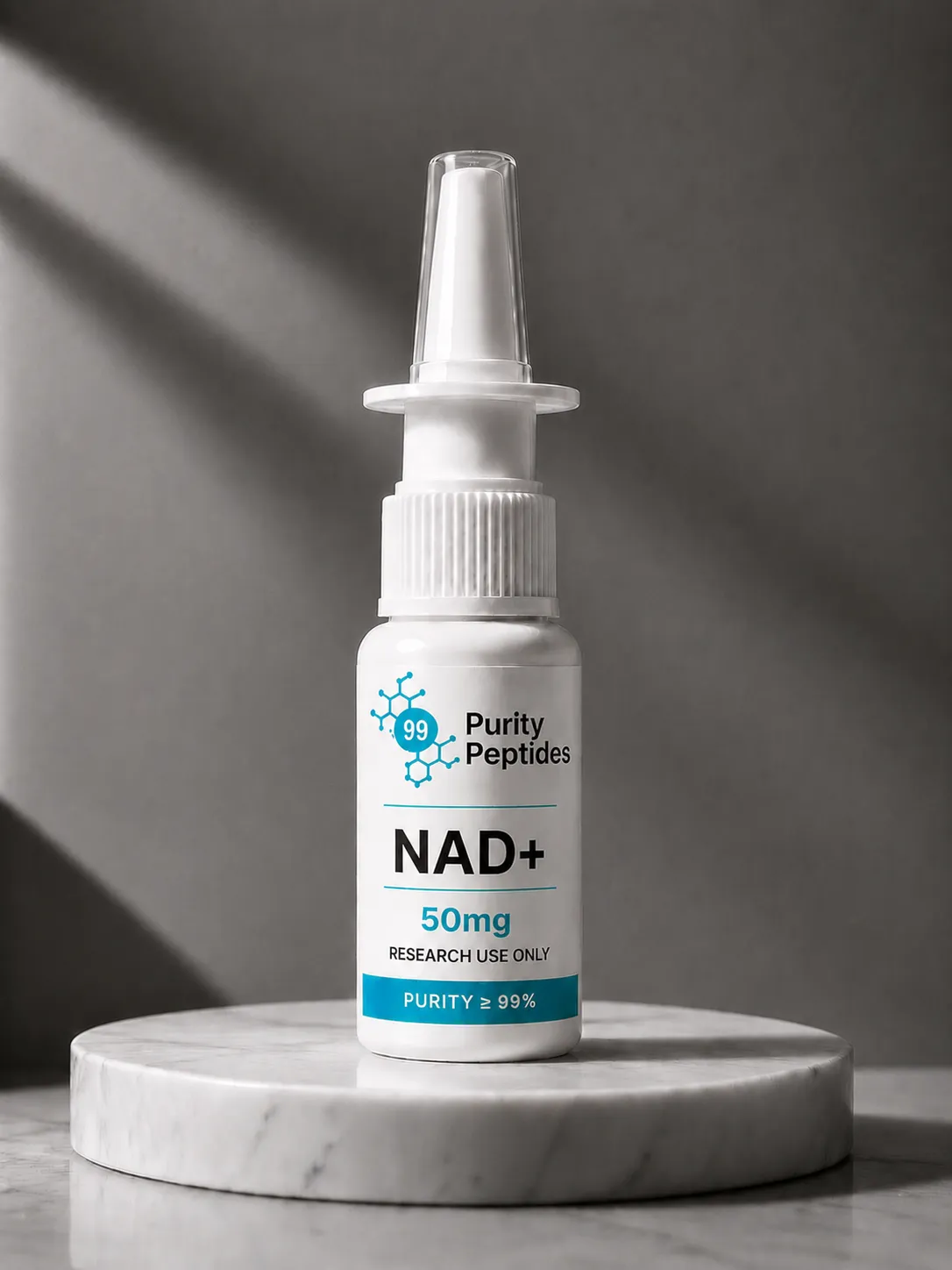
5-Amino-1MQ nasal spray is an intranasal formulation of 5-amino-1-methylquinolinium, a synthetic small-molecule compound that inhibits nicotinamide N-methyltransferase (NNMT). The nasal format delivers the compound across the nasal mucosa rather than through the digestive tract. It is supplied strictly for research use only.
The compound is frequently shortened to 5A1MQ, and occasionally labelled simply as an NNMTi — an NNMT inhibitor. All three names refer to the same molecular entity. Suppliers typically ship it as the iodide salt, which matters more than it sounds, for reasons covered in the 50mg section below.
Chemically, 5-Amino-1MQ is a quinolinium salt: a methylquinolinium scaffold carrying an amine group at the 5-position and a permanent positive charge on the ring nitrogen. That cationic, membrane-permeable character is what allows it to reach an intracellular enzyme target. It is a synthetic organic compound, not a biological extract.
5-Amino-1MQ compound specifications
Attribute | Value |
|---|---|
Full chemical name | 5-amino-1-methylquinolinium |
IUPAC name | 1-methylquinolin-1-ium-5-amine |
Common shorthand | 5-Amino-1MQ, 5A1MQ, NNMTi |
CAS number | 42464-96-0 |
Molecular formula | C10H11N2 · I (iodide salt) |
Molecular weight | 286.11 (iodide salt) |
Compound class | Small-molecule quinolinium salt — not a peptide |
Molecular target | Nicotinamide N-methyltransferase (NNMT) |
Mechanism | Substrate-site-targeting selective NNMT inhibition |
Salt conversion | ~1.89 mg iodide salt ≈ 1 mg 5-Amino-1MQ free-base equivalent |
Human trial status | No completed or published human interventional trial as of August 2026 |
Regulatory status | No FDA approval; supplied under Research Use Only labelling |
Those figures are worth keeping in front of you while reading the rest of this guide. The molecular weight drives the nasal-absorption argument. The salt conversion changes what the label figure means. And the trial status sets the ceiling on every claim anyone can honestly make.
Is 5-Amino-1MQ a Peptide, or a Small Molecule?
5-Amino-1MQ is not a peptide. It is a small-molecule quinolinium salt. Peptides are chains of amino acids joined by amide bonds. 5-Amino-1MQ contains no amino acid residues and no peptide backbone — its structure is a single fused aromatic ring system with a molecular weight of 286.11 Da.
This is not a semantic quibble. The classification determines how the compound behaves, how it should be stored, how it is analysed, and which literature is relevant to it. Treating it as a peptide leads researchers toward the wrong handling protocols and the wrong comparison set entirely.
The structural test, applied plainly
A peptide requires two things: amino acid residues, and amide bonds linking them. Apply that test to a genuine research peptide and to 5-Amino-1MQ side by side, and the distinction resolves in a single line.
Criterion | Research peptide (e.g. BPC-157) | 5-Amino-1MQ |
|---|---|---|
Building blocks | Amino acid residues | Fused aromatic ring system |
Linkage chemistry | Amide (peptide) bonds | No amide backbone |
Typical molecular weight | ~400–4,000+ Da | 286.11 Da |
Synthesis route | Solid-phase peptide synthesis (SPPS) | Small-molecule organic synthesis |
Primary degradation risk | Hydrolysis, oxidation, deamidation, aggregation | Light and moisture exposure; salt hygroscopicity |
Correct classification | Peptide | Small-molecule inhibitor |
So why is 5-Amino-1MQ sold on peptide websites?
Because of shelf convention, not chemistry. Research suppliers organise catalogues by customer and research area rather than by molecular class. 5-Amino-1MQ is studied by the same metabolic and longevity research audience that studies peptide compounds, so it sits on the same shelf.
That is a reasonable merchandising decision. It becomes a problem only when the category label leaks into the technical copy and a small molecule gets described as a peptide in the specification section. Several competing pages do exactly that. Ours does not.
HANDLING IMPLICATION Because 5-Amino-1MQ is not a peptide, peptide-specific guidance does not transfer automatically. Reconstitution volumes calculated for lyophilised peptides, peptide-specific stability assumptions, and peptide degradation pathways such as deamidation are not the right reference frame. Treat it as a small-molecule inhibitor and the handling questions become much simpler. |
What Does the 50mg on a 5-Amino-1MQ Nasal Spray Mean?
On a 5-Amino-1MQ nasal spray, 50mg denotes the total quantity of compound contained in the bottle — not the amount delivered per actuation. A single spray delivers a small fraction of that total. Reading 50mg as a per-spray figure overstates delivery by orders of magnitude.
This single misreading generates more confusion than any other aspect of the product. It is also, conveniently, the one question no competing page answers cleanly — which makes it the most winnable snippet on the topic.
The arithmetic that constrains any nasal format
The human nasal cavity holds roughly 100 to 200 microlitres per nostril. That physical volume limit constrains per-actuation delivery regardless of what the label total says. A nasal spray device is engineered around that ceiling, so the total bottle content divides across many actuations by necessity.
The practical consequence: to know per-spray content, you need three numbers — total compound in the bottle, total solution volume, and per-actuation volume. Two of those come from the manufacturer, not from the label headline. Any page quoting a per-spray figure without stating all three is estimating.
Salt weight versus free-base weight: the second half of the problem
5-Amino-1MQ is typically supplied as the iodide salt. Supplier technical data indicates that approximately 1.89 mg of the iodide salt contains 1 mg equivalent of 5-Amino-1MQ. The iodide counter-ion carries real mass, and that mass counts toward any weight stated on a label.
So "50mg" resolves differently depending on convention. If the figure refers to salt weight, the free-base equivalent is meaningfully lower. If it refers to free-base equivalent, the actual salt mass in the bottle is higher. Neither reading is dishonest — but a supplier should state which one applies.
Reading of "50mg" | What it means | Approximate free-base equivalent |
|---|---|---|
Total iodide salt in bottle | Label reports the weighed salt mass | ~26.5 mg 5-Amino-1MQ equivalent |
Total free-base equivalent in bottle | Label reports active compound content | 50 mg 5-Amino-1MQ equivalent (~94.5 mg salt weighed) |
Per-actuation amount | Incorrect reading — not how nasal formats are labelled | Not applicable |
WHAT TO ASK A SUPPLIER Ask two questions before purchase: does the stated 50mg refer to iodide salt weight or free-base equivalent, and what is the per-actuation volume and total actuation count for the bottle? A supplier who can answer both from lot documentation is a supplier worth using. One who cannot is quoting a marketing figure. |
How Does 5-Amino-1MQ Work? NNMT, NAD+ and the Methyl Economy
5-Amino-1MQ works by binding the substrate site of nicotinamide N-methyltransferase and inhibiting the enzyme's methylation reaction. NNMT normally transfers a methyl group from S-adenosylmethionine (SAM) onto nicotinamide, producing 1-methylnicotinamide (1-MNA). Inhibiting that reaction spares both the nicotinamide and the SAM methyl-donor pool.
What NNMT does, and where it is expressed
Nicotinamide N-methyltransferase is a SAM-dependent methyltransferase. Its job is to methylate nicotinamide, which both clears nicotinamide from circulation and consumes a methyl group from the SAM pool. The enzyme is expressed most notably in liver and adipose tissue, and its expression rises in several metabolic and oncological research contexts.
That dual role explains the research interest. NNMT sits at the junction of two economies at once: the NAD+ salvage pathway, which recycles nicotinamide back into NAD+, and cellular methylation capacity, which depends on available SAM. An inhibitor therefore has two theoretical downstream consequences rather than one.
The mechanism chain, in three steps
- 5-Amino-1MQ binds the NNMT substrate site, competing with nicotinamide for access to the active site.
- Less nicotinamide is methylated, so less 1-methylnicotinamide is produced and more nicotinamide remains available to the NAD+ salvage pathway via NAMPT.
- Less SAM is consumed by this particular reaction, leaving a larger methyl donor pool for other SAM-dependent processes.
Reported selectivity data adds a useful constraint here. 5-Amino-1MQ is described as not inhibiting related SAM-dependent methyltransferases or NAD+ salvage enzymes, which is what distinguishes a targeted inhibitor from a blunt metabolic disruptor. Selectivity is also, notably, one of the harder things to verify from vendor documentation alone.
Does 5-Amino-1MQ raise NAD+ directly?
No. 5-Amino-1MQ does not supply NAD+ or any NAD+ precursor. It acts upstream, by reducing the rate at which nicotinamide is diverted away from the salvage pathway. Any effect on NAD+ levels is indirect and depends on salvage-pathway activity in the tissue being studied.
This distinction gets flattened constantly in market copy, where NNMT inhibition and NAD+ supplementation are presented as interchangeable routes to the same endpoint. Mechanistically they are opposites in direction: one restricts a drain, the other adds supply.
5-Amino-1MQ vs NMN vs nicotinamide riboside
Researchers arriving from NAD+ literature often want a direct comparison. The honest version is a mechanistic contrast rather than a potency ranking, because the three compounds do not act on the same node.
Compound | Compound class | Mechanistic role | Relationship to NAD+ |
|---|---|---|---|
5-Amino-1MQ | Small-molecule enzyme inhibitor | Inhibits NNMT, reducing nicotinamide methylation | Indirect — spares substrate upstream of salvage |
NMN (nicotinamide mononucleotide) | Nucleotide precursor | Enters the salvage pathway downstream of NAMPT | Direct precursor supply |
Nicotinamide riboside (NR) | Nucleoside precursor | Converted via NRK enzymes into NMN | Direct precursor supply |
Nicotinamide | Vitamin B3 form | Salvage-pathway substrate; also the NNMT substrate | Direct precursor — and the molecule NNMT removes |
Read across that table and the research logic becomes clear. Precursor compounds increase what enters the pathway. An NNMT inhibitor reduces what leaves it. Whether either approach matters in a given model system is an empirical question, and one where 5-Amino-1MQ has far less data behind it than the precursors do.
Why Is 5-Amino-1MQ Formulated as a Nasal Spray?
Molecular weight is the main technical argument for a nasal format. At 286 Da, 5-Amino-1MQ sits well below the approximate 1,000 Da threshold above which nasal absorption drops sharply. Small molecules in this band cross the nasal mucosa far more readily than the larger peptides commonly sold in spray format.
The nasal mucosa presents roughly 150 cm² of well-vascularised absorptive surface, and the route bypasses first-pass hepatic metabolism. For a low-molecular-weight cationic compound, that combination is genuinely favourable — which is more than can be said for many spray-format products.
Molecular weight and nasal absorption bands
Molecular weight band | Reported systemic nasal absorption | Example compound |
|---|---|---|
Below ~1,000 Da | Materially higher fractions; an ~800 Da octapeptide reached ~73% in rat studies | 5-Amino-1MQ (286 Da) |
~1,000–3,500 Da | Roughly 3–5% | Desmopressin (~1,070 Da) at 3.3–4.1% |
Above ~3,500 Da | Typically 1–2% without absorption enhancers | Salmon calcitonin (~3,432 Da) at ~3%; larger peptides lower |
Two caveats belong with that table. The figures come from different compounds, species, and formulations, so they describe a gradient rather than a prediction. And no published nasal absorption study for 5-Amino-1MQ specifically exists — the band placement is a structural inference, not a measurement.
Nasal bioavailability is not the same as nose-to-brain delivery
These two numbers get conflated constantly, and the difference is large. Systemic nasal bioavailability measures how much compound reaches the bloodstream. The nose-to-brain fraction measures the much smaller portion that travels directly to the central nervous system along the olfactory and trigeminal pathways.
Almost every published bioavailability figure you will encounter — including the ones in the table above — measures the systemic number. Marketing copy then quotes it in a sentence about bypassing the blood-brain barrier. That is a category error, and it is worth catching whenever you see it.
Nasal spray vs capsules vs lyophilised vial
Format | Route | Published research base | Practical limits |
|---|---|---|---|
Nasal spray (50mg bottle) | Intranasal, across nasal mucosa | No route-specific published data for this compound | Per-actuation volume caps delivery; no nasal PK study exists |
Oral capsule | Gastrointestinal, subject to first-pass metabolism | Most vendor dosing content originates here | Bioavailability unpublished; figures circulate without sourcing |
Lyophilised vial / powder | Prepared by the researcher for the chosen assay | Closest to how published preclinical work was conducted | Requires accurate weighing, solvent selection and handling |
Injectable preparation | Parenteral | Murine studies used subcutaneous and intraperitoneal routes | Rodent-route data does not transfer to other species or formats |
Notice what the third column shows. The nasal format is the commercial SKU, but the published literature was generated almost entirely with powder prepared for injection or cell culture. Anyone designing a study around the spray should treat route as an uncontrolled variable rather than an established equivalent.
What Does the Research on 5-Amino-1MQ Actually Say?
Published 5-Amino-1MQ research is entirely preclinical: in vitro enzyme and cell assays, plus rodent models. Reported work covers adipocyte and 3T3-L1 systems, diet-induced obesity mouse models, aged skeletal muscle models, and intraperitoneal ovarian cancer metastasis models. No completed human interventional trial has been published.
That sentence is the most useful thing on this page. It is also the sentence most competing pages omit, because a page built to sell benefits cannot comfortably lead with an evidence ceiling. Stating it plainly is the differentiator.
Reported in vitro potency values
Measurement | Reported value | Assay context |
|---|---|---|
NNMT IC50 | 1.2 µM | Enzyme inhibition assay |
1-MNA EC50 | 2.3 µM | Adipocyte system |
Lipogenesis EC50 | 30 µM | 3T3-L1 adipocyte model |
The spread between those figures carries information. Enzyme-level inhibition occurs at low micromolar concentrations, while the cellular lipogenesis endpoint requires substantially more compound. A gap of that size between target engagement and functional readout is common, and it is a reason to be cautious about translating enzyme potency into predicted effects.
Published animal research, by model system
Model system | Research area | Reported finding | Limitation |
|---|---|---|---|
3T3-L1 adipocytes | Adipose biology, lipogenesis | Concentration-dependent effects on adipocyte lipogenesis endpoints | Immortalised cell line; not a whole-organism model |
Diet-induced obesity (DIO) mouse | Metabolic research | Efficacy reported at 20 mg/kg/day subcutaneously; no adverse effects noted up to 60 mg/kg/day | Murine dosing does not scale to other species by any simple conversion |
Aged skeletal muscle model | Muscle stem cell and ageing research | Studied for effects on myoblast differentiation and muscle regeneration endpoints | Small body of work; independent replication limited |
Intraperitoneal ovarian cancer model | Oncology research | NNMT inhibition studied in a metastasis context | Disease-model context; unrelated to metabolic endpoints |
Research provenance
NNMT inhibitor development traces to an inhibitor programme at the University of Texas Health Science Center from around 2017 onward, with subsequent work associated with Ridgeline Therapeutics. That lineage is worth knowing, because it explains something important about the evidence base: it originates largely from a single research programme rather than from broad independent replication.
What has not been studied
- No completed or published human interventional trial on 5-Amino-1MQ as of August 2026.
- No published human pharmacokinetic study — no absorption, distribution, metabolism or elimination data in humans.
- No published nasal-route study for this compound in any species.
- No published human safety or tolerability data, which means no published side effect profile exists.
- No long-term exposure data in any model beyond the durations used in the rodent studies above.
HOW TO READ A VENDOR DOSING CHART If a page presents a human dosing schedule for 5-Amino-1MQ, ask which study it came from. There is no human pharmacokinetic study to derive one from, so any such chart is extrapolated — usually from murine mg/kg figures, sometimes from nothing at all. Extrapolation is not inherently wrong, but presenting it as established dosing is. |
Why Do 5-Amino-1MQ Dosage Figures Vary So Much?
Three separate conventions circulate simultaneously, and pages rarely say which one they are using. Oral capsule content is commonly described in the 50–150 mg/day range. Injectable vial content is commonly described in the 150–500 mcg/day range. And bottle or vial totals — like the 50mg on a nasal spray — are stated as product content, not as a dose at all.
The gap between the first two conventions is roughly 150-fold. A researcher reading across two vendor pages without noticing the unit change can misread the figures by more than two orders of magnitude, and nothing on either page flags the discrepancy.
Circulating convention | Typical figure quoted | What it actually describes |
|---|---|---|
Oral capsule content | 50–150 mg/day | Capsule product content, extrapolated to a daily schedule |
Injectable vial content | 150–500 mcg/day | A roughly 150-fold smaller unit convention |
Bottle or vial total | 50mg | Total compound in the container — not a dose |
Published murine data | 20 mg/kg/day subcutaneous | Body-weight-scaled rodent dosing from DIO model work |
Only the last row is traceable to a published study, and it is expressed per kilogram of mouse. It is not a human figure, and no validated conversion turns it into one. That is the whole explanation for the variance: the confident numbers have no shared source to reconcile against.
Side Effects and Safety: What Can and Cannot Be Said
No published human safety data exists for 5-Amino-1MQ, so no human side effect profile can be stated. The only tolerability information in the literature comes from rodent work, where no adverse effects were noted up to 60 mg/kg/day in the DIO mouse studies.
An absence of reported adverse effects in a small rodent study is not a safety profile. It reflects the endpoints those studies measured, over the durations they ran, in one species. Extending it into a claim about human tolerability would require exactly the trials that have not been conducted.
For research planning, this changes what your controls need to do. Without published toxicity thresholds or a characterised metabolite profile, dose-response and vehicle controls carry more weight than usual, and safety margins cannot be assumed from prior literature.
Purity, COA, and How to Verify Research-Grade 5-Amino-1MQ
For an enzyme-inhibitor compound, purity is not a quality nicety — it is an experimental variable. Reported IC50 and EC50 values assume you are measuring the compound you think you are measuring. An unquantified impurity fraction propagates straight into your concentration calculations.
How to read a 5-Amino-1MQ certificate of analysis
- Check lot specificity. The COA must reference the exact lot number printed on your bottle. A generic or undated COA describes a different batch of material than the one you received.
- Confirm identity, not just purity. Purity says how much of the sample is one substance. Identity confirms which substance. Look for LC-MS or equivalent mass confirmation alongside the HPLC result.
- Read the HPLC purity figure and its method. Note the stated percentage, the detection wavelength, and the gradient conditions. A percentage without a method is an assertion.
- Inspect the chromatogram itself. A clean main peak with a flat baseline tells you more than the summary number. Unlabelled shoulder peaks warrant a question.
- Verify the salt form. The COA should state whether the material is the iodide salt or free base, since that determines what your weighed mass actually contains.
- Check the CAS number matches 42464-96-0. A mismatch means you have documentation for a different compound.
- Confirm the testing party. Third-party analysis carries different weight from in-house testing. Both can be legitimate; the distinction should be disclosed rather than implied.
Supplier vetting checklist
- Lot-specific COAs are published or supplied on request without friction.
- Both HPLC purity and LC-MS identity data are available, not purity alone.
- The salt form and CAS number appear in the product documentation.
- Research Use Only labelling is stated clearly, not buried in a footer.
- Storage and stability guidance is provided with the shipment.
- No human dosing schedules, outcome claims, or before-and-after framing appear anywhere on the site.
THE FASTEST RED FLAG The single most reliable signal is the one on the marketing page, not the COA. A supplier publishing human dosing protocols for a compound with no human pharmacokinetic study is telling you how carefully they handle technical claims generally. That inference usually holds. |
How Should 5-Amino-1MQ Nasal Spray Be Stored?
Solid 5-Amino-1MQ is typically stored at -20°C, kept dry and protected from light. A nasal spray solution is a different physical form, so follow the storage conditions on your specific product documentation rather than assuming solid-state guidance transfers.
- Store solid material at -20°C in a sealed, light-protected container.
- Keep the material dry — salt forms can be hygroscopic, and absorbed moisture affects weighing accuracy.
- Protect solutions from light, and store according to the supplier's stated conditions for that formulation.
- Minimise temperature cycling. Repeated freeze-thaw exposure is a common and avoidable source of degradation.
- Label the container with the lot number and the date first opened, so stability questions later have an answer.
One honest note on in-use stability: no published stability study defines how long a 5-Amino-1MQ nasal solution remains within specification after opening. Your supplier's stated shelf life is the best available reference, and it should come from their own testing rather than from a general assumption.
Is 5-Amino-1MQ FDA Approved, and Is It Legal to Buy for Research in the US?
5-Amino-1MQ has no FDA approval for any indication. It is not an approved drug, and it is not a dietary supplement ingredient. In the United States it is supplied under Research Use Only labelling, for laboratory research conducted by qualified personnel.
What Research Use Only actually means
RUO is a labelling and distribution category. It signals that a material is intended for laboratory research and has not been evaluated for diagnostic or therapeutic use in humans or animals. It is not a lesser grade of approval — it is a different category entirely, sitting outside the approval framework.
Practically, that means RUO material is purchased for in vitro and preclinical work, documented as a research reagent, and used within an appropriate research setting. It carries no clinical authorisation of any kind, and nothing in this article should be read as guidance for human use.
For US-based researchers, domestic sourcing also has a practical dimension beyond compliance. Shorter transit reduces temperature-excursion risk, and a domestic supplier is materially easier to query when a COA question comes up mid-project.
Sourcing Research-Grade 5-Amino-1MQ Nasal Spray in the US
If your research programme calls for 5-Amino-1MQ, the sourcing decision reduces to documentation. You want lot-specific analytical data, an explicit salt-form statement, clear RUO labelling, and a supplier who answers technical questions with paperwork rather than marketing copy.
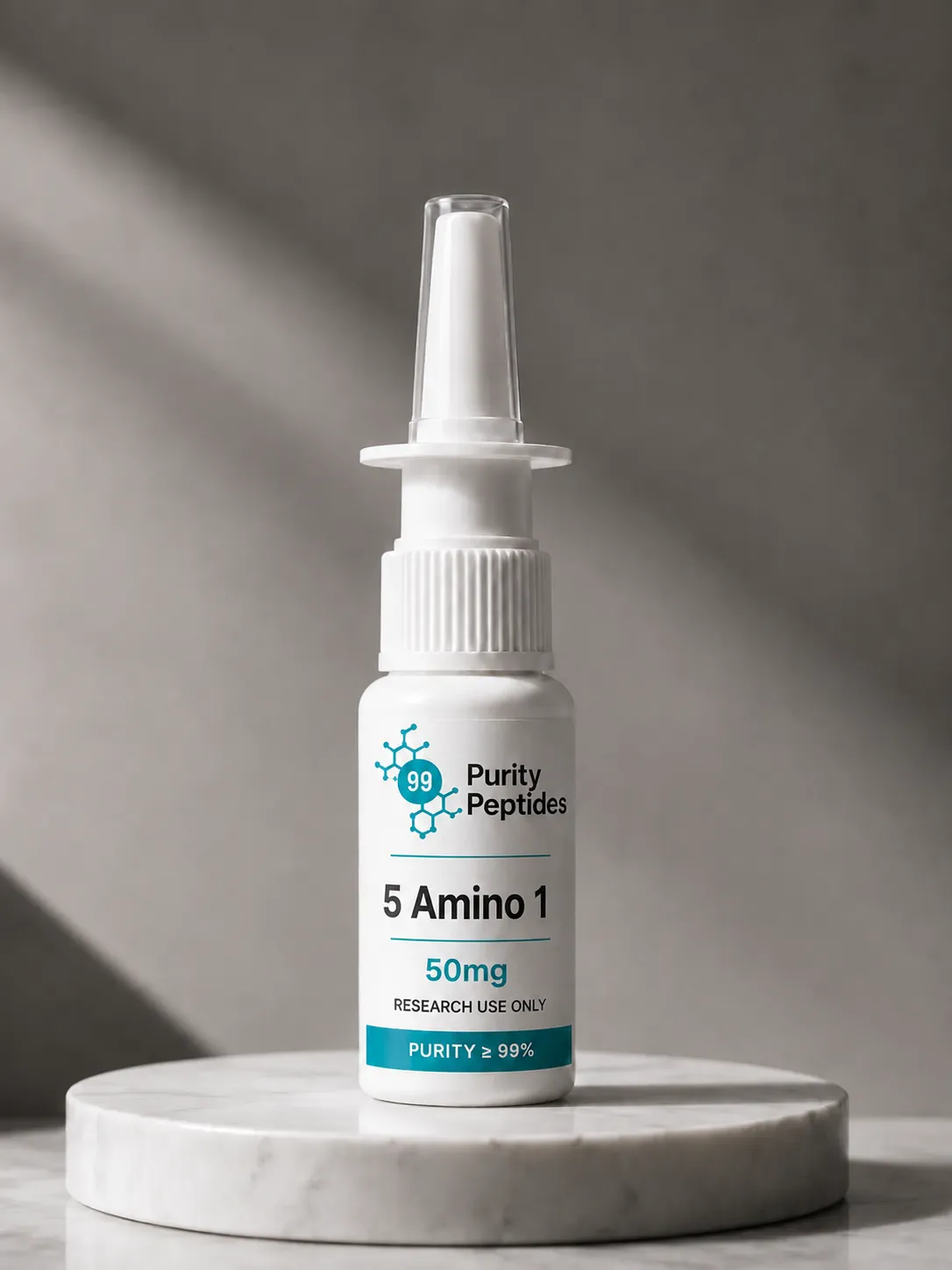
99 Purity Peptides supplies 5-Amino-1MQ nasal spray 50mg for research use only, with certificates of analysis available for review. Compound specifications, analytical documentation and storage guidance accompany each listing so that the details in this guide can be verified against the material you actually receive.
RESEARCH USE ONLY All products referenced on this page are supplied strictly for laboratory research use only. They are not drugs, foods, cosmetics, or dietary supplements, and may not be used for diagnostic or therapeutic purposes in humans or animals. Nothing on this page constitutes medical advice or a recommendation for human use. |
Key Takeaways
- 5-Amino-1MQ is not a peptide. It is 5-amino-1-methylquinolinium, a synthetic small-molecule quinolinium salt (CAS 42464-96-0, MW 286.11 as the iodide salt) sold alongside peptides by shelf convention only.
- The 50mg refers to total bottle content, not a per-spray amount. Nasal cavity volume of roughly 100–200 µL per nostril constrains per-actuation delivery independently of the label figure.
- Salt form changes what the label means. Approximately 1.89 mg of iodide salt contains 1 mg of 5-Amino-1MQ equivalent, so salt weight and free-base weight are different numbers.
- The mechanism is NNMT inhibition, not NAD+ supplementation. Blocking nicotinamide methylation spares nicotinamide and the SAM methyl-donor pool; it does not supply NAD+ directly.
- Molecular weight favours the nasal route. At 286 Da the compound sits below the ~1,000 Da threshold where nasal absorption drops sharply — though no nasal study on this compound has been published.
- All published evidence is preclinical. In vitro assays and rodent models only, with reported NNMT IC50 of 1.2 µM and murine efficacy at 20 mg/kg/day subcutaneously.
- There are no human trials and no FDA approval. No human pharmacokinetic, efficacy, or safety data has been published as of August 2026.
- Dosage figures vary because conventions differ, not because the science is unsettled. Oral, injectable and bottle-total figures circulate together with no shared source.
- Verify before you buy. Lot-specific COA, HPLC purity plus LC-MS identity, stated salt form, and matching CAS number are the four checks that matter.
Frequently Asked Questions
Is 5-Amino-1MQ a peptide?
No. 5-Amino-1MQ is 5-amino-1-methylquinolinium, a synthetic small-molecule quinolinium salt with a molecular weight of 286.11 as the iodide salt. It contains no amino acid residues and no peptide bonds. It is sold alongside peptides by catalogue convention, not because of shared chemistry.
What is 5-Amino-1MQ nasal spray?
5-Amino-1MQ nasal spray is an intranasal formulation of a small-molecule inhibitor of nicotinamide N-methyltransferase (NNMT). It is supplied for research use only. The nasal route delivers the compound across the nasal mucosa rather than through the gastrointestinal tract.
What does the 50mg on the bottle mean?
The 50mg refers to the total quantity of compound in the bottle, not the amount delivered per spray. A single actuation delivers a small fraction of that total. Confirm with your supplier whether the figure describes iodide salt weight or free-base equivalent.
How does 5-Amino-1MQ work?
5-Amino-1MQ binds the substrate site of NNMT and inhibits the enzyme. NNMT normally transfers a methyl group from S-adenosylmethionine onto nicotinamide, producing 1-methylnicotinamide. Inhibiting that reaction spares both nicotinamide and the SAM methyl-donor pool.
What is NNMT?
Nicotinamide N-methyltransferase is a SAM-dependent enzyme that methylates nicotinamide to form 1-methylnicotinamide. It is expressed notably in liver and adipose tissue and sits at the junction of the NAD+ salvage pathway and cellular methylation capacity.
Does 5-Amino-1MQ raise NAD+ directly?
No. 5-Amino-1MQ supplies no NAD+ and no NAD+ precursor. It acts upstream by reducing how much nicotinamide is diverted away from the salvage pathway. Any effect on NAD+ is indirect and depends on salvage-pathway activity in the tissue studied.
Is 5-Amino-1MQ FDA approved?
No. 5-Amino-1MQ holds no FDA approval for any indication. It is not an approved drug and not a dietary supplement ingredient. In the United States it is supplied under Research Use Only labelling for laboratory research by qualified personnel.
Are there human clinical trials on 5-Amino-1MQ?
No completed or published human interventional trial exists as of August 2026. There is also no published human pharmacokinetic study. All available evidence comes from in vitro assays and rodent models, so no human efficacy or safety profile has been established.
What animal studies have been published?
Published preclinical work includes 3T3-L1 and adipocyte studies, diet-induced obesity mouse models, aged skeletal muscle models, and intraperitoneal ovarian cancer metastasis models. Murine efficacy was reported at 20 mg/kg/day subcutaneously, with no adverse effects noted up to 60 mg/kg/day.
Why do 5-Amino-1MQ dosage figures vary so much between sources?
Three conventions circulate at once: oral capsule content described at 50-150 mg/day, injectable content described at 150-500 mcg/day, and bottle totals such as 50mg. The first two differ roughly 150-fold, and pages rarely state which convention they are using.
What is the molecular weight and CAS number of 5-Amino-1MQ?
The molecular weight is 286.11 as the iodide salt, with molecular formula C10H11N2 . I. The CAS number is 42464-96-0. Approximately 1.89 mg of the iodide salt contains 1 mg of 5-Amino-1MQ free-base equivalent.
Why is 5-Amino-1MQ formulated as a nasal spray?
At 286 daltons the compound sits well below the roughly 1,000 dalton threshold above which nasal absorption drops sharply. The nasal mucosa is well vascularised and bypasses first-pass metabolism. No nasal-route study on this specific compound has been published.
Does nasal delivery reach the brain directly?
Systemic nasal bioavailability and the nose-to-brain fraction are different measurements. Most published figures describe systemic absorption into the bloodstream. The direct central nervous system fraction travelling via olfactory and trigeminal pathways is a separate and much smaller number.
How should 5-Amino-1MQ be stored?
Solid material is typically stored at -20 degrees C, kept dry and protected from light. Solution formulations follow the supplier's stated conditions for that product. Avoid repeated temperature cycling and label containers with lot number and date first opened.
How do I verify 5-Amino-1MQ purity before research use?
Request a lot-specific certificate of analysis matching your bottle. Confirm HPLC purity with its method stated, LC-MS or equivalent identity confirmation, the salt form, and a CAS number of 42464-96-0. A generic or undated COA describes different material.