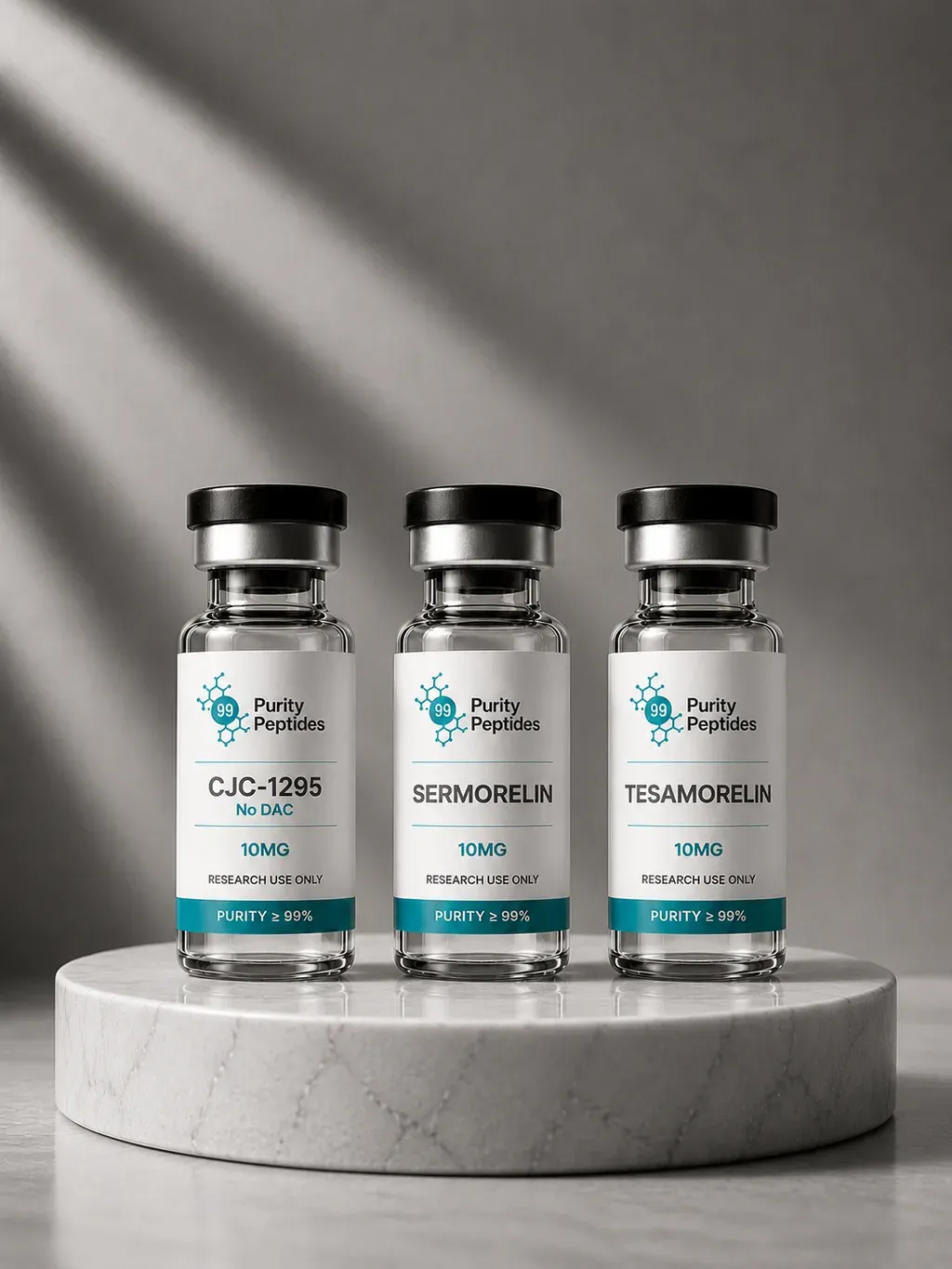
The GHRH Analog Comparator supplies three growth hormone-releasing hormone analogs at 10 mg each: sermorelin, the unmodified GHRH(1-29) sequence; CJC-1295 No DAC, the same sequence with four stabilising amino acid substitutions; and tesamorelin, the full-length GHRH(1-44) sequence with an N-terminal acyl group. All three act at the same receptor, so the set isolates modification strategy as the variable. For research use only.
HPLC certified
Independent analysis
Highest standard
Full traceability
The GHRH Analog Comparator brings together three analogs of growth hormone-releasing hormone at matched 10 mg mass. All three are agonists at the same receptor, which makes the set a comparison of modification strategy rather than of mechanism.
Native GHRH is proteolytically fragile, cleaved rapidly in plasma with dipeptidyl peptidase-4 acting at the N-terminus as a principal route. Each compound in this set represents a different response to that problem.
Sermorelin is GHRH(1-29) in amidated form — the native sequence, unmodified, and the reference against which the others are understood. CJC-1295 No DAC, also known as Mod GRF 1-29, is the same 29-residue sequence carrying four amino acid substitutions, each addressing a specific degradation route. Tesamorelin takes a different approach on two counts: it uses the full 44-residue GHRH sequence rather than the truncated form, and it carries a trans-3-hexenoyl group attached at the N-terminus rather than altering the sequence itself.
One point matters for study design. Tesamorelin is roughly fifty percent larger than the other two, so equal masses do not supply equal molar amounts. At 10 mg each, the two GHRH(1-29) analogs are closely matched on a molar basis while tesamorelin supplies approximately a third fewer moles.
All three vials are supplied lyophilized with batch documentation.
For Research Use Only. Not intended for human consumption, therapeutic use, veterinary use, or diagnostic applications.
The GHRH Analog Comparator is a three-vial set containing sermorelin, CJC-1295 No DAC and tesamorelin at 10 mg each. All three are agonists at the growth hormone-releasing hormone receptor, so mechanism is held constant. What differs is how each is stabilised against proteolytic cleavage: sermorelin is unmodified, CJC-1295 No DAC carries four amino acid substitutions, and tesamorelin carries an N-terminal acyl group.
| Compound | Mass | Also known as | Sequence basis | Modification |
|---|---|---|---|---|
| Sermorelin | 10 mg | GRF(1-29), GHRH(1-29) | GHRH(1-29), amidated | None — native sequence |
| CJC-1295 No DAC | 10 mg | Mod GRF 1-29, Modified GRF (1-29) | GHRH(1-29) | Four amino acid substitutions |
| Tesamorelin | 10 mg | — | GHRH(1-44) | N-terminal trans-3-hexenoyl group |
All three vials are supplied as lyophilized powder with batch documentation.
The three compounds in this set share a receptor. They differ in how each is stabilised, which is what makes them useful held together.
Native growth hormone-releasing hormone is short-lived in plasma. Dipeptidyl peptidase-4 cleaves it near the N-terminus, and additional proteolytic routes contribute to its rapid degradation. Any GHRH analog intended for extended study has to address that fragility.
The three compounds here represent three distinct engineering answers: leave the sequence alone, alter the sequence, or attach something to it.
Sermorelin is GHRH(1-29) in amidated form: the first twenty-nine residues of human growth hormone-releasing hormone, unaltered. The 1-29 fragment retains receptor activity, which is why the truncated sequence is used rather than the full molecule.
Because it is unmodified, sermorelin carries the native sequence’s proteolytic vulnerability in full. That is precisely what makes it valuable in a comparator set — it is the baseline against which the other two modifications are measured. A comparison of engineered analogs without the unmodified parent has no reference point. See how sermorelin and CJC-1295 compare.
CJC-1295 No DAC is the same GHRH(1-29) sequence as sermorelin, carrying four amino acid substitutions. The compound is also known as Mod GRF 1-29 and Modified GRF (1-29) — these names refer to the same material, not to different compounds.
The four substitutions are not arbitrary. Each addresses a specific degradation route:
Four modifications, four failure modes addressed. This is sequence engineering: the peptide itself is altered, and nothing is attached to it.
Tesamorelin differs from the other two on two counts rather than one.
Sequence length. Tesamorelin is based on GHRH(1-44) — the full forty-four residue sequence — rather than the 1-29 fragment. It is therefore roughly fifty percent larger than the other two compounds in this set.
Modification type. Rather than substituting residues, tesamorelin carries a trans-3-hexenoyl group attached at the N-terminal tyrosine. The sequence is left intact and a chemical group is added to protect the vulnerable terminus.
That makes tesamorelin the clearest contrast in the set: a different stabilisation approach applied to a different starting sequence. See how tesamorelin and sermorelin compare.
Be the first to share your experience with this product and help other researchers!
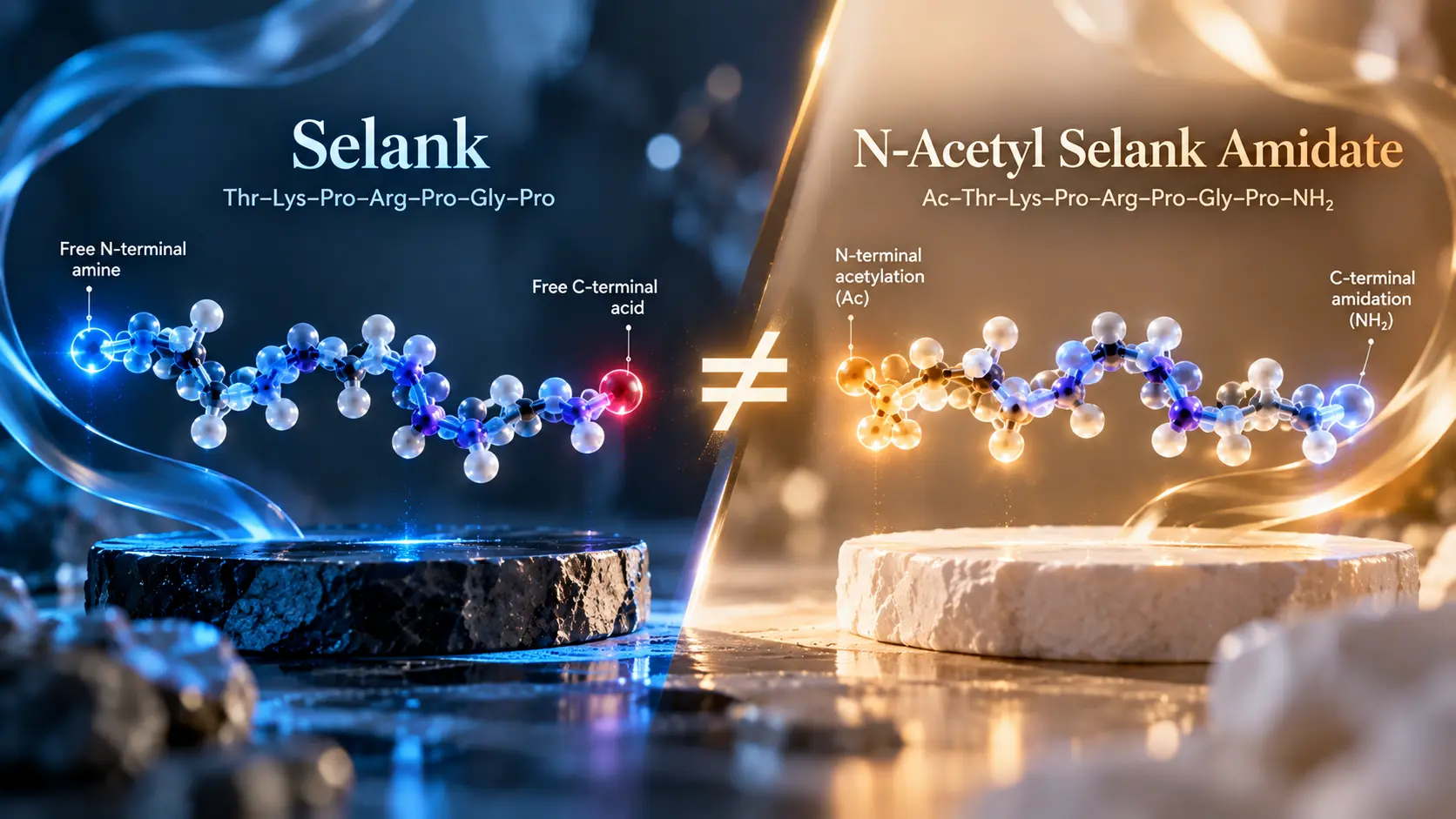
N-acetyl selank amidate is not Selank's full chemical name. Compare sequences, masses and database records, and learn how to tell the two apart on a COA.

Is CJC-1295 legal? It is not FDA-approved, left FDA Category 2 in 2024, was voted down for 503A compounding, and is banned by WADA. Verified status.
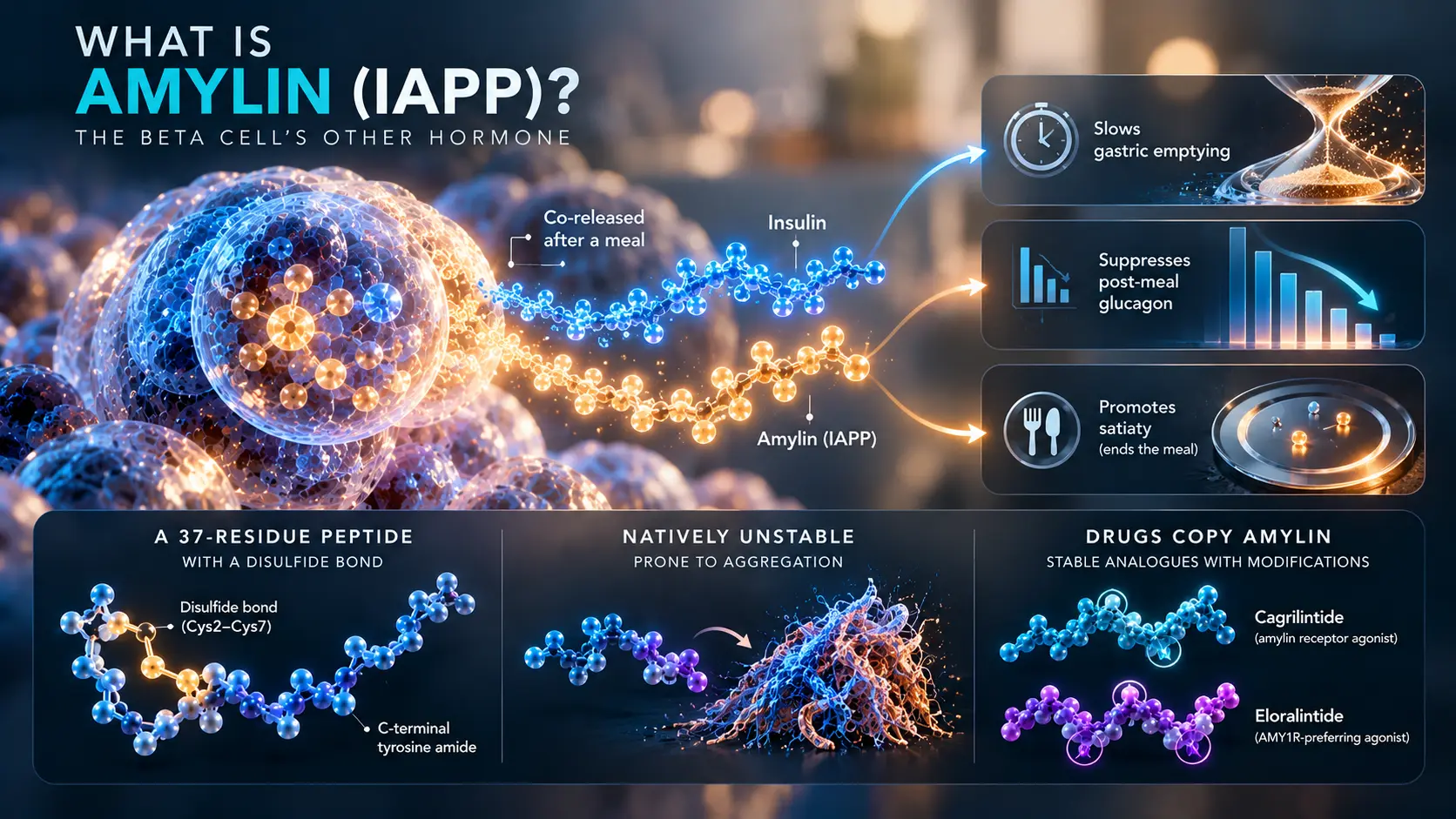
What is amylin? A 37-residue hormone the beta cell releases alongside insulin. Its real job, why it clumps, and how cagrilintide and eloralintide copy it.
(faqs)