
Introduction
Why do some people accumulate fat more easily than others, even on similar diets? Why does metabolism tend to slow with age? Part of the answer may lie in a single, often-overlooked enzyme: nicotinamide N-methyltransferase, or NNMT.
NNMT sits at a metabolic crossroads. It controls how cells manage two of the most important molecules in cellular energy metabolism — NAD+ and SAM — and in doing so, it influences fat storage, insulin sensitivity, and even the epigenetic signals that govern gene expression. Over the past decade, researchers studying obesity, type 2 diabetes, cancer, and aging have converged on NNMT as a shared mechanistic thread connecting all four.
This guide breaks down what NNMT is, how it works at the molecular level, what the published research actually shows about its role in cellular metabolism, and why it has become one of the most closely watched targets in metabolic research today.
Quick Answer: What Is NNMT and Why Does It Matter?
NNMT (nicotinamide N-methyltransferase) is a cytosolic enzyme, most active in liver and fat tissue, that transfers a methyl group from SAM onto nicotinamide (a form of vitamin B3), producing 1-methylnicotinamide (MNAM). This reaction depletes both NAD+ precursor supply and the cell's methylation capacity. Because NAD+ and SAM govern energy metabolism and gene regulation, elevated NNMT activity is linked to fat accumulation, insulin resistance, and metabolic dysfunction — making it a major research target for obesity and metabolic syndrome. |
The Two Molecules NNMT Controls: NAD+ and SAM
To understand NNMT, it helps to understand the two resources it competes for.
NAD+: the cell's energy currency
Nicotinamide adenine dinucleotide (NAD+) is essential for glycolysis, the tricarboxylic acid cycle, fatty acid oxidation, and the activity of NAD+-dependent enzymes such as sirtuins and PARPs, which regulate DNA repair and cellular aging. Nicotinamide (NAM) — the substance NNMT methylates — is also the direct precursor the cell recycles back into NAD+ through the salvage pathway. When NNMT pulls NAM away from that salvage pathway, less is available to regenerate NAD+.
SAM: the cell's methyl donor
S-adenosylmethionine (SAM) is the universal methyl donor used for DNA methylation, histone methylation, and dozens of other methyltransferase reactions that regulate gene expression. Every time NNMT methylates a nicotinamide molecule, it consumes one molecule of SAM and produces S-adenosylhomocysteine (SAH), a precursor of homocysteine. High NNMT activity therefore reduces the SAM-to-SAH ratio — often described as the cell's "methylation potential" — which can alter which genes are turned on or off.
Featured-snippet answer: What does NNMT actually do to cells? NNMT methylates nicotinamide using SAM as the methyl donor, producing 1-methylnicotinamide (MNAM) and SAH. This simultaneously reduces the NAM available for NAD+ recycling and lowers the cell's SAM-to-SAH methylation potential — two changes linked to altered energy metabolism and gene regulation. |
NNMT and Fat Storage: What the Research Shows
NNMT is expressed at especially high levels in the liver and white adipose tissue (WAT) — the two organs most central to whole-body energy storage. Multiple independent research groups have found that NNMT expression and activity rise substantially in the adipose tissue of diet-induced obese mice, and that NNMT mRNA is elevated in the fat tissue of people with type 2 diabetes.
The relationship also appears to run in reverse: NNMT levels in visceral fat decline after bariatric surgery, and NNMT levels in subcutaneous fat decline with increased exercise in people with impaired glucose tolerance or type 2 diabetes — suggesting NNMT expression tracks with metabolic state rather than simply being a fixed trait.
Why lowering NNMT activity affects body weight in animal studies
Several research teams have tested what happens when NNMT activity is reduced, using two different tools:
- Genetic knockdown (antisense oligonucleotides): Reducing NNMT protein in the liver and white adipose tissue of mice lowered body weight and body fat percentage while increasing lean mass, compared to control-treated mice.
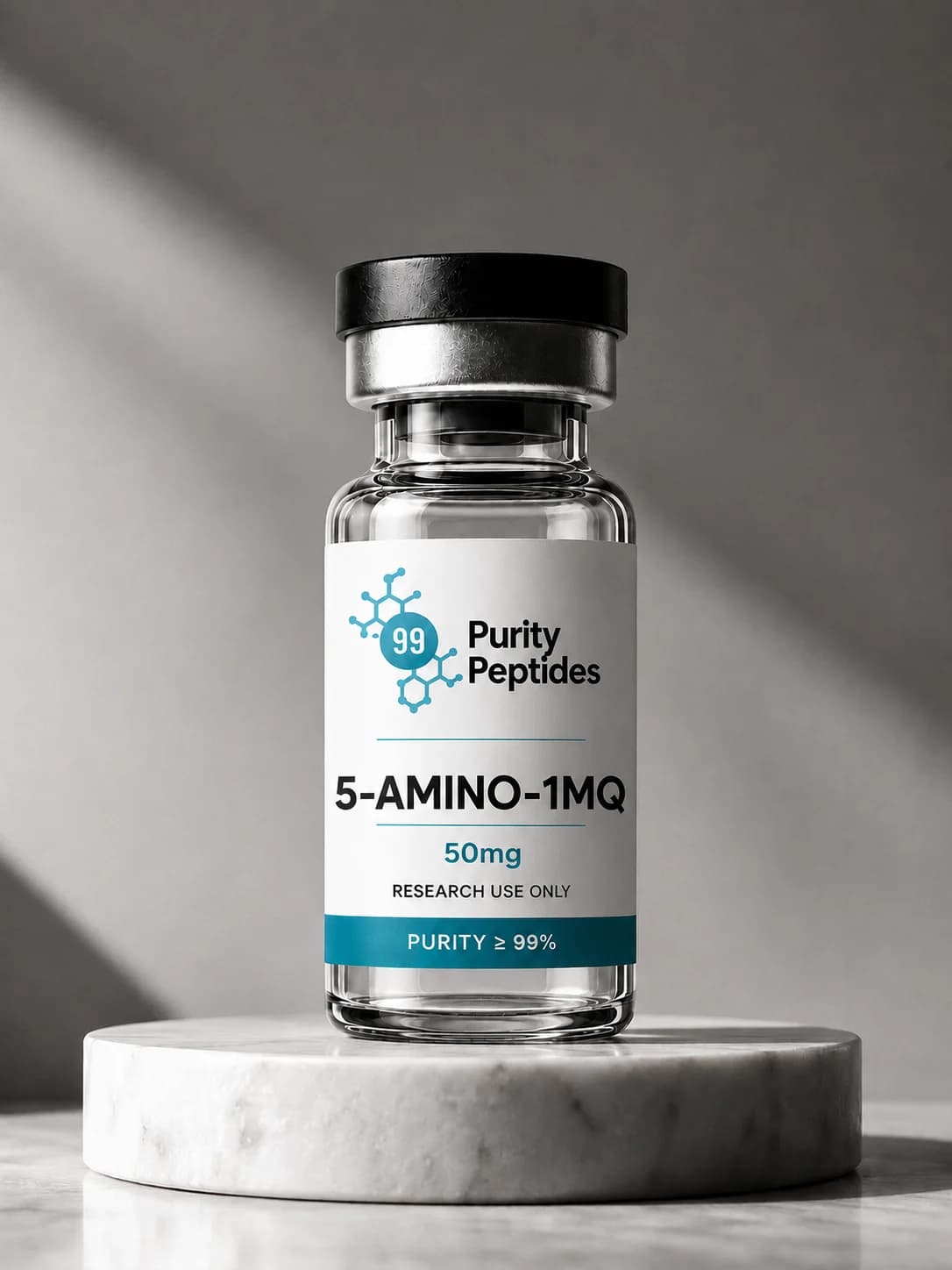
- Small-molecule inhibition (5-amino-1MQ): This selective, cell-permeable NNMT inhibitor reduced intracellular MNAM, increased intracellular NAD+, and suppressed lipogenesis (fat synthesis) in adipocytes in vitro. In diet-induced obese mice, systemic treatment produced a progressive, statistically significant reduction in body weight, white fat mass, and adipocyte size, without significantly changing food intake.
Researchers interpret these findings as evidence that NNMT activity actively drives fat accumulation, rather than simply changing as a side effect of obesity — although this conclusion is currently supported by animal and cell-culture data, not human clinical trials.
NNMT's Broader Role in Metabolic Syndrome
Metabolic syndrome — the cluster of obesity, insulin resistance, high blood pressure, and abnormal lipid levels — has been linked to NNMT through several overlapping mechanisms documented in the literature:
- Insulin sensitivity: In mouse models, adipose-specific changes that improve insulin sensitivity correspond with reduced NNMT expression, while insulin-resistant states (high-fat diet, ob/ob, and db/db mice) show increased NNMT protein in both liver and fat tissue.
- Homocysteine elevation: Because NNMT production of SAH is a precursor step to homocysteine, chronically elevated NNMT activity has been proposed as a contributor to the elevated homocysteine levels seen in metabolic syndrome, a recognized cardiovascular risk marker.
- Chronic kidney disease: Research has also connected NNMT and disrupted NAD+ metabolite balance to renal fibrosis progression, extending NNMT's relevance beyond fat tissue and the liver.
NNMT, Cancer, and Aging: A Wider Metabolic Signature
NNMT's influence isn't limited to obesity research. It is also one of the most consistently overexpressed metabolic enzymes across multiple cancer types, where it has been shown to deplete NAD+ and SAM, activate inflammatory STAT3/IL-1β signaling, and support cancer stem-cell-like properties and treatment resistance in some tumor models. Separately, because NAD+ decline and reduced methylation capacity are both recognized hallmarks of cellular aging, several review papers now discuss NNMT as a candidate mechanistic link between metabolic dysfunction and age-related decline — though this remains an active, evolving research area rather than settled science.
NNMT Across Research Domains: Comparison Table
Research Domain | Reported NNMT Pattern | Proposed Mechanistic Link |
|---|---|---|
Obesity / diet-induced weight gain | Elevated in white adipose tissue and liver | Depletes NAD+/SAM, promotes lipogenesis, reduces energy expenditure |
Type 2 diabetes | Elevated in omental and subcutaneous fat | Associated with reduced insulin sensitivity |
Metabolic syndrome | Elevated NNMT activity proposed as contributor | Reduced NAD+, elevated homocysteine |
Chronic kidney disease | Increased renal NNMT expression in fibrosis models | Disrupted NAD+ metabolite balance |
Cancer | Frequently overexpressed in tumor tissue | NAD+/SAM depletion, STAT3/IL-1β inflammatory signaling |
Aging | Proposed contributor to age-related NAD+ decline | Reduced methylation potential and NAD+-dependent enzyme activity |
Common Mistakes When Interpreting NNMT Research
- Assuming mouse-model weight-loss results with NNMT inhibitors already apply to humans — as of this writing, no NNMT inhibitor has published human clinical trial data.
- Treating NNMT as a single-disease target — the published literature connects it to obesity, diabetes, kidney disease, cancer, and aging simultaneously, so isolated claims miss the bigger mechanistic picture.
- Confusing correlation with causation — elevated NNMT in obese tissue and reduced NNMT after bariatric surgery are both observational associations; knockdown/inhibitor studies are what provide causal evidence in animal models.
- Overlooking tissue specificity — NNMT's effects and expression differ meaningfully between liver, white adipose tissue, brown adipose tissue, and kidney, so findings in one tissue don't automatically generalize to another.
Key Takeaways
- NNMT is an enzyme, most active in liver and fat tissue, that methylates nicotinamide using SAM, producing MNAM and SAH.
- This single reaction simultaneously reduces NAD+ precursor availability and lowers the cell's SAM-dependent methylation capacity.
- NNMT expression rises in obese and insulin-resistant states and falls after bariatric surgery or increased exercise, tracking with metabolic status.
- Genetic knockdown and small-molecule inhibition of NNMT (e.g., 5-amino-1MQ) reduced body weight, fat mass, and lipogenesis in mouse studies — but this evidence has not yet been replicated in published human trials.
- Beyond obesity, NNMT has been implicated in type 2 diabetes, metabolic syndrome, chronic kidney disease, cancer progression, and cellular aging, making it a cross-cutting research target rather than a single-condition biomarker.
Frequently Asked Questions
What does NNMT stand for?
NNMT stands for nicotinamide N-methyltransferase, an enzyme that methylates nicotinamide (a form of vitamin B3) using SAM as the methyl donor.
Where in the body is NNMT most active?
NNMT is most highly expressed in the liver and white adipose tissue, though it has also been studied in the kidney and in various tumor tissues.
How does NNMT affect NAD+ levels?
NNMT consumes nicotinamide, the direct precursor the body recycles into NAD+ through the salvage pathway. Higher NNMT activity diverts nicotinamide away from that pathway, which has been linked to reduced intracellular NAD+ in several studies.
What is 1-methylnicotinamide (MNAM) and why does it matter?
MNAM is the direct product of the NNMT reaction. Researchers use MNAM levels as a biomarker of NNMT activity in both cells and blood or urine samples.
Does NNMT cause obesity or does obesity cause NNMT to rise?
Published research shows both directions: NNMT expression rises in obese and insulin-resistant states, and separately, reducing NNMT activity in mice (via knockdown or inhibitors) causes weight loss — suggesting NNMT can actively drive fat accumulation rather than simply reflect it.
What is 5-amino-1MQ?
5-amino-1MQ is a selective, cell-permeable small-molecule NNMT inhibitor studied in preclinical research. In diet-induced obese mice, it reduced body weight, fat mass, and adipocyte size without significantly affecting food intake.
Has any NNMT inhibitor been tested in humans?
As of current published literature, NNMT inhibitor research — including 5-amino-1MQ — has been conducted in cell culture and animal models only. No completed human clinical trials on NNMT inhibitors have been published.
How is NNMT connected to type 2 diabetes?
NNMT mRNA is elevated in the fat tissue of people with type 2 diabetes, and animal studies link reduced NNMT activity to improved insulin sensitivity and better glucose tolerance.
Does exercise or bariatric surgery change NNMT levels?
Yes. Studies report that NNMT expression in visceral fat declines after bariatric surgery, and NNMT in subcutaneous fat declines with increased exercise in people with impaired glucose tolerance or type 2 diabetes.
Is NNMT linked to aging?
NNMT is discussed in aging research because its activity depletes NAD+ and reduces cellular methylation potential — two processes independently recognized as contributors to age-related cellular decline. This connection is an active research area rather than an established mechanism.
Is NNMT relevant to cancer research?
Yes. NNMT is frequently overexpressed in various cancers, where it has been associated with tumor aggressiveness, NAD+/SAM depletion, and inflammatory signaling pathways such as STAT3/IL-1β.
What is the difference between SAM and NAD+ in this context?
SAM (S-adenosylmethionine) is the cell's primary methyl donor, used for DNA and histone methylation. NAD+ is the cell's central energy-metabolism cofactor. NNMT uniquely sits between both systems, consuming SAM while diverting a NAD+ precursor.
Can NNMT activity be measured in humans?
Researchers can estimate NNMT activity by measuring MNAM levels in blood, urine, or tissue samples, alongside direct enzyme expression assays in biopsied tissue.