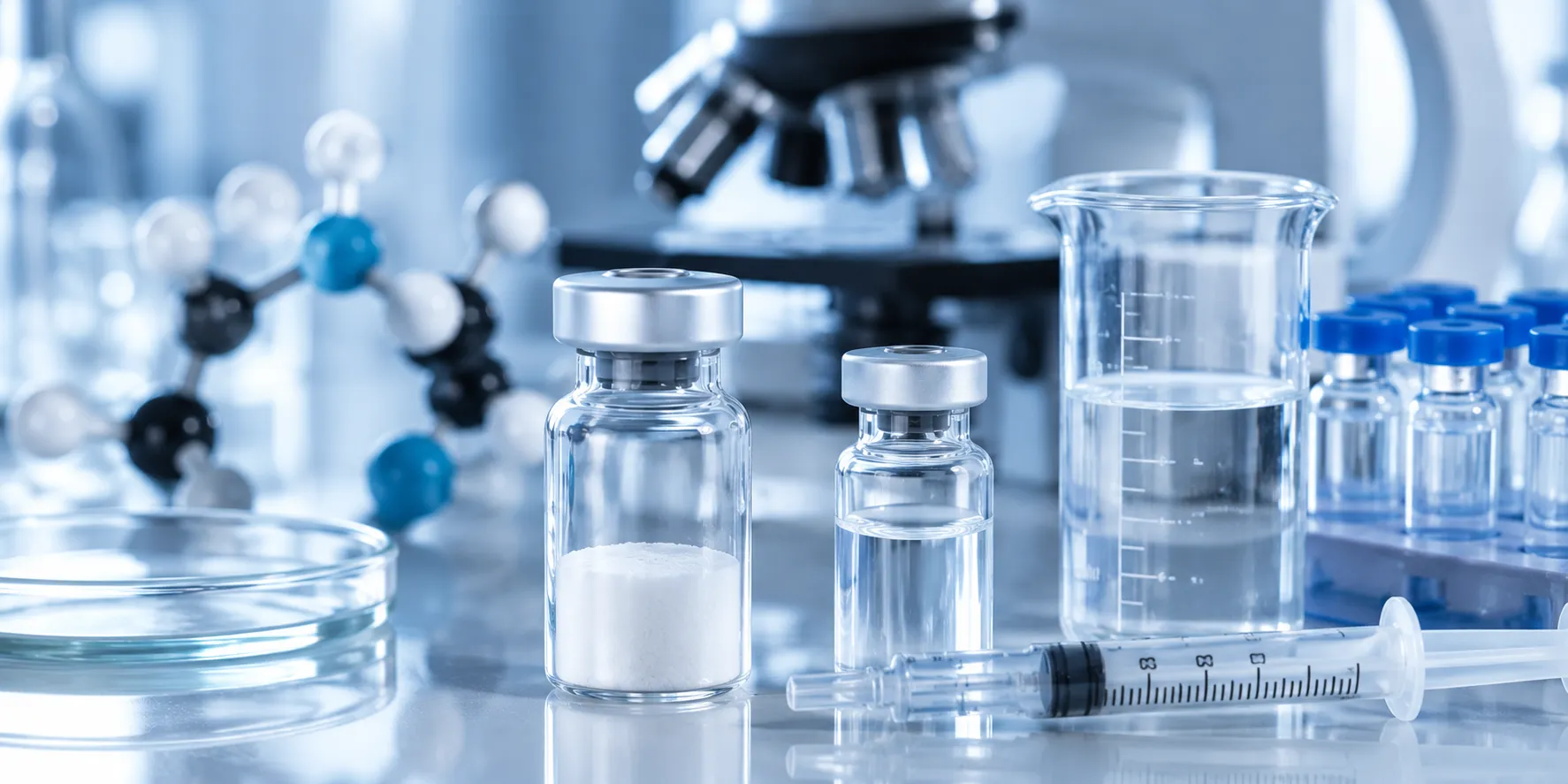
A vial labeled with four peptide names instead of one raises an obvious question: what's actually in it, and in what ratio? Multi-peptide blends have become a standard fixture in research catalogs, but the composition science behind them rarely gets explained in plain terms.
This guide covers the fundamentals researchers need before evaluating any multi-peptide blend: what a peptide is at the molecular level, how blends are formulated and ratioed, how purity is verified through HPLC and mass spectrometry, and how to store and reconstitute lyophilized compounds without compromising a study.
Whether you are comparing a peptide blend against sourcing individual compounds, reading a certificate of analysis for the first time, or setting up storage protocols for a new shipment, this guide gives you the composition literacy to make that call with confidence.
QUICK ANSWER A multi-peptide blend is a single research vial combining two or more peptides at a fixed, pre-determined ratio, rather than requiring a researcher to source and mix each compound separately. Blends are formulated for consistency across replicate samples and are verified for purity using HPLC and mass spectrometry, with results documented on a batch-specific Certificate of Analysis (COA). |
What Is a Peptide? Structure, Bonds & Molecular Basics
A peptide is a short chain of amino acids linked together by peptide bonds. Where proteins typically involve 50 or more amino acid residues folded into complex three-dimensional structures, most research peptides are much shorter chains, which makes their structure — and their composition inside a blend — easier to characterize and verify.
Amino Acids and Peptide Bonds
Each peptide bond forms when the carboxyl group of one amino acid reacts with the amino group of the next, releasing a water molecule and creating a defined chain. This chain has a distinct N-terminus and C-terminus, and the order of amino acids — the sequence — is what gives a peptide its identity and its research properties.
- Primary structure: the linear amino acid sequence itself
- Peptide backbone: the repeating chain of bonded amino acid units
- Side chain residues: the variable groups that determine a peptide's chemical behavior
- Disulfide bridges: bonds that can stabilize certain peptide structures, cyclic or linear
Peptide Molecular Weight and Isoelectric Point
Molecular weight reflects the combined mass of a peptide's amino acid residues and is one of the values researchers use to confirm a compound's identity against its expected mass spectrometry reading. The isoelectric point — the pH at which a peptide carries no net electrical charge — also matters for research protocols, since it affects solubility and how a peptide behaves in different buffer conditions.
What Is a Multi-Peptide Blend?
Featured Snippet Answer: A multi-peptide blend combines two or more distinct peptides into one vial at a fixed concentration ratio, formulated so that each dose delivers a consistent combination rather than requiring separate measurement and mixing of individual compounds.
Blends exist because many research questions look at how compounds interact rather than how a single peptide performs in isolation. Instead of reconstituting and combining several vials by hand — introducing measurement variability at every step — a pre-formulated blend locks in the ratio at the manufacturing stage.
How Multi-Peptide Blends Are Formulated
Formulating a blend starts with selecting compounds whose research profiles are commonly studied together, then determining a milligram-to-milligram ratio that reflects how each compound is typically used on its own. That ratio is fixed during lyophilization, so every vial from the same batch delivers the same composition.
- Compound selection based on complementary or overlapping research applications
- Ratio determination, typically informed by each compound's individual research dosing range
- Combined synthesis or post-synthesis blending under controlled lab conditions
- Lyophilization (freeze-drying) into a stable powder for shipping and storage
- Batch testing via HPLC and mass spectrometry to confirm the final ratio and purity
Peptide Blend vs. Single Peptide: Which Fits Your Research?
Comparison Snippet: single peptides give researchers full control over individual compound ratios and are better suited to isolating one variable. Blends offer consistency, lower per-study handling, and are typically more cost-effective when a protocol already calls for the same compound combination every time.
Factor | Multi-Peptide Blend | Single Peptide |
|---|---|---|
Ratio control | Fixed at manufacturing | Fully researcher-controlled |
Measurement variability | Low — pre-combined | Higher — manual combination required |
Best for | Studies using an established combination | Studies isolating one compound's effect |
Cost per study | Often lower for repeated use | Can be higher when multiple vials are needed |
Customization | Limited to the blend's fixed ratio | Full flexibility on ratio and timing |
Documentation | Single COA covers the whole blend | Separate COA per compound |
How Peptide Purity Is Tested
Featured Snippet Answer: Peptide purity is verified primarily through High-Performance Liquid Chromatography (HPLC), which separates and quantifies compounds in a sample, and mass spectrometry, which confirms the molecular weight matches the expected peptide identity. Results are documented on a Certificate of Analysis (COA).
HPLC (High-Performance Liquid Chromatography)
HPLC separates the components of a sample as it passes through a column, producing a chromatogram where each compound appears as a distinct peak. The area under the target peptide's peak, relative to the total area of all peaks, gives the purity percentage reported on a COA.
Mass Spectrometry
Mass spectrometry measures the mass-to-charge ratio of ionized molecules in a sample, confirming that the peptide's actual molecular weight matches its expected value. This step verifies identity — that the vial contains the peptide it claims to — rather than purity percentage alone.
Reading a Certificate of Analysis (COA)
A COA should be batch-specific, not a generic reference document, and should show the tested purity percentage, the confirmed molecular weight, the testing method used, and the batch or lot number tied to the exact vial purchased.
- Confirm the COA lists a batch or lot number matching your order
- Check that both HPLC purity and mass spectrometry identity confirmation are included
- Look for a named or accredited third-party testing lab, not solely in-house results
- For blends, confirm the COA documents the ratio of each compound, not just overall purity
Handling, Storage & Reconstitution
Step-by-Step Snippet: lyophilized peptides are reconstituted by adding bacteriostatic water to the vial using sterile technique, allowing the powder to dissolve without agitation, then storing the reconstituted solution under refrigeration.
Lyophilized Peptide Storage
Unreconstituted, lyophilized peptides are relatively stable when kept refrigerated or frozen and protected from light and moisture. This freeze-dried powder form is what allows research peptides to ship without a continuous cold chain in many cases, though manufacturer guidance should always take precedence.
Bacteriostatic Water & Reconstitution
Bacteriostatic water — sterile water containing a small amount of benzyl alcohol as a preservative — is the standard solvent used to reconstitute lyophilized peptides for laboratory use. It is added slowly along the vial wall rather than directly onto the powder, to avoid disrupting the peptide structure.
- Use sterile technique and a new needle/syringe for each reconstitution
- Add bacteriostatic water gently along the inside wall of the vial, not directly onto the powder
- Allow the vial to sit and dissolve naturally rather than shaking vigorously
- Label the vial with the reconstitution date immediately after mixing
Shelf Life & Stability
Once reconstituted, most research peptides have a defined stability window under refrigeration, after which potency can decline. Repeated freeze-thaw cycles are one of the most common causes of premature degradation, so single-use aliquoting is often preferable to repeatedly accessing the same vial over an extended study.
Commonly Combined Research Peptides
Certain compounds appear together across multiple blend formulations because their research profiles are frequently studied in combination. The table below summarizes compound classes researchers most often encounter in multi-peptide products.
Compound | Class | Common Research Focus |
|---|---|---|
BPC-157 | Pentadecapeptide | Tissue repair, angiogenesis research |
TB-500 | Thymosin Beta-4 fragment | Cell migration, wound-healing research |
GHK-Cu | Copper tripeptide | Extracellular matrix, dermal research |
CJC-1295 | GHRH analog | Growth hormone pathway research |
Ipamorelin | GHRP (growth hormone releasing peptide) | Growth hormone pathway research, often paired with CJC-1295 |
Sermorelin | GHRH analog | Growth hormone pathway research |
Epithalon | Synthetic tetrapeptide | Cellular aging and telomerase research |
This table reflects general research-literature associations, not usage recommendations. All compounds referenced are sold strictly for laboratory research use and are not intended for human or animal consumption.
How to Choose a Reputable Research Peptide Supplier
Composition and purity data are only useful if the supplier providing them is transparent and consistent. A handful of checks separate reliable vendors from ones worth avoiding.
- Batch-specific COAs available for every product, not a single generic document reused across batches
- Clear "Research Use Only" (RUO) labeling and compliance framing on every product page
- Domestic US sourcing and shipping, with transparent order tracking
- Named third-party testing labs rather than purity claims with no attribution
- Accessible customer support that can answer composition and testing questions directly
Common Mistakes When Evaluating Multi-Peptide Blends
- Assuming a higher peptide count automatically means a "better" or more potent blend
- Skipping the COA because a vendor is already familiar or previously trusted
- Reconstituting with plain sterile water instead of bacteriostatic water without checking manufacturer guidance
- Repeatedly freeze-thawing a reconstituted vial instead of aliquoting for single use
- Treating blend research data as directly interchangeable with single-compound research findings
Key Takeaways
- A multi-peptide blend combines two or more peptides into one vial at a fixed, manufacturer-set ratio
- Purity and identity are confirmed through HPLC (purity percentage) and mass spectrometry (molecular weight/identity)
- A trustworthy COA is batch-specific and documents both testing methods plus the compound ratio for blends
- Lyophilized peptides are reconstituted with bacteriostatic water using sterile technique, then refrigerated and used within a defined stability window
- Choose a blend when a study already calls for an established compound combination; choose individual peptides when isolating one variable matters more than convenience
Frequently Asked Questions
What is a multi-peptide blend?
A multi-peptide blend is a single research vial combining two or more peptides at a fixed, manufacturer-set ratio, rather than requiring separate sourcing and mixing of individual compounds.
How is a peptide blend different from a single-compound peptide?
A blend pre-combines multiple compounds at a set ratio for consistency, while a single peptide gives researchers full control over concentration and combination but requires manual mixing if multiple compounds are needed.
What does 99% purity mean for research peptides?
It means that, based on HPLC testing, approximately 99% of the material in the sample corresponds to the target peptide, with the remaining fraction made up of related impurities or byproducts.
How is peptide purity measured?
Purity is primarily measured using High-Performance Liquid Chromatography (HPLC), which separates and quantifies the compounds present in a sample, often paired with mass spectrometry to confirm molecular identity.
What is the difference between HPLC and mass spectrometry testing?
HPLC measures purity by separating compounds and calculating the proportion of the target peptide in a sample. Mass spectrometry confirms identity by measuring molecular weight against the expected value.
How do I read a Certificate of Analysis (COA)?
A COA should show the batch or lot number, the tested purity percentage, the confirmed molecular weight, and the testing method used — and for blends, the ratio of each compound.
What is bacteriostatic water and do I need it?
Bacteriostatic water is sterile water containing a small amount of benzyl alcohol as a preservative, and it is the standard solvent used to reconstitute lyophilized peptides for laboratory use.
How do I reconstitute a lyophilized peptide?
Bacteriostatic water is added slowly along the inside wall of the vial using sterile technique, then the vial is left to dissolve naturally rather than shaken, following the specific guidance provided with each batch.
How long does a reconstituted peptide remain stable?
Stability windows vary by compound, but reconstituted peptides are generally stored refrigerated and used within a defined timeframe, with repeated freeze-thaw cycles reducing stability faster than a single continuous refrigeration period.
What is the shelf life of unreconstituted, lyophilized peptides?
Lyophilized peptides are relatively stable when stored refrigerated or frozen and protected from light, generally maintaining integrity for extended periods compared to their reconstituted form.
Is it better to buy a peptide blend or individual peptides for research?
It depends on the study design: blends offer consistency and convenience for an established compound combination, while individual peptides offer full ratio control for studies isolating one variable.
What documentation should come with a research peptide order?
At minimum, a batch-specific Certificate of Analysis showing purity percentage, molecular weight confirmation, and testing method, along with clear Research Use Only (RUO) labeling.
What does 'Research Use Only' (RUO) mean on a peptide label?
RUO labeling indicates the product is sold strictly for laboratory research purposes and is not intended for human or animal consumption, in line with FDA research-chemical marketing standards.
How are multi-peptide blends formulated?
Formulation involves selecting compounds with complementary research applications, setting a milligram ratio, combining and lyophilizing the mixture, then verifying the final composition through HPLC and mass spectrometry testing.
How can I verify a peptide vendor is reputable?
Look for batch-specific COAs, named third-party testing labs, clear RUO compliance labeling, domestic sourcing and shipping transparency, and responsive customer support for composition questions.