Quick Answer
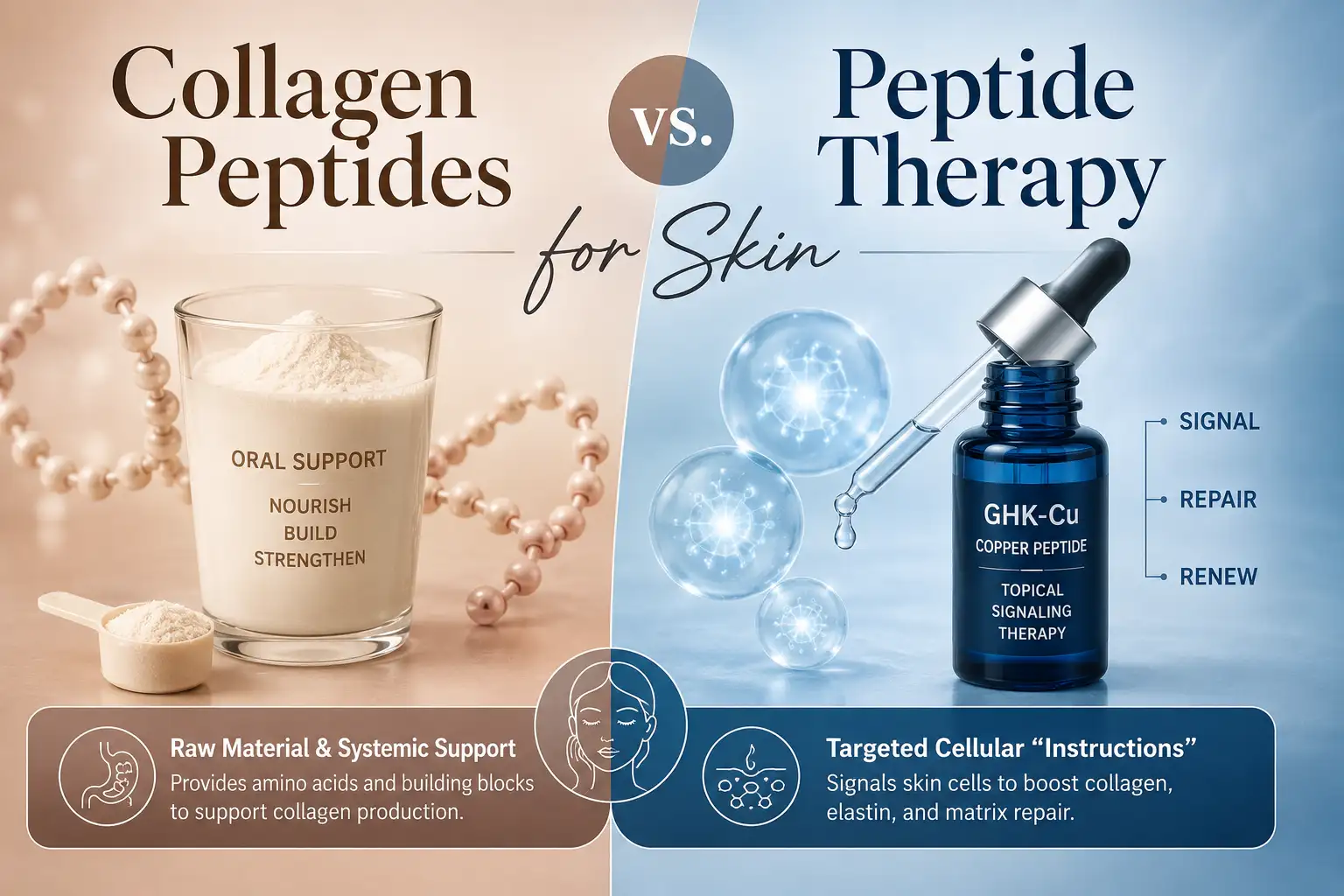
Collagen peptides and peptide therapy are two different approaches to skin aging. Collagen peptides are hydrolyzed protein fragments taken orally, with multiple randomized controlled trials showing improved skin hydration and elasticity. "Peptide therapy" for skin usually refers to bioactive signaling peptides such as GHK-Cu (copper peptide), studied for collagen synthesis and tissue remodeling, and available as topicals and as research-grade compounds for laboratory study only. They aren't really competitors: collagen peptides supply raw material from the inside; signaling peptides like GHK-Cu instruct skin cells from the outside.
Important framing: 99 Purity Peptides supplies research-grade compounds for research use only (RUO) — not for human consumption, diagnosis, or treatment. Nothing below is medical advice.
If you have spent any time researching skin and aging, you have probably run into two phrases that sound similar but mean very different things: collagen peptides and peptide therapy. The marketing often blurs them together. The biology does not. One is a protein you ingest. The other is a signal that tells skin cells what to do. Understanding that distinction is the difference between buying the right thing and wasting months.
The two approaches at a glance
| Feature | Collagen Peptides | Peptide Therapy (GHK-Cu & signaling peptides) |
|---|---|---|
| What it is | Hydrolyzed collagen broken into small bioavailable peptides | Bioactive signaling peptides (e.g., GHK-Cu, copper peptide) |
| How it's used | Oral supplement (powder/capsule); 2.5–15 g/day in studies | Topical serums/creams; injectables prescription-only; raw compound is RUO |
| Mechanism | Supplies amino acids + signals fibroblasts to make collagen | Signals genes for collagen, elastin, matrix remodeling |
| Evidence (skin) | Strong: multiple RCTs + 2023 meta-analysis (26 RCTs, 1,721 people) | Moderate: foundational lab + topical studies; long cosmetic history |
| Best thought of as | Raw material + systemic support | Targeted cellular "instructions" |
| Regulatory status | Dietary supplement / food | OTC topical or RUO research compound |
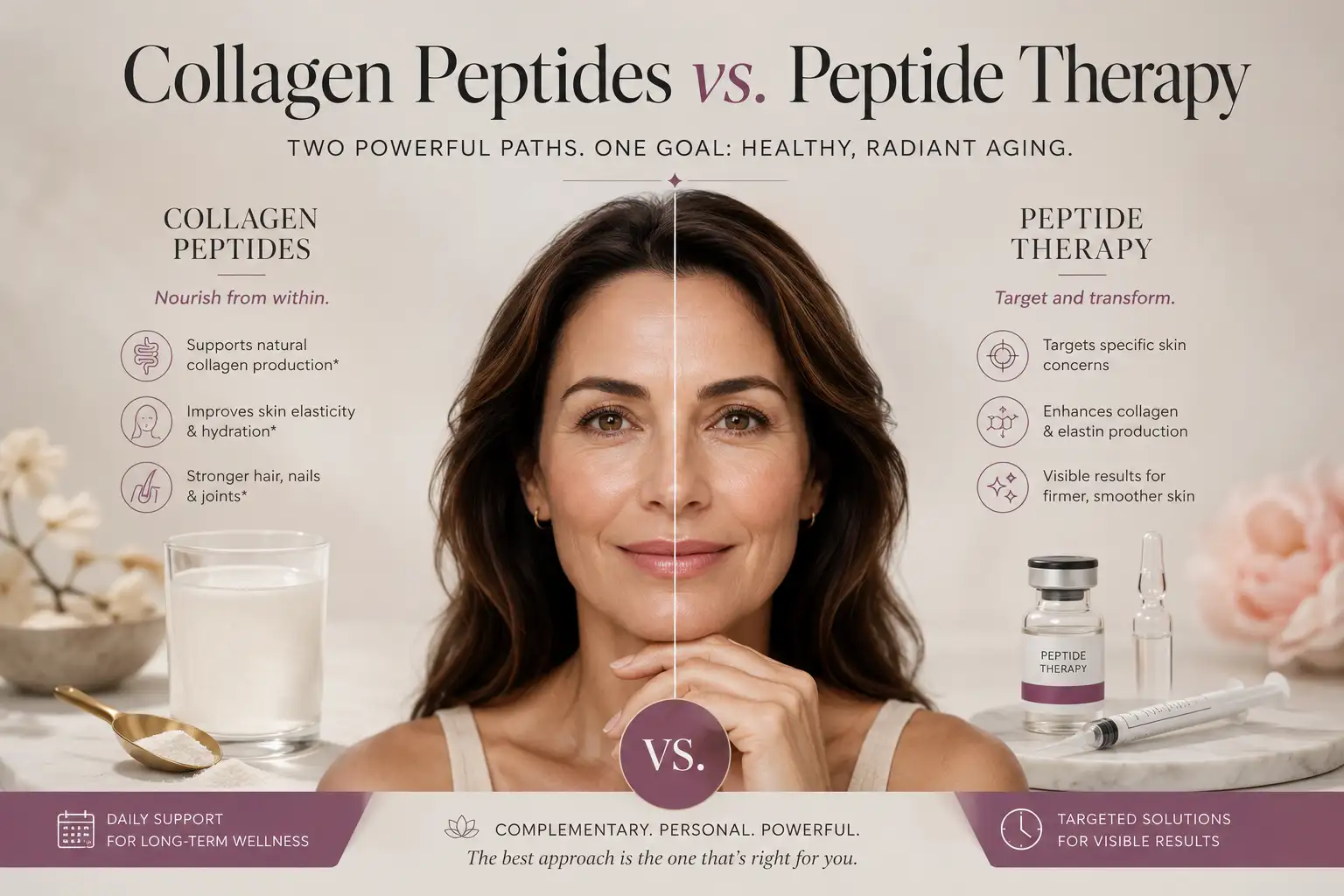
Takeaway: Collagen peptides have the broader human-trial base for skin appearance. Copper peptides have the more targeted signaling story. Many people researching healthy aging look at both.
What do collagen peptides actually do for skin?
Collagen is the most abundant structural protein in skin. With age, collagen density falls and existing collagen fragments — which is why skin loses firmness and fine lines deepen. Because whole collagen is too large to absorb, supplements use hydrolyzed collagen: the protein is enzymatically cut into short peptides (often 3–4 amino acids, including signature dipeptides like Pro-Hyp).
What the research supports. A 2023 systematic review and meta-analysis of 26 randomized controlled trials covering 1,721 participants found that hydrolyzed collagen supplementation produced statistically significant improvements in skin hydration and elasticity versus placebo. A separate double-blind RCT in women aged 30–60 found that a 1,650 mg/day collagen peptide for 12 weeks significantly improved skin wrinkling, hydration, desquamation, and elasticity compared with placebo. Most trials report good tolerability with no serious adverse events.
What collagen peptides don't do. They aren't a targeted wrinkle "eraser." Results build over 8–12 weeks of consistent daily use, and effect sizes vary by formulation and dose. They support skin from a nutritional, structural angle rather than commanding specific repair pathways.
Takeaway: Collagen peptides are the most evidence-backed oral option for supporting skin hydration and elasticity — a slow, foundational approach.
What does "peptide therapy" mean for skin — and where does GHK-Cu fit?
"Peptide therapy" is a broad, trending umbrella term for using bioactive signaling peptides to influence specific biological pathways. For skin, the standout is GHK-Cu — glycyl-L-histidyl-L-lysine bound to a copper ion, a tripeptide naturally present in human plasma that declines with age.
Unlike collagen peptides (which are mostly raw material), GHK-Cu is a signaling molecule. In the foundational review by Pickart and Margolina (2018), GHK-Cu is described as increasing collagen, elastin, and glycosaminoglycan synthesis, supporting dermal fibroblast function, and influencing a broad set of genes tied to tissue repair. A frequently cited finding: in one study, GHK-Cu applied to thigh skin for 12 weeks improved collagen production in 70% of women treated — compared with 50% for vitamin C cream and 40% for retinoic acid.
The honest caveats. Much of the strongest GHK-Cu data comes from lab models, topical cosmetic studies, and older trials. Some research notes part of the collagen-stimulating effect may come from the copper ion itself, and that high concentrations can irritate skin. Injectable peptide forms are prescription-only; raw GHK-Cu sold online is a research-use-only compound, not an approved skin treatment.
Takeaway: GHK-Cu is the most compelling "signaling" peptide for skin — strong mechanism, long cosmetic track record, but a thinner modern RCT base than oral collagen.
Where research-grade peptides come in
At 99 Purity Peptides, GHK-Cu is studied within multi-compound research blends rather than sold as an isolated skincare product. The GLOW research blend is described as a cosmetic-oriented skin and connective-tissue rejuvenation blend combining GHK-Cu and BPC-157 with supportive cofactors — investigated in dermal remodeling, collagen support, and skin elasticity research. Every batch is analytically verified for purity with batch-specific quality control. These are RUO reagents for laboratory study — not skincare.
How do peptides compare to retinol and other actives?
Most women researching skin aging already know retinol. It's useful context: retinol (a vitamin A derivative) speeds cell turnover and is one of the best-studied topical anti-agers, but it can irritate, and gentler alternatives like bakuchiol exist. Peptides work differently — collagen peptides nourish from within; GHK-Cu signals repair pathways. They're generally considered complementary to a retinol routine rather than replacements. The same goes for supporting actives like hyaluronic acid (hydration) and niacinamide (barrier support), which many people layer alongside peptide approaches.
Takeaway: You don't have to choose peptides OR retinol — most evidence-aware routines treat them as different jobs.
Collagen peptides vs. peptide therapy: which should you research?
- If your priority is broad, well-studied skin support from the inside: collagen peptides have the deepest human-trial base.
- If you're interested in targeted cellular signaling and the regenerative-research angle: GHK-Cu and blends like GLOW are the relevant area — within an RUO framework.
- If you're a researcher studying these compounds: purity and documentation matter most. Look for HPLC verification, LC-MS identity confirmation, and a COA.
Bottom line: They answer different questions. Collagen peptides = structural raw material with strong RCT support. Peptide therapy (GHK-Cu) = targeted signaling with a strong mechanism and long cosmetic history.
Why purity matters for any peptide research
Whether you're studying collagen fragments or copper peptides, the data is only as good as the reagent. 99 Purity Peptides supplies every compound with analytical verification confirming molecular identity and purity, batch-specific quality control, and documented impurity profiles — the analytical transparency research protocols require. Compare options across the full research catalog.
Shop the sale
Research-grade peptides are currently discounted. Use code 99PURITY for 10% off all products (or KITS5 for 5% off kits). Browse all research peptides →
Frequently Asked Questions
What is the difference between collagen peptides and copper peptides?
Collagen peptides are hydrolyzed collagen protein taken orally to supply amino-acid building blocks and support collagen production. Copper peptides (GHK-Cu) are signaling peptides applied topically or studied as research compounds; they instruct skin cells to ramp up collagen, elastin, and matrix repair. One is raw material; the other is an instruction.
Do collagen peptides actually work for skin?
The evidence is relatively strong. A 2023 meta-analysis of 26 randomized controlled trials (1,721 participants) found hydrolyzed collagen significantly improved skin hydration and elasticity versus placebo, with benefits typically appearing after 8–12 weeks of daily use.
Do copper peptides build collagen?
Research indicates GHK-Cu can stimulate collagen and elastin synthesis and support fibroblast function. In one study, topical GHK-Cu improved collagen production in 70% of treated women over 12 weeks — outperforming vitamin C and retinoic acid in that trial. Some of the effect may be attributable to the copper ion itself.
Is peptide therapy better than collagen for skin?
Neither is universally better. Oral collagen peptides have the broader modern RCT base for skin appearance; GHK-Cu has a stronger targeted-signaling mechanism and long cosmetic history. Many people researching healthy aging consider both as complementary.
Are research peptides safe to use on skin?
Research-grade peptides such as those from 99 Purity Peptides are for research use only — not for human or veterinary use, diagnosis, or treatment. OTC topical copper-peptide cosmetics are a separate, regulated category. Always respect the RUO designation.
Can I use peptides and retinol together?
They generally serve different roles and are often treated as complementary rather than mutually exclusive — retinol drives cell turnover topically, while collagen peptides support skin nutritionally and GHK-Cu signals repair pathways.
What does retinol do for your skin compared to peptides?
Retinol accelerates skin-cell turnover and is among the best-studied topical anti-agers. Peptides act differently: collagen peptides supply structural building blocks systemically, while GHK-Cu signals repair pathways. They target different mechanisms, which is why routines often combine them.
Where can I buy research-grade GHK-Cu or collagen-focused peptides?
99 Purity Peptides offers GHK-Cu within research blends such as GLOW, alongside a full catalog of analytically verified compounds. All products are research-use-only. Browse the shop and apply code 99PURITY for 10% off.
Ready to source verified research peptides? Explore the GLOW skin & connective-tissue research blend, read the GHK-Cu research guide, or shop the full catalog with code 99PURITY for 10% off. All compounds analytically verified for purity. For research use only.
Ready to source verified research peptides? Explore the GLOW skin & connective-tissue research blend, read the GHK-Cu research guide, or shop the full catalog with code 99PURITY for 10% off. All compounds analytically verified for purity. For research use only.
Meta Block & Technical SEO