8437439007
 orders@99puritypeptides.com
Synthetic Research Peptides for Laboratory Applications
Documented synthetic research peptides are supplied for controlled laboratory and analytical research environments only.
Showing all 10 results
-

AOD (Spray – AOD-9604)
$90.00Spray version of AOD-9604, intended for route-of-administration comparison in lipolysis and fat-loss models.Add to cart -
Sale!
BPC-157 (Spray)
Original price was: $80.00.$67.50Current price is: $67.50.A non-injectable BPC-157 formulation for studying local mucosal and GI tract effects, barrier integrity, and topical cytoprotection.Add to cart -
Sale!
Dream Catcher (Spray)
Original price was: $80.00.$67.50Current price is: $67.50.A multi-agent sleep-support spray (often DSIP-centered) directed at sleep onset, REM/deep sleep distribution, and dream characteristics.Add to cart -
MELANOTAN II 10mg (Spray)
$80.00Spray-based Melanotan II for research on pigmentation and melanocyte activation via a non-injectable route.Add to cart -
NAD+ 1,000mg (Spray)
$95.00A mucosal delivery format for NAD+, used to investigate non-parenteral NAD+ supplementation, absorption kinetics, cognitive and fatigue endpoints,…Add to cart -
Sale!
PT-141 (Spray)
Original price was: $80.00.$67.50Current price is: $67.50.A nasal spray form of PT-141, targeting melanocortin-mediated sexual arousal with rapid central access.Add to cart -
PUMP XXL 20mg – Research Grade Compound
$60.00PUMP XXL 20mg is a research-grade amino blend studied in laboratory environments for its interaction with nitric oxide…Add to cart -
Sale!
Selank (Spray)
Original price was: $70.00.$67.50Current price is: $67.50.Intranasal Selank configured for fast CNS penetration.Add to cart -
Sale!
Semax (Spray)
Original price was: $80.00.$67.50Current price is: $67.50.An intranasal formulation of Semax, enabling rapid CNS access via the nasal mucosa.Add to cart -
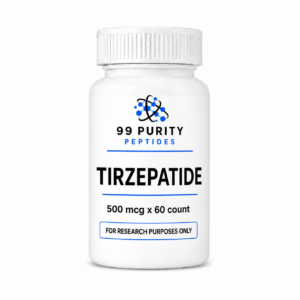
Tirzepatide 500mcg – 60 Count Research Grade Peptide
$140.00Tirzepatide 500mcg is supplied in a 60 count research format for controlled laboratory investigation. Produced with verified purity…Add to cart


Questions
Common questions about research peptides, ordering, and lab standards
What research peptides are available from 99PurityPeptides?
99PurityPeptides offers an extensive catalog of laboratory-grade research peptides including individual amino acid sequences, modified peptides, peptide fragments, conjugated peptides, and custom synthesis options. Our inventory includes commonly requested research compounds for cellular studies, biochemical assays, receptor binding investigations, and molecular biology applications. All products are provided in lyophilized (freeze-dried) powder form with purity levels ranging from 95% to 99%+ as verified by analytical testing. Browse our complete catalog organized by sequence length, research category, or specific peptide families.
Are all 99PurityPeptides products tested for purity and quality?
Every research peptide undergoes rigorous third-party analytical testing before release. Our quality control process includes High-Performance Liquid Chromatography (HPLC) to verify purity percentages, Mass Spectrometry (MS) to confirm molecular weight and sequence accuracy, and peptide content analysis to ensure accurate concentration. Each product batch receives an individual Certificate of Analysis (COA) documenting test results, storage recommendations, and lot-specific data. This analytical verification ensures you receive research-grade materials meeting published specifications for your laboratory investigations.
What purity levels are standard for research peptides?
99PurityPeptides specializes in high-purity research compounds with most products achieving 95-99%+ purity as determined by HPLC analysis. Standard catalog peptides typically meet ≥95% purity suitable for most research applications. Premium-grade options offer ≥98% purity for experiments requiring exceptional quality, and custom synthesis can target >99% purity for highly sensitive analytical work. Product pages clearly indicate tested purity levels, and COAs provide exact percentage for your specific lot. Higher purity reduces experimental variables caused by impurities or synthesis by-products.
How do I interpret the Certificate of Analysis (COA)?
Certificates of Analysis include several key data points for research validation. The HPLC chromatogram shows the purity peak representing your target peptide versus any impurities; the percentage represents the area under the curve for your compound. Mass Spectrometry data confirms the molecular weight matches the theoretical weight calculated from the amino acid sequence. Peptide content indicates the actual peptide mass as a percentage of total powder weight (remainder being counterions and moisture). Storage conditions specify temperature requirements for maintaining stability. For assistance interpreting COA data, contact our technical team.
Do you offer custom peptide synthesis for specific research needs?
Yes. Our custom synthesis services produce research peptides not available in standard catalogs, including novel sequences, unusual modifications (phosphorylation, methylation, acetylation), fluorescent labels, biotinylation, cyclization, D-amino acid incorporation, and peptide libraries. Submit your sequence and modification requirements through our custom synthesis request form. Our synthesis team provides feasibility assessment, timeline estimates (typically 2-4 weeks depending on complexity), and pricing quotes. Minimum order quantities apply for custom work, with all products receiving the same rigorous analytical testing as catalog items.
What are proper storage instructions for research peptides?
Lyophilized (unopened) research peptides should be stored at -20°C (standard freezer temperature) in a dry environment protected from light and moisture. Under these conditions, most peptides maintain stability for 1-2 years or longer. Once reconstituted in solution, peptide stability decreases significantly—store reconstituted solutions at -20°C for short-term use (days to weeks) or -80°C for longer storage (months), depending on the specific sequence. Avoid repeated freeze-thaw cycles which degrade peptide integrity. Aliquot reconstituted peptides into single-use portions to minimize freeze-thaw damage. Always check product-specific COAs for sequence-dependent storage recommendations.
How should I reconstitute lyophilized peptides for laboratory use?
Reconstitution protocols depend on the peptide sequence and intended research application. General guidelines: use sterile, ultra-pure water or appropriate buffer (PBS, DMSO, acetic acid solution) based on peptide solubility characteristics. Add solvent slowly down the vial wall, avoid vigorous mixing that could denature peptides, and allow gentle dissolution at room temperature or 4°C. For peptides with poor water solubility, DMSO often serves as an initial solvent followed by dilution into aqueous buffers. Calculate final concentration based on peptide content percentage from your COA. Detailed reconstitution protocols are provided with each order and available on product pages.
What is the shelf life of research peptides?
Properly stored lyophilized peptides typically maintain stability for 2-3 years at -20°C, though exact shelf life varies by sequence composition. Peptides containing methionine, cysteine, or tryptophan may have shorter shelf life due to oxidation susceptibility. Reconstituted peptide solutions have significantly shorter stability—typically days to weeks at -20°C or several months at -80°C, depending on sequence and storage conditions. Always use peptides within the stability window indicated on the COA. For experiments requiring extended peptide use, consider ordering smaller quantities more frequently rather than storing large volumes long-term.
Can peptides be damaged during shipping or storage?
Research peptides are relatively stable when properly packaged and stored, but can degrade under adverse conditions. Our shipping protocols use temperature-controlled packaging with cold packs or dry ice to maintain product integrity during transit. Upon receipt, immediately transfer peptides to appropriate storage (-20°C for lyophilized products). Exposure to heat, humidity, or repeated temperature fluctuations accelerates degradation. If you suspect shipping damage (compromised packaging, warm products, visible moisture), do not use the material—contact us immediately for replacement. Proper storage and handling maintains peptide quality throughout its usable lifetime.
Should I aliquot peptides after reconstitution?
Yes, aliquoting is strongly recommended for laboratory best practices. Divide reconstituted peptide solutions into multiple small-volume vials representing single-use portions for your experiments. This approach minimizes freeze-thaw cycles that progressively damage peptide structure and reduce biological activity. Use sterile technique when aliquoting to prevent contamination. Label each aliquot with peptide identity, concentration, reconstitution date, and storage temperature. Store aliquots at -20°C or -80°C depending on anticipated usage timeline. This practice ensures consistent experimental results across multiple assays using material from the same synthesis batch.
Do you offer bulk discounts for laboratory peptide purchases?
Yes. Volume pricing is available for research institutions, universities, and biotech companies ordering large quantities of research peptides. Discount tiers typically begin at 10+ vials of the same peptide, with increasing discounts for 25+, 50+, and 100+ unit orders. For custom synthesis, bulk orders of the same sequence qualify for per-gram pricing reductions. Contact orders@99puritypeptides.com with your anticipated order volume to receive institutional pricing. Long-term supply agreements and contract manufacturing arrangements offer additional cost savings for ongoing research programs requiring consistent peptide supply.
Can I order research peptides in different quantities?
Research peptides are available in multiple package sizes to accommodate different experimental scales. Standard offerings include 1mg, 5mg, 10mg, 25mg, and larger quantities upon request. Product pages display available sizes with corresponding pricing. For expensive or rarely-used sequences, smaller quantities minimize waste. For high-throughput screening or long-term research projects, larger quantities provide better per-milligram value. Custom quantities beyond standard offerings can be requested through our sales team. Choose package sizes based on your experimental requirements, anticipated usage rate, and stability considerations for your storage conditions.
Are COAs available before ordering to verify product specifications?
Representative COAs for catalog peptides are available upon request to help researchers evaluate product suitability before purchase. Contact us with the catalog number or peptide sequence, and we’ll provide a recent COA showing typical purity and analytical data for that product. Please note that COAs are lot-specific—your shipped product will include a COA for its specific batch, which may show minor variations from representative samples while still meeting guaranteed specifications. This pre-purchase COA review allows verification that our quality standards meet your experimental requirements.
How do I find specific peptides in your catalog?
Navigate our product catalog using multiple search and filter options. Search directly by peptide name, sequence, catalog number, or CAS number for known compounds. Browse by category (signaling peptides, enzyme substrates, receptor ligands, antimicrobial peptides, etc.) or by research application. Filter results by purity level (95%+, 98%+, 99%+), package size, price range, or availability status. Advanced search allows filtering by sequence characteristics like length, specific amino acids, or modifications. If you cannot locate a specific peptide, contact us—we may carry it under alternate nomenclature or can synthesize it as a custom order.
What information is included on product pages?
Each product page provides comprehensive information for research planning: peptide name and common aliases, amino acid sequence, molecular formula and weight, CAS number (when applicable), tested purity range, available package sizes and pricing, storage recommendations, solubility guidelines, and links to representative COAs. Many listings include reconstitution protocols, relevant research literature citations, and related products for comparative studies. Product pages serve as complete technical references for making informed purchasing decisions and planning experimental protocols before your order arrives.
Are all products manufactured in the USA for research compliance?
99PurityPeptides manufactures research compounds in US-based facilities operating under current Good Manufacturing Practices (cGMP) guidelines appropriate for research-grade materials. Domestic manufacturing ensures compliance with US regulatory frameworks governing research chemicals, enables faster quality control and delivery, and provides transparency in our supply chain. All products are labeled “For Research Use Only – Not for Human Consumption” per regulatory requirements. US-based operations support American research institutions with reliable domestic supply of laboratory materials meeting recognized quality standards.
What does "Research Use Only" mean for these products?
“Research Use Only” (RUO) designation means these peptides are manufactured and sold exclusively for laboratory investigation by qualified researchers in controlled settings. These products are not intended for, and must not be used for: human consumption or administration, medical treatment or diagnosis, veterinary applications, food or cosmetic production, or any purpose outside legitimate scientific research. Researchers must handle RUO materials according to institutional biosafety protocols, maintain appropriate documentation, and ensure compliance with their organization’s research guidelines. This designation protects both researchers and suppliers under current regulatory frameworks.
Do research peptides require special handling or safety precautions?
Handle all research peptides using standard laboratory safety practices. Wear appropriate personal protective equipment (gloves, lab coat, safety glasses). Work in well-ventilated areas or under fume hoods when reconstituting peptides, especially when using organic solvents like DMSO. Avoid skin contact, inhalation of powder, or ingestion. Safety Data Sheets (SDS) provided with each product detail specific hazards and recommended precautions. Dispose of peptide waste according to your institution’s chemical waste protocols. While most research peptides present minimal hazard when properly handled, treat all laboratory chemicals with respect and follow your facility’s biosafety and chemical hygiene plans.
Can I use these peptides for any purpose outside research?
No. 99PurityPeptides products are manufactured, labeled, and sold exclusively for in vitro laboratory research applications. Using these compounds for human consumption, athletic performance, bodybuilding, medical treatment, or any non-research purpose violates regulatory guidelines, our terms of sale, and potentially federal and state laws. We monitor purchases for compliance and reserve the right to refuse orders that appear intended for inappropriate use. Researchers must certify that products will be used only for legitimate scientific investigation in controlled laboratory environments under appropriate oversight.
Are your products approved by the FDA or other regulatory agencies?
Research peptides sold for laboratory investigation are not FDA-approved drugs and do not require FDA approval, as they are not intended for therapeutic use. These are research-grade chemical reagents for scientific study, similar to other laboratory supplies. 99PurityPeptides operates in compliance with applicable regulations governing the manufacture and sale of research chemicals. Our quality systems follow industry best practices, and products undergo analytical testing to meet labeled specifications. Researchers using these materials are responsible for ensuring their investigations comply with relevant oversight including institutional review boards, biosafety committees, and applicable research regulations.