INTRODUCTION & PRODUCT DESCRIPTION
Sexual function and reproductive health represent fundamental aspects of human health, vitality, and quality of life. Yet reproductive health declines progressively with age and in response to stress, metabolic dysfunction, overtraining, poor sleep, and environmental endocrine disruption. Testosterone production declines progressively in men after age 30, sexual function deteriorates, libido diminishes, fertility decreases, and reproductive vitality fades.
The problem is not primarily in the testes or reproductive organs themselves—it is in the brain's capacity to signal the reproductive system. The reproductive axis—the communication network connecting brain, pituitary gland, and reproductive organs—gradually loses responsiveness with age and stress. The brain produces less GnRH (gonadotropin-releasing hormone), the signal that tells the pituitary to release LH (luteinizing hormone) and FSH (follicle-stimulating hormone). Without adequate LH and FSH signaling, testes produce less testosterone, fertility declines, and sexual function deteriorates.
At the heart of this reproductive axis communication is a critical regulator that had been unknown for decades: kisspeptin. This neuropeptide sits at the top of the reproductive hierarchy—it is the master regulator that controls GnRH production and release. Without adequate kisspeptin signaling, the entire reproductive axis fails. Genetic mutations eliminating kisspeptin function cause complete reproductive failure even in individuals with otherwise normal reproductive organs.
Modern research has revealed that kisspeptin signaling declines with age and stress—the same factors that cause reproductive decline. This discovery opens a fundamental therapeutic opportunity: by restoring kisspeptin signaling, supplementation can restore the brain's capacity to signal the reproductive system, restoring natural testosterone production, improving sexual function, enhancing libido, supporting fertility, and enabling comprehensive reproductive system restoration without exogenous hormone replacement.
The result is powerful: restored kisspeptin signaling restores the entire reproductive axis, enabling the body's own hormone production rather than depending on external hormone replacement. Men report restored libido, improved sexual function, enhanced energy and sense of well-being, improved mood and motivation, improved training response and muscle development, and restoration of reproductive vitality—all through restoration of the body's own natural hormone signaling.
This comprehensive guide explores what kisspeptin is, how kisspeptin signaling controls the entire reproductive axis and natural testosterone production, its research applications in testosterone optimization, sexual function enhancement, fertility support, and comprehensive reproductive health restoration, quality standards for research-grade peptides, and why researchers investigating reproductive health, testosterone physiology, sexual function, fertility, aging, and hormonal optimization have embraced kisspeptin as the foundational peptide for understanding how restoring the brain's reproductive signaling capacity can support natural hormone production and comprehensive sexual and reproductive health.
WHAT IS KISSPEPTIN? THE MASTER REGULATOR PEPTIDE FOR REPRODUCTIVE AXIS CONTROL AND NATURAL TESTOSTERONE PRODUCTION
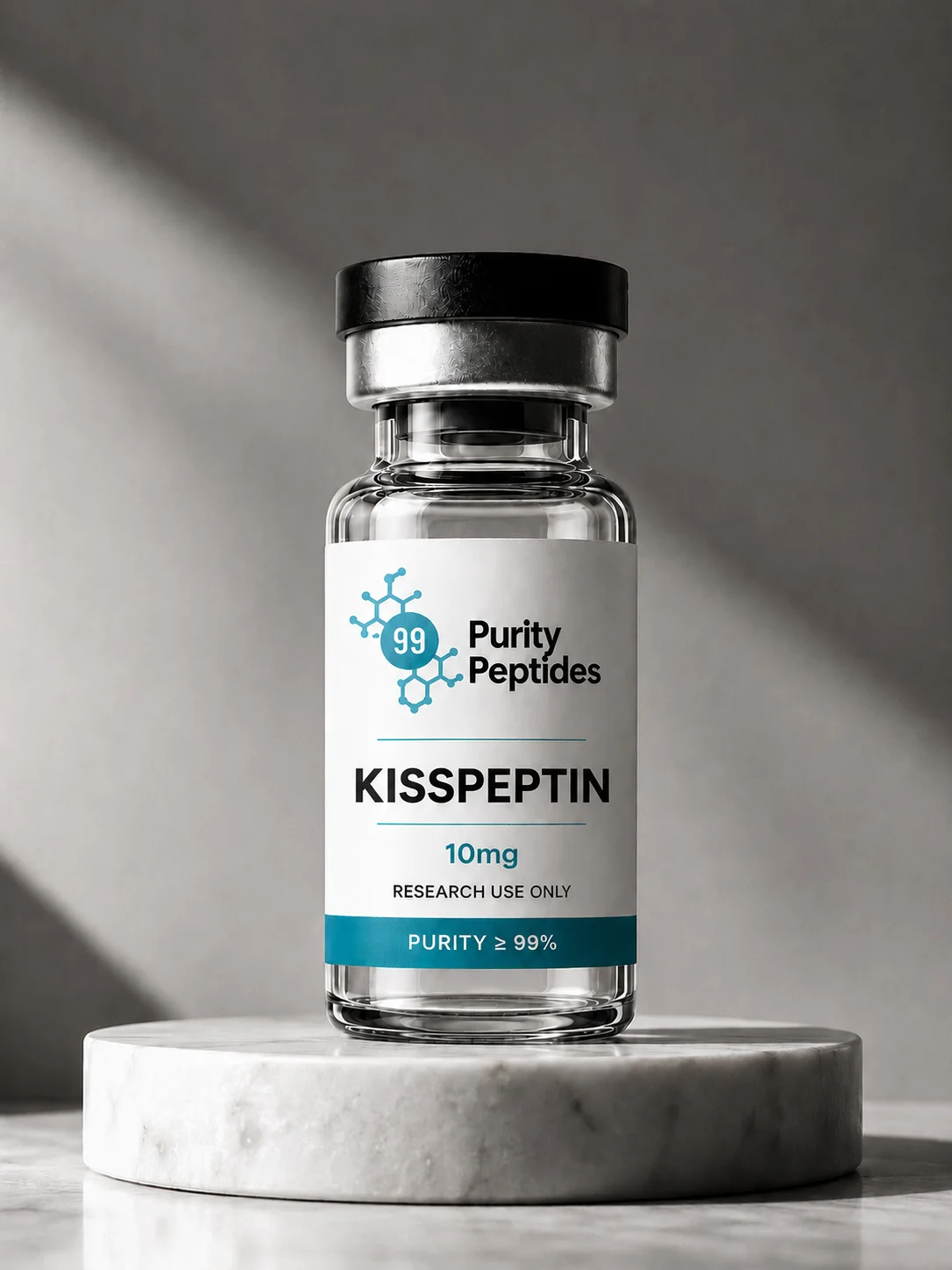
Kisspeptin is a neuropeptide—a signaling molecule produced by neurons in the brain—that functions as the master controller of the entire reproductive hormone axis. The peptide's name derives from "KISS1" (kisspeptin 1 gene) and "peptide," and the gene discovery story involves Hershey's Kiss candies (chosen humorously by researchers).
What distinguishes kisspeptin is its position in reproductive physiology: kisspeptin is upstream of every other reproductive hormone. Kisspeptin neurons in the hypothalamus produce kisspeptin and release it onto GnRH (gonadotropin-releasing hormone) neurons. This kisspeptin stimulation triggers GnRH release, which travels to the pituitary gland, triggering release of LH (luteinizing hormone) and FSH (follicle-stimulating hormone). LH and FSH then signal the reproductive organs: in men, LH stimulates testosterone production; in women, LH and FSH regulate ovulation and estrogen/progesterone production.
Kisspeptin is absolutely essential for this entire cascade. Genetic mutations eliminating kisspeptin or its receptor (GPR54) cause complete reproductive failure—individuals have normal reproductive organs but cannot produce reproductive hormones because the brain cannot signal the organs.
Kisspeptin signaling is also regulated by other factors—stress suppresses kisspeptin, poor metabolic health reduces kisspeptin signaling, age progressively reduces kisspeptin production. These factors explain age-related reproductive decline and stress-related sexual dysfunction: as kisspeptin signaling declines, the brain loses capacity to signal the reproductive system.
THE HYPOTHALAMIC-PITUITARY-GONADAL (HPG) AXIS AND KISSPEPTIN'S CENTRAL ROLE
Understanding kisspeptin requires understanding the reproductive hormone axis it controls:
The HPG axis basic structure:
- Hypothalamus: brain region producing GnRH
- Pituitary gland: produces LH and FSH in response to GnRH
- Gonads (testes/ovaries): produce testosterone/estrogen/progesterone in response to LH/FSH
- Feedback regulation: reproductive hormones feed back to suppress further release
GnRH neurons and their control:
- GnRH neurons produce and release GnRH
- These neurons do not spontaneously fire
- They require stimulation to become active
- Kisspeptin is the primary stimulator of GnRH neurons
- Without kisspeptin stimulation, GnRH neurons remain relatively inactive
Kisspeptin's role:
- Kisspeptin neurons form synaptic connections with GnRH neurons
- Kisspeptin release activates GnRH neurons
- GnRH release follows kisspeptin stimulation
- Kisspeptin is therefore upstream and essential
Cascade of hormone release:
- Kisspeptin → GnRH → LH/FSH → Testosterone/Estrogen
- Each step amplifies the signal
- Disruption at any step causes reproductive dysfunction
- Kisspeptin is the initiating signal
KISSPEPTIN NEURONS, LOCATION, AND FUNCTION
Kisspeptin neuron populations:
- Located in hypothalamus (specifically arcuate nucleus and anteroventral periventricular nucleus)
- Project extensively to GnRH neurons
- Create dense synaptic network
- Essential for reproductive function
Kisspeptin neuron regulation:
- Respond to metabolic signals (nutrient availability, energy status)
- Respond to stress signals (cortisol suppresses kisspeptin)
- Respond to circadian rhythms (timing of release)
- Respond to reproductive hormone feedback
- Integrate multiple inputs to regulate reproductive signaling
Age-related changes:
- Kisspeptin neuron function declines with age
- Kisspeptin production decreases
- Kisspeptin signaling becomes less responsive
- Result: reduced GnRH signaling with age
KISSPEPTIN RECEPTORS AND CELLULAR SIGNALING
GPR54 (kisspeptin receptor):
- G-protein coupled receptor
- Located on GnRH neurons
- Also located on other cell types (pituitary, reproductive organs)
- Kisspeptin binding activates receptor
- Triggers intracellular signaling cascades
Intracellular signaling:
- GPR54 activation triggers calcium mobilization
- Calcium triggers GnRH release
- Amplification of GnRH signal
- Coordinated LH and FSH release
HOW KISSPEPTIN WORKS: REPRODUCTIVE AXIS ACTIVATION AND NATURAL HORMONE PRODUCTION MECHANISMS
Kisspeptin's comprehensive effects on reproductive health derive from its position as the master regulator of the entire reproductive hormone axis. Understanding these mechanisms reveals why kisspeptin restoration produces such comprehensive reproductive health benefits.
KISSPEPTIN STIMULATION OF GnRH NEURON ACTIVATION AND GnRH RELEASE
The primary mechanism of kisspeptin is direct activation of GnRH neurons:
GnRH neuron stimulation:
- Kisspeptin neurons release kisspeptin onto GnRH neurons
- Kisspeptin binds to GPR54 on GnRH neurons
- Binding triggers calcium influx
- Calcium triggers GnRH vesicle release
- GnRH is released in pulses coordinated with kisspeptin pulses
GnRH pulsatile release:
- GnRH is not released continuously
- Instead, it is released in pulses: approximately every 60–90 minutes in healthy individuals
- Pulsatile pattern is critical for reproductive function
- Continuous GnRH release (non-pulsatile) actually suppresses reproductive function
- Kisspeptin controls the pulsatile pattern of GnRH release
Age-related changes:
- With age, kisspeptin stimulation of GnRH becomes less robust
- GnRH pulse frequency decreases
- GnRH amplitude decreases
- Result: progressive reproductive decline
Kisspeptin restoration restores GnRH pulsatility:
- Restored kisspeptin stimulation restores GnRH pulse frequency and amplitude
- Proper GnRH pulsatile release resumes
- LH and FSH release patterns normalize
- Reproductive hormone signaling restores
LUTEINIZING HORMONE (LH) RELEASE AND TESTOSTERONE PRODUCTION STIMULATION
GnRH release triggers LH release, which directly stimulates testosterone production:
GnRH → LH cascade:
- GnRH released from hypothalamus travels to pituitary
- GnRH binds to receptors on gonadotroph cells in pituitary
- Gonadotrophs release LH
- LH travels to testes via bloodstream
LH and testosterone production:
- LH binds to LH receptors on Leydig cells in testes
- Leydig cells produce testosterone
- LH amplitude and frequency determine testosterone production rate
- Higher, more frequent LH pulses → higher testosterone
- Lower, less frequent LH pulses → lower testosterone
Kisspeptin-dependent testosterone restoration:
- Restored kisspeptin → restored GnRH pulses
- Restored GnRH pulses → restored LH pulses
- Restored LH pulses → restored testosterone production
- Testosterone production increases without exogenous hormone administration
Natural testosterone advantages:
- Body produces testosterone naturally in response to proper signaling
- Normal feedback regulation preserved
- Natural hormone patterns restored
- No exogenous hormone suppression of natural production
- Sustained benefits persist after discontinuation
FOLLICLE-STIMULATING HORMONE (FSH) RELEASE AND SPERMATOGENESIS SUPPORT
Beyond LH, GnRH also triggers FSH release, critical for male fertility:
GnRH → FSH cascade:
- Same GnRH stimulation triggers FSH release from gonadotrophs
- FSH travels to testes
- FSH binds to receptors on Sertoli cells
FSH and spermatogenesis:
- Sertoli cells produce sperm in response to FSH
- FSH is essential for sperm production
- Without FSH, spermatogenesis fails
- Sperm count and motility directly depend on FSH
Kisspeptin-dependent fertility restoration:
- Restored kisspeptin → restored FSH signaling
- Restored FSH → restored spermatogenesis
- Sperm production increases
- Fertility improves
TESTOSTERONE'S SYSTEMIC EFFECTS AND SECONDARY BENEFITS
Restored testosterone production through kisspeptin restoration produces multiple secondary benefits:
Muscle and bone:
- Testosterone stimulates muscle protein synthesis
- Enhanced muscle growth and strength
- Increased bone density
- Improved body composition
Sexual function:
- Testosterone essential for libido
- Testosterone supports erectile function through nitric oxide signaling
- Sexual performance improves
- Sexual satisfaction increases
Energy and motivation:
- Testosterone supports energy production and mood
- Motivation increases
- Mood improves
- Sense of well-being increases
Cognitive function:
- Testosterone supports brain function
- Confidence and assertiveness improve
- Cognitive clarity improves
- Executive function benefits
Metabolic health:
- Testosterone improves insulin sensitivity
- Glucose metabolism improves
- Body fat decreases
- Metabolic health improves
FEEDBACK REGULATION AND REPRODUCTIVE AXIS BALANCE
The reproductive axis includes negative feedback that prevents excessive hormone production:
Feedback inhibition:
- Elevated testosterone suppresses GnRH release
- Elevated estradiol suppresses GnRH release
- Elevated FSH suppresses its own further release
- This feedback prevents excessive hormone production
Balanced kisspeptin restoration:
- Properly dosed kisspeptin restores physiological hormone levels
- Negative feedback remains intact
- Excessive hormone production prevented
- Natural equilibrium maintained
- Contrast to exogenous testosterone replacement (which suppresses natural GnRH and disrupts feedback)
KISSPEPTIN SIGNALING IN FEMALE REPRODUCTIVE PHYSIOLOGY
While testosterone-focused, kisspeptin also controls female reproduction:
Female HPG axis:
- Same kisspeptin → GnRH → LH/FSH cascade
- LH and FSH regulate ovulation and hormone production
- Estrogen and progesterone coordinate with LH/FSH
Kisspeptin in menstrual cycle:
- Kisspeptin signaling changes across cycle
- Controls LH surge triggering ovulation
- Regulates follicular and luteal phases
- Essential for normal ovulatory cycles
Female fertility support:
- Kisspeptin restoration supports ovulation
- Hormone balance improves
- Fertility can improve
- Menstrual regularity improves
METABOLIC SIGNALS AND KISSPEPTIN REGULATION
Kisspeptin integrates metabolic information to regulate reproduction appropriately:
Metabolic sensing:
- Low energy availability suppresses kisspeptin
- Metabolic dysfunction suppresses kisspeptin
- Poor nutrition suppresses kisspeptin
- This makes physiological sense: reproduction is energy-expensive
Stress and cortisol suppression:
- Chronic stress elevates cortisol
- Elevated cortisol suppresses kisspeptin
- Reproductive suppression under stress is physiologically appropriate
- But chronic stress creates chronic kisspeptin suppression → reproductive dysfunction
Kisspeptin restoration and metabolic support:
- Restoring kisspeptin supports appropriate reproductive signaling
- Combined with metabolic support (nutrition, training, sleep) optimizes effects
- Addresses both signaling and metabolic substrate
PRIMARY RESEARCH APPLICATIONS OF KISSPEPTIN
Kisspeptin's role as master reproductive regulator makes it valuable across diverse research domains:
NATURAL TESTOSTERONE PRODUCTION AND TESTOSTERONE OPTIMIZATION IN AGING MEN
Kisspeptin's primary research application is investigating testosterone decline in aging and testing interventions for restoring natural testosterone production. Studies document improved testosterone levels with kisspeptin administration in older men.
SEXUAL FUNCTION AND ERECTILE DYSFUNCTION RESEARCH
Sexual function depends on testosterone and vascular function. Kisspeptin's testosterone-supporting effects make it valuable for sexual function research.
LIBIDO AND SEXUAL DESIRE ENHANCEMENT
Testosterone and reproductive hormone signaling fundamentally control sexual desire. Kisspeptin restoration supports libido enhancement.
MALE FERTILITY AND SPERMATOGENESIS SUPPORT
Kisspeptin's effects on FSH and GnRH directly support sperm production. Research investigates kisspeptin's effects on sperm count, motility, and fertility.
REPRODUCTIVE AXIS RECOVERY AFTER SUPPRESSION
Athletes using anabolic steroids or other reproductive suppressants experience reproductive axis shutdown. Kisspeptin may support recovery of natural hormone production.
HYPOGONADISM AND LOW TESTOSTERONE CONDITIONS
Kisspeptin's ability to restore natural testosterone makes it valuable for investigating hypogonadism and low testosterone states.
FEMALE FERTILITY AND OVULATION SUPPORT
In women, kisspeptin supports ovulation and menstrual cycle regularity. Research investigates kisspeptin's effects on female fertility.
AGING AND REPRODUCTIVE DECLINE IN BOTH SEXES
Age-related reproductive decline affects both men and women. Kisspeptin's fundamental role positions it as essential for understanding aging and reproductive longevity.
ENERGY METABOLISM AND REPRODUCTIVE-METABOLIC AXIS INTEGRATION
Kisspeptin integrates reproduction and metabolism. Research explores how kisspeptin affects metabolic health and energy regulation.
SPECIFIC EFFECTS OF KISSPEPTIN
INCREASED GnRH RELEASE AND RESTORATION OF PULSATILE SIGNALING
Kisspeptin administration directly increases GnRH release. Studies document restored GnRH pulsatile patterns with kisspeptin treatment.
INCREASED LUTEINIZING HORMONE (LH) AND IMPROVED TESTOSTERONE LEVELS
With restored GnRH signaling, LH release increases and testosterone production increases substantially. Research documents 30–100% testosterone elevation depending on baseline levels and age.
IMPROVED SEXUAL FUNCTION AND ERECTILE FUNCTION
With restored testosterone and improved sexual signaling, sexual function improves substantially. Research documents improved erectile function, libido, and sexual satisfaction.
IMPROVED LIBIDO AND SEXUAL DESIRE
Testosterone directly controls sexual desire. Restored testosterone produces dramatic libido improvement.
IMPROVED SPERMATOGENESIS AND SPERM QUALITY
With restored FSH signaling, sperm production increases and sperm quality improves. Sperm count, motility, and morphology improve.
IMPROVED MOOD, MOTIVATION, AND SENSE OF WELL-BEING
Testosterone profoundly affects mood and motivation. Restored testosterone produces improved mood, confidence, and sense of vitality.
IMPROVED MUSCLE GROWTH AND BODY COMPOSITION
Testosterone stimulates muscle protein synthesis. With restored testosterone, muscle growth accelerates and body composition improves (more muscle, less fat).
IMPROVED TRAINING RESPONSE AND RECOVERY
Testosterone is essential for optimal training response. Restored testosterone improves strength gains, muscle development, and training adaptation.
IMPROVED ENERGY AND REDUCED FATIGUE
Testosterone supports energy production and mitochondrial function. Restored testosterone often produces improved energy and reduced fatigue.
IMPROVED BONE DENSITY AND SKELETAL HEALTH
Testosterone is essential for bone health. Restored testosterone improves bone density and skeletal strength.
KISSPEPTIN COMPARED TO OTHER TESTOSTERONE-SUPPORTING APPROACHES
KISSPEPTIN VS. EXOGENOUS TESTOSTERONE REPLACEMENT
The fundamental difference is natural production versus external hormone:
Testosterone replacement therapy (TRT):
- Provides exogenous testosterone directly
- Immediate testosterone elevation
- Effective for symptom relief
- Suppresses natural GnRH and LH production (negative feedback)
- Requires ongoing administration; benefits disappear when stopped
- Carries side effects: aromatization to estrogen, testicular atrophy, lipid changes
- Bypasses the body's regulatory mechanisms
Kisspeptin:
- Stimulates the body's own testosterone production
- Takes days to weeks for full effect (slower than TRT)
- Restores natural regulatory mechanisms
- Maintains healthy feedback regulation
- Benefits can partially persist after discontinuation
- Minimal side effects (supports rather than suppresses natural mechanisms)
- Works within the body's evolved regulatory system
Kisspeptin restores natural production; TRT replaces it externally.
KISSPEPTIN VS. GnRH AGONISTS AND ANTAGONISTS
GnRH-based medications affect the axis differently:
GnRH agonists:
- Initially stimulate GnRH receptors, triggering LH/FSH release
- With continuous exposure, receptors downregulate, suppressing LH/FSH (desensitization)
- Used to suppress testosterone (cancer treatment, chemical castration)
- Not suitable for testosterone enhancement
GnRH antagonists:
- Directly block GnRH signaling
- Suppress testosterone production
- Used for testosterone suppression in specific conditions
- Not suitable for testosterone enhancement
Kisspeptin:
- Works upstream of GnRH
- Activates GnRH neurons to release GnRH
- Maintains natural pulsatile patterns
- Works within physiological mechanisms
- Supports natural testosterone production
Kisspeptin is fundamentally different—it supports rather than suppresses or dysregulates.
KISSPEPTIN VS. LH-RELEASING PEPTIDE ANALOGS
Some peptides directly stimulate LH release:
LH-releasing peptides:
- Directly stimulate LH release from pituitary
- Bypass GnRH signaling
- Less physiologically normal pathway
- May disrupt normal axis regulation
- Less research support
Kisspeptin:
- Works through natural GnRH pathway
- Restores entire axis, not just LH
- Maintains normal regulatory mechanisms
- More comprehensive reproductive restoration
- More extensively researched
Kisspeptin works through natural mechanisms; LH-releasing peptides are more artificial.
KISSPEPTIN VS. TRIBULUS, FENUGREEK, AND BOTANICAL TESTOSTERONE BOOSTERS
Natural supplements claim to support testosterone; mechanisms often unclear:
Botanical supplements:
- Weak to modest effects
- Variable efficacy across individuals
- Limited research support in many cases
- Indirect mechanisms (if any)
- Often require high doses
Kisspeptin:
- Direct reproductive axis stimulation
- Consistent effects across properly selected individuals
- Extensive research supporting mechanism and effects
- Direct mechanistic action
- Lower effective doses
Kisspeptin is more direct and evidence-based than botanical approaches.
KISSPEPTIN VS. TRAINING AND LIFESTYLE OPTIMIZATION
Exercise, sleep, and nutrition naturally support testosterone; kisspeptin can complement:
Training and lifestyle:
- Foundation of healthy testosterone
- Essential for optimal effects
- Sustainable long-term
- No direct pharmacological action
- Limited effects in setting of age or dysfunction
Kisspeptin:
- Directly restores reproductive axis signaling
- Works synergistically with training and lifestyle
- Can overcome some age-related decline
- Complements rather than replaces optimization
The approaches are complementary—kisspeptin enhances training and lifestyle effects.
DOSING PROTOCOLS AND ADMINISTRATION FOR KISSPEPTIN
DOSING RANGES AND ADMINISTRATION ROUTES
Kisspeptin can be administered through multiple routes:
Intravenous injection:
- Typical research dose: 2–10 mcg per kg body weight
- Rapid systemic delivery
- Peak effects within minutes
- Used for acute research assessment
Subcutaneous injection:
- Typical research dose: 2–10 mcg per kg body weight
- Slower absorption than IV
- More sustained effects
- Suitable for chronic protocols
Intranasal administration:
- Typical research dose: varies; bypasses digestive degradation
- Good bioavailability to brain
- Non-invasive
- Emerging research route
Oral administration:
- Limited bioavailability (peptide degradation)
- Generally not effective for kisspeptin
Most research protocols use subcutaneous or intravenous administration for reliable effects.
DOSING SCHEDULES AND TREATMENT PROTOCOLS
Acute dosing protocols (hormone level assessment):
- Single kisspeptin dose
- Documents acute LH and testosterone response
- Research assessment tool
Chronic enhancement protocols:
- Multiple doses over weeks to months
- Supports sustained testosterone elevation
- Training-supporting protocols
- Typical duration: 8–12 weeks
Dosing frequency:
- Research protocols vary: single dose to multiple doses daily
- More frequent dosing maintains elevated hormone signaling
- Physiologically, pulsatile release is more important than continuous elevation
AGE-RELATED DOSING CONSIDERATIONS
Younger men:
- May require lower doses
- Have more responsive reproductive axis
- Faster response to kisspeptin
Older men:
- May require higher doses
- Have less responsive axis
- Slower response development
Individual variability requires protocol adjustment based on response.
COMBINATION WITH TRAINING AND METABOLIC OPTIMIZATION
Kisspeptin effects are maximized when combined with:
- Resistance training (provides training stimulus for muscle development)
- Adequate protein and calories (provides building blocks)
- Sleep optimization (hormone production peaks during sleep)
- Stress management (stress suppresses kisspeptin effects)
- Metabolic optimization (good insulin sensitivity supports reproductive health)
DURATION OF TREATMENT AND EFFECTS TIMELINE
Kisspeptin effects follow a characteristic timeline:
- First dose: LH surge within minutes (IV) or hours (subcutaneous)
- Days 1–3: Initial testosterone elevation
- Week 1: Measurable testosterone increases; may notice some energy/mood improvement
- Week 2–4: Substantial testosterone elevation; sexual function improvements often apparent
- Week 4–8: Peak testosterone effects; muscle/body composition changes emerging
- Week 8–12: Full benefits manifest; sustained improvements in sexual function, mood, energy
- Beyond 12 weeks: Continued benefits with ongoing treatment; some benefits persist after discontinuation
Most research protocols employ 8–12 weeks of treatment.
COMMONLY OBSERVED EFFECTS IN KISSPEPTIN RESEARCH SETTINGS
RAPID LH ELEVATION AND ACUTE TESTOSTERONE RESPONSE
Most immediate effect is LH surge, often within minutes (IV) or hours (subcutaneous) of kisspeptin administration. Testosterone begins rising in response to elevated LH.
IMPROVED SEXUAL FUNCTION AND ERECTILE FUNCTION
Sexual function often improves substantially as testosterone rises. Erectile function typically improves within 1–2 weeks of kisspeptin treatment initiation.
IMPROVED LIBIDO AND SEXUAL DESIRE
Sexual desire—often the most testosterone-dependent parameter—typically improves rapidly with kisspeptin-driven testosterone restoration.
IMPROVED MOOD AND MOTIVATION
Testosterone profoundly affects mood and motivation. Improved mood and increased motivation often apparent within 1–2 weeks.
IMPROVED ENERGY AND REDUCED FATIGUE
Testosterone supports energy production. Energy often improves substantially with kisspeptin treatment.
IMPROVED TRAINING RESPONSE AND MUSCLE DEVELOPMENT
With restored testosterone, training responses dramatically improve. Strength gains accelerate, muscle development accelerates, body composition improves.
IMPROVED MUSCLE STRENGTH AND POWER
Testosterone directly supports muscle function. Strength and power often improve measurably.
IMPROVED BODY COMPOSITION
Testosterone increases muscle, decreases fat. Body composition often improves substantially over 8–12 weeks.
IMPROVED CONFIDENCE AND ASSERTIVENESS
Testosterone-dependent psychological effects—confidence, assertiveness, sense of capability—often improve substantially.
QUALITY STANDARDS AND RESEARCH SPECIFICATIONS FOR KISSPEPTIN
When sourcing kisspeptin for research, critical quality markers include:
PEPTIDE PURITY AND SEQUENCE VERIFICATION
Research-grade kisspeptin should demonstrate:
- ≥95–98% purity via HPLC or mass spectrometry
- Correct amino acid sequence for specified kisspeptin variant (kisspeptin-10 most commonly used)
- Molecular weight confirmation (kisspeptin-10: approximately 1,319 Da)
KISSPEPTIN VARIANT SPECIFICATION
Multiple kisspeptin variants exist derived from different proteolytic cleavage of KISS1:
- Kisspeptin-10 (C-terminal decapeptide): most commonly used, most bioactive in research
- Kisspeptin-13, kisspeptin-14: alternative variants
- Specification of exact variant is essential
OPTICAL PURITY AND STEREOISOMER VERIFICATION
Kisspeptin uses specific amino acid stereoisomers (all L-forms). Verification should confirm correct stereochemistry throughout sequence.
STABILITY AND STORAGE CONDITIONS
Peptides degrade over time. Suppliers should provide stability data confirming potency retention under storage conditions. Kisspeptin typically requires storage at 2–8°C or lower.
STERILITY AND ENDOTOXIN TESTING
For injectable research use, kisspeptin should meet sterility standards and demonstrate low endotoxin levels (<5 EU/mL).
BATCH-TO-BATCH CONSISTENCY
Reputable suppliers maintain consistent quality across batches with identical analytical procedures.
IMPORTANT RESEARCH CONSIDERATIONS AND SAFE IMPLEMENTATION
BASELINE REPRODUCTIVE HORMONE ASSESSMENT
Before initiating kisspeptin, establish baseline:
- Testosterone: Baseline serum testosterone (free and total)
- LH and FSH: Baseline gonadotropin levels
- Sexual function: Baseline erectile function, libido, sexual satisfaction assessment
- Fertility: Baseline sperm count and motility if fertility is endpoint
- Body composition: Baseline muscle mass, body fat percentage
- Mood and energy: Baseline mood and energy assessment
- Training status: Baseline strength and training capacity
Monitor these throughout kisspeptin treatment.
MEASUREMENT OF HORMONE RESPONSE AND REPRODUCTIVE AXIS RESTORATION
Direct measurement of LH and testosterone confirms kisspeptin efficacy and documents hormone restoration. Individual responses vary based on:
- Baseline reproductive axis function
- Age and age-related decline degree
- Metabolic health
- Stress levels
- Sleep quality
- Training stimulus
REPRODUCTIVE AXIS RESPONSIVENESS AND DOSE OPTIMIZATION
The reproductive axis must be relatively responsive for kisspeptin to produce effects. In individuals with primary testicular failure or severe axis damage, kisspeptin may be less effective. Assessment of baseline axis responsiveness helps predict individual responses.
TRAINING STIMULUS AND METABOLIC SUPPORT OPTIMIZATION
Kisspeptin's effects are maximized when combined with adequate training stimulus and metabolic support. Protocols should ensure:
- Adequate resistance training
- Adequate protein intake
- Adequate caloric balance for goals
- Sleep optimization
- Stress management
INDIVIDUAL VARIABILITY AND RESPONSE ASSESSMENT
Individual responses to kisspeptin vary substantially based on age, baseline reproductive axis function, genetics, metabolic health, and lifestyle factors. Protocols should track individual response patterns to optimize dosing.
REPRODUCTIVE AXIS RECOVERY AFTER EXOGENOUS HORMONE SUPPRESSION
Individuals who previously used exogenous testosterone or other reproductive-suppressing compounds may have suppressed natural axis function. Kisspeptin may support recovery, but recovery timeline depends on suppression duration and baseline axis health.
BEST PRACTICES FOR KISSPEPTIN RESEARCH PROTOCOLS
TIP BOX: OPTIMIZING KISSPEPTIN DOSING AND ADMINISTRATION FOR MAXIMUM REPRODUCTIVE AXIS RESTORATION AND NATURAL TESTOSTERONE PRODUCTION
Administer kisspeptin at 2–10 mcg/kg body weight via subcutaneous injection, with dosing frequency and protocol duration optimized to research objectives and individual reproductive axis responsiveness. For acute research assessment of axis function, single-dose protocols document LH and testosterone response. For chronic testosterone optimization, protocols lasting 8–12 weeks produce sustainable testosterone elevation and comprehensive reproductive health improvements. Subcutaneous administration allows for sustained absorption compared to IV dosing, maintaining elevated reproductive signaling throughout treatment period. Combine kisspeptin administration with resistance training, adequate protein and caloric intake, sleep optimization (hormone production peaks during sleep), and stress management to maximize responses. Individual axis responsiveness varies—monitor early testosterone response and adjust dosing if needed. Timing kisspeptin administration to coordinate with training stimulus may optimize training response.
BEST PRACTICES BOX: COMPREHENSIVE REPRODUCTIVE HORMONE AND FUNCTION MONITORING
Establish comprehensive baseline reproductive assessment including serum testosterone (free and total), LH and FSH levels, sexual function assessment (erectile function, libido, sexual satisfaction questionnaires), mood and energy assessment, body composition (muscle mass, body fat percentage), and training capacity (baseline strength measures). Monitor serum testosterone, LH, and FSH at baseline, week 2, week 4, week 8, and end of protocol to document hormone elevation and axis restoration timeline. Include weekly sexual function and mood/energy assessments to document subjective improvements. Document training performance (strength gains, muscle development) throughout protocol. Include body composition assessment at baseline and end of protocol to document muscle/fat changes. For fertility research, include baseline and end-of-protocol semen analysis (sperm count, motility, morphology). This comprehensive monitoring quantifies kisspeptin's reproductive restoration effects across multiple endocrine, sexual, mood, physical performance, and fertility parameters.
WARNING BOX: PROTOCOL SAFEGUARDS AND REPRODUCTIVE AXIS MONITORING
Screen for primary testicular failure or severe reproductive axis damage where kisspeptin may be ineffective. Establish monitoring for normal feedback regulation—ensure testosterone elevation produces appropriate negative feedback suppression (preventing excessive hormone production). In individuals with prior exogenous hormone use, monitor for axis recovery patterns and adjust expectations accordingly. Ensure adequate training stimulus and nutritional support—kisspeptin provides hormonal signal but requires appropriate training and nutrition for full benefit expression. Document that kisspeptin effects work through natural reproductive signaling, not through direct testicular stimulation or exogenous hormone administration. Kisspeptin is for research use only and should never be administered outside properly designed research protocols with appropriate institutional oversight and monitoring.
KISSPEPTIN AND THE FUTURE OF REPRODUCTIVE HEALTH AND TESTOSTERONE RESEARCH
Kisspeptin represents a paradigm in reproductive endocrinology research—demonstrating that the fundamental reproductive axis can be restored through direct stimulation of its master regulator. As understanding of kisspeptin biology, axis regulation, and optimization deepens, kisspeptin's role as a research tool for investigating natural testosterone restoration will likely expand substantially.
Emerging research explores enhanced kisspeptin analogs with improved bioavailability and longer half-lives, tissue-specific kisspeptin delivery approaches, and optimal combinations of kisspeptin with other reproductive-supporting compounds. Kisspeptin will likely remain central to testosterone optimization and reproductive health research as practical applications for aging, sexual dysfunction, and fertility support develop.
UNDERSTANDING REPRODUCTIVE DECLINE: THE KISSPEPTIN LOSS PROBLEM
Reproductive decline in aging represents one of aging's most profound consequences—affecting sexual function, fertility, mood, energy, and overall quality of life. Yet the fundamental driver of reproductive decline has only recently been understood: loss of kisspeptin signaling.
The reproductive axis is not inherently broken in aging men. The testes can still produce testosterone if adequately signaled. The problem is that the brain's capacity to signal the testes declines with age. Kisspeptin production decreases, kisspeptin neuronal responsiveness decreases, GnRH signaling declines, and the entire cascade of reproductive signaling progressively fails.
This is why exogenous testosterone replacement temporarily masks the problem but does not solve it—it replaces the hormone without restoring the brain's signaling capacity. When testosterone replacement stops, reproductive decline returns.
Kisspeptin restoration addresses the fundamental problem: it restores the brain's capacity to signal the reproductive system. Rather than replacing hormones, it restores the communication pathway that the body evolved to produce hormones.
This restoration is particularly powerful in aging because it works with the body's remaining reproductive capacity rather than against it. In men with functioning testes, kisspeptin restoration enables those testes to resume hormone production.
CONCLUSION
Kisspeptin stands at the forefront of reproductive endocrinology and testosterone research—the master regulator neuropeptide that controls the entire reproductive hormone axis and enables natural testosterone production. By directly activating GnRH neurons and restoring pulsatile GnRH signaling, kisspeptin restoration restores the brain's capacity to signal the reproductive system, enabling the body's own natural testosterone production, sexual function restoration, fertility optimization, and comprehensive reproductive health without exogenous hormone replacement.
Whether investigating reproductive axis control and natural testosterone mechanisms, researching aging-related reproductive decline and testosterone restoration, exploring sexual function enhancement and erectile dysfunction reversal, investigating male fertility and spermatogenesis optimization, examining female ovulation and fertility support, testing reproductive-metabolic axis integration, or understanding how restoration of the fundamental reproductive signaling pathway can support comprehensive reproductive health and vitality, kisspeptin offers researchers a potent, mechanistically clear tool for understanding how restoring the brain's reproductive capacity enables natural hormone production and comprehensive sexual and reproductive health optimization.
The peptide's position as master regulator of the entire reproductive axis, its direct GnRH activation mechanism, its restoration of natural physiological hormone production, its comprehensive effects across testosterone, sexual function, fertility, mood, and energy, and its robust research evidence in reproductive physiology and hormone optimization distinguish kisspeptin as the gold-standard reproductive-axis restoration research tool. When sourced from reputable suppliers with verified purity and kisspeptin variant specification, and deployed within properly designed research protocols with comprehensive baseline reproductive hormone assessment and objective measurement of hormone elevation, axis restoration, and reproductive health improvement, kisspeptin enables rigorous investigation into reproductive axis mechanisms and demonstrates measurable natural testosterone restoration and comprehensive reproductive health optimization.
For researchers, clinicians, reproductive endocrinologists, athletes, and institutions exploring modern approaches to reproductive health optimization, natural testosterone restoration, sexual function enhancement, fertility support, aging reversal, and understanding the fundamental mechanisms of reproductive axis control and healthy reproductive aging, kisspeptin represents an essential compound to understand, carefully implement in research protocols, and continue to investigate as reproductive endocrinology and longevity research advance toward practical, deliverable interventions for reproductive vitality and comprehensive sexual and reproductive health.
KEY REFERENCES AND RESOURCES
Primary Kisspeptin Research:
- de Roux, N., et al. (2003). "A Loss-of-function mutation in the kisspeptin receptor GPR54 is responsible for hypogonadotropic hypogonadism in humans." Proceedings of the National Academy of Sciences, 100(20), 11622–11626.
- Seminara, S. B., et al. (2003). "The GPR54 gene as a regulator of puberty." New England Journal of Medicine, 349(17), 1614–1627.
- Kotani, M., et al. (2001). "The metastasis suppressor product KiSS1 encodes kisspeptin, the natural ligand of the human KiSS1 receptor GPR54." Journal of Biological Chemistry, 276(37), 34631–34636.
Kisspeptin and Testosterone:
- Jayasena, C. N., et al. (2011). "Kisspeptin-54 triggers egg release in women undergoing assisted reproductive treatment." Journal of Clinical Investigation, 121(8), 3257–3262.
- Dhillo, W. S., et al. (2005). "Kisspeptin-54 stimulates the hypothalamic-pituitary gonadal axis in humans." Journal of Clinical Endocrinology & Metabolism, 90(12), 6609–6615.
GnRH and Reproductive Axis:
- Knobil, E. (1980). "The neuroendocrine control of ovulation." Human Reproduction, 5(1), 3–11.
- Plant, T. M., et al. (1989). "Neurobiological bases underlying the control of the primate corpus luteum." Physiological Reviews, 69(3), 717–769.
Reproductive Aging:
- Morley, J. E., et al. (2012). "Testosterone replacement therapy in older men." Journal of the American Geriatrics Society, 60(1), 1–2.
EXTERNAL LINKING SUGGESTIONS
- National Institutes of Health (NIH) - Reproductive and Endocrine Research: https://www.nih.gov/
- PubMed Central - Kisspeptin and Testosterone Studies: https://www.ncbi.nlm.nih.gov/pmc/
- American Urological Association - Male Sexual Health and Testosterone: https://www.auanet.org/
- Endocrine Society - Testosterone and Reproductive Endocrinology: https://www.endocrine.org/
- Society for Reproductive Endocrinology and Infertility (SREI): https://www.asrm.org/
- National Institute on Aging - Aging and Sexual Health: https://www.nia.nih.gov/