843-330-7365
 orders@99puritypeptides.com

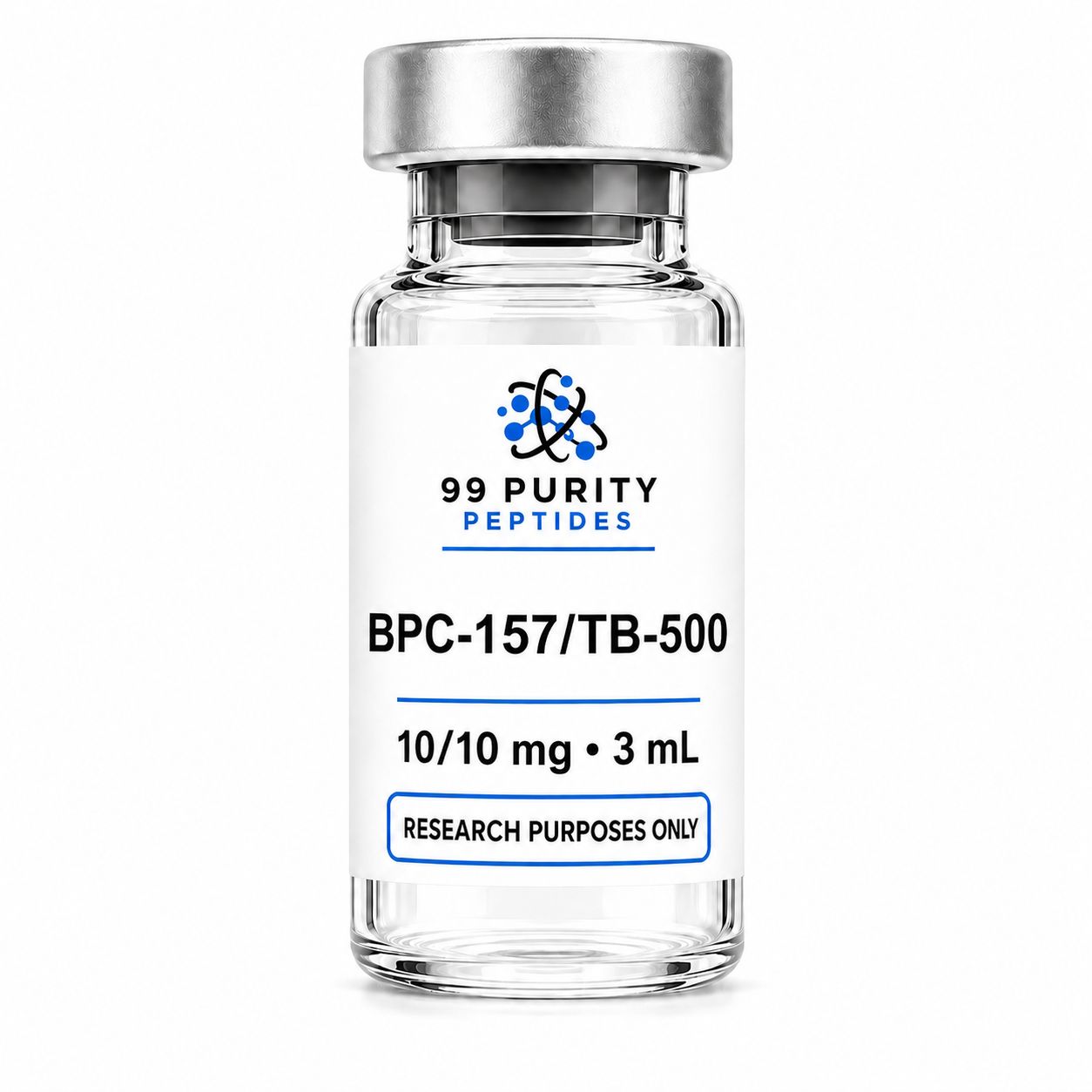
TB500/BPC157
A combination of TB-500’s actin/angiogenesis signaling with BPC-157’s cytoprotection and growth-factor modulation, used in complex injury scenarios. Research applications include multi-tissue regeneration, multi-site injuries, inflammatory control, and functional recovery in musculoskeletal and soft-tissue systems.
For research use only – not for human or veterinary use, diagnosis, or treatment.
Price range: $70.00 through $800.00
Additional information
| Weight | 0.1 lbs |
|---|---|
| Strength | 10/10mg, 20/20mg, 5/5mg |
| Volume | 3ML |
| Kit Sizes | Single, 5 Kit (Save 10%), 10 Kit (Best Value 🔥) |
TB-500 / BPC-157 is a research peptide blend combining Thymosin Beta-4 fragment (TB-500) and Body Protection Compound-157 (BPC-157) in equal 10mg/10mg concentration. In controlled laboratory environments, this dual-peptide formulation has been studied for its interaction with cellular migration pathways, angiogenesis-related signaling mechanisms, and cytoskeletal regulatory processes. Due to their complementary molecular characteristics, the combination remains a compound of interest in tissue signaling and regenerative research models.
Preclinical investigations have examined TB-500 for its association with actin-binding protein pathways and cellular differentiation research, while BPC-157 has been studied for its interaction with nitric oxide signaling and growth factor expression frameworks. Ongoing scientific evaluations continue to assess their combined influence on intracellular communication, vascular signaling research, and molecular pathway modulation within experimental laboratory settings.
This research peptide blend is supplied in a 3ML vial and manufactured under strict laboratory-controlled standards. Each batch undergoes analytical verification to confirm molecular identity, purity, and structural integrity. TB-500 / BPC-157 is intended strictly for laboratory research and analytical purposes only and is not for human consumption.
- Thymosin Beta-4 fragment and BPC-157 peptide blend
- Studied for angiogenesis and cellular migration pathways
- Investigated in cytoskeletal and actin-binding research models
- Evaluated for nitric oxide and growth factor signaling studies
- Explored in regenerative molecular pathway frameworks
- Research-grade TB-500 / BPC-157 peptide blend
- High-purity synthesis and formulation protocols
- Analytical verification (HPLC tested)
- Batch-specific quality control procedures
- Secure, laboratory-compliant packaging
Related products
-
Sale!

TB-500
Price range: $60.00 through $65.00$60.00A synthetic peptide modeled on thymosin β4, a protein involved in actin regulation, cell migration, and angiogenesis.Select options This product has multiple variants. The options may be chosen on the product page -
Sale!
KLOW
Price range: $125.00 through $1,000.00$125.00A branded joint and soft-tissue recovery blend, typically incorporating healing and anti-inflammatory peptides (such as BPC-157, TB-500, KPV,…Select options This product has multiple variants. The options may be chosen on the product page -
Sale!
BPC-157
Price range: $65.00 through $675.00$65.00A stable pentadecapeptide derived from a gastric protective factor, noted in preclinical work for cytoprotective, pro-angiogenic, and anti-inflammatory…Select options This product has multiple variants. The options may be chosen on the product page -
Sale!
Semaglutide
Price range: $50.00 through $90.00$50.00A long-acting GLP-1 receptor agonist widely used as a reference incretin in studies of appetite control, gastric emptying,…Select options This product has multiple variants. The options may be chosen on the product page


Questions
Common questions about research peptides, ordering, and lab standards